Edward Stone: 50 Years at NASA ends, but his brainchild Voyager’s Project goes on

Stone’s remarkable tenure on NASA’s longest-operating mission spans decades of historic discoveries and firsts.

Edward Stone has retired as the project scientist for NASA’s Voyager mission a half-century after taking on the role. Stone accepted scientific leadership of the historic mission in 1972, five years before the launch of its two spacecraft, Voyager 1 and Voyager 2. Under his guidance, the Voyagers explored the four giant planets and became the first human-made objects to reach interstellar space, the region between the stars containing material generated by the death of nearby stars.

Until now, Stone was the only person to have served as project scientist for Voyager, maintaining his position even while serving as director of NASA’s Jet Propulsion Laboratory in Southern California from 1991 to 2001. JPL manages the Voyager mission for NASA. Stone retired from JPL in 2001 but continued to serve as the mission’s project scientist.

“It has been an honor and a joy to serve as the Voyager project scientist for 50 years,” Stone said. “The spacecraft have succeeded beyond expectation, and I have cherished the opportunity to work with so many talented and dedicated people on this mission. It has been a remarkable journey, and I’m thankful to everyone around the world who has followed Voyager and joined us on this adventure.”

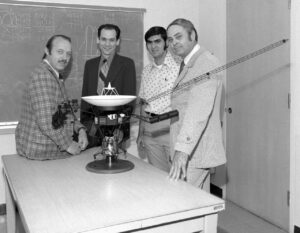
Edward Stone, second from left, and other members of the Voyager team pose with a model of the spacecraft in 1977, the year the twin probes launched. Credit: NASA/JPL-Caltech

Linda Spilker will succeed Stone as Voyager’s project scientist as the twin probes continue to explore interstellar space. Spilker was a member of the Voyager science team during the mission’s flybys of Jupiter, Saturn, Uranus, and Neptune. She later became project scientist for NASA’s now-retired Cassini mission to Saturn, and rejoined Voyager as deputy project scientist in 2021.

Jamie Rankin, a research scientist at Princeton University and a member of the Voyager science steering group, has been appointed deputy project scientist for the mission. Rankin received her Ph.D. in 2018 from Caltech, where Stone served as her advisor. Her research combines data from Voyager and other missions in NASA’s heliophysics fleet.

The twin Voyager spacecraft launched in 1977, on a mission to explore Jupiter and Saturn, ultimately revealing never-before-seen features of those planets and their moons. Voyager 1 continued its journey out of the solar system, while Voyager 2 continued on to Uranus and Neptune – and remains the only spacecraft to have visited the ice giants.

Edward Stone, left, talks to reporters at a news conference to announce findings from Voyager 2’s flyby of Uranus in 1986. Credit: NASA/JPL-Caltech

Following this “grand tour” of the outer planets, the Voyager Interstellar Mission began. The goal was to exit the heliosphere – a protective bubble created by the Sun’s magnetic field and outward flow of solar wind (charged particles from the Sun). Voyager 1 crossed the boundary of the heliosphere and entered interstellar space in 2012, followed by Voyager 2 (traveling slower and in a different direction) in 2018. Today, as part of NASA’s longest-running mission, both spacecraft continue to illuminate the interplay between our Sun, and the particles and magnetic fields in interstellar space.

“Ed likes to say that Voyager is a mission of discovery, and it certainly is,” said Suzanne Dodd, Voyager project manager. “From the flybys of the outer planets in the 1970s and ’80s, to the heliopause crossing and current travels through interstellar space, Voyager never ceases to surprise and amaze us. All those milestones and successes are due to Ed’s exceptional scientific leadership and his keen ability to share his excitement about these discoveries to the world.”

Among the many honors bestowed on him, Stone has been a member of the National Academy of Sciences since 1984. He was awarded the National Medal of Science from President George H.W. Bush in 1991. When Stone was interviewed on the late-night TV show “The Colbert Report” in 2013, NASA arranged for host Stephen Colbert to present him with the NASA Distinguished Public Service Medal, the agency’s highest honor for a nongovernment individual. In 2019, he received the Shaw Prize in Astronomy from the Shaw Foundation in Hong Kong for his work on the Voyager mission.

Also Read:

NASA’s Hubble finds spiraling stars ‘NGC 346’, providing window into early universe

US Postal Service Celebrates NASA’s Webb Telescope With New Postal Stamp

Cassini Takes Plunge Into Saturn, Scientists Cross-Fingered

Where do high-energy particles that endanger satellites, astronauts, airplanes come from?

For decades, scientists have been trying to solve a vexing problem about the weather in outer space: At unpredictable times, high-energy particles bombard the earth and objects outside the earth’s atmosphere with radiation that can endanger the lives of astronauts and destroy satellites’ electronic equipment. These flare-ups can even trigger showers of radiation strong enough to reach passengers in airplanes flying over the North Pole. Despite scientists’ best efforts, a clear pattern of how and when flare-ups will occur has remained enduringly difficult to identify.

This week, in a paper in The Astrophysical Journal Letters, authors Luca Comisso and Lorenzo Sironi of Columbia’s Department of Astronomy and the Astrophysics Laboratory, have for the first time used supercomputers to simulate when and how high-energy particles are born in turbulent environments like that on the atmosphere of the sun. This new research paves the way for more accurate predictions of when dangerous bursts of these particles will occur.

“This exciting new research will allow us to better predict the origin of solar energetic particles and improve forecasting models of space weather events, a key goal of NASA and other space agencies and governments around the globe,” Comisso said. Within the next couple of years, he added, NASA’s Parker Solar Probe, the closest spacecraft to the sun, may be able to validate the paper’s findings by directly observing the predicted distribution of high-energy particles that are generated in the sun’s outer atmosphere.

NASA/Photo: Nasa.gov

In their paper, “Ion and Electron Acceleration in Fully Kinetic Plasma Turbulence,” Comisso and Sironi demonstrate that magnetic fields in the outer atmosphere of the sun can accelerate ions and electrons up to velocities close to the speed of light. The sun and other stars’ outer atmosphere consist of particles in a plasma state, a highly turbulent state distinct from liquid, gas, and solid states. Scientists have long believed that the sun’s plasma generates high-energy particles. But particles in plasma move so erratically and unpredictably that they have until now not been able to fully demonstrate how and when this occurs.

Using supercomputers at Columbia, NASA, and the National Energy Research Scientific Computing Center, Comisso and Sironi created computer simulations that show the exact movements of electrons and ions in the sun’s plasma. These simulations mimic the atmospheric conditions on the sun, and provide the most extensive data gathered to-date on how and when high-energy particles will form.

The research provides answers to questions that scientists have been investigating for at least 70 years: In 1949, the physicist Enrico Fermi began to investigate magnetic fields in outer space  as a potential source of the high-energy particles (which he called cosmic rays) that were observed entering the earth’s atmosphere. Since then, scientists have suspected that the sun’s plasma is a major source of these particles, but definitively proving it has been difficult.

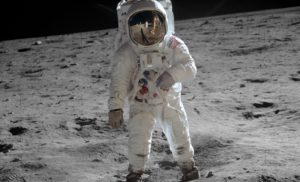
Aldrin walks on the surface of the Moon during Apollo 11(NASA)

Comisso and Sironi’s research, which was conducted with support from NASA and the National Science Foundation, has implications far beyond our own solar system. The vast majority of the observable matter in the universe is in a plasma state. Understanding how some of the particles that constitute plasma can be accelerated to high-energy levels is an important new research area since energetic particles are routinely observed not just around the sun but also in other environments across the universe, including the surroundings of black holes and neutron stars.

While Comisso and Sironi’s new paper focuses on the sun, further simulations could be run in other contexts to understand how and when distant stars, black holes, and other entities in the universe will generate their own bursts of energy.

“Our results center on the sun but can also be seen as a starting point to better understanding how high-energy particles are produced in more distant stars and around black holes,” Comisso said. “We’ve only scratched the surface of what supercomputer simulations can tell us about how these particles are born across the universe.”

What happens when weakening magnetic field creates 3 poles, instead of 2 on Earth?

NASA has taken it seriously as this unique phenomenon will finally result in weakening the earth’s magnetic field and eventually affects the protective field that shields us from solar flares, and disrupts satellite communication.

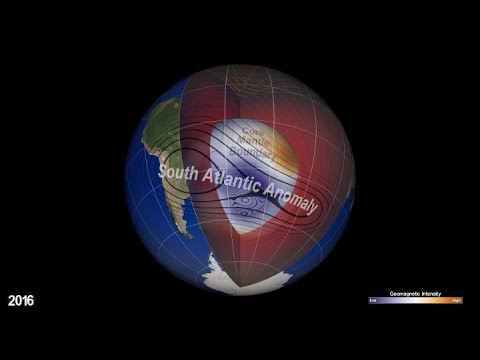
Already, over South America and the southern Atlantic Ocean, this unusually weak spot in the field – called the South Atlantic Anomaly, or SAA – allows these particles to dip closer to the surface than normal. Earth’s magnetic field acts like a protective shield around the planet, repelling and trapping charged particles or solar flares from the Sun.

Currently, the SAA has shown no visible impact on daily life on earth but some recent observations and forecasts show that the region is expanding westward and continuing to weaken in its intensity, making NASA to study the phenomenon.

The South Atlantic Anomaly is also of interest to NASA’s Earth scientists who monitor the changes in magnetic strength there, both for how such changes affect Earth’s atmosphere and as an indicator of what’s happening to Earth’s magnetic fields, deep inside the globe. Instead of two poles, what happens if the earth has many more poles or even three poles?

The future remains unimaginable but a certainty that geophysicists are wary of. See the NASA video here:

How SAA affects satellites?

In order to understand how the SAA and to prepare for future threats to satellites, the Godard team of NASA is assessing the current state of the magnetic field using data from the European Space Agency’s Swarm constellation, previous missions from agencies around the world, and ground measurements.

The geo-dynamo models are unique in their ability to use core physics to create near-future forecasts, said Andrew Tangborn, a mathematician in Goddard’s Planetary Geodynamics Lab. “This is similar to how weather forecasts are produced, but we are working with much longer time scales,” he said. “This is the fundamental difference between what we do at Goddard and most other research groups modeling changes in Earth’s magnetic field.”

One such application is the International Geomagnetic Reference Field, or IGRF — used for a variety of research from the core to the boundaries of the atmosphere, collecting candidate models made by worldwide research teams that describe Earth’s magnetic field and track how it changes in time.

As of now, the changing SAA poses a great challenge to researchers on earth’s dynamics influence other aspects of the Earth system, by tracking this slowly evolving “dent” in the magnetic field.