Scientists Explore Differences in Extragalactic Jets Emerging From Black Holes

A team of international astrophysicists have uncovered new insights into the mystery behind the differences in the appearances of extragalactic jets emerging from the environments of supermassive blackholes. They showed that the plasma composition can affect the appearances of these jets. This may help to unravel the mystery of matter content of relativistic jets.

At the centers of many distant galaxies reside supermassive black holes with masses millions to billions of times that of our Sun. These black holes don’t just eat everything, but can also act like powerful engines, launching narrow beams of plasma and energy known as “jets” that shoot into space at nearly the speed of light. These extragalactic jets can travel for thousands of light-years and emit radiation ranging from low-energy radio waves to high-energy gamma rays.

For a long time, astronomers have been wondering about a noticeable difference in radio images of extragalactic jets, first identified by Fanaroff & Riley in 1974. They broadly classified radio jets into two main categories: FR I & FR II. The FR I jets are “core-brightened,” meaning they are brightest near the core and gradually fade into diffuse structures as they move outward. The FR II jets, on the other hand, are “edge-brightened,” meaning they are fainter near the core but stay tightly focused over long distances until they hit the surrounding gas, creating giant “hot spots” at their tips.

Scientists have for long continued to debate whether this difference is due to the black hole itself, the environment around it, or the intrinsic properties of the jet, such as its speed, temperature, and magnetic strength, etc.

A new research published in The Astrophysical Journal by Mr. Priyesh Kumar Tripathi, Dr. Indranil Chattopadhyay, and Mr. Sanjit Debnath from Aryabhatta Research Institute of Observational Sciences (ARIES), Dr. Raj Kishore Joshi from the Nicolaus Copernicus Astronomical Center, Poland, Dr. Ritaban Chatterjee from Presidency University, Kolkata, and Dr. M. Saleem Khan from MJPRU Barelly, used advanced computer simulations to reveal that the secret to these differences may be due to the jet’s composition and the environment it travels through. The research team performed large 3D magnetohydrodynamic (MHD) simulations of these jets at kiloparsec scales using a numerical simulation code developed by the Numerical and Theoretical Astrophysics Group at ARIES. Notably, this code incorporates a relativistic equation of state, which can accurately handle a very large range of temperatures encountered at different regions of the jet.

The team discovered that a phenomenon called the “kink instability” is a major player in shaping these powerful, narrow jets, causing wiggles (small bend). In space, if this wiggle grows faster than the jet can flow forward, the jet beam disrupts, spreading its energy into a faint, diffuse cloud – the classic look of an FR I jet. Astrophysical jets aren’t made of ordinary matter. Instead, they are composed of plasma, a soup of charged particles including electrons, positrons (the antimatter twin of electrons), and sometimes heavier particles like protons. One of the study’s most significant findings is that the composition of jet plasma can determine its fate.

Jets can be made of mostly electrons and protons (Hadronic plasma), a mixture that includes positrons (the antimatter twin of the electron– Leptonic/Mixed plasma).
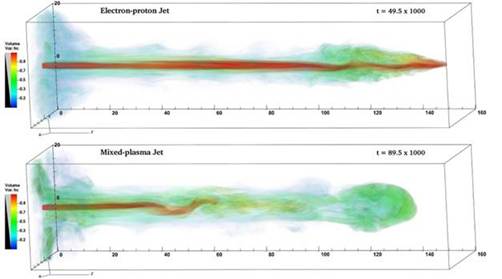
Fig: 3D Volume rendering of the jet tracer for electron-proton and mixed plasma jet

The simulations showed that jets rich in positrons (lepton-rich) are relatively hotter, causing them to expand and slow down. They often can’t stay straight and get twisted by the kink instability. As a result, they form a diffuse, FR I–like structure, where the jet gradually fades instead of ending in a bright hotspot. In contrast, jets composed primarily of electrons and protons were more likely to transition between morphologies, thereby changing their identity. This suggests that what we see through our telescopes might just be a snapshot of a long, evolving cosmic process.


Also Read:

Turning human waste into plastic, nutrients could aid long-distance space travel

ISRO to Explore Space With Japan Agency JAXA


‘Dancing Jets’ from black hole reveal extraordinary cosmic power

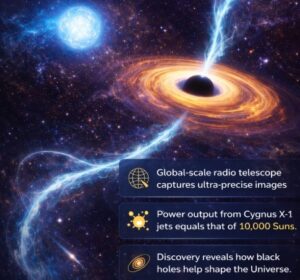
A new study led by Curtin University has harnessed a global-scale radio telescope network to capture detailed images revealing the extraordinary power of jets emitted by black holes, offering strong confirmation of long-standing theories about their role in shaping the Universe’s structure.

Published in Nature Astronomy, the research found that the jets from Cygnus X-1—a system containing the first confirmed black hole and a supergiant companion star—generate energy comparable to the output of around 10,000 Suns.

To record the measurement, researchers used an array of linked up telescopes separated by large distances to observe the black hole jets being buffeted by the winds of the star as the black hole moved around its orbit – much like how strong winds on Earth can push around water in a fountain.

By knowing the power of the wind and measuring how much the jets were bent, the researchers could determine the instantaneous power of the jets for the first time.

In addition, they were able to determine the speed of the black hole’s jets – about half the speed of light, or 150,000 km per second – another measurement that has challenged scientists for decades.

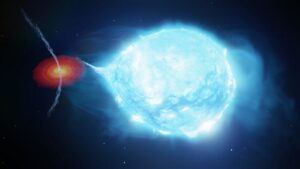
The strong stellar wind from the supergiant star pushes the jets launched by the black hole away from the star. This causes the jet direction to vary as the black hole and the supergiant star move around their orbit./ International Centre for Radio Astronomy Research (ICRAR)

The research was led from the Curtin Institute of Radio Astronomy (CIRA) and the Curtin node of the International Centre for Radio Astronomy Research (ICRAR), in collaboration with the University of Oxford.

Lead author Dr Steve Prabu, who worked at CIRA at the time of the research and who is now based at the University of Oxford, said researchers were able to make the measurement using a sequence of images of the “dancing jets” – a term he used to describe the jets’ movement pattern as they were repeatedly deflected in different directions by the supergiant star’s powerful winds as the star and black hole moved around their orbits.

Dr Prabu said the measurement allowed scientists to understand what fraction of the energy released around black holes could be deposited into the surrounding environment, thereby changing the environment.

“A key finding from this research is that about 10 per cent of the energy released as matter falls in towards the black hole is carried away by the jets,” Dr Prabu said.

“This is what scientists usually assume in large-scale simulated models of the Universe, but it has been hard to confirm by observation until now.”

Co-author Professor James Miller-Jones, from CIRA and the Curtin node of ICRAR, said previous methods could only measure the average jet power over thousands or even millions of years, preventing accurate comparisons with the X-ray energy released instantaneously from the infalling matter.

“And because our theories suggest that the physics around black holes is very similar, we can now use this measurement to anchor our understanding of jets, whether they are from black holes 10 or 10 million times the mass of the Sun,” Professor Miller-Jones said.

“With radio telescope projects such as the Square Kilometre Array Observatory currently under construction in Western Australia and South Africa, we expect to detect jets from black holes in millions of distant galaxies, and the anchor point provided by this new measurement will help calibrate their overall power output.

“Black hole jets provide an important source of feedback to the surrounding environment and are critical to understanding the evolution of galaxies.”


Also Read:

RRI scientists trace mysterious X-ray bursts to wobbling disk in distant galaxy

XRISM finally solves famous star’s 50-year space mystery

Scientists Explore Potential Black Holes In Dwarf Galaxies

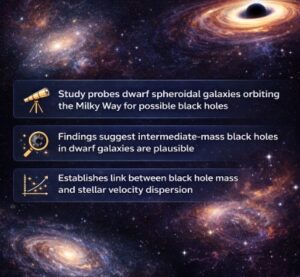
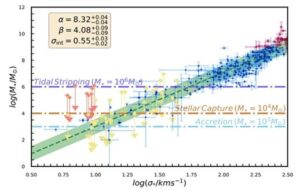
A recent study has examined whether some of the universe’s smallest galaxies—particularly dwarf spheroidal galaxies orbiting the Milky Way—could host black holes, offering fresh insight into how these cosmic objects form and evolve over time.


Indian Origin Scientist Makes it to 36 NASA Fellows of 2016 Final List

NASA has selected 36 fellows for its prestigious Einstein, Hubble and Sagan fellowships, including one Indian called Dheeraj Pasham from Massachusetts Institute of Technology, Cambridge, who will conduct research on “Quest for the Elusive Intermediate-mass Black Holes”.


Dheeraj Pasham

Dheeraj Pasham (“DJ”) received his Bachelor’s degree in Aerospace Engineering from the Indian Institute of Technology Bombay in 2004. He obtained his Ph.D. from the University of Maryland in College Park (2014) where he focused on X-ray timing studies to understand the nature of ultraluminous X-ray sources in order to answer the question of whether they host stellar-mass or intermediate-mass black holes.

As an Einstein fellow at MIT, he plans to apply and extend his expertise in time series analysis to (1) identify and weigh intermediate-mass black holes, and (2) address the many open questions concerning the tidal disruption of stars by supermassive and intermediate-mass black holes.

See full bio of other selected scientists here.

Each post-doctoral fellowship provides three years of support to awardees to pursue independent research in astronomy and astrophysics. The new fellows will begin their programs in the fall of 2016 at a host university or research center of their choosing in the United States.

“The selected fellows are some of the brightest, rising stars in the field of astronomy and astrophysics,” said Paul Hertz, director of Astrophysics at NASA Headquarters, Washington. “We look forward to the exciting discoveries they make that further our understanding of the universe.”