

A team of international astrophysicists have uncovered new insights into the mystery behind the differences in the appearances of extragalactic jets emerging from the environments of supermassive blackholes. They showed that the plasma composition can affect the appearances of these jets. This may help to unravel the mystery of matter content of relativistic jets.
At the centers of many distant galaxies reside supermassive black holes with masses millions to billions of times that of our Sun. These black holes don’t just eat everything, but can also act like powerful engines, launching narrow beams of plasma and energy known as “jets” that shoot into space at nearly the speed of light. These extragalactic jets can travel for thousands of light-years and emit radiation ranging from low-energy radio waves to high-energy gamma rays.
For a long time, astronomers have been wondering about a noticeable difference in radio images of extragalactic jets, first identified by Fanaroff & Riley in 1974. They broadly classified radio jets into two main categories: FR I & FR II. The FR I jets are “core-brightened,” meaning they are brightest near the core and gradually fade into diffuse structures as they move outward. The FR II jets, on the other hand, are “edge-brightened,” meaning they are fainter near the core but stay tightly focused over long distances until they hit the surrounding gas, creating giant “hot spots” at their tips.
Scientists have for long continued to debate whether this difference is due to the black hole itself, the environment around it, or the intrinsic properties of the jet, such as its speed, temperature, and magnetic strength, etc.
A new research published in The Astrophysical Journal by Mr. Priyesh Kumar Tripathi, Dr. Indranil Chattopadhyay, and Mr. Sanjit Debnath from Aryabhatta Research Institute of Observational Sciences (ARIES), Dr. Raj Kishore Joshi from the Nicolaus Copernicus Astronomical Center, Poland, Dr. Ritaban Chatterjee from Presidency University, Kolkata, and Dr. M. Saleem Khan from MJPRU Barelly, used advanced computer simulations to reveal that the secret to these differences may be due to the jet’s composition and the environment it travels through. The research team performed large 3D magnetohydrodynamic (MHD) simulations of these jets at kiloparsec scales using a numerical simulation code developed by the Numerical and Theoretical Astrophysics Group at ARIES. Notably, this code incorporates a relativistic equation of state, which can accurately handle a very large range of temperatures encountered at different regions of the jet.
The team discovered that a phenomenon called the “kink instability” is a major player in shaping these powerful, narrow jets, causing wiggles (small bend). In space, if this wiggle grows faster than the jet can flow forward, the jet beam disrupts, spreading its energy into a faint, diffuse cloud – the classic look of an FR I jet. Astrophysical jets aren’t made of ordinary matter. Instead, they are composed of plasma, a soup of charged particles including electrons, positrons (the antimatter twin of electrons), and sometimes heavier particles like protons. One of the study’s most significant findings is that the composition of jet plasma can determine its fate.
Jets can be made of mostly electrons and protons (Hadronic plasma), a mixture that includes positrons (the antimatter twin of the electron– Leptonic/Mixed plasma).
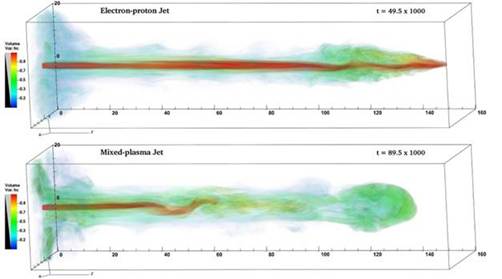

Fig: 3D Volume rendering of the jet tracer for electron-proton and mixed plasma jet
The simulations showed that jets rich in positrons (lepton-rich) are relatively hotter, causing them to expand and slow down. They often can’t stay straight and get twisted by the kink instability. As a result, they form a diffuse, FR I–like structure, where the jet gradually fades instead of ending in a bright hotspot. In contrast, jets composed primarily of electrons and protons were more likely to transition between morphologies, thereby changing their identity. This suggests that what we see through our telescopes might just be a snapshot of a long, evolving cosmic process.
Also Read:
Turning human waste into plastic, nutrients could aid long-distance space travel
ISRO to Explore Space With Japan Agency JAXA