

NASA’s Curiosity Mars rover uncovered a diverse mix of organic molecules on Mars, including chemicals widely considered building blocks for the origin of life on Earth.
The findings, which come from a chemical experiment performed for the first time on another world, reveal that the Martian surface can preserve the kinds of molecules that could serve as signs of ancient life. However, this experiment cannot distinguish between organic compounds from potential past life on Mars and those formed through geologic processes or delivered by meteorites.
Definitively identifying signs of past life would require returning rock samples to Earth.
The study was led by Amy Williams, Ph.D., a professor of geological sciences at the University of Florida and a scientist on the Curiosity and Perseverance Mars rover missions. Curiosity landed on Mars in 2012 to find evidence that ancient Mars had conditions that could support microbial life billions of years ago; the Perseverance rover, which landed in 2021, was sent to look for signs of any ancient life that might have formed.
“We think we’re looking at organic matter that’s been preserved on Mars for 3.5 billion years,” said Williams, who helped develop this chemical experiment. “It’s really useful to have evidence that ancient organic matter is preserved, because that is a way to assess the habitability of an environment. And if we want to search for evidence of life in the form of preserved organic carbon, this demonstrates it’s possible.”
Williams and an international collaboration of researchers published their findings April 21 in the journal Nature Communications.
Among the 20-plus chemicals identified by the experiment, Curiosity spotted a nitrogen-bearing molecule with a structure similar to DNA precursors — a chemical never before spotted on Mars. The rover also identified benzothiophene, a large, double-ringed, sulfurous chemical often delivered to planets by meteorites.
“The same stuff that rained down on Mars from meteorites is what rained down on Earth, and it probably provided the building blocks for life as we know it on our planet,” Williams said.

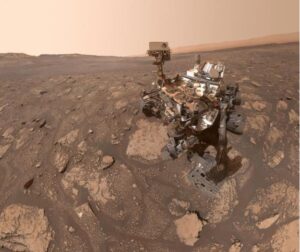
NASA’s Curiosity Mars rover took this selfie at a location nicknamed “Mary Anning” after a 19th century English paleontologist. This was the site of the chemical experiment uncovering diverse organic molecules on Mars, in the Glen Torridon region, which scientists believe was a site where ancient conditions would have been favorable to supporting life, if it ever was present.Credit:NASA/JPL-Caltech/MSSS
Led by NASA’s Jet Propulsion Laboratory, Curiosity Mars landed in Gale crater, in a former lake bed, in August 2012. The rover conducted the experiment in 2020 in the Glen Torridon region of the crater, an area rich in the clay minerals that indicate the area once contained water. Those clays can hold on to and preserve organic chemicals better than other minerals, making them a prime target for uncovering these compounds.
The experiment was conducted by the instrument suite known as the Sample Analysis at Mars, or SAM. Led in part by Jennifer Eigenbrode, Ph.D., an astrobiologist at NASA’s Goddard Space Flight Center and co-author of the new study, SAM has been responsible for many of the mission’s most important discoveries about organic chemistry, atmosphere and habitability on Mars.
Using a chemical known as TMAH, the experiment broke apart larger organic molecules so they could be analyzed by onboard instruments within SAM. With only two cups of the TMAH chemical onboard Curiosity, success required careful planning and choosing the most favorable location to sample.
The promising results come as future missions — including the Rosalind Franklin mission to Mars and the Dragonfly expedition to Saturn’s moon Titan — plan to bring the TMAH test onboard to search for organic compounds.
“We now know that there are big complex organics preserved in the shallow subsurface of Mars, and that holds a lot of promise for preserving large complex organics that might be diagnostic of life,” Williams said.
Also Read:
NASA’s Perseverance Rover Gets the Dirt on Mars
What’s Mars made of ? Japanese study throws light and opens up new study