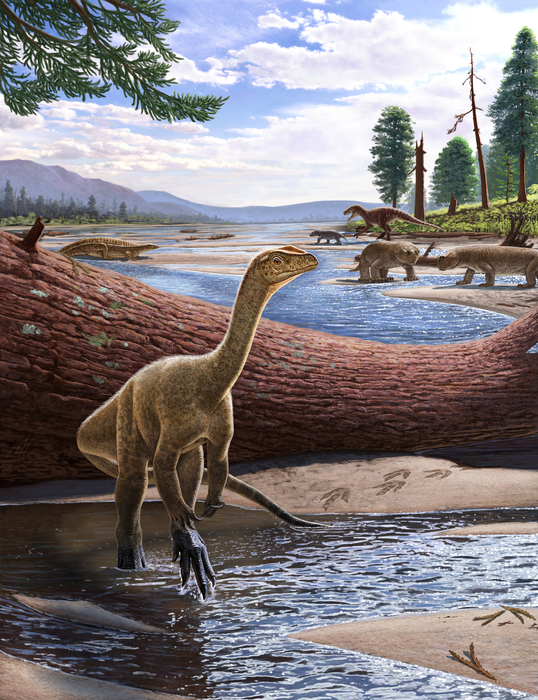
Unearthed in Ghost Ranch, New Mexico, Labrujasuchus expectatus—the ‘Witch Croc’—highlights the weirdness of life at the dawn of the dinosaurs and the legacy and ongoing discoveries at an iconic site 20 years into excavation
In the Triassic, the modern animals we know were just beginning to diversify into a menagerie of forms and body plans that rhyme with the lifestyles of extinct and living animals better known to the public, but nested in groups that ended up taking wildly divergent paths. Case in point: Labrujasuchus expectatus.
Described in the journal Journal of Vertebrate Paleontology, Labrujasuchus looked very much like ornithomimosaurs, a group of bipedal dinosaurs from the Cretaceous with body plans similar to those of modern ostriches. But Labrujasuchus comes from the branch of archosaurs that led to crocodiles, famously four-legged and full of teeth. The newly-described Labrujasuchus navigated the world on two legs with tiny arms and a toothless mouth tipped in a beak—about as far away from a crocodile as possible.

In the Triassic, you can expect the unexpected.
The Triassic was the first period of the Mesozoic Era — often called the “Age of Dinosaurs.” It lasted from about 252 million to 201 million years ago, after the massive Permian extinction that wiped out most life on Earth.
Among the primordial Star Wars bar denizens of the epoch were the lagerpetids, bipedal dinosaur cousins whose relatives would take to the skies as pterosaurs; the funky tree-dwelling Drepanosaurus, with a single tree-sloth-like claw on its hands and a little one on its prehensile tail; and the aquatic reptilian mini-tank, Vancleavea, to name a few. Labrujasuchus expectatus, the newest identified member of Shuvosauridae—a group of ancient crocodile relatives with body plans resembling bipedal, small-armed theropod dinosaurs—stepped into this world of bizarre reptiles with both feet.
“We see a lot of the successful strategies for modern animals and non-avian dinosaurs first arise in the Triassic, and shuvosaurs are a great example of that convergent evolution,” says Dr. Alan Turner, lead author on the paper. “Bipedalism is certainly a unique path for crocodile relatives to take, but it’s a path well-trod by dinosaurs and later birds. It obviously worked for these animals.”
One of only five identified species, Labrujasuchus expectatus fills the gap between two earlier discovered shuvosaurs from the region, an evolutionary link paleontologists knew was waiting to be found. The discovery was the expected unexpected, which inspired the species name ‘expactatus’. The witchy genus moniker, Labrujasuchus, references the ‘Ranchos de los Brujos,’ or Ranch of the Witches, an old Spanish name for Ghost Ranch, and the Greek word Σοῦχος (suchus) meaning “crocodile”.
“Legend has it, the local rancheros gave the site the name ‘Ranchos de Los Brujos’ to keep folks away from the cattle-rustling operations of the Archuleta brothers,” says Dr. Nate Smith, co-author and Gretchen Augustyn Director & Curator of the NHMLAC Dinosaur Institute. “We wanted to give a nod to that colorful history, and honor the incredible role Ghost Ranch has played in expanding our view of the Triassic. We also wanted to highlight how the fossil record works—finding one shuvosaur from earlier in the Triassic and one from later meant that we paleontologists knew there were probably more from in-between waiting to be discovered and described.”


(Ghost Ranch is a famous desert retreat, fossil site, and cultural landmark in northern New Mexico)
Marking 20 Years of Collaboration at Ghost Ranch
With its bizarre assortment of creatures, the Triassic can feel like it belongs to another Earth entirely, but the body plans of long-gone weirdos reverberate through time, mirroring our modern weirdos, who are often in danger of going extinct. In short, understanding the Triassic past helps us better understand and protect our present, and perhaps nowhere on Earth gives a better view of that long-gone epoch than Ghost Ranch. Home to four quarries excavated by paleontologists for decades, Ghost Ranch continues to produce some of the most exquisitely produced fossils from the epoch.
Also Read:
‘Nagatitan’: Southeast Asia’s biggest long-necked dinosaur discovered
New dinosaur Mbiresaurus, a boon for Zimbabwe and Virginia Tech paleontology