
1,300-year-old Hindu temple of Ghandhara style discovered in Swat, Pakistan

A 1,300-year-old Hindu temple of Vishnu has been discovered by Pakistani and Italian archaeological team at a mountain in northwest Pakistan’s Swat district.

The temple was unearthed during an excavation at Barikot Ghundai. Built 1,300 years ago during the Hindu Shahi period, the temple site has traces of cantonment and watchtowers, said Fazle Khaliq of Khyber Pakhtunkhwa Department of Archaeology.

The Hindu Shahis or Kabul Shahis ruled present day Afghan and Pakistan region during 850 and 1026 AD centred around the Kabul Valley, including Gandhara (modern- Pakistan and Afghanistan) and northwestern India. With a water tank near the temple site, it reflected many ancient temple structures in south India.

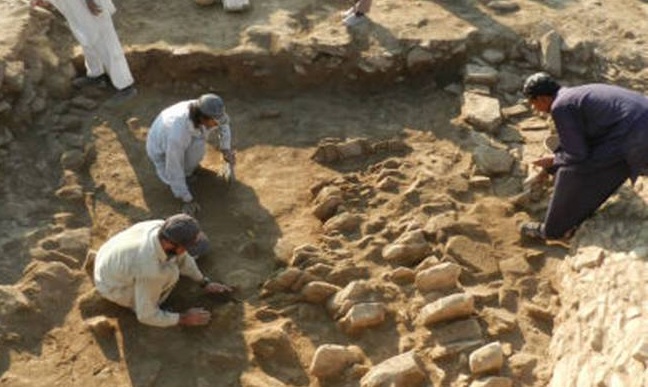
Excavation under way at Barikot in Swat district of Pakistan’s Khyber Pakhtunkhwa Province. Photo: Italian Archaeological Mission to Pakistan

Fazle Khaliq said that Swat district is home to many thousand-year-old archaeological sites belonging to the Hindu Shahi period. Dr. Luca M. Olivieri, who is the current Director of the Italian Archaeological Mission in Pakistan and joint mission explorer of the temple, said this was the first temple of the Ghandhara civilisation discovered in Swat district.

Swat home to Hindu, Buddhist temples

Modern archaeological excavations began in Swat in 1955 and remained uninterrupted for 60 years, except for brief interruption between 2007 and 2010 due to insurgency in the valley.

The project has taken up conservation at Jahanabad, the colossal rock-cut Buddha mined by the Taliban, the excavation at two major protohistoric graveyards, the excavations and conservations at three major Buddhist sacred areas, and finally the large-scale excavation project at the historic settlement site of Bazira/Vajiristhana (Barikot) in the region.

Fatal Cancer found in dinosaur that lived in present Canada 76 million years ago

Roughly 76 million years ago, a Centrosaurus that lived in what is now Canada was walking around with a malignant tumour in its lower leg, found scientists based on its deformed fossil bone.

The cancer was diagnosed osteosarcoma and this is the first time that cancer has been confirmed in a dinosaur, although scientists have identified benign tumours in Tyrannosaurus rex fossils in the past.
Researchers say that the tumour could have eventually been fatal, but the Centrosaurus probably died in a flood with the rest of its herd.

dinosaur bone cancer / © ROYAL ONTARIO MUSEUM/MCMASTER UNIVERSITY

This deformed bone had a malignant tumor in the dinosaur fossil of partial fibula—a bone from the lower leg—belonged to a horned, plant-eating Centrosaurus that lived about 76 million years ago in what is now Dinosaur Park in southern Alberta in Canada.

Paleontologists initially thought the bone was deforemd due to a fracture but a new study, published in The Lancet Oncology, found it after comparing it with a bone tumor from a human patient. The osteosarcoma cancer primarily attacks teens and young adults and causes tumors of immature bone tissue, frequently in the long bones of the leg.

Similar cancer diagnosis in dinosaurs

In the past such a tumor was found in Tyrannosaurus rex fossils and arthritis in duck-billed hadrosaurs, as well as an osteosarcoma in a 240-million-year-old turtle but they were benign. The present study is the first to confirm a dinosaur cancer diagnosis at the cellular level.

Scientists examined the full fossil with high-resolution computerized tomography scans and examined thin sections under the microscope to find the tumor advanced enough that it had probably plagued the animal for some time.

A similar case in a human, left untreated, would be fatal, they wrote. However, because the fossil was found in a bone bed with lots of other Centrosaurus specimens, the dinosaur likely died in a flood with the rest of its herd and not from the cancer, they said.

Mexico cave stone tools hint Americans arrived much earlier, say 30,000 years ago

A massive haul of stone tools discovered in a cave in Mexico provide evidence that people occupied the area more than 30,000 years ago, suggesting that humans arrived in North America at least 15,000 years earlier than had been previously thought. The discovery is backed up by a separate statistical analysis incorporating data from sites in North America and Siberia.

But some researchers are not convinced. They question the age of the tools, and whether the artefacts are tools or rather created by natural processes. Data from caves are “notoriously troublesome” to interpret, says archaeologist François Lanoë from the University of Arizona in Tucson.

First Humans in America

The first humans in the Americas came from East Asia, but when the date of their arrival remains still debatable. Some researchers suggest that it could have been as early as 130,000 years ago, but lacking the archaeological evidence, this theory is disputed. Many stone artefacts are so simple that sceptics say they were probably produced by natural geological processes and not by humans.

The mainstream consensus is that the people ff the Americas began about 15,000 or 16,000 years ago — based on genetic evidence and artefacts found at sites including the 14,000-year-old Monte Verde II in Chile.  The latest discoveries, published on 22 July in Nature, question that consensus.

New evidence from Chiquihuite Cave in Mexico joins other sites across the Americas where scientists have found signs of early human occupation (kyr, a thousand years ago) / Nature

Since 2012, a team led by Ciprian Ardelean at the Autonomous University of Zacatecas in Mexico has been excavating Chiquihuite Cave in Astillero Mountains. The researchers found 2,000 stone tools, 239 of which were embedded in layers of gravel that have been carbon dated to between 25,000 and 32,000 years old.

Caves Occasional Camps

There are some tools that Ardelean thinks suggest the site could have been visited only occasionally, perhaps as a refuge every few decades, during severe winters. At the height of the last ice age, 26,000 years ago, North America would have been a dangerous place. “There must have been horrible storms, hail, snow,” he says. He adds that the Chiquihuite Cave is well insulated and could have provided shelter to any humans who were around to witness the blizzards.

Other controversial studies claim that humans reached Americas 100,000 years earlier than thought but the analysis was disputed pointing out that it purposely omitted information from the most controversial sites, to make its case stronger. If there were people in North America so early, it’s unclear what happened to them.

“There continues to be no convincing genetic evidence of a pre-15,000-years-ago human presence in the Americas,” says geneticist David Reich at Harvard Medical School in Boston, Massachusetts

However, Ardelean says there is a simple reason why genetic studies suggest that humans spread across the Americas only relatively recently, and early groups such as the one he thinks was present at Chiquihuite Cave didn’t survive to contribute to modern gene pools. “I definitely advocate for the idea of lost groups,” he says.

Flowers origin traced to 174 million years, 50 Mln years earlier than previously thought

Analysis of fossil specimens of a flower called Nanjinganthus from the Early Jurassic (more than 174 million years ago) suggests that flowers originated 50 million years earlier than previously thought, a study published in eLife reports.

Before now, angiosperms (flowering plants) were thought to have a history of no more than 130 million years – despite molecular clocks indicating they must have appeared earlier – since no convincing fossil-based evidence existed.

The discovery of Nanjinganthus dendrostyla, however, offers fossil evidence that extends the evolutionary timeline and, due to the flower’s unexpected characteristics, throws widely accepted theories of plant evolution into question.

“Researchers were not certain where and how flowers came into existence because it seems that many flowers just popped up in the Cretaceous from nowhere,” said FU Qiang, a researcher from the Nanjing Institute of Geology and Paleontology of the Chinese Academy of Sciences (NIGPAS). “Studying fossil flowers, especially those from earlier geologic periods, is the only reliable way to get an answer to these questions.”

The team studied 264 specimens of 198 individual flowers preserved on 34 rock slabs from the South Xiangshan Formation – an outcrop of rocks in the Nanjing region of China renowned for its fossils from the Early Jurassic epoch.

Due to the abundance of fossil samples used, the researchers could dissect some and then study them with sophisticated microscopy. The high-resolution pictures of the flowers – from different angles and with different magnifications – allowed the team to envision the features of Nanjinganthus dendrostyla.

Siltstone slabs bearing Nanjinganthus. CREDIT
NIGPAS

The key feature of angiosperms is the presence of fully enclosed ovules, which are precursors of seeds before pollination. In the current study, the reconstructed flower was found to have a cup-form receptacle and ovarian roof that together enclose the ovules/seeds. This discovery was crucial, since these features can confirm the flower as of an angiosperm.

Although there have been reports of angiosperms from the Middle-Late Jurassic epochs in northeastern China, the morphological features of Nanjinganthus distinguish it from other specimens and suggest that it is a new angiosperm genus.

Individuals of Nanjinganthus
CREDIT
NIGPAS

The team hopes to determine whether angiosperms are monophyletic – which would mean Nanjinganthus represents a stem group giving rise to all later species – or polyphyletic, meaning Nanjinganthus represents an evolutionary dead end and has little to do with many later species.

“The origin of angiosperms has long been an academic headache for many botanists,” said WANG Xin of NIGPAS. “Our discovery has moved the botany field forward and will allow a better understanding of angiosperms.”

First human migration out of Africa began 90,000 years ago, far wider than previously thought: Study

A bone, identified instantly as a human middle finger by an archaeologist in Saudi Arabia turned out to be 88,000 years old sending the scientists into ecstasy. The excavation was led by the Max Planck Institute for the Science of Human History.

The bone is the oldest fossil of Homo Sapiens species to ever be found outside of Africa and the Levant or the present Middle-East.

Prior to this discovery, it was thought that early migration into Eurasia remained restricted to the Mediterranean forests of the Levant, on the doorstep of Africa.

The middle finger bone fossil found at the Al Wusta site shows that there were both multiple dispersals out of Africa, and these spread further than previously known.

General view of the excavations at the Al Wusta site, Saudi Arabia. The ancient lake bed (in white) is surrounded by sand dunes of the Nefud Desert.(Michael Petraglia)

Found in the Nefud desert in 2016 by Iyad Zalmout, a scientist with the Saudi Geological Survey, as a part of the excavations at the Al Wusta site, the finger joint just lying in the sand, it did not match the Neanderthals and was sent to the University of Cambridge, where specialists made 3D scan to confirm it as Homo Sapiens.

The 3.2cm-long middle finger, along with other samples found at the Al Wusta site, was sent to the Australian National University in Canberra where researchers conducted uranium series dating to confirm that it was 88,000 years old.

Project Lead Michael Petraglia said, “The Arabian Peninsula has long been considered to be far from the main stage of human evolution. This discovery firmly puts Arabia on the map as a key region for understanding our origins and expansion to the rest of the world. As fieldwork carries on, we continue to make remarkable discoveries in Saudi Arabia.” The results of this study were published today in Nature Ecology & Evolution.

The ancient fossils ever found was 120,000 years old, found in China but their human origin was not dated precisely so far.