‘Love hormone’ revealed to have heart healing properties in Humans like EpiPCs regenerate organs in zebrafish

The neurohormone oxytocin is well-known for promoting social bonds including trust, empathy, positive memories, processing of bonding cues, and positive communication and generating pleasurable feelings, for example from art, exercise, or intimacy.

Now, researchers from Michigan State University show that in zebrafish and human cell cultures, oxytocin has yet another, unsuspected, function: it stimulates stem cells derived from the heart’s outer layer (epicardium) to migrate into its middle layer (myocardium) and there develop into cardiomyocytes, muscle cells that generate heart contractions. This discovery could one day be used to promote the regeneration of the human heart after a heart attack.

“Here we show that oxytocin, a neuropeptide also known as the love hormone, is capable of activating heart repair mechanisms in injured hearts in zebrafish and human cell cultures, opening the door to potential new therapies for heart regeneration in humans,” said Dr Aitor Aguirre, an assistant professor at the Department of Biomedical Engineering of Michigan State University, and the study’s senior author.

Stem-like cells can replenish cardiomyocytes

Cardiomyocetes typically die off in great numbers after a heart attack. Because they are highly specialized cells, they can’t replenish themselves. But previous studies have shown that a subset of cells in the epicardium can undergo reprogramming to become stem-like cells, called Epicardium-derived Progenitor Cells (EpiPCs), which can regenerate not only cardiomyocytes, but also other types of heart cells.

“Think of the EpiPCs as the stonemasons that repaired cathedrals in Europe in the Middle Ages,” explained Aguirre.

Unfortunately for us, the production of EpiPCs is inefficient for heart regeneration in humans under natural conditions.

Zebrafish could teach us how to regenerate hearts more efficiently

Enter the zebrafish: famous for their extraordinary capacity for regenerating organs, including the brain, retina, internal organs, bone, and skin. They don’t suffer heart attacks, but its many predators are happy to take a bite out of any organ, including the heart – so zebrafish can regrow their heart when as much as a quarter of it has been lost. This is done partly by proliferation of cardiomyocytes, but also by EpiPCs. But how do the EpiPCs of zebrafish repair the heart so efficiently? And can we find a ‘magic bullet’ in zebrafish that could artificially boost the production of EpiPCs in humans?

Yes, and this ‘magic bullet’ appears to be oxytocin, argue the authors.

To reach this conclusion, the authors found that in zebrafish, within three days after cryoinjury – injury due to freezing – to the heart, the expression of the messenger RNA for oxytocin increases up to 20-fold in the brain. They further showed that this oxytocin then travels to the zebrafish epicardium and binds to the oxytocin receptor, triggering a molecular cascade that stimulates local cells to expand and develop into EpiPCs. These new EpiPCs then migrate to the zebrafish myocardium to develop into cardiomyocytes, blood vessels, and other important heart cells, to replace those which had been lost.

zebrafish/wikipedia

Similar effect on human tissue cultures

Crucially, the authors showed that oxytocin has a similar effect on human tissue in vitro. Oxytocin – but none of 14 other neurohormones tested here – stimulates cultures of human Induced Pluripotent Stem Cells (hIPSCs) to become EpiPCs, at up to twice the basal rate: a much stronger effect than other molecules previously shown to stimulate EpiPC production in mice. Conversely, genetic knock-down of the oxytocin receptor prevented the the regenerative activation of human EpiPCs in culture. The authors also showed that the link between oxytocin and the stimulation of EpiPCs is the important ‘TGF-β signaling pathway’, known to regulate the growth, differentiation, and migration of cells.

Aguirre said: “These results show that it is likely that the stimulation by oxytocin of EpiPC production is evolutionary conserved in humans to a significant extent. Oxytocin is widely used in the clinic for other reasons, so repurposing for patients after heart damage is not a long stretch of the imagination. Even if heart regeneration is only partial, the benefits for patients could be enormous.”

Also Read:

Meal timing may influence mood vulnerability; Daytime eating benefits mental health


Mind your language when diagnosing women with polycystic ovary syndrome


Scientists sequence world’s largest pangenome to help unlock genetic mysteries behind finer silk

BGI Genomics, in collaboration with Southwest University, the State Key Laboratory of Silkworm Genome Biology, and other partners, has constructed a high-resolution pangenome dataset representing almost the entire genomic content in a silkworm.

Previously, due to the scarcity of wild silkworms and technical limitations of former studies, many trait-associated sites were missing. This is the first research ever to digitize silkworm gene pool and create a “digital silkworm”, greatly facilitating functional genomic research, promoting precise breeding, and thus enabling additional silk use cases.

The team deeply re-sequence 1,078 silkworms (B. mori, including 205 local strains, 194 improved varieties, and 632 genetic stocks and 47 wild silkworms, B. mandarina) and assemble long-read genomes on 545 of these samples, generating 55.57 T of genomic data.

This pangenome dataset contains the most comprehensive information on the genomes of domestic and wild silkworm, and is the largest long-read pangenome in the world for plants and animals to date. At the same time, in-depth studies on various genetic variation, population structure, artificial selection and ecological adaptations and economic traits of silkworm have been carried out, yielding fruitful results.

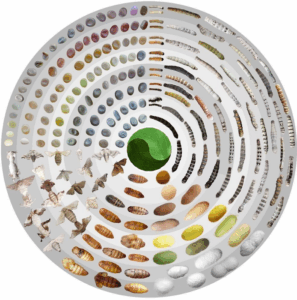
Phenotypic diversity in silkworms/CREDIT:BGI Genomics

The origins of the domestic silkworm:

The domestic silkworm, B. mori, domesticated from the wild mulberry silkworm, B. mandarina. It has an history of over 5,000 years, but its domestication origin location has long been an open question, due to a lack of strong biological evidence.

The study found out that endemic species from China’s lower and middle Yellow River region are distributed at the base of the domestic silkworm branch on the evolutionary tree, thus suggesting that the domestic silkworm originated in this region. The available archaeological evidence, including a half cocoon excavated in 1926 at Xiyin Village, Xia County, Shanxi Province, and a stone-carved silkworm pupa excavated in 2019 at Shicun in the same county, provide important support to this conclusion.

Breaking the bottleneck in silkworm breeding:

The traditional breeding of silkworms has a long and unique history, but since the 1990s remained stuck in a bottleneck. Systematic analysis of the genetic basis of domestication and improvement selection is essential to solve the unresolved issues in silkworm breeding. The team has identified 468 domestication-associated genes and 198 improvement-associated genes, of which respectively 264 and 185 are newly identified. These genes will be important candidate targets for molecular improvement of silkworm.

At the same time, it was found out that the Chinese and Japanese utility species share less than 3% of the improvement loci. This not only reveals the relatively independent breeding histories of Chinese and Japanese silkworm, but also explains why this shared genetic basis provides such hybrid advantages for both species. This result sheds new insights for future breeding of the silkworm.

Economic traits of silkworm breeding:

Yield and quality of silk have long been targeted as the main economic criteria for artificial selection of silkworm. However, up to this date, little is known about how genes and loci control these quantitative traits. The pangenome is arguably the ‘nearest bridge’ between phenotypes, especially complex traits.

A case in point is the regulation of silk production by the cell cycle-related transcription factor BmE2F1, which was revealed through selection signalling and structural variation. CRISPR-cas9 mediated knockout of BmE2F1 reduces the number of silk gland cells by 7.68% and silk yield by 22%. Conversely, the transgenic overexpression of BmE2F1 increases the number of silk gland cells by 23% and silk yield by 16%.

Fine silk has unique applications and higher economic value, but the genetic basis of fiber fineness remained previously unknown. Analysis of rare variants in the genomes of slender varieties led to the identification of BmChit β-GlcNAcase, a gene controlling silk fineness that can significantly be detected in fine varieties, and CRISPR-cas9 mediated knockout, resulting in coarser silk fineness produced by domestic silkworms. This suggests this gene plays a key role in determining silk fineness.

Adaptive traits of silkworm breeding:

Diapause is a common ecological adaptive trait in insects that ensures that insects can survive despite unfavorable environmental conditions. Although the diapause hormone was first identified in the silkworm in 1957, little information is available on the embryonic dipause gene. In this study, based on the analysis of the pnd strain and genomic structural variation in the silkworm, and functional validation by gene editing, the BmTret1-like gene revealed itself to be an important determinant of post-embryonic stalling. This is the first time that a post-embryonic determinant gene has been identified in an insect.

This study reveals the complete pan-genome of the silkworm to unlock artificial selection and ecological adaptation insights. Shuaishuai Tai, co-author and BGI Genomics senior researcher commented, “With comprehensive sampling and dataset combined with a variety of experiments to identify genes for future potential study, we hope to accelerate the process of silkworm molecular design breeding.”

Soon new material to replace rogue plastic; It biodegrades in ocean water within 4 weeks

‘Mystery gene’ matures the skeleton of the cell

“I’m a professional pin-in-a-haystack seeker,” geneticist Thijn Brummelkamp responds when asked why he excels at tracking down proteins and genes that other people did not find, despite the fact that some have managed to remain elusive for as long as forty years. His research group at the Netherlands Cancer Institute has once again managed to track down one of these “mystery genes” – the gene that ensures that the final form of the protein actin is created, a main component of our cell skeleton.

Cell biologists are very interested in actin, because actin – a protein of which we produce more than 100 kilograms in our lifetime – is a main component of the cell skeleton and one of the most abundant molecules in a cell. Large quantities can be found in every cell type and it has many purposes: it gives shape to the cell and makes it firmer, it plays an important role in cell division, it can propel cells forward, and provides strength to our muscles. People with faulty actin proteins often suffer from muscle disease. Much is known about the function of actin, but how the final form of this important protein is made and which gene is behind it? “We didn’t know,” says Brummelkamp, whose mission is to find out the function of our genes.

Multi-purpose method for genetics in human cells
Together with other researchers, Brummelkamp uses this multi-purpose method to find the genetic causes of particular conditions. He has already shown how the Ebola virus and a number of other viruses, as well as certain forms of chemotherapy, manage to enter a cell. He also investigated why cancer cells are resistant to certain types of therapy and discovered a protein found in cancer cells that acts as a brake on the immune system. This time he went looking for a gene that matures actin – and as a result, the skeleton of the cell.

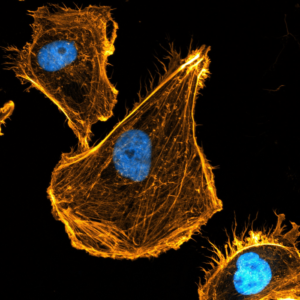
Microscopy image of actine. (Actine is yellow, cell core is blue)/CREDIT:Peter Haarh, Netherlands Cancer Institute

In search of scissors
Before a protein is completely “finished” – or mature, as the researchers describe it in Science – and can fully perform its function in the cell, it usually has to be stripped of a specific amino acid first. This amino acid is then cut from a protein by a pair of molecular scissors. This is also what occurs with  actin. It was known on which side of the actin the relevant amino acid is cut off. However, no one managed to find the enzyme that acts as scissors in this process.

Peter Haahr, postdoc in Brummelkamp’s group, worked on the following experiment: first he caused random mutations (mistakes) in random haploid cells. Then he selected the cells containing the immature actin by adding a fluorescently labeled antibody to his cells that fit in the exact spot where the amino acid is cut off. As a third and final step, he investigated which gene mutated after this process.

They called it ‘ACTMAP’
Then came the “eureka”-moment: Haahr had traced down the molecular scissors that cut the essential amino acid from actin. Those scissors turned out to be controlled by a gene with a previously unknown function; one no researcher had ever worked with. This means that the researchers were able to name the gene themselves, and they settled on ACTMAP (ACTin MAturation Protease).

More scissors found in the skeleton of the cell
ACTMAP is not the first mystery gene discovered by Brummelkamp that plays a role in our cell skeleton function. Using the same method, his group has been able to detect three unknown molecular scissors over recent years that cut an amino acid from tubulin, the other main component of the cell skeleton. These scissors allow tubulin to perform its dynamic functions properly inside the cell. The last scissors (MATCAP) were discovered and described in Science this year. Through this earlier work on the cell skeleton, Brummelkamp managed to arrive at actin.

Also Read:

Not just chemotherapy, now phototherapy is here for cancer treatment [Details]

Ovarian cancer detection takes a step forward with liquid biopsy

Hunger-controlling brain cells may offer path for new obesity drugs

New malaria analysis method reveals disease severity in minutes

Left untreated, malaria can progress from being mild to severe — and potentially fatal — in 24 hours. So researchers at the University of British Columbia developed a method to quickly and sensitively assess the progression of the mosquito-borne infectious disease, which remains a leading killer in low-income countries.

One way malaria wreaks havoc on the body is by causing excessive amounts of toxic heme, the non-protein component of hemoglobin, to accumulate in the bloodstream. Among other things, this free heme induces oxidative stress in red blood cells (RBCs), leading to their rigidification, destruction and subsequent removal from circulation — a condition known as hemolytic anemia.

In their study, which appeared in Integrative Biology, the UBC investigators found that RBCs become increasingly rigid in direct correlation with the concentration of oxidized heme, or hemin, in the blood. Since hemin is difficult to measure directly — it tends to insert itself into cell membranes — monitoring changes in RBC deformability can therefore serve as a reliable alternative marker of hemin-induced oxidative stress and malaria progression.

“Because this method is mechanical, it’s well suited for use in resource-poor countries, where the vast majority of malaria transmission takes place,” says Kerryn Matthews, a postdoctoral fellow at UBC and the study’s lead author. “Other methods of analyzing malaria severity require training or expensive equipment or chemicals that are not readily available in developing nations.”

To measure RBC deformability quickly and sensitively, the UBC investigators developed the “multiplex fluidic plunger”: a simple microfluidic device consisting of a parallel array of 34 funnel-shaped, micro-sized channels across which uniform, carefully controlled pressures can be simultaneously applied.

By loading the plunger with whole blood, docking an RBC at each channel and applying progressively higher pressures until the RBCs are squeezed through — or not, if an RBC is too stiff — one is able to determine the rigidity, or cortical tensions, of many cells at once and build an RBC deformability profile in minutes.

“The device can be easily integrated with a conventional microscope coupled with a digital camera,” says Matthews. “And the accompanying software, which does all the analysis and records the pressures, is simple to use.”

In addition to indicating the status of a malaria infection, RBC deformability information would be valuable in the development of antimalarial drugs, as well as in illuminating the mechanism by which RBCs are sequestered from circulation and destroyed.

Healthy RBCs are extremely flexible, capable of squeezing through spaces — the tiniest blood vessels, for example, or the channels between cells — that are just fractions of their original size. By rendering them less deformable, malaria parasites impair blood flow and ultimately cause organ failure and possibly death.

According to the World Health Organization, malaria killed an estimated 429,000 people and caused approximately 212 million clinical episodes in 2015. It primarily affects children and pregnant women in poor tropical and subtropical countries.