

“I’m a professional pin-in-a-haystack seeker,” geneticist Thijn Brummelkamp responds when asked why he excels at tracking down proteins and genes that other people did not find, despite the fact that some have managed to remain elusive for as long as forty years. His research group at the Netherlands Cancer Institute has once again managed to track down one of these “mystery genes” – the gene that ensures that the final form of the protein actin is created, a main component of our cell skeleton.
Cell biologists are very interested in actin, because actin – a protein of which we produce more than 100 kilograms in our lifetime – is a main component of the cell skeleton and one of the most abundant molecules in a cell. Large quantities can be found in every cell type and it has many purposes: it gives shape to the cell and makes it firmer, it plays an important role in cell division, it can propel cells forward, and provides strength to our muscles. People with faulty actin proteins often suffer from muscle disease. Much is known about the function of actin, but how the final form of this important protein is made and which gene is behind it? “We didn’t know,” says Brummelkamp, whose mission is to find out the function of our genes.
Multi-purpose method for genetics in human cells
Together with other researchers, Brummelkamp uses this multi-purpose method to find the genetic causes of particular conditions. He has already shown how the Ebola virus and a number of other viruses, as well as certain forms of chemotherapy, manage to enter a cell. He also investigated why cancer cells are resistant to certain types of therapy and discovered a protein found in cancer cells that acts as a brake on the immune system. This time he went looking for a gene that matures actin – and as a result, the skeleton of the cell.

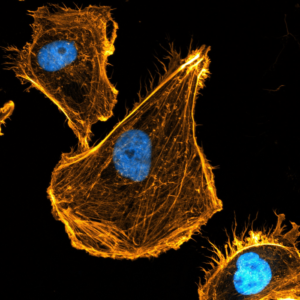
Microscopy image of actine. (Actine is yellow, cell core is blue)/CREDIT:Peter Haarh, Netherlands Cancer Institute
In search of scissors
Before a protein is completely “finished” – or mature, as the researchers describe it in Science – and can fully perform its function in the cell, it usually has to be stripped of a specific amino acid first. This amino acid is then cut from a protein by a pair of molecular scissors. This is also what occurs with actin. It was known on which side of the actin the relevant amino acid is cut off. However, no one managed to find the enzyme that acts as scissors in this process.
Peter Haahr, postdoc in Brummelkamp’s group, worked on the following experiment: first he caused random mutations (mistakes) in random haploid cells. Then he selected the cells containing the immature actin by adding a fluorescently labeled antibody to his cells that fit in the exact spot where the amino acid is cut off. As a third and final step, he investigated which gene mutated after this process.
They called it ‘ACTMAP’
Then came the “eureka”-moment: Haahr had traced down the molecular scissors that cut the essential amino acid from actin. Those scissors turned out to be controlled by a gene with a previously unknown function; one no researcher had ever worked with. This means that the researchers were able to name the gene themselves, and they settled on ACTMAP (ACTin MAturation Protease).
More scissors found in the skeleton of the cell
ACTMAP is not the first mystery gene discovered by Brummelkamp that plays a role in our cell skeleton function. Using the same method, his group has been able to detect three unknown molecular scissors over recent years that cut an amino acid from tubulin, the other main component of the cell skeleton. These scissors allow tubulin to perform its dynamic functions properly inside the cell. The last scissors (MATCAP) were discovered and described in Science this year. Through this earlier work on the cell skeleton, Brummelkamp managed to arrive at actin.
Also Read:
Not just chemotherapy, now phototherapy is here for cancer treatment [Details]
Ovarian cancer detection takes a step forward with liquid biopsy
Hunger-controlling brain cells may offer path for new obesity drugs