UN forum to spotlight health, gender equality, oceans, in critical bid to meet development goals

The 2025 High-Level Political Forum, or HLPF, follows two recent successful UN conferences focused on vital development issues: one in June in Nice, France, dedicated to ocean protection, and another held in Sevilla, Spain, centred on boosting financing for sustainable initiatives.

The Sevilla meeting ended with a strong call to action: to urgently address the massive $4 trillion annual shortfall in financing needed to achieve the SDGs. It also highlighted the pressing need for greater investment and deep reform of the global financial system.

Held under the auspices of the UN Economic and Social Council (ECOSOC), the forum will take place from 14 to 23 July at UN Headquarters in New York.

Here are five key things to know about this year’s forum:

1. It’s all about accelerating action

The HLPF is the United Nations’ main platform for tracking global progress on the Sustainable Development Goals. It meets each year to review countries’ efforts, share solutions, and push for faster action to meet the 2030 targets

The 2025 forum is convening under the theme:

Advancing sustainable, inclusive, science- and evidence-based solutions for the 2030 Agenda for Sustainable Development and its Sustainable Development Goals leaving no one behind.

This reflects a growing sense of urgency. With the 2030 deadline fast approaching, the forum will emphasise practical, data-driven strategies to close implementation gaps– particularly in the face of intersecting global crisis including climate change, inequality, and economic instability.

The 17 Sustainable Development Goals are all interconnected, for instance progress on SDG 2 to end hunger is closely tied to advances in health and education.

2. Five SDGs in the spotlight

Each year, the HLPF conducts in-depth reviews of selected Goals. In 2025, the focus will be on:

SDG 3: Good health and well-being

SDG 5: Gender equality

SDG 8: Decent work and economic growth

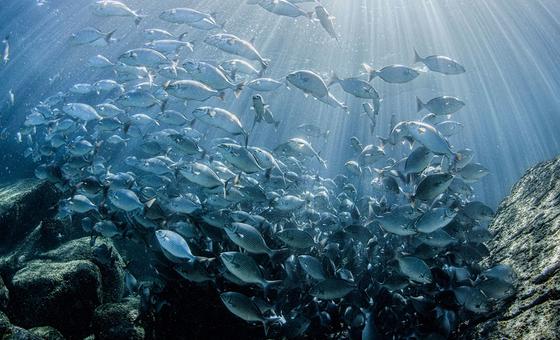
SDG 14: Life below water

SDG 17: Partnerships for the goals

These Goals span a wide range of issues – from public health and gender equity to economic resilience and marine conservation.

SDG 17, which is reviewed annually, highlights the importance of revitalising global partnerships and enhancing means of implementation – including financing, which nations committed to just last month in Sevilla.

© UNICEF/Lasse Bak Mejlvang

3. Countries will share their progress, voluntarily

A hallmark of the HLPF is the Voluntary National Reviews (VNRs) – self-assessments by Member States on their progress toward the SDGs. In 2025, dozens of countries are expected to present their VNRs, offering insights into both achievements and persistent challenges.

These reviews foster transparency, peer learning, and accountability. They also provide a platform for civil society and other stakeholders to engage directly with governments on development priorities.

VNR Labs – interactive sessions focused on national reviews – create space for dialogue, innovation, and collaboration

4. It’s not just governments

While the HLPF is a UN intergovernmental platform, it brings together a diverse range of voices, including youth groups, local authorities, indigenous peoples, NGOs, academics, the private sector, and UN system agencies.

A rich programme of side events, exhibitions, and roundtable-discussions. This inclusive approach reflects the spirit of the 2030 Agenda, which recognises sustainable development is a universal, shared endeavour.

A wide view of the opening of the 2023 High-Level Political Forum on Sustainable Development convened under the auspices of the Economic and Social Council (ECOSOC), held in the General Assembly Hall.

5 – 4 – 3 – 2 – 1 The Final Countdown

With only five years left to deliver on the 2030 Agenda, the 2025 HLPF marks a critical inflection point.

It is more than a yearly check-in. This year’s session comes at a time when science, solidarity, and urgent action must converge. It will help set the tone for the next Sustainable Development Goals Summit in 2027, where world leaders will take stock of collective progress and determine the final push toward 2030.

What happens now – at this two-thirds deadline moment – will shape whether the SDGs will realise a global promise or become a missed opportunity.

Source link

Greed is driving oceans toward collapse

Mr. Guterres’ stark assessment came during a press conference on the second day of the weeklong UN Ocean summit, known as UNOC3, where hundreds of government leaders, scientists and civil society representatives are gathered on France’s Côte D’Azur. Their mission: to confront the escalating emergency facing the world’s oceans.

Greed is a ‘clear enemy’

“We are in Nice on a mission – save the ocean, to save our future,” the Secretary-General said, and warned that a tipping point is fast-approaching “beyond which recovery may become impossible.”

The “clear enemy” that is pushing our oceans towards the brink is greed.

According to the UN chief, greed sows doubt, denies science, distorts truth, rewards corruption and destroys life for profit. “We cannot let greed dictate the fate of our planet,” he insisted.

Calling for all stakeholders to assume their responsibility and to play a vital role to push back against these profit-hungry forces, the Secretary-General said: “That is why we are here this week: to stand in solidarity against those forces and reclaim what belongs to us all.”

He cited four priorities for governments, business leaders, fishers, scientists, saying “everyone has a responsibility and a vital role to play”:

  • Transform ocean harvesting – It’s not just about fishing, it’s about how we fish. We must meet the globally agreed “30 by 30” goal to conserve 30 per cent of oceans by 2030.
     
  • Tackle plastic pollution: Phase out single-use plastics and improve recycling; and finalize a global treaty to end plastic pollution this year.
     
  • Fight climate change at sea: Countries must submit bold climate plans ahead of COP30 in Brazil. Plans must align with the 1.5°C target and cover all emissions.
     
  • Enforce the High Seas Treaty: Ratify and implement the new treaty, known by the shorthand, BBNJ treaty, to protect marine biodiversity, and urge all nations to join and bring the agreement into force.

Calling for a grand global coalition of governments, business leaders, fishers, scientists, the Secretary-General urged everyone to step forward with decisive commitments and tangible funding.

“The ocean has given us so much. It is time we returned the favour.”

More to follow.


Source link

The world’s oceans are dying. Can a UN summit in Nice turn the tide?

From June 9 to 13, the coastal city of Nice will host the Third United Nations Ocean Conference (UNOC3), a high-level summit co-chaired by France and Costa Rica. Its mission: to confront a deepening ocean emergency that scientists warn is nearing a point of no return.

“The ocean is facing an unprecedented crisis due to climate change, plastic pollution, ecosystem loss, and the overuse of marine resources,” Li Junhua, a senior UN official serving as Secretary-General of the event, told UN News.

“We hope the conference will inspire unprecedented ambition, innovative partnerships, and maybe a healthy competition,” he said, highlighting the need for international cooperation to avoid irreversible damage.

The pressure is on. UNOC3 is bringing together world leaders, scientists, activists, and business executives to tackle the growing crisis in the world’s oceans. The goal: to spark a wave of voluntary pledges, forge new partnerships, and — if organizers succeed — inject a much-needed dose of accountability into the fight against marine degradation.

The week-long talks will culminate in the adoption of a political declaration and the unveiling of the Nice Ocean Action Plan — an effort to match the scale of the crisis and accelerate action to conserve and sustainably use the ocean.

Warming seas, bleaching reefs

The crisis isn’t a distant threat: it’s happening now. In April, global sea surface temperatures hit their second-highest levels ever for that monthaccording to the European Union’s Copernicus Climate Change Service. Meanwhile, the most extensive coral bleaching event in recorded history is underway — sweeping across the Caribbean, the Indian Ocean, and parts of the Pacific. More than a single event, it’s a planetary unraveling.

Coral reefs, which sustain a quarter of all marine species and underpin billions in tourism and fisheries, are vanishing before our eyes. Their collapse could unleash cascading effects on biodiversity, food security, and climate resilience.

And the damage runs deeper still. The ocean continues to absorb more than 90 per cent of excess heat from greenhouse gas emissions — a worldwide service that may be nearing its limits. “Challenges like plastic pollution, overfishing, biodiversity loss, ocean acidification, and warming are all linked to climate change,” Mr. Li warned.

Turning versus tipping points

Still, there have been notable breakthroughs. In 2022, the World Trade Organization struck a far-reaching deal to phase out harmful subsidies that fuel overfishing, offering a rare glimmer of multilateral resolve. The following year, after decades of deadlock, nations adopted the High Seas Treaty, known by the shorthand BBNJ, to safeguard marine life in international waters. That long-awaited agreement is now poised to enter into force at the Nice summit.

But policy alone cannot reverse an ecosystem in free fall. “The global response is insufficient,” Li Junhua cautioned.

Progress, in other words, depends not only on political will but on the resources to match it.

An estimated 60 per cent of the world’s marine ecosystems have been degraded or are being used unsustainably.

A lifeline starved of funds

Despite its vital role in regulating life on Earth — producing half of our oxygen and buffering against climate extremes — the ocean remains chronically underfunded.  Sustainable Development Goal 14 , on ‘Life Below Water’, receives the least resources of the 17 global UN goals Member States agreed to meet by 2030.

The estimated cost to protect and restore marine ecosystems over the next five years is $175 billion annually. “But less than $10 billion was allocated between 2015 and 2019,” Mr. Li noted, signaling the need to move ocean funding from trickle to torrent.

That ambition is at the heart of what the Conference aims to deliver.

The Nice Ocean Action Plan

The theme of UNOC3, Accelerating action and mobilizing all actors to conserve and sustainably use the ocean, reflects a shift from declarations to delivery.

Over five days, participants will grapple with the big questions: how to stem illegal fishing, reduce plastic pollution, and scale sustainable blue economies. Hundreds of new pledges are expected to build on the more than 2,000 voluntary commitments made since the first ocean summit in 2017.

The Nice Ocean Action Plan is set to align with the Kunming-Montreal Global Biodiversity Framework, a 2022 agreement calling for the protection of at least 30 per cent of marine and terrestrial ecosystems by 2030.

Alongside new pledges, the plan will include a formal declaration, which Mr. Li described as a “concise” and “action-oriented” political document.

“The draft political declaration, led by Australia and Cabo Verde, focuses on ocean conservation and sustainable ocean-based economies and includes concrete measures for accelerating action,” the UN official teased.

The rapid loss of biodiversity threatens the livelihood of 3 billion people, including coastal communities.

Crisis by the numbers — and what Nice hopes to deliver

  • Up to 12 million metric tons of plastic enter the ocean every year — the equivalent of a garbage truck every minute.

    At Nice, delegates hope to advance a global agreement to tackle plastic pollution at its source.

  • Over 60 per cent of marine ecosystems are degraded or unsustainably used.

    The summit aims to bolster efforts toward protecting 30 per cent of the ocean by 2030 and to launch a roadmap for decarbonizing maritime transport.

  • Global fish stocks within safe biological limits have plunged from 90 per cent in the 1970s to just 62 per cent in 2021.

    Nice hopes to pave the way for a new international agreement on sustainable fisheries.

  • More than 3 billion people depend on marine biodiversity for their livelihoods.

    In response, the summit seeks to boost financing for blue economies and elevate community-led solutions.

In small developing island states, the ocean is not just an economic engine, it’s a lifeline.

From Paris to Nice

The timing of the summit is intentional. A decade after the landmark Paris Agreement set targets for limiting global warming, UNOC3 is pushing to place the ocean at the center of climate action — not as an afterthought, but as a frontline battlefield.

“UNOC 3 addresses the interconnected crisis facing our oceans,” noted Mr. Li.

The summit also aims to be inclusive, highlighting voices often sidelined in global forums, such as women, Indigenous people, fisherfolk, and coastal communities. “These groups are the first to suffer the impacts of climate change and ocean degradation,” Mr. Li emphasized. “But they are also leaders and problem solvers, so they must be empowered.”

A pivotal moment

Nice isn’t just a scenic backdrop — it’s part of the story. The Mediterranean is warming 20 per cent faster than the global average, making it a so-called climate “hot spot.” For many, the location only sharpens the stakes.

Whether the conference generates real momentum or simply more declarations will depend on what countries, companies, and communities bring to the table.

As delegates descend on the sun-drenched coast of Nice, the sea laps gently at the shores. But the question rising with the tide is anything but gentle: can the world still turn this around?


Source link

Seals Can Serve As ‘Smart Sensors’ to Know Fish Populations in Ocean’s Twilight Zone: Study

UC Santa Cruz marine biologists have made a groundbreaking discovery, revealing that northern elephant seals can serve as “smart sensors” for monitoring fish populations in the ocean’s twilight zone. The study, led by researcher Roxanne Beltran and published in Science, suggests that tracking the foraging success of these marine mammals could revolutionize our understanding of deep-sea ecosystems and sustainable fisheries management.

For the past 60 years, scientists at UC Santa Cruz have closely monitored elephant seals migrating to Año Nuevo Natural Reserve. With an extensive dataset comprising over 350,000 observations on more than 50,000 seals, researchers have gained invaluable insight into the behavior, foraging success, and population dynamics of these marine giants. Now, this long-term research is shedding light on an oceanic region that remains largely unexplored: the twilight zone.

The twilight zone, located between 200 and 1,000 meters below the ocean’s surface, is a critical but poorly understood ecosystem. It harbors the majority of the planet’s fish biomass, yet current ocean monitoring tools—ships, floating buoys, and satellites—struggle to provide comprehensive data from these depths. Beltran’s study demonstrates that elephant seals, which dive into this zone to feed, can offer real-time insights into fish abundance and distribution, presenting a potential game-changer for marine science and conservation.

“Given the importance of the ocean for climate regulation, carbon sequestration, and food security, it is urgent that we develop new ways to measure changes in marine ecosystems,” said Beltran, an assistant professor of ecology and evolutionary biology at UC Santa Cruz. “Our research shows that elephant seals are not only top predators but also exceptional ecosystem sentinels.”

Each elephant seal embarks on a remarkable journey spanning 6,000 miles over seven months, making an average of 75,000 foraging dives. Tracking just 14 seals per year could provide fish population estimates across a staggering 4.4 million cubic kilometers of ocean. By measuring the weight fluctuations of these seals, researchers can also assess long-term changes in prey abundance, offering valuable data to fisheries managers as commercial fishing extends deeper into the ocean.

This research holds profound implications as discussions intensify around harvesting twilight zone fish to meet the growing demand for protein-rich food. With little known about the potential ecological consequences, experts warn that overfishing this hidden realm could disrupt food chains and impact economically significant species.

“The fish in the twilight zone are crucial prey for commercially valuable species, yet our best estimates of their abundance vary by a factor of ten,” Beltran explained. “If their populations decline, the entire marine ecosystem, including species relied upon by humans, could suffer.”

In addition to its scientific significance, this study also highlights the power of education and collaboration. Fourteen undergraduate students co-authored the paper after participating in an immersive field course at UC Santa Cruz, where they analyzed six decades of elephant seal data. Students conducted research, developed hypotheses, and presented findings, making real contributions to marine science.

“We want students to feel like they are part of a scientific community,” said Allison Payne, a graduate student in Beltran’s lab and teaching assistant for the course. “This experience builds confidence and provides invaluable hands-on training.”

The study also builds on decades of research led by distinguished professors Burney LeBoeuf and Dan Costa. Their work previously uncovered elephant seals’ long-distance migrations and the critical role of maternal foraging success in seal pup survival.

Costa emphasized that only a long-term dataset and a multidisciplinary team—including oceanographers, modelers, and marine biologists—could have achieved this breakthrough. “This research connects elephant seal behavior thousands of miles at sea to their breeding success on land,” he said.

Beltran’s study also demonstrated that elephant seal foraging success aligns with broad-scale oceanographic indices detected by satellites, allowing scientists to estimate fish population trends over the past 50 years and even project them into the future.

“This research provides a crucial ecological baseline for sustainable fisheries and helps assess the impact of human-driven environmental changes,” Beltran concluded.

With the potential to revolutionize marine conservation efforts, the findings underscore the value of long-term ecological research and the extraordinary role elephant seals play in unveiling the ocean’s mysteries.

Are we alone in the universe? JPL’s OWLS, other tools to help search for life in deep space

A team at the Lab has invented new technologies that could be used by future missions to analyze liquid samples from watery worlds and look for signs of alien life.

Are we alone in the universe? An answer to that age-old question has seemed tantalizingly within reach since the discovery of ice-encrusted moons in our solar system with potentially habitable subsurface oceans. But looking for evidence of life in a frigid sea hundreds of millions of miles away poses tremendous challenges. The science equipment used must be exquisitely complex yet capable of withstanding intense radiation and cryogenic temperatures. What’s more, the instruments must be able to take diverse, independent, complementary measurements that together could produce scientifically defensible proof of life.

To address some of the difficulties that future life-detection missions might encounter, a team at NASA’s Jet Propulsion Laboratory in Southern California has developed OWLS, a powerful suite of science instruments unlike any other. Short for Oceans Worlds Life Surveyor, OWLS is designed to ingest and analyze liquid samples. It features eight instruments – all automated – that, in a lab on Earth, would require the work of several dozen people.

JPL’s OWLS combines powerful chemical-analysis instruments that look for the building blocks of life with microscopes that search for cells. This version of OWLS would be miniaturized and customized for use on future missions. Credit: NASA/JPL-Caltech

One vision for OWLS is to use it to analyze frozen water from a vapor plume erupting from Saturn’s moon Enceladus. “How do you take a sprinkling of ice a billion miles from Earth and determine – in the one chance you’ve got, while everyone on Earth is waiting with bated breath – whether there’s evidence of life?” said Peter Willis, the project’s co-principal investigator and science lead. “We wanted to create the most powerful instrument system you could design for that situation to look for both chemical and biological signs of life.”

OWLS has been funded by JPL Next, a technology accelerator program run by the Lab’s Office of Space Technology. In June, after a half-decade of work, the project team tested its equipment – currently the size of a few filing cabinets – on the salty waters of Mono Lake in California’s Eastern Sierra. OWLS found chemical and cellular evidence of life, using its built-in software to identify that evidence without human intervention.

“We have demonstrated the first generation of the OWLS suite,” Willis said. “The next step is to customize and miniaturize it for specific mission scenarios.”

Challenges, Solutions

A key difficulty the OWLS team faced was how to process liquid samples in space. On Earth, scientists can rely on gravity, a reasonable lab temperature, and air pressure to keep samples in place, but those conditions don’t exist on a spacecraft hurtling through the solar system or on the surface of a frozen moon. So the team designed two instruments that can extract a liquid sample and process it in the conditions of space.

Since it’s not clear what form life might take on an ocean world, OWLS also needed to include the broadest possible array of instruments, capable of measuring a size range from single molecules to microorganisms. To that end, the project joined two subsystems: one that employs a variety of chemical analysis techniques using multiple instruments, and one with several microscopes to examine visual clues.

Water ice and vapor are seen spraying from Saturn’s frozen moon Enceladus, which hosts a hidden subsurface ocean, in this image captured by NASA’s Cassini mission during a 2010 flyby. OWLS is designed to ingest and analyze liquid samples from such plumes. Credit:NASA/JPL/Space Science Institute 

Full Image Details

OWLS’ microscope system would be the first in space capable of imaging cells. Developed in conjunction with scientists at Portland State University in Oregon, it combines a digital holographic microscope, which can identify cells and motion throughout the volume of a sample, with two fluorescent imagers, which use dyes to observe chemical content and cellular structures. Together, they provide overlapping views at a resolution of less than a single micron, or about 0.00004 inches.

Dubbed Extant Life Volumetric Imaging System (ELVIS), the microscope subsystem has no moving parts – a rarity. And it uses machine-learning algorithms to both home in on lifelike movement and detect objects lit up by fluorescent molecules, whether naturally occurring in living organisms or as added dyes bound to parts of cells.

“It’s like looking for a needle in a haystack without having to pick up and examine every single piece of hay,” said co-principal investigator Chris Lindensmith, who leads the microscope team. “We’re basically grabbing big armfuls of hay and saying, ‘Oh, there’s needles here, here, and here.’”

To examine much tinier forms of evidence, OWLS uses its Organic Capillary Electrophoresis Analysis System (OCEANS), which essentially pressure-cooks liquid samples and feeds them to instruments that search for the chemical building blocks of life: all varieties of amino acids, as well as fatty acids and organic compounds. The system is so sensitive, it can even detect unknown forms of carbon. Willis, who led development of OCEANS, compares it to a shark that can smell just one molecule of blood in a billion molecules of water – and also tell the blood type. It would be only the second instrument system to perform liquid chemical analysis in space, after the Microscopy, Electrochemistry, and Conductivity Analyzer (MECA) instrument on NASA’s Phoenix Mars Lander.

OCEANS uses a technique called capillary electrophoresis – basically, running an electric current through a sample to separate it into its components. The sample is then routed to three types of detectors, including a mass spectrometer, the most powerful tool for identifying organic compounds.

Sending It Home

These subsystems produce massive amounts of data, just an estimated 0.0001% of which could be sent back to faraway Earth because of data transmission rates that are more limited than dial-up internet from the 1980s. So OWLS has been designed with what’s called “onboard science instrument autonomy.” Using algorithms, computers would analyze, summarize, prioritize, and select only the most interesting data to be sent home while also offering a “manifest” of information still on board.

“We’re starting to ask questions now that necessitate more sophisticated instruments,” said Lukas Mandrake, the project’s instrument autonomy system engineer. “Are some of these other planets habitable? Is there defensible scientific evidence for life rather than a hint that it might be there? That requires instruments that take a lot of data, and that’s what OWLS and its science autonomy is set up to accomplish.”

Also Read:

NASA-Built ‘Weather Sensors’ Capture Vital Data on Hurricane Ian

NASA’s Perseverance Rover Investigates Geologically Rich Mars Terrain; Collects ‘Wildcat Ridge’, analyzes with SHERLOC instrument

No Picnic in the Clouds! It’s JPL aerobot

MIT engineers build a battery-free, wireless underwater camera; captures color photos even in unclear environment

Scientists estimate that more than 95 percent of Earth’s oceans have never been observed, which means we have seen less of our planet’s ocean than we have the far side of the moon or the surface of Mars.

The high cost of powering an underwater camera for a long time, by tethering it to a research vessel or sending a ship to recharge its batteries, is a steep challenge preventing widespread undersea exploration.

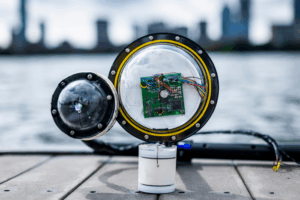
MIT researchers have taken a major step to overcome this problem by developing a battery-free, wireless underwater camera that is about 100,000 times more energy-efficient than other undersea cameras. The device takes color photos, even in dark underwater environments, and transmits image data wirelessly through the water.

The autonomous camera is powered by sound. It converts mechanical energy from sound waves traveling through water into electrical energy that powers its imaging and communications equipment. After capturing and encoding image data, the camera also uses sound waves to transmit data to a receiver that reconstructs the image.

Because it doesn’t need a power source, the camera could run for weeks on end before retrieval, enabling scientists to search remote parts of the ocean for new species. It could also be used to capture images of ocean pollution or monitor the health and growth of fish raised in aquaculture farms.

“One of the most exciting applications of this camera for me personally is in the context of climate monitoring. We are building climate models, but we are missing data from over 95 percent of the ocean. This technology could help us build more accurate climate models and better understand how climate change impacts the underwater world,” says Fadel Adib, associate professor in the Department of Electrical Engineering and Computer Science and director of the Signal Kinetics group in the MIT Media Lab, and senior author of the paper.

Joining Adib on the paper are co-lead authors and Signal Kinetics group research assistants Sayed Saad Afzal, Waleed Akbar, and Osvy Rodriguez, as well as research scientist Unsoo Ha, and former group researchers Mario Doumet and Reza Ghaffarivardavagh. The paper is published in Nature Communications.

The battery-free, wireless underwater camera could help scientists explore unknown regions of the ocean, track pollution, or monitor the effects of climate change./CREDIT-Image: Adam Glanzman

Going battery-free

To build a camera that could operate autonomously for long periods, the researchers needed a device that could harvest energy underwater on its own while consuming very little power.

The camera acquires energy using transducers made from piezoelectric materials that are placed around its exterior. Piezoelectric materials produce an electric signal when a mechanical force is applied to them. When a sound wave traveling through the water hits the transducers, they vibrate and convert that mechanical energy into electrical energy.

Those sound waves could come from any source, like a passing ship or marine life. The camera stores harvested energy until it has built up enough to power the electronics that take photos and communicate data.

To keep power consumption as a low as possible, the researchers used off-the-shelf, ultra-low-power imaging sensors. But these sensors only capture grayscale images. And since most underwater environments lack a light source, they needed to develop a low-power flash, too.

They solved both problems simultaneously using red, green, and blue LEDs. When the camera captures an image, it shines a red LED and then uses image sensors to take the photo. It repeats the same process with green and blue LEDs.

Even though the image looks black and white, the red, green, and blue colored light is reflected in the white part of each photo, Akbar explains. When the image data are combined in post-processing, the color image can be reconstructed.

Nature/water/Ians

Sending data with sound

Once image data are captured, they are encoded as bits (1s and 0s) and sent to a receiver one bit at a time using a process called underwater backscatter. The receiver transmits sound waves through the water to the camera, which acts as a mirror to reflect those waves. The camera either reflects a wave back to the receiver or changes its mirror to an absorber so that it does not reflect back.

A hydrophone next to the transmitter senses if a signal is reflected back from the camera. If it receives a signal, that is a bit-1, and if there is no signal, that is a bit-0. The system uses this binary information to reconstruct and post-process the image.

“This whole process, since it just requires a single switch to convert the device from a nonreflective state to a reflective state, consumes five orders of magnitude less power than typical underwater communications systems,” Afzal says.

The researchers tested the camera in several underwater environments. In one, they captured color images of plastic bottles floating in a New Hampshire pond. They were also able to take such high-quality photos of an African starfish that tiny tubercles along its arms were clearly visible. The device was also effective at repeatedly imaging the underwater plant Aponogeton ulvaceus in a dark environment over the course of a week to monitor its growth.

Now that they have demonstrated a working prototype, the researchers plan to enhance the device so it is practical for deployment in real-world settings. They want to increase the camera’s memory so it could capture photos in real-time, stream images, or even shoot underwater video.

They also want to extend the camera’s range. They successfully transmitted data 40 meters from the receiver, but pushing that range wider would enable the camera to be used in more underwater settings.

This research is supported, in part, by the Office of Naval Research, the Sloan Research Fellowship, the National Science Foundation, the MIT Media Lab, and the Doherty Chair in Ocean Utilization.


Clarifying the chaos of narwhals behavior; what are narwhals, how they help [Details]

Researchers have used the mathematical equations of chaos theory to analyse the data from long-term monitoring of an electronically tagged narwhal. They have extracted previously undetected diurnal patterns within what initially appeared to be irregular diving and surface resting behavior, using records extending across 83 days.

“While animal-borne ocean sensors continue to advance and collect more data, there is a lack of adequate methods to analyse records of irregular behavior,” says Hokkaido University geophysicist Evgeny A. Podolskiy, first author of the research published in the journal PLOS Computational Biology.

Podolskiy developed the procedure to find behavioral patterns in seemingly intractable complexity with Mads Peter Heide‐Jørgensen at the Greenland Institute of Natural Resources.

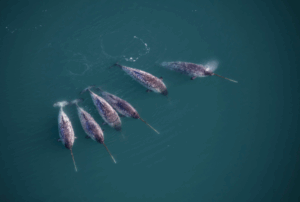
Narwhals (Monodon monoceros) are relatively small whales found in Arctic seas, famous for their long single tusks and called the unicorns of the sea. They are one of the most endangered Arctic species due to climate change, human activity, and predation by such invasive species as killer whales. The narwhals are notable for undertaking dives to extreme depths of more than 1,800 metres. Their life cycle is tightly coupled with sea ice, which is rapidly declining.

A pod of adult male narwhals, Greenland, September 2019 (Photo: Carsten Egevang; This image may exclusively be used in relation to this press release. The image can not be included in media archives for use apart from the above and not be handed over to third parties, without prior acceptance by the photographer)./CREDIT: Carsten Egevang

Podolskiy and Heide‐Jørgensen combined their expertises in signal processing and biologging to understand the full diversity of behaviors of a satellite-tagged narwhal. Mathematical techniques developed as part of chaos theory can interpret complicated and seemingly chaotic behavior in dynamic systems to reveal states called ‘attractors’, which the systems tend to develop towards. In essence, the approach identifies significant patterns that would otherwise be difficult to detect.

The analysis of the behavior of the electronically tagged narwhal, inspired by Podolskiy’s previous work on turbulence, revealed a daily pattern of activity and how it was affected by changing seasons, features of narwhal behavior that were previously unrecognised. The animal rested nearer to the surface around noon, but when they did dive at that time the dives were very deep. During twilight and at night the dives became more shallow but also more intense, possibly due to hunting for squid, which is known for diurnal vertical migration. It was also found that increased sea ice constrains the narwhal’s surface activity, and is correlated with more intense diving.

“Our approach is relatively simple to implement and can map and label long term data, identifying differences between the behavior of individual animals and different species, and also detecting perturbations in behavior caused by changing influences,” the authors suggest.

The researchers expect that their new method may be especially useful for assessing the challenges to narwhals and other Arctic animals posed by climate change and the loss of sea ice. Such information may prove vital in adopting policies to protect endangered species in the face of natural change and increased human activity.

Related: http://dx.doi.org/10.1371/journal.pcbi.1010432