Gender Equality: UN Women Body Calls For Political Will and Accelerated Global Action

The world is retreating from gender equality, and the cost is being counted in lives, rights, and opportunities. Five years from the Sustainable Development Goals (SDGs) deadline in 2030, none of the gender equality targets are on track.

That’s according to this year’s SDG Gender Snapshot report launched on Monday by UN Women and the UN Department of Economic and Social Affairs, which draws on more than 100 data sources to track progress across all 17 Goals.

2025 marks three major milestones for women and girls: the 30th anniversary of the Beijing Declaration and Platform for Action, the 25th anniversary of United Nations Security Council resolution 1325 on women, peace and security, and the 80th anniversary of the United Nations, but with the new sobering data, it is urgent to accelerate action and investment.

Other findings in the report reveal that female poverty has barely shifted in half a decade, stuck at around 10 per cent since 2020. Most of those affected live in sub-Saharan Africa and Central and Southern Asia.

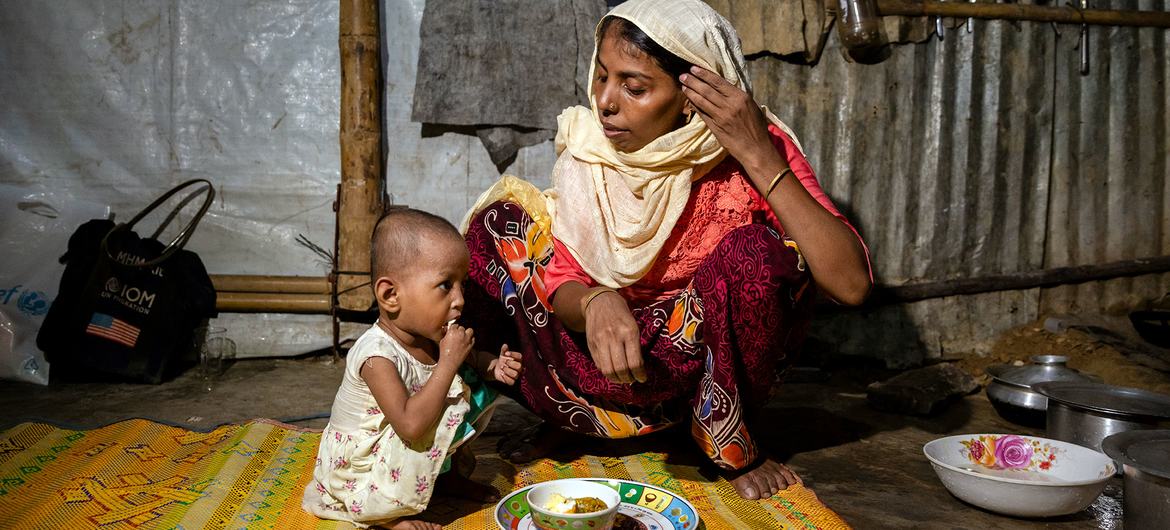
A two-year-old girl suffering from malnutrition is fed by her mother at their shelter in Cox’s Bazar, Bangladesh / © UNICEF/Ilvy Njiokiktjien

In 2024 alone, 676 million women and girls lived within reach of deadly conflict, the highest number since the 1990s. For those caught in war zones, the consequences extend far beyond displacement. Food insecurity, health risks, and violence rise sharply, the report notes.

Violence against women and girls remains one of the most pervasive threats. More than one in eight women worldwide experienced physical or sexual violence at the hands of a partner in the past year, while nearly one in five young women was married before the age of 18. Each year, an estimated four million girls undergo female genital mutilation, with over half cut before their fifth birthday.

Prioritizing gender equality

Yet, amid the grim statistics, the report highlights what is possible when countries prioritize gender equality. Maternal mortality has dropped nearly 40 per cent since 2000, and girls are now more likely than ever to finish school.

Speaking to UN News, Sarah Hendriks, Director of the Policy Division at UN Women, said that when she first moved to Zimbabwe in 1997, “giving birth was actually a matter of life and death”.

“Today, that’s no longer the reality. And that’s an incredible level of progress in a short 25, 30 years”, she added.

Technology, too, holds promise. Today, 70 per cent of men are online compared to 65 per cent of women. Closing that gap, the report estimates, could benefit 343.5 million women and girls by 2050, lifting 30 million out of poverty and adding $1.5 trillion to the global economy by 2030.

“Where gender equality has been prioritized, it has propelled societies and economies forward,” said Sima Bahous, Executive Director of UN Women. “Targeted investments in gender equality have the power to transform societies and economies.”

At the same time, an unprecedented backlash on women’s rights, shrinking civic space, and growing defunding of gender equality initiatives is threatening hard-won gains.

According to UN Women, without action women remain “invisible” in data and policymaking, with 25 per cent less gender data available now due to survey funding cuts.

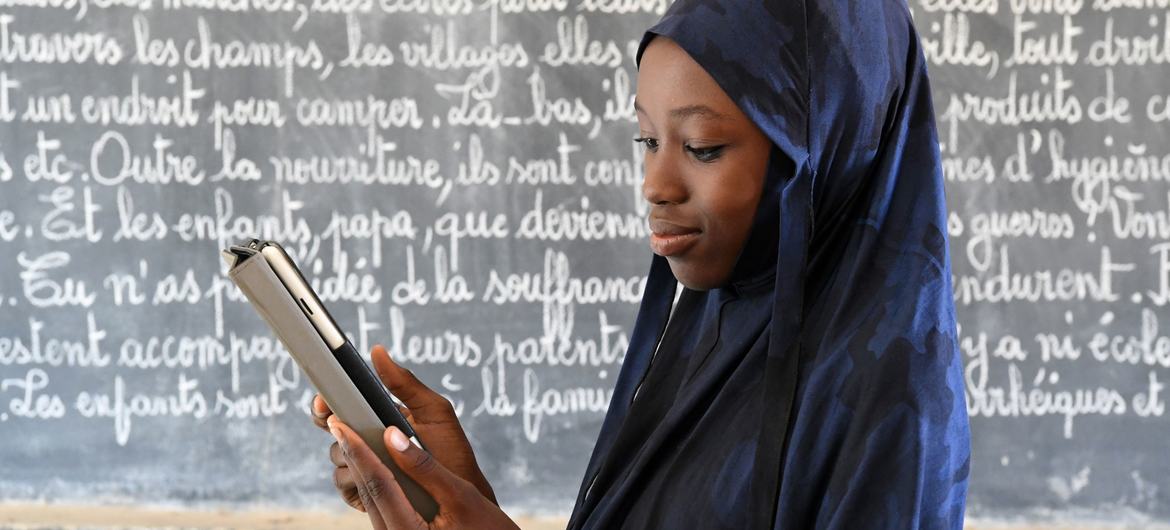
A girl uses a tablet during class at her school in Safi, South Niger.

“The Gender Snapshot 2025 shows that the costs of failure are immense but so are the gains from gender equality,” said Li Junhua, United Nations Under-Secretary-General for Economic and Social Affairs.

“Accelerated action and interventions focused on care, education, the green economy, labour markets and social protection could reduce the number of women and girls in extreme poverty by 110 million by 2050, unlocking an estimated $342 trillion in cumulative economic returns.”

But progress remains uneven, and often painfully slow.  Women hold just 27.2 per cent of parliamentary seats worldwide, and their representation in local governments has stalled at 35.5 per cent. In management, women occupy only 30 per cent of roles, and at this pace, true parity is nearly a century away.

Marking 30 years since the Beijing Platform for Action, the report frames 2025 as a moment of reckoning. “Gender equality is not an ideology,” it warns. “It is foundational for peace, development, and human rights.” Ahead of the UN high-level week, the Gender Snapshot report makes clear that the choice is urgent: invest in women and girls now, or risk losing another generation of progress.

Ms. Hendriks shared UN Women’s message for world leaders: “Change is absolutely possible, and a different pathway is before us, but it is not inevitable, and it requires the political will, as well as the determined resolve of governments right around the world to make gender equality, women’s rights and their empowerment a reality once and for all”.

Anchored in the Beijing+30 Action Agenda, the report identifies six priority areas where urgent, accelerated action is needed to achieve gender equality for all women and girls by 2030, which include a digital revolution, freedom from poverty, zero violence, full and equal decision-making power, peace and security and climate justice.


‘By women, for women’: 15 years of the UN agency championing gender equality

This is just one way that the de facto authorities have restricted women and girls’ fundamental rights. Today, Afghanistan has the second largest gender gap in the world after Yemen. 

“Sometimes I wonder how to remain hopeful in these dark circumstances,” said Fariba, whose name was changed to protect her.

Afghanistan is not the only country where gender equality is losing ground. Worldwide, one in four countries is experiencing a backlash against women’s rights.

These are the challenges that UN Women confronts on its 15th anniversary, making its mandate and work more urgent than ever. 

“This is not the moment to pull back. It is the moment to step forward,” said Sima Bahous, the agency’s Executive Director.

Progress in peril

Established in July 2010, UN Women is currently working in 80 countries to empower women and girls to achieve their full potential.

Despite previous hard-won gains in accessible education for girls and advocacy for legal rights, funding for gender equality is drying up and progress is moving at a snail’s pace.

One in 10 women and girls lives in abject poverty, something the world will not eliminate for another 137 years at the current rate.  

The number of women living near and in conflict zones has doubled in the past decade, putting them at greater risk of gender-based violence, food insecurity and malnutrition.  

Additionally, 103 countries have never had a female Head of State, and gender parity in top governmental leadership will not be achieved for another 130 years.

While a digital revolution and increasingly high-powered artificial intelligence is sweeping the world, the gender digital divide is widening, making it hard for women and girls to access the tools around which the future will be built.  

However, despite such bleak circumstances, or perhaps because of them, UN Women continues to be a “powerhouse for gender equality and women’s empowerment”.

War and peace

Over 600 million women and girls live within 50 kilometres of a conflict, making them key stakeholders in any peace building process. More than that, evidence suggests that peace processes with women signatories are more durable.  

Despite this, between 2020 and 2023, 80 per cent of peace talks did not include women.  

However, in some countries, there are promising shifts towards great gender inclusion and parity in peace-related activities.  

For example, in Ukraine, demining, a profession which has historically excluded women due to normative perceptions of danger, is attracting more women.  

“What seems ‘not a woman’s job’ may turn out to be your mission,” said Tetiana Rubanka, the head of a demining team there.  

This is especially important in Ukraine, where the UN Mine Action Service (UNMAS) estimates that at least 20 per cent of land is contaminated with unexploded ordnance.

A collective voice

Despite clear proof that quotas in government work to ensure gender parity, women remain excluded from many policy making conversations.  

Because of this reality, UN Women works to support collective action by and for women whose voices are heeded more when they speak together.  

In the Pacific, women make up the majority of vendors at markets, but the markets themselves are managed and run by municipal councils, which tend to be predominantly made up of men. In the past, this meant that women’s concerns, including poor ventilation, security concerns and refrigeration infrastructure, went unaddressed.

With the support of a UN Women project launched in 2014, over 50,000 women vendors have formed associations that enable them to bargain collectively and achieve lasting changes.  

“We are not ordinary women who have nothing. We are women who are important. We just never thought of it that way in the past,” said Joy Janet Ramo, the head of a vendors’ association in the Solomon Islands.


SDG 5

SDG 5: EMPOWER ALL WOMEN AND GIRLS


  • End all forms of discrimination and violence against women and girls
  • Eliminate such harmful practices as early and forced marriages and female genital mutilation
  • Adapt and strengthen legislation to promote gender equality and empower women and girls
  • Ensure women’s full and effective participation and equal opportunities for leadership in political, economic and public life
  • Ensure universal access to sexual and reproductive health care


Globally, almost half of all married women currently lack decision-making power over their sexual and reproductive health and rights.


Finding hope

In Afghanistan, there are over 80 edicts that curtail women and girls’ fundamental rights, or 80 ways in which their potential is being restricted and 80 reasons to lose hope.  

“The colours of the rainbow have dimmed in my life, and I no longer see any colours to paint,” said Anita, a woman who used to be an artist and a teacher.

But still, they refuse to lose hope, instead forming local grassroots organizations that work to promote women’s leadership and prepare them for a time when they can again enjoy fundamental rights.  

Currently, there is a $420 billion annual gap in financing for gender equality globally, making the work of UN Women increasingly untenable. But, after 15 years, the agency insists that it is “doubling down” on the commitment to gender equality.

“My fellow women: never lose hope in the ups and downs of life, in the lows and highs,” Anita said. 

Source link

UN forum to spotlight health, gender equality, oceans, in critical bid to meet development goals

The 2025 High-Level Political Forum, or HLPF, follows two recent successful UN conferences focused on vital development issues: one in June in Nice, France, dedicated to ocean protection, and another held in Sevilla, Spain, centred on boosting financing for sustainable initiatives.

The Sevilla meeting ended with a strong call to action: to urgently address the massive $4 trillion annual shortfall in financing needed to achieve the SDGs. It also highlighted the pressing need for greater investment and deep reform of the global financial system.

Held under the auspices of the UN Economic and Social Council (ECOSOC), the forum will take place from 14 to 23 July at UN Headquarters in New York.

Here are five key things to know about this year’s forum:

1. It’s all about accelerating action

The HLPF is the United Nations’ main platform for tracking global progress on the Sustainable Development Goals. It meets each year to review countries’ efforts, share solutions, and push for faster action to meet the 2030 targets

The 2025 forum is convening under the theme:

Advancing sustainable, inclusive, science- and evidence-based solutions for the 2030 Agenda for Sustainable Development and its Sustainable Development Goals leaving no one behind.

This reflects a growing sense of urgency. With the 2030 deadline fast approaching, the forum will emphasise practical, data-driven strategies to close implementation gaps– particularly in the face of intersecting global crisis including climate change, inequality, and economic instability.

The 17 Sustainable Development Goals are all interconnected, for instance progress on SDG 2 to end hunger is closely tied to advances in health and education.

2. Five SDGs in the spotlight

Each year, the HLPF conducts in-depth reviews of selected Goals. In 2025, the focus will be on:

SDG 3: Good health and well-being

SDG 5: Gender equality

SDG 8: Decent work and economic growth

SDG 14: Life below water

SDG 17: Partnerships for the goals

These Goals span a wide range of issues – from public health and gender equity to economic resilience and marine conservation.

SDG 17, which is reviewed annually, highlights the importance of revitalising global partnerships and enhancing means of implementation – including financing, which nations committed to just last month in Sevilla.

© UNICEF/Lasse Bak Mejlvang

3. Countries will share their progress, voluntarily

A hallmark of the HLPF is the Voluntary National Reviews (VNRs) – self-assessments by Member States on their progress toward the SDGs. In 2025, dozens of countries are expected to present their VNRs, offering insights into both achievements and persistent challenges.

These reviews foster transparency, peer learning, and accountability. They also provide a platform for civil society and other stakeholders to engage directly with governments on development priorities.

VNR Labs – interactive sessions focused on national reviews – create space for dialogue, innovation, and collaboration

4. It’s not just governments

While the HLPF is a UN intergovernmental platform, it brings together a diverse range of voices, including youth groups, local authorities, indigenous peoples, NGOs, academics, the private sector, and UN system agencies.

A rich programme of side events, exhibitions, and roundtable-discussions. This inclusive approach reflects the spirit of the 2030 Agenda, which recognises sustainable development is a universal, shared endeavour.

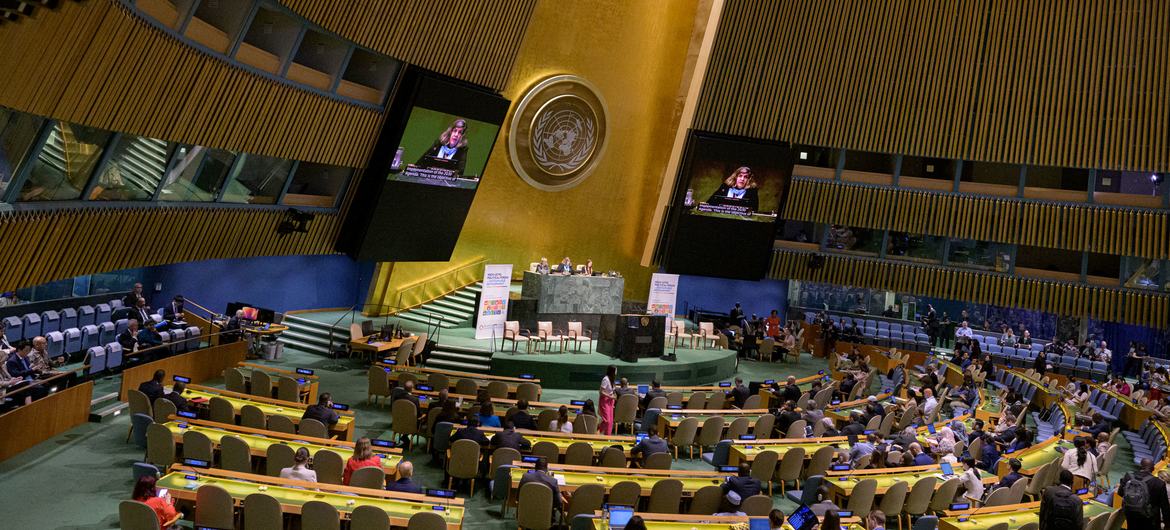
A wide view of the opening of the 2023 High-Level Political Forum on Sustainable Development convened under the auspices of the Economic and Social Council (ECOSOC), held in the General Assembly Hall.

5 – 4 – 3 – 2 – 1 The Final Countdown

With only five years left to deliver on the 2030 Agenda, the 2025 HLPF marks a critical inflection point.

It is more than a yearly check-in. This year’s session comes at a time when science, solidarity, and urgent action must converge. It will help set the tone for the next Sustainable Development Goals Summit in 2027, where world leaders will take stock of collective progress and determine the final push toward 2030.

What happens now – at this two-thirds deadline moment – will shape whether the SDGs will realise a global promise or become a missed opportunity.

Source link

‘The margins of the budget’: Gender equality in developing countries underfunded by $420 billion annually

“The money simply is not reaching the women and girls who need it most,” UN Women said in a news release issued on Monday.  

This estimate comes in the midst of the Fourth International Conference on Financing for Development underway in Sevilla, Spain.

There, world leaders are working to revitalize the international financing structure to better support the Sustainable Development Goals (SDGs), one of which is gender equality.  

“We cannot close gender gaps with budgets that are lacking a gender lens … Gender equality must move from the margins of the budget lines to the heart of public policy,” said Nyaradzayi Gumbonzvanda, Deputy Executive Director of UN Women.

Move from promise to action

In order to remedy this shortfall, UN Women said that the world needs a decade of targeted and consistent investment to end gender gaps and ensure that no one is left behind.

This includes expanding gender-responsive budgeting which carefully tracks where funding is most needed and supporting programs which target those areas.

Currently, three-fourths of countries do not have systems to track the allocation of public funds in relation to gender equality.  

Specifically, investment in public care systems – such as child and elder care programmes – is essential to ensuring that women can enter the workforce.

Overwhelmed by debt

Additionally, UN Women called for urgent debt relief, citing that many countries are so burdened by debt financing that they cannot dedicate money to advancing gender equality.  

In this vein, UN Women welcomed the Compromiso de Sevilla, the outcome of the Conference adopted by Member States, which lays out new commitments to development financing, including on promoting gender equality.

Ms. Gumbonzvanda emphasised the need for governments to back the commitments they made in this document with real action.  

“[Gender equality] takes money. It takes reform. And it takes leadership that sees women not as a cost, but as a future.”

Source link

PM hails SC judgement on Triple Talaq

The Prime Minister, Shri Narendra Modi, has hailed the judgement of the Hon’ble Supreme Court on Triple Talaq. Calling the judgement historic, the Prime Minister said that it grants equality to Muslim women and is a powerful measure for women empowerment.

“Judgement of the Hon’ble SC on Triple Talaq is historic. It grants equality to Muslim women and is a powerful measure for women empowerment”, the Prime Minister said.