Security Council to meet following Russia’s violation of Polish airspace, as concern mounts over drone warfare

The meeting was requested by Poland after reporting that at least 19 violations by Russian drones of its territory overnight into Wednesday during a large-scale missile and drone strike against Ukraine.

The episode marked the most serious such incursion since the start of Russia’s full-scale invasion of Ukraine in 2022.  

While Poland and its NATO allies reportedly downed several of the drones, the incident has heightened tensions across the region – and put the new threats posed by drone warfare at the heart of diplomatic debate.

Russia’s Defence Ministry said the strikes were aimed at Ukraine’s military-industrial targets and that it did not intend drones to stray across the border.

UN political chief to brief

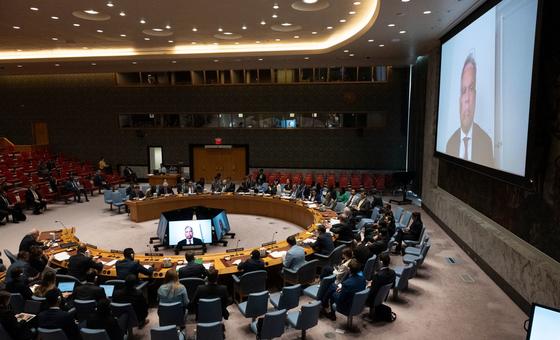
UN’s political official, Rosemary DiCarlo, is expected to brief ambassadors. Poland’s deputy foreign minister will attend, alongside regional states and the European Union.

The incident has raised deep concern over spillover of the conflict in Ukraine.

Stay with UN News as we bring you live coverage of the meeting…

Rise of the drone

The reported incursion into Polish airspace highlights the growing role of drones in modern conflict.

Relatively inexpensive and easy to deploy, drones are increasingly supplementing – and in some cases supplanting – conventional military hardware.  

Armies, armed groups and militias worldwide are rapidly adapting to their use, allowing for strikes and reconnaissance with lower risk to personnel.

However, malfunctions, loss of control and human error can lead to unintended strikes or impacts – especially when they’re deployed in towns and cities as opposed to the battlefield.

Analysts also say drones blur the line between traditional military operations and asymmetric warfare, raising the risk of unintended escalation across borders.

Read more in our explainer, here.

Source link

UN highlights need for peaceful resolution, as Trump and Putin prepare to meet on Ukraine

The UN is stressing that any peace effort or deal must be consistent with the principles of the UN Charter, including respect for Ukraine’s sovereignty and territorial integrity.

Speaking to reporters on Thursday, UN Spokesperson Stéphane Dujarric welcomed “dialogue at the highest level” between the two permanent members of the Security Council.

The meeting is scheduled to take place in Alaska at 11 AM local time (3 PM in New York). The northern US state is separated from the mainland by Canada, while Russia lies just to the west across the Bering Strait and the International Date Line.

Mr. Dujarric reaffirmed that the “[UN’s] position regarding the war in Ukraine remains the same.”

We want an immediate, full and unconditional ceasefire as a first step towards finding a just and sustainable and comprehensive peace, one that upholds Ukraine’s sovereignty, its territorial integrity and independence within internationally recognized border and in line with UN Charter, international law and all relevant UN resolutions,” he said.

Asked about reports that the United States and Russia would meet without Ukraine at the table, Mr. Dujarric recalled the UN’s principled view that, to reach a durable settlement, “it’s helpful to have all the parties of the conflict at the table, the same table.”

“We’ll obviously be watching what happens, and we’re watching what comes out of it.”

The summit takes place against a backdrop of worsening humanitarian conditions. According to the UN relief coordination office, OCHA, hostilities continue to exact a heavy civilian toll, destroying homes and infrastructure, forcing thousands more to flee.

Between Monday and Wednesday alone, over 6,000 people evacuated their high-risk communities near frontlines in the Donetsk region, either through organized evacuations or of their own volition.

The UN Human Rights Monitoring Mission in Ukraine reported this week that July saw the highest monthly civilian casualty toll since May 2022, with 286 people killed and 1,388 injured.

Since Russia launched its full-scale invasion of Ukraine, the rights mission has documented the deaths of at least 13,883 civilians, including 726 children, and 35,548 injured, including 2,234 children.

Source link

SECURITY COUNCIL LIVE: Ambassadors meet in emergency session, amid starvation in the Gaza Strip

The UN Security Council is meeting in New York following the Israeli cabinet’s decision to again expand its military operation inside the Gaza Strip and take full control of the key population centre of Gaza City. UN chief António Guterres described it as a “dangerous escalation” for the two million civilians trapped in the enclave as well as the remaining Israeli hostages still held captive. Follow our Meetings Coverage Section’s live reporting of the crisis meeting and UN News app users can follow here.

Source link

Indigenous youth meet trailblazers ahead of Nelson Mandela Day

Accompanied by their parents and mentors from the midwestern state of Wisconsin, the group wore handmade ribbon skirts and vests featuring seven coloured bands, each symbolizing a Sustainable Development Goal (SDG) of personal significance, such as good health and gender equality.

Also visiting the UN in New York for the first time that day was Brenda Reynolds, a social worker from Canada and a member of the Fishing Lake First Nation. She was joined by her husband, Robert Buckle, and 12-year-old granddaughter Lillian, and wore one of her own ribbon skirts for the occasion.

Ms. Reynolds will be awarded the 2025 United Nations Nelson Rolihlahla Mandela Prize on 18 July. The Prize, presented every five years, recognizes two individuals whose life work exemplifies service to humanity. Ms. Reynolds will receive the award alongside Kennedy Odede, a social entrepreneur from Kenya.

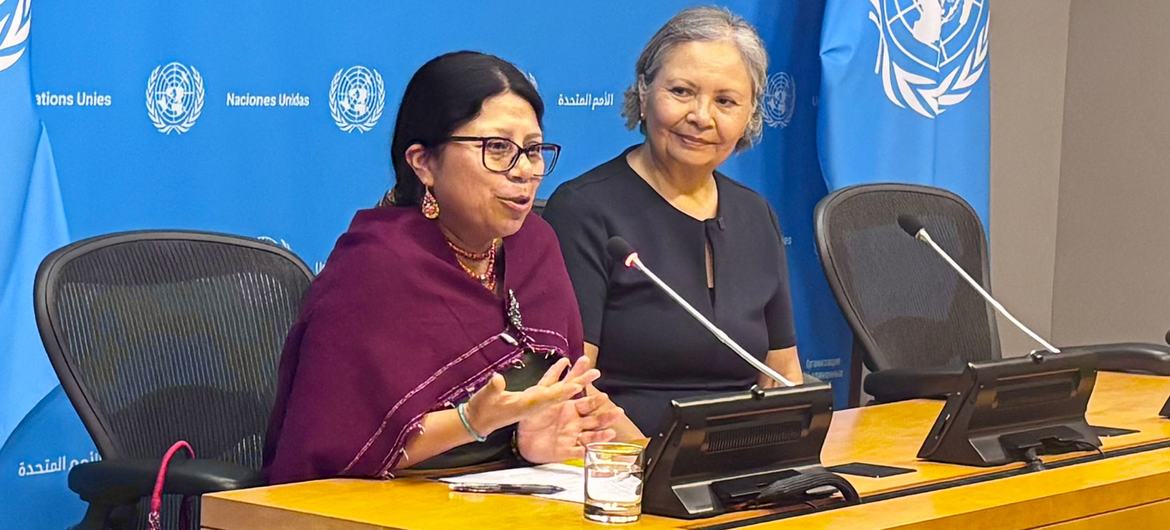
Mirian Masaquiza Jerez, a UN Social Affairs Officer, and Brenda Reynolds, a recipient of the 2025 United Nations Nelson Rolihlahla Mandela Prize, brief Indigenous youth visiting UN Headquarters in New York.

Agents of change

After a UN tour (unanimously enjoyed) and a quick stop for lunch and souvenirs at the UN Bookshop (where one plushie hummingbird was traded for a green turtle named “Coral”), the group settled into a briefing room.

Onstage, Ms. Reynolds was joined by Mirian Masaquiza Jerez, a Kichwa woman from Ecuador and a Social Affairs Officer at the UN Department of Economic and Social Affairs (UNDESA), easily recognized in the UN corridors for always wearing traditional regalia from her Indigenous community of Salasaka,

“Wherever you go to public spaces, wear who you are,” she said.  “The UN is the place to raise your voice. Be free to be who you are.”

Encouraging them to speak their languages and honour their cultures, Ms. Masaquiza urged the young students to see themselves as agents of change.

“You didn’t come by invitation. You came because you belong,” she said. “You are the future. You are the present. As Indigenous, we have the space. Use it.”

A painful past

Ms. Reynolds shared her personal story with the group, reflecting on her early career as a counsellor at Gordon’s Indian Residential School in Saskatchewan, the last federally funded residential school to close in Canada.

She described seeing children as young as five separated from their families for a year at a time and issued shirts with numbers instead of their names written inside: “The only other time I had seen people identified that way was when Jewish people had numbers tattooed on them.”

During her first year at Gordon’s in 1988, a young girl confided that she had been abused. By the next morning, 17 would come forward, launching what would become the province’s first major residential school abuse case.

Ms. Reynolds, then labeled a “troublemaker,” went on to help shape the Indian Residential Schools Settlement Agreement and advise the Truth and Reconciliation Commission. Her work has impacted hundreds of thousands of Indigenous People across Canada.

The room echoed with laughter, knowing nods and tears, and phrases from Ojibwe and other languages represented by the Indigenous Peoples in the room, including Potawatomi, Ho-Chunk, Ojibwe, Menomonee, Oneida, Navajo, Hawaiian, Pacific Islander, and Afro-Indigenous communities.

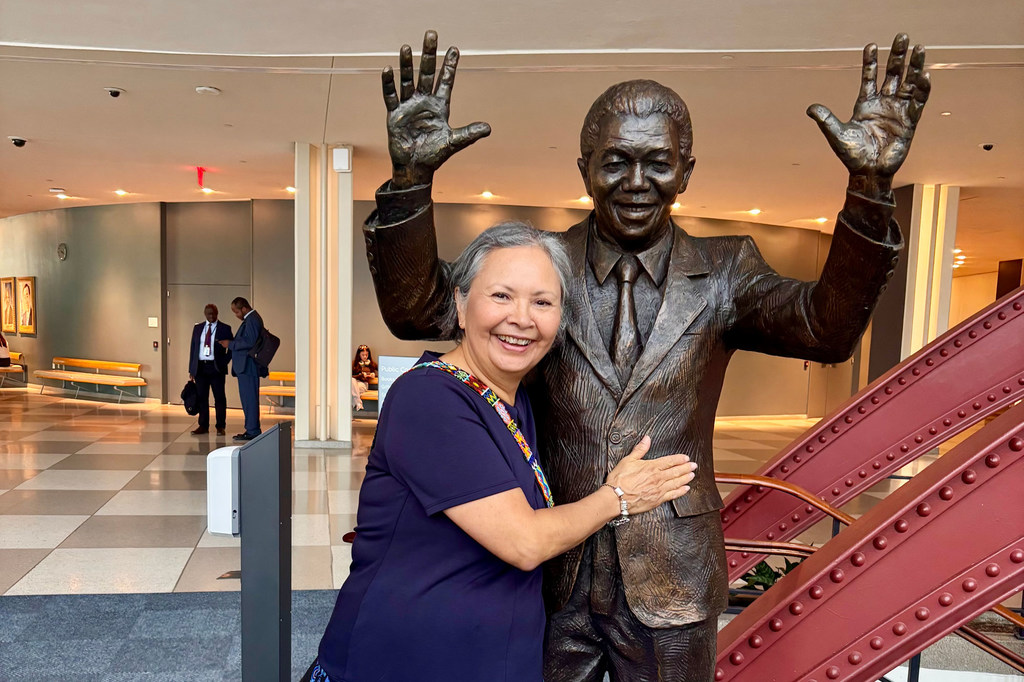
Brenda Reynolds, a recipient of the 2025 United Nations Nelson Rolihlahla Mandela Prize, poses with a statute of the late South African President at UN Headquarters in New York.

Coming full circle

The youth came from the Daughters of Tradition and the Sons of Tradition, part of a long-running healing initiative by Milwaukee’s Healing Intergenerational Roots (HIR) Wellness Institute, which supports Indigenous communities with no-cost, comprehensive mental healthcare and other services.

The founder, Lea S. Denny, wants Indigenous youth to see themselves in positions of power. This particular group has been together for eight years, with some heading off to college in the fall.

One father, attending with his three daughters, reflected on raising Indigenous youth in the digital age. “We want them to access the world out there,” he said, “but also protect the inside world we want to hold dear.” He said he also offered the advice that “if you don’t see yourself on the screen, sometimes you have to be the first.”

The day finished with hugs and exchanges of handmade leis as a symbol of the breath of life and sharing a good life source.

They will reunite on 18 July to see Ms. Reynolds accept the Mandela Prize in the General Assembly Hall.

Before then, a planned detour to visit Times Square.

Meanwhile, Ms. Reynolds and her family discussed their plans for a Broadway show. On the way out, she paused to hug a life-sized bronze statue of Nelson Mandela, a gift from the South African Government to the UN.

“I started my work with children,” she said. “And today, I spoke to children. This feels full circle for me.”


Source link

UN forum to spotlight health, gender equality, oceans, in critical bid to meet development goals

The 2025 High-Level Political Forum, or HLPF, follows two recent successful UN conferences focused on vital development issues: one in June in Nice, France, dedicated to ocean protection, and another held in Sevilla, Spain, centred on boosting financing for sustainable initiatives.

The Sevilla meeting ended with a strong call to action: to urgently address the massive $4 trillion annual shortfall in financing needed to achieve the SDGs. It also highlighted the pressing need for greater investment and deep reform of the global financial system.

Held under the auspices of the UN Economic and Social Council (ECOSOC), the forum will take place from 14 to 23 July at UN Headquarters in New York.

Here are five key things to know about this year’s forum:

1. It’s all about accelerating action

The HLPF is the United Nations’ main platform for tracking global progress on the Sustainable Development Goals. It meets each year to review countries’ efforts, share solutions, and push for faster action to meet the 2030 targets

The 2025 forum is convening under the theme:

Advancing sustainable, inclusive, science- and evidence-based solutions for the 2030 Agenda for Sustainable Development and its Sustainable Development Goals leaving no one behind.

This reflects a growing sense of urgency. With the 2030 deadline fast approaching, the forum will emphasise practical, data-driven strategies to close implementation gaps– particularly in the face of intersecting global crisis including climate change, inequality, and economic instability.

The 17 Sustainable Development Goals are all interconnected, for instance progress on SDG 2 to end hunger is closely tied to advances in health and education.

2. Five SDGs in the spotlight

Each year, the HLPF conducts in-depth reviews of selected Goals. In 2025, the focus will be on:

SDG 3: Good health and well-being

SDG 5: Gender equality

SDG 8: Decent work and economic growth

SDG 14: Life below water

SDG 17: Partnerships for the goals

These Goals span a wide range of issues – from public health and gender equity to economic resilience and marine conservation.

SDG 17, which is reviewed annually, highlights the importance of revitalising global partnerships and enhancing means of implementation – including financing, which nations committed to just last month in Sevilla.

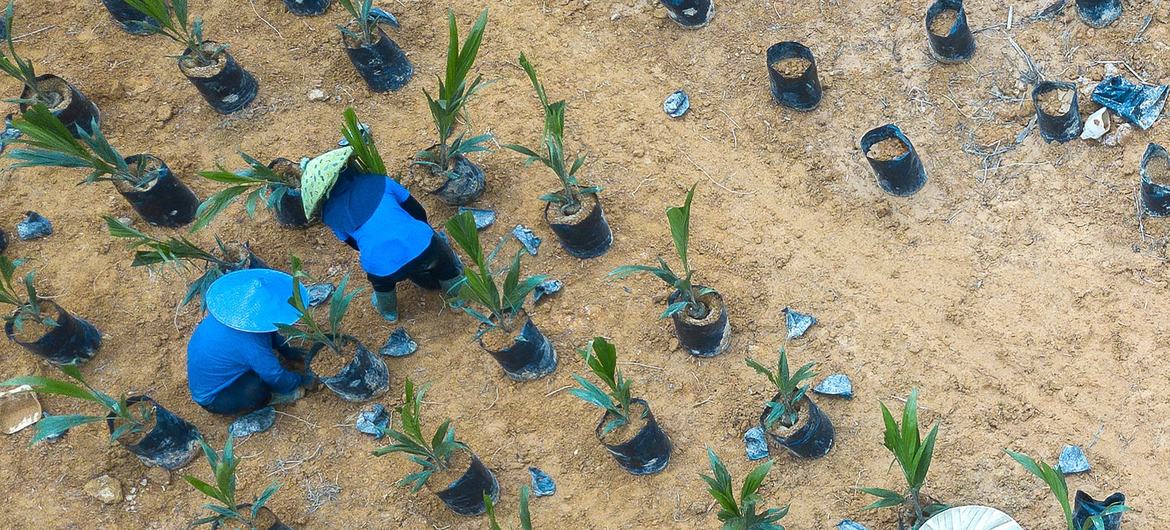
© UNICEF/Lasse Bak Mejlvang

3. Countries will share their progress, voluntarily

A hallmark of the HLPF is the Voluntary National Reviews (VNRs) – self-assessments by Member States on their progress toward the SDGs. In 2025, dozens of countries are expected to present their VNRs, offering insights into both achievements and persistent challenges.

These reviews foster transparency, peer learning, and accountability. They also provide a platform for civil society and other stakeholders to engage directly with governments on development priorities.

VNR Labs – interactive sessions focused on national reviews – create space for dialogue, innovation, and collaboration

4. It’s not just governments

While the HLPF is a UN intergovernmental platform, it brings together a diverse range of voices, including youth groups, local authorities, indigenous peoples, NGOs, academics, the private sector, and UN system agencies.

A rich programme of side events, exhibitions, and roundtable-discussions. This inclusive approach reflects the spirit of the 2030 Agenda, which recognises sustainable development is a universal, shared endeavour.

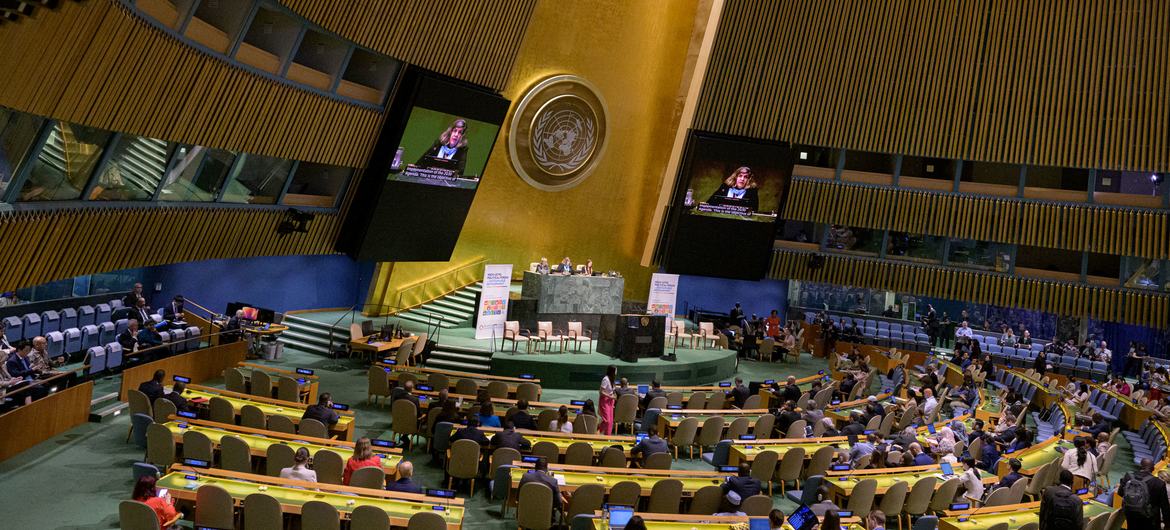
A wide view of the opening of the 2023 High-Level Political Forum on Sustainable Development convened under the auspices of the Economic and Social Council (ECOSOC), held in the General Assembly Hall.

5 – 4 – 3 – 2 – 1 The Final Countdown

With only five years left to deliver on the 2030 Agenda, the 2025 HLPF marks a critical inflection point.

It is more than a yearly check-in. This year’s session comes at a time when science, solidarity, and urgent action must converge. It will help set the tone for the next Sustainable Development Goals Summit in 2027, where world leaders will take stock of collective progress and determine the final push toward 2030.

What happens now – at this two-thirds deadline moment – will shape whether the SDGs will realise a global promise or become a missed opportunity.

Source link

GAZA LIVE: Security Council to meet on aid crisis amid ‘critical risk of famine’ due to Israeli blockade

The Security Council is set to meet this afternoon at 3 PM in New York to discuss the deepening crisis in Gaza, where humanitarians warn of “a critical risk of famine” and aid shipments have been blocked for over 70 days. UN relief chief Tom Fletcher is expected to brief ambassadors. Follow live for key updates from UN Headquarters and reports from the region. App users can follow coverage here.