Thailand grants work rights to long-term refugees from Myanmar, UN welcomes resolution

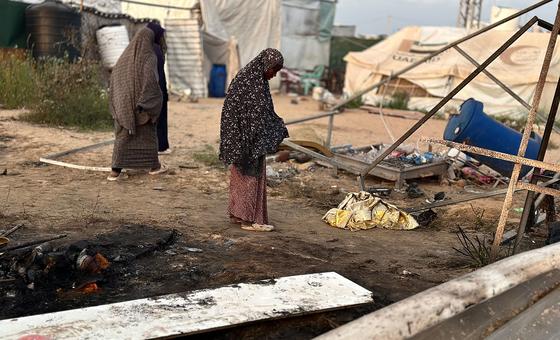
Some 81,000 forcibly displaced people are hosted in temporary shelters along the Thai-Myanmar border where they have been living in the camps for decades.

Nearly half the refugee population were born under canvas, where displaced families have largely depended on humanitarian assistance.

Over a million Rohingya, a mostly-Muslim minority from Myanmar, have fled conflict and persecution in multiple waves of displacement.

Monday marked eight years since the mass exodus of Rohingya from Myanmar’s Rakhine state in Myanmar and the UN on Monday called for greater international solidarity over their plight.

‘Turning point’

UNHCR’s Representative in Thailand, Tammi Sharpe, described the Government’s decision as a major “turning point.”

She said it would not only help refugees support themselves but also benefit local economies and strengthen Thailand’s long-term growth.

By unlocking the potential of these individuals, Thailand is not only upholding humanitarian principles but also making a strategic investment in its own future,” Ms. Sharpe said.

Although the new resolution covers a limited number, the UN agency said it would continue to advocate for wider refugee inclusion – offering support to the Thai Government in rolling out the new policy.

Aid cuts

The move comes at a time when aid budgets for displaced people worldwide are facing severe cuts.

For the UN agency, Thailand’s move could set a regional precedent for sustainable, rights-based refugee policies – and serve as a model for countries facing similar challenges, UNHCR said.

According to agency, $25.4 million is needed in 2025 to ensure operations covered by the Thailand-based international office is sustained – which also oversees operations in Cambodia, the Lao People’s Democratic Republic and Viet Nam.
Source link

UN highlights need for peaceful resolution, as Trump and Putin prepare to meet on Ukraine

The UN is stressing that any peace effort or deal must be consistent with the principles of the UN Charter, including respect for Ukraine’s sovereignty and territorial integrity.

Speaking to reporters on Thursday, UN Spokesperson Stéphane Dujarric welcomed “dialogue at the highest level” between the two permanent members of the Security Council.

The meeting is scheduled to take place in Alaska at 11 AM local time (3 PM in New York). The northern US state is separated from the mainland by Canada, while Russia lies just to the west across the Bering Strait and the International Date Line.

Mr. Dujarric reaffirmed that the “[UN’s] position regarding the war in Ukraine remains the same.”

We want an immediate, full and unconditional ceasefire as a first step towards finding a just and sustainable and comprehensive peace, one that upholds Ukraine’s sovereignty, its territorial integrity and independence within internationally recognized border and in line with UN Charter, international law and all relevant UN resolutions,” he said.

Asked about reports that the United States and Russia would meet without Ukraine at the table, Mr. Dujarric recalled the UN’s principled view that, to reach a durable settlement, “it’s helpful to have all the parties of the conflict at the table, the same table.”

“We’ll obviously be watching what happens, and we’re watching what comes out of it.”

The summit takes place against a backdrop of worsening humanitarian conditions. According to the UN relief coordination office, OCHA, hostilities continue to exact a heavy civilian toll, destroying homes and infrastructure, forcing thousands more to flee.

Between Monday and Wednesday alone, over 6,000 people evacuated their high-risk communities near frontlines in the Donetsk region, either through organized evacuations or of their own volition.

The UN Human Rights Monitoring Mission in Ukraine reported this week that July saw the highest monthly civilian casualty toll since May 2022, with 286 people killed and 1,388 injured.

Since Russia launched its full-scale invasion of Ukraine, the rights mission has documented the deaths of at least 13,883 civilians, including 726 children, and 35,548 injured, including 2,234 children.

Source link

UN General Assembly adopts Gaza ceasefire resolution by overwhelming majority

The move followed the Security Council’s failure to pass a similar resolution last week due to a lone veto by permanent member the United States.

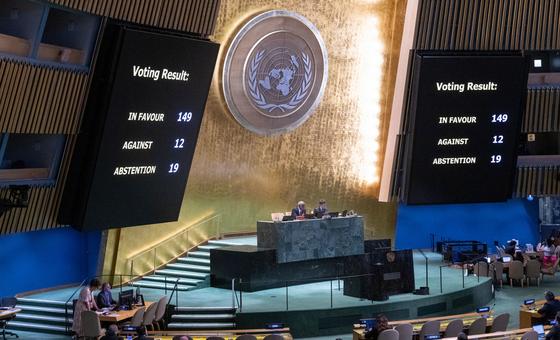
The resolution was backed by 149 Member States, with 12 voting against and 19 abstaining. Among those opposing the resolution were the United States and Israel, who were joined among others by Argentina, Hungary and Paraguay.

India, Georgia, Ecuador, Romania and Ethiopia were among the countries abstaining.

End starvation as weapon of war

Brought forward by over 20 countries, it strongly condemns the use of starvation as a weapon of war, demands a full lifting of the Israeli blockade on humanitarian aid, and insists on the protection of civilians under international law.

Although General Assembly resolutions are not legally binding, they carry significant political and moral weight.

On 4 June, the Security Council failed to adopt its draft resolution after a veto by the United States, a permanent member.

Meanwhile, famine conditions continue to threaten lives across Gaza, and reports persist of civilians being killed or injured while trying to access food at distribution points operated independently of the UN but supported by Israel and the US.

Assembly steps into as Security Council stalls

Opening the special session, General Assembly President Philémon Yang said that “the horrors in Gaza must end” after 20 months of war. He criticised the Security Council’s ongoing paralysis and inability to fulfil its core responsibility to uphold peace and security.

He called the situation on the ground “unacceptable”, highlighting the deprivation of food, water and medicine for civilians, the continued captivity of hostages, and the need for urgent international action.

Mr. Yang noted that next week’s high-level meeting in New York on implementing a two-State solution, chaired by France and Saudi Arabia, saying it would offer a chance for renewed commitment towards peace in the Occupied Palestinian Territory.

Key elements of the resolution:

  • Ceasefire: Calls for an immediate, unconditional and permanent ceasefire by all parties.
  • Hostages: Demands the immediate and unconditional release of all hostages held by Hamas and other armed groups.
  • Implementation: Urges the full and immediate implementation of Security Council resolution 2735 (2024), including the ceasefire, hostage and prisoner exchanges, return of displaced persons, and withdrawal of Israeli troops from Gaza.
  • International law: Reaffirms that all parties must uphold international humanitarian and human rights law, with particular attention to civilian protection and accountability for violations.
  • Starvation as a weapon: Strongly condemns the use of starvation and the denial of aid as tactics of war.
  • Humanitarian access: Demands the full, safe and unimpeded delivery of aid – including food, medicine, water, shelter and fuel – throughout Gaza.
  • Detention practices: Calls for the humane treatment and release of those arbitrarily detained, and the return of remains.
  • ICJ advisory opinion: Recalls the request for an urgent advisory opinion from the International Court of Justice on Israel’s obligations in the Occupied Palestinian Territory.
  • End of blockade: Demands Israel immediately lift the blockade on Gaza and open all border crossings for aid deliveries.
  • Accountability: Urges Member States to take necessary steps to ensure Israel complies with its international legal obligations.
  • UN and humanitarian personnel: Calls for full respect for the work and immunity of UN staff and humanitarian workers.
  • Protection of aid workers: Urges both humanitarian and UN bodies to ensure the safety of their personnel.
  • Medical neutrality: Underscores the duty to protect medical workers, health facilities, and transport routes.

You can catch up with the full meeting by going to our live coverage of the emergency session and today’s developments in Gaza, here.

Source link

GAZA LIVE: UN General Assembly to vote on resolution demanding immediate, unconditional and permanent ceasefire

The General Assembly meets at 3pm in New York on Thursday in emergency session following the Security Council’s failure to adopt a resolution on 4 June calling for an immediate and permanent ceasefire in Gaza, which was vetoed by permanent member the United States. As starvation looms across the Strip, mass casualties continue to be reported of desperate civilians trying to access food at Israel and US-backed distribution sites. App users can follow our live coverage here.

US vetoes Security Council resolution demanding permanent ceasefire in Gaza

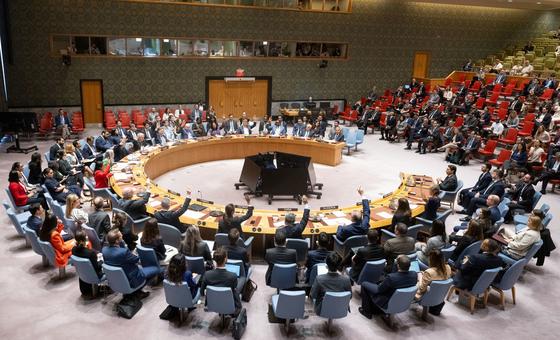
The text, co-sponsored by Algeria, Denmark, Greece, Guyana, Pakistan, Panama, the Republic of Korea, Sierra Leone, Slovenia, and Somalia – collectively known as the E-10 – received 14 votes in favour, with the US casting the lone vote against.

As one of the council’s five permanent members, the US holds veto power – a negative vote that automatically blocks any resolution from going forward.

Had it been adopted, the draft would have demanded “an immediate, unconditional and permanent ceasefire in Gaza” to be respected by all parties.

Release all hostages

The text reaffirmed the Council’s earlier call for the “immediate, dignified and unconditional release of all hostages held by Hamas and other groups.”

The draft also expressed grave concern over the “catastrophic humanitarian situation” in Gaza – following more than the months of almost total Israeli aid blockade – including the risk of famine, highlighted by recent international food security assessments.

It reaffirmed the obligation of all parties to comply with international law, including international humanitarian and human rights law.

Resume flow of aid

In addition to a ceasefire, the draft resolution demanded the “immediate and unconditional lifting of all restrictions” on the entry and distribution of humanitarian aid in Gaza, calling for safe and unhindered access for UN and humanitarian partners across the enclave.

It also urged the restoration of essential services, in accordance with humanitarian principles and prior Security Council resolutions.

The text voiced support for ongoing mediation efforts led by Egypt, Qatar, and the United States to revive the phased ceasefire framework outlined in resolution 2735 (2024), which envisions a permanent cessation of hostilities, the release of all hostages, the exchange of Palestinian prisoners, the return of all remains, full Israeli military withdrawal from Gaza, and the start of a long-term reconstruction plan.

Draft resolution unacceptable: United States

Speaking ahead of the vote, acting US Representative Dorothy Shea described the draft resolution as “unacceptable”.  

“US opposition to this resolution should come as no surprise – it is unacceptable for what it does say, it is unacceptable for what it does not say, and it is unacceptable for the manner in which it has been advanced,” she said.

“The United States has been clear,” she continued, “we would not support any measure that fails to condemn Hamas and does not call for Hamas to disarm and leave Gaza.”

She added that Hamas has rejected numerous ceasefire proposals, including one over the weekend that would have provided a pathway to end the conflict and release the remaining hostages.

“We cannot allow the Security Council to award Hamas’ intransigence,” Ms. Shea said, stressing, “Hamas and other terrorists must have no future in Gaza. As Secretary [Marco] Rubio has said: ‘If an ember survives, it will spark again into a fire’.” 

‘The world is watching’

The failure of the resolution comes as the humanitarian crisis in Gaza deepens, with UN agencies warning of the total collapse of health services, growing displacement, and a rising death toll around the new privatized US-Israel led aid distribution system which bypasses established agencies.

“The world is watching, day after day, horrifying scenes of Palestinians being shot, wounded or killed in Gaza while simply trying to eat,” said UN relief chief Tom Fletcher earlier on Wednesday.

Source link

SECURITY COUNCIL LIVE: US vetoes new resolution calling for immediate Gaza ceasefire, unconditional release of hostages


The United States has vetoed a new draft resolution on Gaza, standing as the lone vote against the text which called for an immediate, unconditional and permanent ceasefire, the unconditional release of hostages held by Hamas and others and the immediate lifting of all aid restrictions. Follow live coverage from our Meetings Coverage Section and UN News app users can follow here.

Source link

NEET Row: Bengal Assembly passes resolution on scrapping of NEET; Karnataka next?

On Wednesday, the West Bengal Assembly passed a resolution, introduced by the ruling Trinamool Congress, demanding the abolition of the National Eligibility cum Entrance Test (NEET) and advocating for the return to state-level entrance exams. This move positions West Bengal as the second state, after Tamil Nadu, to formally call for the scrapping of NEET.

This resolution follows recent incidents of NEET paper leaks across the country. Prior to the motion, West Bengal Chief Minister Mamata Banerjee had written to Prime Minister Narendra Modi, urging the same change.

With the passage of this motion, the West Bengal Treasury Bench has officially documented its opposition to NEET. Education Minister Bratya Basu reiterated that his party has consistently opposed NEET due to its nationwide scope, arguing that it undermines the federal structure of the country.

Previously, in 2021, the DMK government in Tamil Nadu had passed legislation seeking exemption from NEET, with Chief Minister MK Stalin calling the exam as discriminatory and disadvantageous to rural aspirants aspiring to pursue medical careers. A similar attempt was made by the AIADMK government under Edappadi K Palaniswami, but the bill failed to receive presidential approval in 2017.

Meanwhile, the Central Bureau of Investigation (CBI) has initiated investigations into multiple alleged irregularities and instances of paper leaks in the NEET-UG 2024 exams, lodging six FIRs so far.

Karnataka Next?


Meanwhile, the Karnataka Cabinet, led by Chief Minister Siddaramaiah, approved a resolution on Monday to abolish the National Eligibility-cum-Entrance Test (NEET) in the state, proposing a new entrance exam for undergraduate and postgraduate medical students.

During a late-night session, the Cabinet also approved two additional resolutions: one addressing the delimitation of state legislative assemblies and Lok Sabha constituencies, and another opposing the ‘One Nation, One Election’ concept. It will be taken up by the current legislative session next.

This move comes amid increasing concerns about NEET. Last week, Deputy Chief Minister DK Shivakumar urged the central government to scrap NEET and allow states to conduct their own entrance examinations.

“The irregularities in the NEET exam are serious. It is a question of the future of lakhs of students. The Centre must scrap NEET and allow states to conduct their own entrance tests. Students from across the country can participate in the tests conducted by states,” Shivakumar stated.

He also highlighted the negative impact on Karnataka students, saying, “Injustice is being meted out to the students from Karnataka. Karnataka has built colleges, but it is benefitting students from North India and depriving its own students. We have to fight unitedly against this. The Centre must conduct an inquiry into the NEET exam irregularities.”