
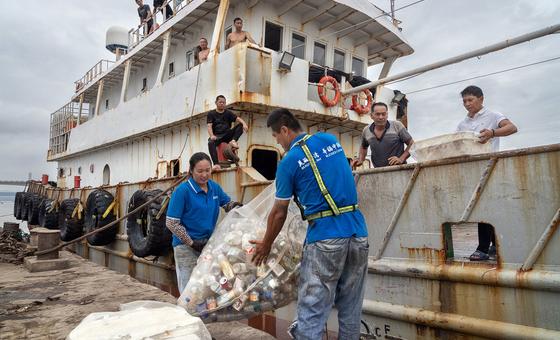
The world is demanding action over plastic pollution: UN environment chief

The world wants and indeed needs a plastic conventional treaty because the crisis is getting out of hand – and people are frankly outraged,” said Inger Andersen, UNEP Executive Director of the UN Environment Programme (UNEP), the UN agency leading the talks.

“We know that plastic is in our nature, in our oceans, and yes, even in our bodies…What is sure is that no one wants to live with the plastic pollution.”

Out of control

Unless an international accord is inked, plastic production and waste is projected to triple by 2060, causing significant damage – including to our health – according to UNEP.

Switzerland’s top environment official Katrin Schneeberger echoed the call for a legally binding treaty, insisting that plastic waste “is choking our lakes, harming wildlife and threatening human health. This is more than just an environmental issue, it is a global challenge that demands urgent and collective action.”

Speaking to journalists on the sidelines of the treaty negotiations, Ms. Schneeberger underscored that there was “no call for a production cap” by producing countries.

Spirit of compromise?

Reaching a shared understanding that measures are needed on both the production and consumption sides can help unlock the negotiations,” she said in her capacity as Director of the Swiss Federal Office for the Environment.

Supporters of a deal have compared it to the Paris Climate Accord in terms of its significance. They have also pointed to the pressure allegedly being brought to bear against a deal by petrostates, whose crude oil and natural gas provide the building blocks of plastics.

“We will not recycle our way out of the plastic pollution crisis: we need a systemic transformation to achieve the transition to a circular economy,” UNEP Executive Director Inger Andersen has insisted in previous comments on the need for global regulations on plastics.

Virtuous circle

With 10 days of talks scheduled on the treaty at the UN in Geneva, supporters of an accord hope that the deal will cover the full life cycle of plastics, from design to production and disposal.

The treaty should “promote plastic circularity and prevent leakage of plastics in the environment”, according to the text now guiding negotiations led by the Intergovernmental Negotiating Committee (INC).

At 22 pages, the INC document contains 32 draft articles which will be discussed line by line. The text is designed to shape the future instrument and serves as a starting point for negotiations by countries meeting in Geneva.

“Some [countries] will have to deal with reduction, others will have to deal with mechanical recycling and others will deal with alternatives,” Ms. Andersen said. “Let’s see how we can get to this through the negotiations. I think there’s a lot of good faith in the working group right now.”

The UNEP-led talks follow a decision in 2022 by Member States to meet and develop an international legally binding instrument to end the plastic pollution crisis, including in the marine environment, within two years.

The scale of the problem is massive, with straws, cups and stirrers, carrier bags and cosmetics containing microbeads just a few of the single-use products ending up in our oceans and landfill sites.

In comments to journalists, Ms. Andersen recalled touring Pakistan after deadly flooding killed more than 1,000 people in 2022 and seeing that debris and plastic were “a big part of the problem and so this is why we’re here, to find a solution while not leaving anyone behind and while ensuring that the economic wheels would keep turning”.

Disabling effect

Campaigners gathering on the sidelines of the negotiations expressed their hopes for as ambitious a treaty as possible.

They included Shellan Saling, from California, who’s the interim chair of the Youth Plastic Action Network (YPAN). “Plastic affects everything from climate change to health to fertility to even birth defects; it affects physical disabilities, as well as invisible disabilities,” she told UN News on Monday.

Any treaty inked in Geneva will have to be sufficiently robust to accommodate the needs of all countries of the world whose approach differs regarding plastic design, production, waste and recycling. It will also have to stand the test of time, Ms. Andersen said.
UN News interview with YPAN interim chair Shellan Saling

Source link

GAZA LIVE: UN General Assembly to vote on resolution demanding immediate, unconditional and permanent ceasefire

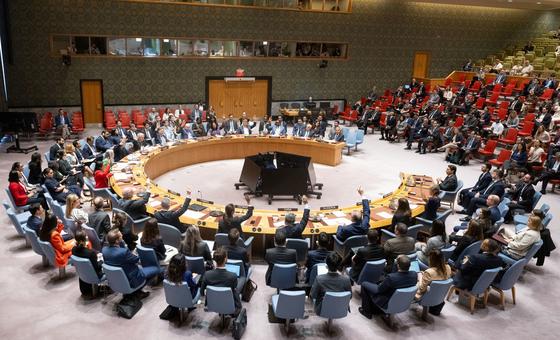
The General Assembly meets at 3pm in New York on Thursday in emergency session following the Security Council’s failure to adopt a resolution on 4 June calling for an immediate and permanent ceasefire in Gaza, which was vetoed by permanent member the United States. As starvation looms across the Strip, mass casualties continue to be reported of desperate civilians trying to access food at Israel and US-backed distribution sites. App users can follow our live coverage here.

US vetoes Security Council resolution demanding permanent ceasefire in Gaza

The text, co-sponsored by Algeria, Denmark, Greece, Guyana, Pakistan, Panama, the Republic of Korea, Sierra Leone, Slovenia, and Somalia – collectively known as the E-10 – received 14 votes in favour, with the US casting the lone vote against.

As one of the council’s five permanent members, the US holds veto power – a negative vote that automatically blocks any resolution from going forward.

Had it been adopted, the draft would have demanded “an immediate, unconditional and permanent ceasefire in Gaza” to be respected by all parties.

Release all hostages

The text reaffirmed the Council’s earlier call for the “immediate, dignified and unconditional release of all hostages held by Hamas and other groups.”

The draft also expressed grave concern over the “catastrophic humanitarian situation” in Gaza – following more than the months of almost total Israeli aid blockade – including the risk of famine, highlighted by recent international food security assessments.

It reaffirmed the obligation of all parties to comply with international law, including international humanitarian and human rights law.

Resume flow of aid

In addition to a ceasefire, the draft resolution demanded the “immediate and unconditional lifting of all restrictions” on the entry and distribution of humanitarian aid in Gaza, calling for safe and unhindered access for UN and humanitarian partners across the enclave.

It also urged the restoration of essential services, in accordance with humanitarian principles and prior Security Council resolutions.

The text voiced support for ongoing mediation efforts led by Egypt, Qatar, and the United States to revive the phased ceasefire framework outlined in resolution 2735 (2024), which envisions a permanent cessation of hostilities, the release of all hostages, the exchange of Palestinian prisoners, the return of all remains, full Israeli military withdrawal from Gaza, and the start of a long-term reconstruction plan.

Draft resolution unacceptable: United States

Speaking ahead of the vote, acting US Representative Dorothy Shea described the draft resolution as “unacceptable”.  

“US opposition to this resolution should come as no surprise – it is unacceptable for what it does say, it is unacceptable for what it does not say, and it is unacceptable for the manner in which it has been advanced,” she said.

“The United States has been clear,” she continued, “we would not support any measure that fails to condemn Hamas and does not call for Hamas to disarm and leave Gaza.”

She added that Hamas has rejected numerous ceasefire proposals, including one over the weekend that would have provided a pathway to end the conflict and release the remaining hostages.

“We cannot allow the Security Council to award Hamas’ intransigence,” Ms. Shea said, stressing, “Hamas and other terrorists must have no future in Gaza. As Secretary [Marco] Rubio has said: ‘If an ember survives, it will spark again into a fire’.” 

‘The world is watching’

The failure of the resolution comes as the humanitarian crisis in Gaza deepens, with UN agencies warning of the total collapse of health services, growing displacement, and a rising death toll around the new privatized US-Israel led aid distribution system which bypasses established agencies.

“The world is watching, day after day, horrifying scenes of Palestinians being shot, wounded or killed in Gaza while simply trying to eat,” said UN relief chief Tom Fletcher earlier on Wednesday.

Source link