General Assembly President urges Europeans to ‘stand up’ for the UN

In a key address to the European Parliament in Strasbourg, France, Annalena Baerbock repeated her call to uphold multilateralism amid “trying times” globally. 

She noted that just 40 days into 2026, the world has already seen crises around Venezuela, Iran and Greenland, on top of continuing devastation in Ukraine, Gaza, Sudan and elsewhere.

International order ‘under attack’ 

The international order is not only under pressure, it is under attack,” she told lawmakers.  

“And we face a new and more troubling kind of crisis: conflicts waged not even under the pretence of self-defence or respect for international law but often carried out in open defiance of it.” 

She warned that at precisely the moment the world most needs cooperation and the UN, “powers – even those who have a special responsibility to protect peace and security – are pulling away from it or even outright attacking it.”  

Protect the UN Charter 

Ms. Baerbock recalled that four years ago, when she was Germany’s Foreign Minister, she addressed the General Assembly and called for the UN to stand up for Europe’s peace as Russia launched its full-scale invasion of Ukraine. 

“Today, I’m coming as President of the General Assembly to Europe, calling for Europe to stand up for the United Nations because the world needs the UN. But right now, the UN and its principles as enshrined in the Charter, needs the world too,” she said, referring to all continents. 

“It needs you to form a cross-regional alliance to protect, defend and champion the Charter and the international rules-based system that benefits us all individually and collectively.” 

Defend the truth 

First and foremost, the EU must defend the truth in a world where “fake news, falsities, mis- and disinformation” are everywhere.  

“Defending the truth means we cannot negotiate the facts; we cannot ‘go along to get along’ in the hope that it will avoid a tariff,” she said.  

Ms. Baerbock acknowledged that defending the truth “is easier said than done, especially when you’re faced with blackmail or coercion, or threats and intimidation.”   

European unity over Ukraine 

She stressed, however, that “no one can do it alone”, highlighting European Union (EU) collective action in this regard. 

“Four years ago, Europe watched as 100,000 troops amassed on Ukraine’s borders, shocked into paralysis. Nobody could have imagined the EU, which has been described as ‘too slow and too bureaucratic, too divided’ would unite over a weekend,” she said. 

The invasion began on a Thursday and by that Monday morning “the EU collectively passed one of the largest sanctions packages ever recorded because it responded as one, with conviction and purpose.” 

‘The world is calling’ 

But Europe did not act alone as she pointed to late-night calls and pleas made to other countries around the world.  

Today dear colleagues, the world is calling. It’s not only about Greenland, it’s also about Latin America, about Africa. Once again, it’s about the international peace order, once again it’s about the UN Charter,” she said. 

“The UN needs Europe and I count on your answer to be a clear and resounding: yes, we will be there for our peace, for the international peace order, for the United Nations.” 

Support UN reform 

The Assembly President said the UN also needs Europe “to reform it, to make it better, to make it more effective and efficient.”  While the 80-year-old Organization is not perfect, she insisted that the world would not be better off without it. 

“Imperfection is an opportunity to strengthen and refine, not to cut down and demolish,” said Ms. Baerbock. 

“We cannot allow those who would weaponize failings or setbacks to use existing inefficiencies or duplications as justification to unravel all that we have built, nor allow exclusive clubs to hold responsibilities for world peace.”  

Lead by example 

The UN is also “dealing with an existential liquidity crisis,” with some Member States not paying their assessed contributions – whether late, or not at all, for years. 

She noted that UN financial rules further require any “unspent” budgeted money to be returned to Member States, even if it was never received in the first place. 

“If the EU wants to preserve and strengthen the UN, then the EU should lead by example,” she said.  This includes paying dues on time and in full and proposing ways “to overhaul this Kafkaesque financial rule of reimbursing funds never received”. 

Similarly, the EU should step up when it comes to the selection of the next Secretary-General “as one might wonder how in 80 years the UN has never selected a woman to serve its highest office, despite there being four billion potential candidates on Earth.” 

Source link

General Assembly endorses New York Declaration on two-State solution between Israel and Palestine

The New York Declaration is the outcome of an international conference held in July at UN Headquarters, organized by France and Saudi Arabia, which resumes later this month.

The General Assembly comprises all 193 UN Member States and 142 countries voted in favour of a resolution backing the document.

Israel voted against it, alongside nine other countries – Argentina, Hungary, Micronesia, Nauru, Palau, Papua New Guinea, Paraguay, Tonga and the United States – while 12 nations abstained.

‘Roadmap’ for the future

Prior to the vote, French Ambassador Jérôme Bonnafont recalled that the New York Declaration “lays out a single roadmap to deliver the two-State solution”.

This involves an immediate ceasefire in Gaza, release of all hostages held there, and the establishment of a Palestinian State that is both viable and sovereign.

The roadmap further calls for the disarmament of Hamas and its exclusion from governance in Gaza, normalization between Israel and the Arab countries, as well as collective security guarantees.

Speaking ahead of the vote, Israeli Ambassador Danny Danon said that “this one-sided Declaration will not be remembered as a step toward peace, only as another hollow gesture that weakens this Assembly’s credibility.” 

He said that “Hamas is the biggest winner of any endorsement here today” and will declare it “the fruit of 7 October”.

The high-level international conference in July was held against the backdrop of the war in Gaza and deteriorating prospects for the two-State solution.

In remarks to the opening segment, UN Secretary-General António Guterres noted that “the central question for Middle East peace is implementation of the two-State solution, where two independent, sovereign, democratic States – Israel and Palestine – live side-by-side in peace and security.” 

‘No ordinary session’: Baerbock opens UN General Assembly with call for courage and reform

This will be “no ordinary session,” she pledged, with the multilateral system beset by overlapping crises and heightened disunity.

A former foreign minister of Germany, Ms. Baerbock becomes only the fifth woman in history to preside over the General Assembly.

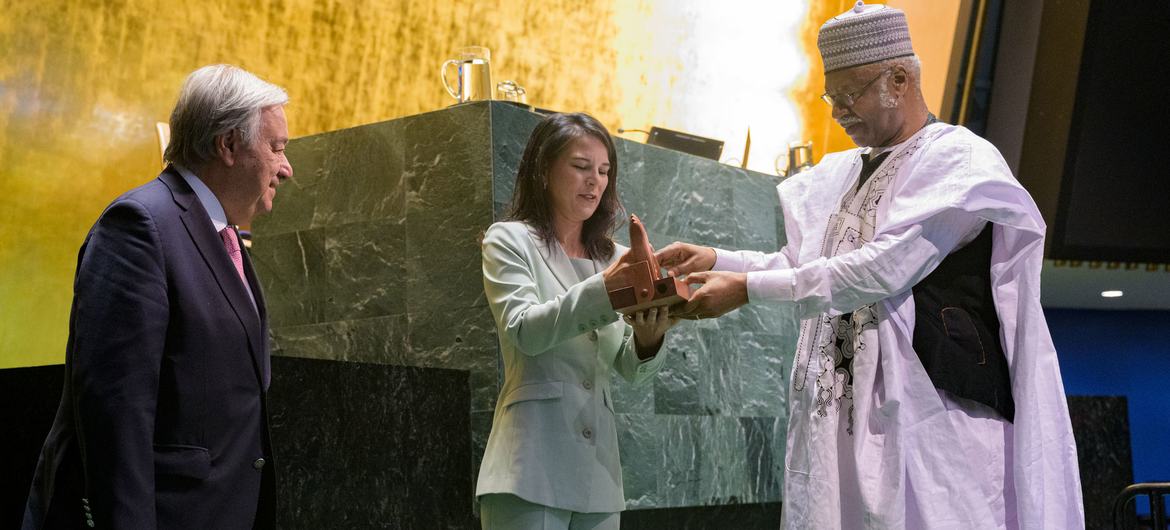
In a symbolic gesture linking past to present, she swore her oath on the UN’s founding Charter from the San Francisco Conference in 1945 – and accepted the Assembly’s ornate gavel from her predecessor, Philémon Yang of Cameroon.

The Charter itself, preserved by the US National Archives, has returned to UN Headquarters for the first time in decades.

Now on display through September, the 1945 document is more than a historical artifact – it is a living reminder of the collective pledge to build peace, uphold human rights and pursue shared values and goals through multilateral cooperation.

The gavel carries its own storied weight. A gift from Iceland, it is larger and more ornate than the ones used in UN conference rooms. The symbol of order in the “parliament of the world,” it is used to open and close meetings, adopt resolutions, and, at times, bring the Assembly to silence.

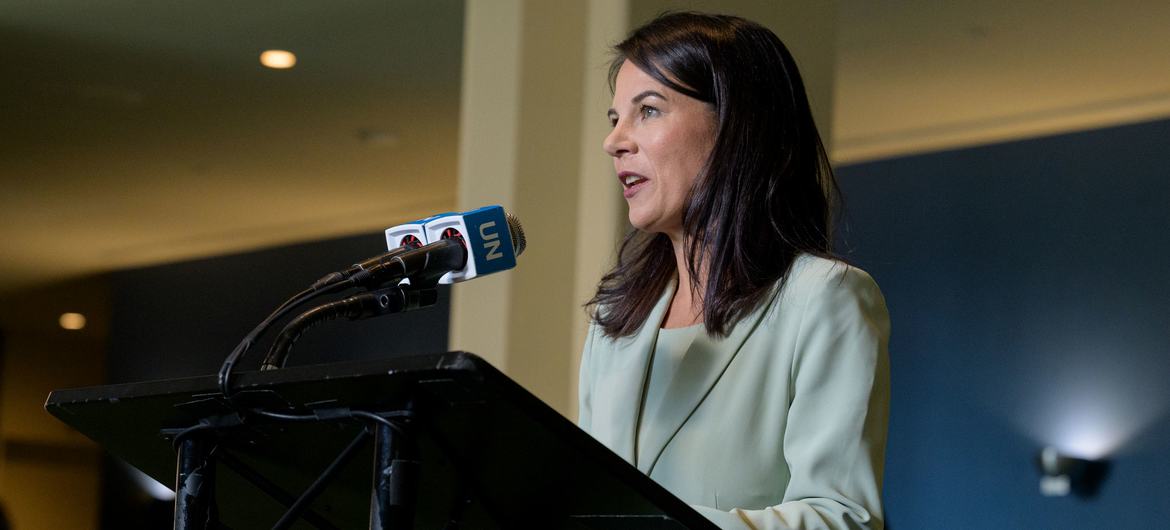
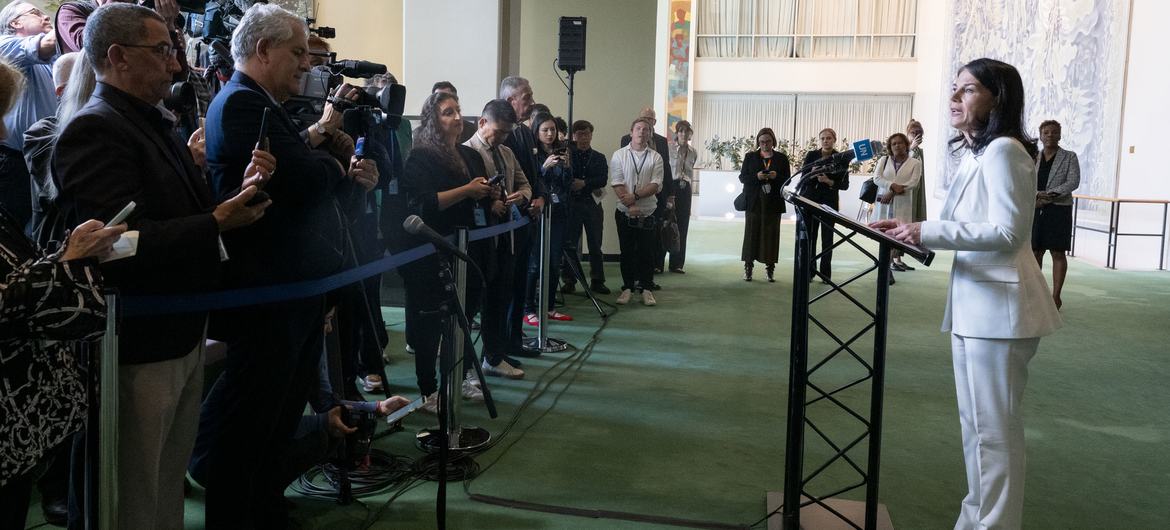
Assembly President Baerbock speaks to reporters outside the General Assembly Hall.

The world needs the United Nations

In her address, Ms. Baerbock acknowledged the grim realities facing millions across the globe – from children starving in Gaza and Afghan girls barred from school – to families in Ukraine hiding from missile attacks, and Pacific Islanders watching their homes swallowed by the sea.

Our world is in pain, indeed,” she told delegates in the General Assembly Hall.

But imagine how much more pain there would be without the United Nations.

Ms. Baerbock underscored the UN’s vital role in humanitarian assistance, citing the millions who rely on agencies such as the UN Children’s Fund (UNICEF), the World Food Programme (WFP) and the World Health Organization (WHO).

She urged Member States to make the UN “fit for the 21st century” by advancing reforms, implementing the Pact for the Future adopted last year, and focusing on substance over procedure.

The General Assembly must focus on its mandates and deliver on its commitments,” she said, promising to serve all 193 members equally, to be “a bridge builder,” and to ensure every voice is heard.

Among the priorities she set for the year ahead are implementing the UN80 reform agenda, guiding the process of selecting the next Secretary-General, and advancing peace, sustainable development, and human rights.

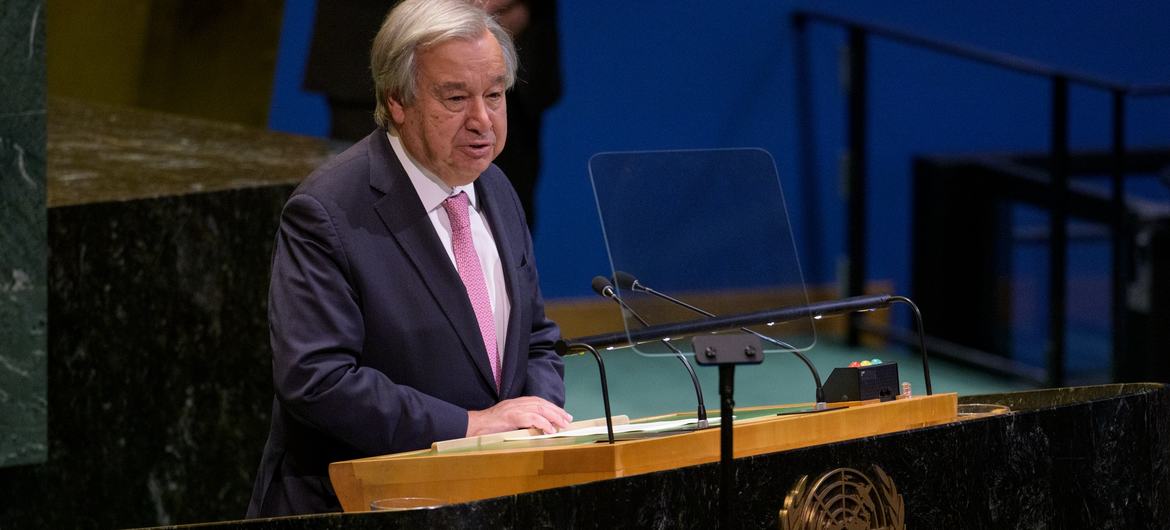
Secretary-General António Guterres addresses the first plenary meeting of the 80th session of the General Assembly.

The Charter is not self-executing: Guterres

Secretary-General António Guterres, congratulating Ms. Baerbock on her election, praised her vision and experience, while urging governments to summon the same resolve that brought nations together to establish the UN 80 years ago.

The United Nations provides the place. The Charter provides the tools,” he said. “But nothing can happen without this Assembly – all of you – working as one.

Mr. Guterres stressed the need to heal divisions, recommit to international law, accelerate action on the Sustainable Development Goals, and transition to renewable energy while supporting developing countries.

He pointed to last year’s Pact for the Future as a “shot in the arm” for multilateralism and called on Member States to “re-build trust and faith in one another.”

Philémon Yang (right), President of the General Assembly at its 79th session presents the Assembly’s iconic gavel to Annalena Baerbock (centre), President of the Assembly at its 80th session. On the left is Secretary-General António Guterres.

‘Collective promise’ remains

Earlier in the day, outgoing Assembly President Philémon Yang closed the 79th session, highlighting initiatives on humanitarian law, small arms control, sustainable development, and child labour – as well as dialogues on multilingualism and the role of women in mediation.

Mr. Yang, who emphasised gender equality and Security Council reform during his tenure, also oversaw the 80th anniversary commemoration.

Member States made clear that in spite of rising global conflicts, the Charter, and the United Nations itself, represent a collective promise for a better future world,” he said.

A year of high stakes

Ms. Baerbock’s presidency comes at a pivotal moment for the United Nations.

Alongside navigating conflicts from Ukraine to Sudan, the Assembly will oversee the implementation of the Pact for the Future and prepare for the critical selection of the next Secretary-General.

She challenged delegates to embrace courage and unity: “If girls in Afghanistan or parents in Gaza can wake up – in the darkest hours of life – and push forward, then so can we. We owe it to them. But we owe it also to ourselves, because there is simply no alternative.”


Source link

UN80 initiative should be ‘inclusive and transparent’, recognises General Assembly

The text, introduced by Russia and adopted without a vote, “welcomes the efforts of the Secretary‑General to strengthen the United Nations in order to keep pace with a changing world” and calls on UN entities and specialised agencies to align their reform efforts “as appropriate”.

In the resolution, the 193-member Assembly “recognises the central role of Member States in the reform process, which should be inclusive and transparent”.

It also “looks forward to receiving, in accordance with established procedures” the Secretary‑General’s proposals under the initiative, “taking into account the necessity to have clearly defined objectives and an evidence-based approach, and aiming at strengthening the impact of the United Nations and enhancing its agility, responsiveness and resilience while addressing the issue of duplicative efforts and ensuring effective and efficient mandate delivery across all three pillars of the work of the United Nations.”

Launched by the Secretary-General in March, the UN80 Initiative centres on three priorities: enhancing operational efficiency, assessing how mandates – or key tasks – from Member States are implemented and exploring structural reforms across the UN system.

Mixed reactions on timing

Several delegations voiced backing for the reform effort, but questioned the timing of the resolution.

Speaking for the European Union, Denmark said the process was “premature and unnecessarily rushed”, noting that limited time for consultations “did not allow for the constructive engagement such an initiative requires”.

Australia, on behalf of the CANZ group (Canada, Australia and New Zealand), echoed that view, warning that an early resolution “risks limiting both the scope and ambition of the forthcoming proposals”.

Switzerland, speaking for a group including Iceland, Norway and Liechtenstein, also stressed that reform should be “ambitious and strategic”, building on existing assets while ensuring long‑term efficiencies.

Japan emphasised its “commitment to multilateralism” and said the initiative responds to the urgency of revitalising the UN.

“The success of the UN80 initiative relies on our shared and complementary responsibilities,” its delegate said.

Member States in the driving seat

Exercising its right of reply, Russia rejected claims that the text was rushed, saying it had “conducted several rounds of consultations” and “took into account the red lines specified by delegations, which came out in the silence procedure”.

The silence procedure sets out a window of time for delegations to express objections to a draft resolution or decision before it is formally acted upon.

The Russian delegate said the resolution puts Member States “into the driving force of this process” while recognising the Secretary‑General’s prerogative as chief administrative officer under the UN Charter.

“We seek success in the UN’s adaptation to current and future challenges,” the Russian delegate said, calling the resolution’s adoption “a very important step” to ensure universal support for the initiative.

Source link

General Assembly approves $5.4 billion UN peacekeeping budget for 2025-2026

Acting on the recommendation of its Fifth Committee (Administrative and Budgetary), the Assembly endorsed the budgets for 12 missions, the logistics centres in Entebbe (Uganda) and Brindisi (Italy), and the support account for peacekeeping.

The budgets were adopted without a vote, except for the resolution on the UN Interim Force in Lebanon (UNIFIL), which was adopted by 147 votes in favour to 3 against (Argentina, Israel, and United States), with 1 abstention (Paraguay).

The adoption of UNIFIL’s budget followed an Israeli-proposed oral amendment, which was rejected by 5 votes in favour (Argentina, Canada, Israel, Paraguay, and US) to 83 against, with 57 abstentions.

Last year, the peacekeeping budget stood at $5.59 billion for 14 operations, meaning the 2025-2026 figure reflects a modest decrease, following final settlements of former missions in Côte d’Ivoire and Liberia.

Pressing liquidity challenges

Despite the agreement on the budgets, UN Controller Chandramouli Ramanathan outlined a sobering picture about the fragility of the UN’s broader liquidity situation.

You manage somehow to find common ground three times a year. But I only wish you had gone a little bit further to solve one of the underlying problems of the UN, which has been plaguing us for 80 years,” he told delegates last week as they concluded negotiations in the Fifth Committee.

He described how approved budgets are often undermined by cash shortages, forcing immediate instructions to slash spending by 10, 15, or even 20 per cent.

No money, no implementation. There is not enough cash. I cannot emphasize enough a massive effort needed on your side to somehow take us over that line and deal with a problem that’s plagued the UN for the last so many years,” he said.

UN peacekeeping operations

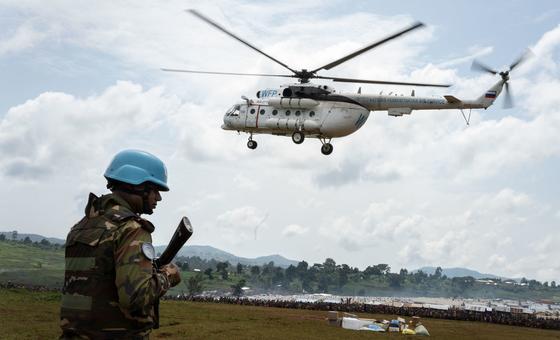
UN peacekeeping remains one of the most iconic UN activities, with nearly 70,000 military, police and civilian personnel deployed across Africa, the Middle East and Europe.

Missions include long-standing deployments such as MONUSCO in the Democratic Republic of the Congo, UNFICYP in Cyprus, and MINUSCA in the Central African Republic. Mandated by the Security Council, these operations work to stabilize conflict zones, support political processes, protect civilians, and assist in disarmament and rule-of-law efforts.

UN’s peacekeeping budget is separate from its regular budget, which supports the Organization’s core programs, including human rights, development, political affairs, communications and regional cooperation.

The peacekeeping budget cycle runs from July-June, while the regular budget is aligned with the calendar year.

Source link

UN General Assembly adopts Gaza ceasefire resolution by overwhelming majority

The move followed the Security Council’s failure to pass a similar resolution last week due to a lone veto by permanent member the United States.

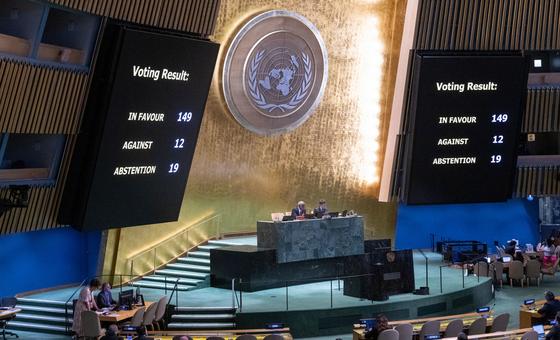
The resolution was backed by 149 Member States, with 12 voting against and 19 abstaining. Among those opposing the resolution were the United States and Israel, who were joined among others by Argentina, Hungary and Paraguay.

India, Georgia, Ecuador, Romania and Ethiopia were among the countries abstaining.

End starvation as weapon of war

Brought forward by over 20 countries, it strongly condemns the use of starvation as a weapon of war, demands a full lifting of the Israeli blockade on humanitarian aid, and insists on the protection of civilians under international law.

Although General Assembly resolutions are not legally binding, they carry significant political and moral weight.

On 4 June, the Security Council failed to adopt its draft resolution after a veto by the United States, a permanent member.

Meanwhile, famine conditions continue to threaten lives across Gaza, and reports persist of civilians being killed or injured while trying to access food at distribution points operated independently of the UN but supported by Israel and the US.

Assembly steps into as Security Council stalls

Opening the special session, General Assembly President Philémon Yang said that “the horrors in Gaza must end” after 20 months of war. He criticised the Security Council’s ongoing paralysis and inability to fulfil its core responsibility to uphold peace and security.

He called the situation on the ground “unacceptable”, highlighting the deprivation of food, water and medicine for civilians, the continued captivity of hostages, and the need for urgent international action.

Mr. Yang noted that next week’s high-level meeting in New York on implementing a two-State solution, chaired by France and Saudi Arabia, saying it would offer a chance for renewed commitment towards peace in the Occupied Palestinian Territory.

Key elements of the resolution:

  • Ceasefire: Calls for an immediate, unconditional and permanent ceasefire by all parties.
  • Hostages: Demands the immediate and unconditional release of all hostages held by Hamas and other armed groups.
  • Implementation: Urges the full and immediate implementation of Security Council resolution 2735 (2024), including the ceasefire, hostage and prisoner exchanges, return of displaced persons, and withdrawal of Israeli troops from Gaza.
  • International law: Reaffirms that all parties must uphold international humanitarian and human rights law, with particular attention to civilian protection and accountability for violations.
  • Starvation as a weapon: Strongly condemns the use of starvation and the denial of aid as tactics of war.
  • Humanitarian access: Demands the full, safe and unimpeded delivery of aid – including food, medicine, water, shelter and fuel – throughout Gaza.
  • Detention practices: Calls for the humane treatment and release of those arbitrarily detained, and the return of remains.
  • ICJ advisory opinion: Recalls the request for an urgent advisory opinion from the International Court of Justice on Israel’s obligations in the Occupied Palestinian Territory.
  • End of blockade: Demands Israel immediately lift the blockade on Gaza and open all border crossings for aid deliveries.
  • Accountability: Urges Member States to take necessary steps to ensure Israel complies with its international legal obligations.
  • UN and humanitarian personnel: Calls for full respect for the work and immunity of UN staff and humanitarian workers.
  • Protection of aid workers: Urges both humanitarian and UN bodies to ensure the safety of their personnel.
  • Medical neutrality: Underscores the duty to protect medical workers, health facilities, and transport routes.

You can catch up with the full meeting by going to our live coverage of the emergency session and today’s developments in Gaza, here.

Source link

GAZA LIVE: UN General Assembly to vote on resolution demanding immediate, unconditional and permanent ceasefire

The General Assembly meets at 3pm in New York on Thursday in emergency session following the Security Council’s failure to adopt a resolution on 4 June calling for an immediate and permanent ceasefire in Gaza, which was vetoed by permanent member the United States. As starvation looms across the Strip, mass casualties continue to be reported of desperate civilians trying to access food at Israel and US-backed distribution sites. App users can follow our live coverage here.

Germany’s Annalena Baerbock elected President of the 80th General Assembly

She assumes the role at a challenging time, with ongoing conflicts, faltering development goals, mounting financial pressures, and the upcoming selection of the next Secretary-General.

Ms. Baerbock received 167 votes following the secret ballot. Write-in candidate Helga Schmid (also from Germany) received seven. Fourteen delegations abstained.

She becomes the first woman from the Western European group to hold the post and the fifth woman overall to lead the General Assembly. The presidency rotates among the world body’s five regional groups.

At 44 years, Ms. Baerbock is also one of the youngest leaders to secure the top job.

Crucial juncture

Ms. Baerbock’s election comes at a critical juncture for the multilateral system, spearheaded by the United Nations.

With the Security Council deadlocked – especially on moves to help end the wars in Ukraine and Gaza – the Assembly has become a vital forum for diplomatic engagement and consensus-building, even without binding authority on peace and security issues.

As conflicts rage, the Assembly has passed a series of resolutions calling for ceasefires, humanitarian access and the protection of civilians.

Many now see the Assembly as an essential platform for accountability and maintaining international focus on intractable crises, especially through the “Veto Initiative” adopted in 2022 which ensures that issues blocked by permanent members on the Security Council are debated in the Assembly as a priority.

A power wielded by the five permanent members – China, France, Russia, the United Kingdom, and the United States – a veto (or negative vote) can block Council action even when all other members support a motion.

Pledge to be an honest broker

In her acceptance speech, President-elect Baerbock acknowledged the current global challenges and pledged to serve as “an honest broker and a unifier” for all 193 Member States, emphasising her theme of “Better Together.”

She outlined three priorities for her presidency: making the Organization more efficient and effective; advancing the 2030 Agenda for Sustainable Development; and making the Assembly a “truly inclusive forum”.

She called for a UN “that embraces everyone. I see the diversity of the General Assembly as our strength. This is the place where all nations come together and where every country has a seat and a voice.”

She also highlighted the importance of promoting gender equality, multilingualism, and engagement with civil society and youth.

UN Video | Annalena Baerbock elected to lead 80th session of the UN General Assembly

UN80 initiative

Ms. Baerbock also touched on the UN80 initiative, which was launched by Secretary-General António Guterres in March.

The UN80 Initiative should not be a mere cost-cutting exercise,” she said, stressing the need for bold ambition and readiness to take difficult decisions.

Our common goal is a strong, focused, nimble and fit-for-purpose organization. One that is capable of realising its core objectives – we need a United Nations that delivers on peace, development and justice.”

A career defined by multilateralism

In congratulating Ms. Baerbock, current President Philemon Yang described her as a leader defined by “an unwavering commitment to multilateralism”, praising her “Better Together” vision.

Mr. Yang, who steered the Assembly through a year marked by the Summit of the Future and persistent global crises, expressed confidence in her ability to build trust and foster dialogue across divides.

Secretary-General António Guterres said Mr. Yang’s successor was taking the gavel amid a “difficult and uncertain moment for the multilateral system,” noting she was only the fifth woman to lead the body.

The UN chief warned that “conflicts, climate catastrophe, poverty and inequality continue to challenge the human family,” and called on the Assembly to unite in forging common solutions.

Annalena Baerbock, President-elect of the eightieth session of the UN General Assembly, speaks to the media following her election.

The world parliament

The General Assembly remains the UN’s most representative body, where each Member State has an equal voice – and an equal say in decisions.

While its resolutions are non-binding, the GA – as the acronym goes in New York – helps define global diplomatic norms, convenes dialogues on worldwide challenges and holds the Security Council to account.

The 80th session, starting 9 September, is expected to be pivotal – not only for sheer number and intensity of crises ongoing – but for advancing long-term reforms, including the UN80 initiative and the selection of the next Secretary-General before his term ends in 2026.

Source link

UN needed ‘more than ever before’ says Germany’s candidate to head General Assembly

Annalena Baerbock presented her priorities during an informal dialogue with Member States held on Thursday at Headquarters in New York. 

If chosen, she will only be the fifth woman to lead the UN’s main policy-making organ and most representative body, comprising all 193 Member States who elect a new president annually, rotating among regional groups. 

“As President, if elected, I will serve all 193 Member States – large and small. As an honest broker. As a unifier. With an open ear. And an open door,” she said. 

No time for despair

The UN turns 80 this year and Ms. Baerback noted that the anniversary comes as the Organization faces numerous existential challenges.

Some 120 conflicts are raging worldwide in places such as Gaza and Ukraine, achievement of the Sustainable Development Goals (SDGs) is off-track, and the world body itself is under heavy pressure financially and politically.

Her vision is grounded in the theme “Better Together” which she weaved throughout her remarks, arguing this is no time to despair.

These crises and challenges weigh heavy upon us as the international community. But they also show the United Nations, our United Nations, is needed more than ever before,” she said.

Making the UN ‘fit for purpose’

She added that the UN needs to be “fit for the future” and “fit for purpose” – her first priority.

She pointed to the Pact for the Future, adopted by Member States last year, which laid the groundwork to revitalize multilateralism, turbocharge the SDGs, and adapt the UN system to 21st century challenges.

She said to maximize its impact, implementation must be linked to the UN80 Initiative.  Launched in March by Secretary-General António Guterres, the plan calls for major reforms to cut costs and improve efficiency. 

Ms. Baerbock said if elected General Assembly President, she would place strong emphasis on ensuring that the perspectives of all regions and groups are heard in the major reform process. 

Delivering for the world’s people

Her second priority highlighted the need for a UN that delivers results. “People must feel that our work makes a real difference in their daily lives,” she said.

She stressed the need for close cooperation with the Security Council and the Peacebuilding Commission in promoting a more peaceful world.

You cannot sustain lasting peace without ensuring that there is no shortage of food, that people have jobs, that children go to school, that women are safe,” she said.

She also plans to engage with Member States on reforming the financial system, in addition to giving special emphasis to the climate crisis – “one of the greatest threats of our time.”

A truly inclusive UN

Ms. Baerbock’s third priority calls for a UN that is truly inclusive and embraces everyone, which includes engaging with civil society and especially young people.

“The United Nations is there to serve its people. And building a better future is only possible by engaging with the generations to come,” she said.

“Our work does not end in New York, Geneva, Nairobi or Bonn. But we need to bring our discussions and outreach closer to the people.” 

Source link