MIDDLE EAST LIVE: Israeli attack on Hamas leaders in Doha ‘potentially opens a new and perilous chapter’

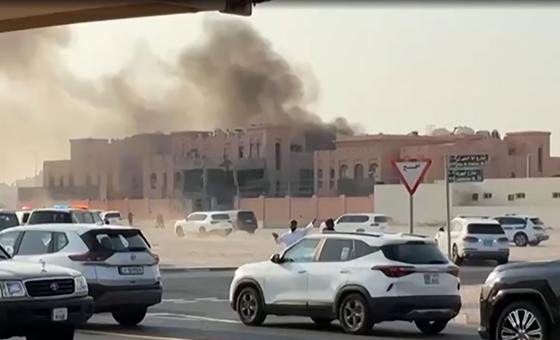
The UN Secretary-General has condemned an Israeli strike targeting Hamas leaders in Doha, the capital of Qatar, on Tuesday, while highlighting the “very positive role” played by the country in achieving a ceasefire in Gaza and securing the release of hostages.

Source link

‘No ordinary session’: Baerbock opens UN General Assembly with call for courage and reform

This will be “no ordinary session,” she pledged, with the multilateral system beset by overlapping crises and heightened disunity.

A former foreign minister of Germany, Ms. Baerbock becomes only the fifth woman in history to preside over the General Assembly.

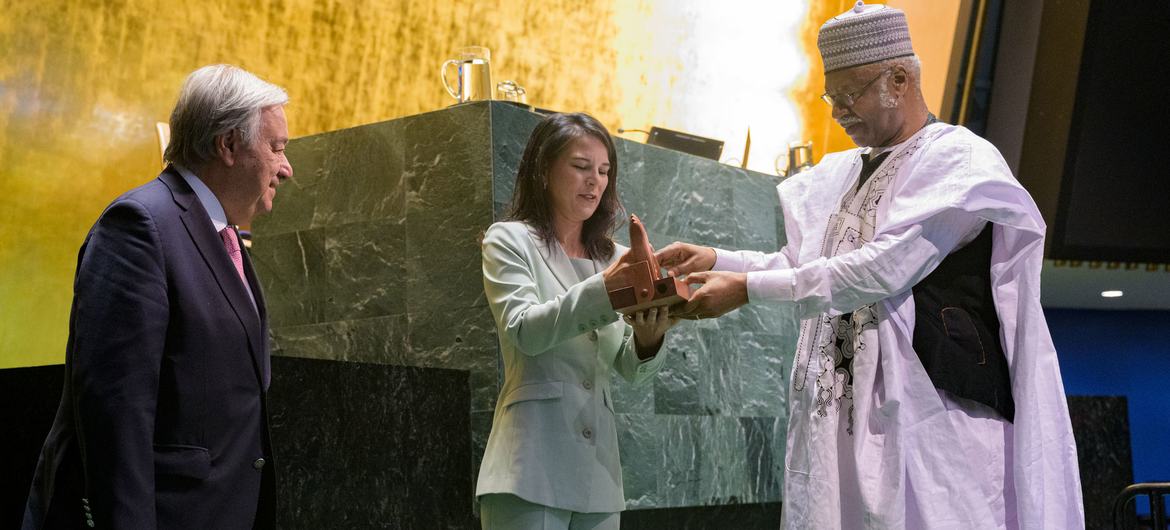
In a symbolic gesture linking past to present, she swore her oath on the UN’s founding Charter from the San Francisco Conference in 1945 – and accepted the Assembly’s ornate gavel from her predecessor, Philémon Yang of Cameroon.

The Charter itself, preserved by the US National Archives, has returned to UN Headquarters for the first time in decades.

Now on display through September, the 1945 document is more than a historical artifact – it is a living reminder of the collective pledge to build peace, uphold human rights and pursue shared values and goals through multilateral cooperation.

The gavel carries its own storied weight. A gift from Iceland, it is larger and more ornate than the ones used in UN conference rooms. The symbol of order in the “parliament of the world,” it is used to open and close meetings, adopt resolutions, and, at times, bring the Assembly to silence.

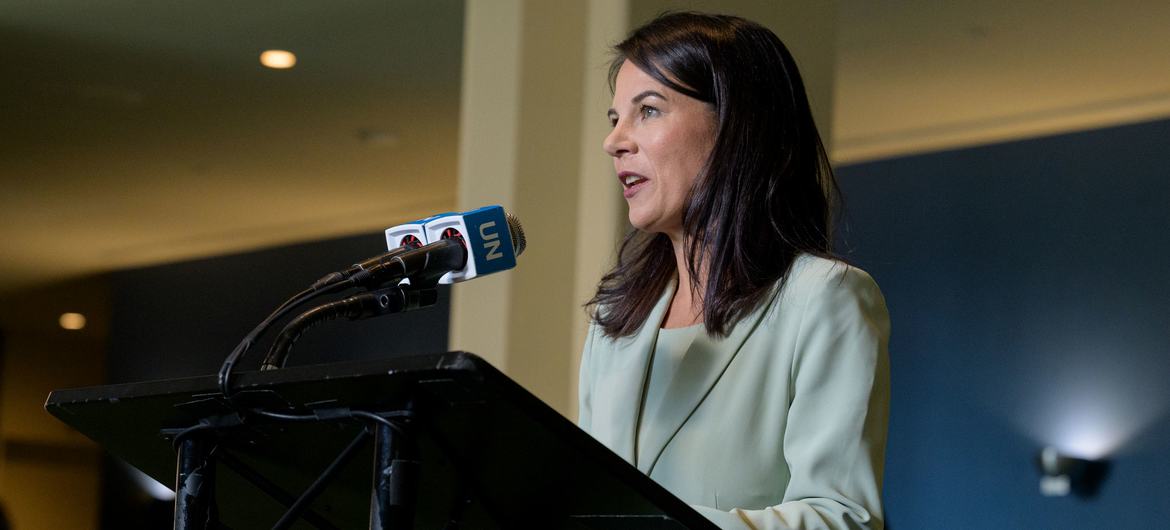
Assembly President Baerbock speaks to reporters outside the General Assembly Hall.

The world needs the United Nations

In her address, Ms. Baerbock acknowledged the grim realities facing millions across the globe – from children starving in Gaza and Afghan girls barred from school – to families in Ukraine hiding from missile attacks, and Pacific Islanders watching their homes swallowed by the sea.

Our world is in pain, indeed,” she told delegates in the General Assembly Hall.

But imagine how much more pain there would be without the United Nations.

Ms. Baerbock underscored the UN’s vital role in humanitarian assistance, citing the millions who rely on agencies such as the UN Children’s Fund (UNICEF), the World Food Programme (WFP) and the World Health Organization (WHO).

She urged Member States to make the UN “fit for the 21st century” by advancing reforms, implementing the Pact for the Future adopted last year, and focusing on substance over procedure.

The General Assembly must focus on its mandates and deliver on its commitments,” she said, promising to serve all 193 members equally, to be “a bridge builder,” and to ensure every voice is heard.

Among the priorities she set for the year ahead are implementing the UN80 reform agenda, guiding the process of selecting the next Secretary-General, and advancing peace, sustainable development, and human rights.

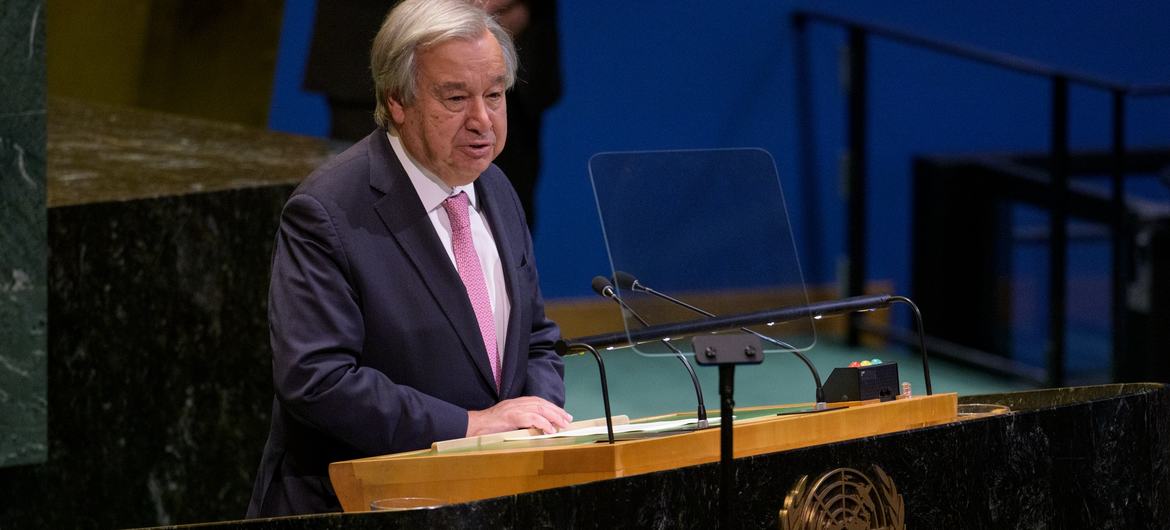
Secretary-General António Guterres addresses the first plenary meeting of the 80th session of the General Assembly.

The Charter is not self-executing: Guterres

Secretary-General António Guterres, congratulating Ms. Baerbock on her election, praised her vision and experience, while urging governments to summon the same resolve that brought nations together to establish the UN 80 years ago.

The United Nations provides the place. The Charter provides the tools,” he said. “But nothing can happen without this Assembly – all of you – working as one.

Mr. Guterres stressed the need to heal divisions, recommit to international law, accelerate action on the Sustainable Development Goals, and transition to renewable energy while supporting developing countries.

He pointed to last year’s Pact for the Future as a “shot in the arm” for multilateralism and called on Member States to “re-build trust and faith in one another.”

Philémon Yang (right), President of the General Assembly at its 79th session presents the Assembly’s iconic gavel to Annalena Baerbock (centre), President of the Assembly at its 80th session. On the left is Secretary-General António Guterres.

‘Collective promise’ remains

Earlier in the day, outgoing Assembly President Philémon Yang closed the 79th session, highlighting initiatives on humanitarian law, small arms control, sustainable development, and child labour – as well as dialogues on multilingualism and the role of women in mediation.

Mr. Yang, who emphasised gender equality and Security Council reform during his tenure, also oversaw the 80th anniversary commemoration.

Member States made clear that in spite of rising global conflicts, the Charter, and the United Nations itself, represent a collective promise for a better future world,” he said.

A year of high stakes

Ms. Baerbock’s presidency comes at a pivotal moment for the United Nations.

Alongside navigating conflicts from Ukraine to Sudan, the Assembly will oversee the implementation of the Pact for the Future and prepare for the critical selection of the next Secretary-General.

She challenged delegates to embrace courage and unity: “If girls in Afghanistan or parents in Gaza can wake up – in the darkest hours of life – and push forward, then so can we. We owe it to them. But we owe it also to ourselves, because there is simply no alternative.”

Source link

Geography shouldn’t define destiny: UN summit on landlocked nations opens in Turkmenistan

Urging global leaders to rethink development for landlocked nations, the UN chief declared: “We gather today to reaffirm a fundamental truth: geography should never define destiny.”

According to the UN Development Programme, of the 32 landlocked developing countries (LLDCs) worldwide, 16 are in Africa, 10 in Asia, four in Europe, and two in Latin America. Together, they are home to over 500 million people.

Trade barriers, debt distress, and deep inequality

Mr. Guterres outlined the “daunting challenges” LLDCs continue to face – steep barriers to trade, high transport costs, and limited access to global markets. He warned that the debt burden of these countries has reached “dangerous and unsustainable levels.”

Although LLDCs account for seven per cent of the world’s population, they represent just over one percent of global economic output and trade. “This is a stark example of deep inequalities that perpetuate marginalization,” said the Secretary-General, attributing this to “an unfair global economic and financial architecture that does not reflect the realities of today’s interconnected world”, as well as to the legacy of colonialism.

Decade of ambition: the Awaza Programme of Action

The task before the conference, known as LLDC3 and running in Awaza through Friday, is to find solutions to these challenges.

“LLDC3 is about launching a new decade of ambition – through the Awaza Programme of Action and its deliverables – and fully unlocking the development potential of landlocked developing countries,” said Mr. Guterres.

Adopted by the UN General Assembly in December 2024, that action plan represents a renewed and strengthened global commitment to support LLDCs’ development aspirations.

Four priorities for progress

The Secretary-General outlined four key priorities:

  1. Accelerate Economic Diversification & Digital Transformation
    • Invest in value-added industries, local innovation, and inclusive growth.
    • Bridge the digital divide to unlock AI, e-commerce, and smart logistics.
  2. Strengthen Trade, Transit & Regional Connectivity
    • Upgrade infrastructure and simplify cross-border procedures.
    • Integrate LLDCs into global value chains and reform trade systems.
  3. Advance Climate Action & Resilience
    • Double adaptation finance and build climate-resilient infrastructure.
    • Support LLDCs in green transitions with technology and partnerships.
  4. Mobilize Financing & Partnerships
    • Reform global financial systems to ensure fair, accessible funding.
    • Scale concessional finance and unlock climate investment at speed.

“The success of landlocked developing countries is essential to the success of the 2030 Agenda,” Mr. Guterres stressed.

“We have the knowledge, and we have the tools … Together, we can transform geography from a barrier to a bridge – connecting not just markets, but the peoples and cultures that give meaning to development.”

Speaking to reporters later, Mr. Guterres emphasized that the conference reflects a new era of cooperation taking shape across Central Asia – one grounded in mutual trust, shared priorities, and growing regional solidarity.
 
“At a time when multilateral cooperation is being tested, this spirit of partnership is more essential than ever,” he said.

Regional challenges, global solidarity

The session opened with a welcome from Turkmenistan’s President, Serdar Berdimuhamedov, who highlighted national initiatives to strengthen international cooperation in healthcare, climate action, and environmental protection.

He also drew attention to regional challenges such as the drying of the Aral Sea and falling water levels in the Caspian Sea, which is the world’s largest enclosed body of water and the setting for the Third UN LLDC Conference.

In his remarks, UN General Assembly President Philemon Yang noted the “rapidly approaching deadline for the 2030 Agenda” and called for decisive action and a renewed commitment to multilateralism and foundational values.

He emphasized that the three pillars of the UN Charter – peace, development, and human dignity – must remain at the heart of all efforts, and that actions must reflect the promise to leave no one behind.

Noting LLDCs’ vulnerability to climate change and structural challenges, Mr. Yang said these countries “must never lack access to opportunity, prosperity, or hope,” and called for international solidarity, infrastructure investment, and the practical realization of freedom of transit.

He also announced that the General Assembly had proclaimed 6 August as the International Day of Awareness on Landlocked Developing Countries, to be observed annually.

“The General Assembly will continue to serve as a global platform in support of these countries,” he said, emphasizing the importance of monitoring the Awaza Programme of Action and preparing for its high-level review in 2029.

Turning vulnerability into opportunity

Also addressing the opening session, Lok Bahadur Thapa, President of the UN Economic and Social Council, said LLDC3 is “a pivotal moment” for the 32 landlocked nations striving to overcome structural barriers to development.

Hailing from Nepal, which is both landlocked and least developed, he emphasized that the Awaza Programme of Action must serve as a “bold, ambitious, actionable, and future-oriented blueprint” to turn vulnerability into opportunity for over 570 million people.

Mr. Thapa underscored the urgency of addressing the “growing complexity, scale and urgency” of challenges facing LLDCs, including debt distress, climate impacts, and infrastructure gaps. Mr. Thapa urged the creation of an infrastructure investment facility for LLDCs, along with scaled-up climate finance, increased concessional resources, and accelerated technology transfer.

He also stressed the importance of regional cooperation and sustainable transport, praised Turkmenistan’s leadership, and reaffirmed ECOSOC’s commitment to advancing the Awaza Programme of Action – pledging to integrate LLDC priorities such as food security, youth empowerment, and climate resilience across all ECOSOC discussions and processes.

LLDC3 continues tomorrow, Wednesday 6 August, with roundtables and events on a range of topics, including connectivity and transport, South-South cooperation, youth engagement and more. Find all our coverage here.

Source link

Guterres calls for an end to ocean ‘plunder’ as UN summit opens in France

“The ocean is the ultimate shared resource,” he told delegates gathered at the port of Nice. “But we are failing it.”

Oceans, he warned, are absorbing 90 per cent of the excess heat from greenhouse gas emissions and buckling under the strain: overfishing, rising temperatures, plastic pollution, acidification. Coral reefs are dying. Fish stocks are collapsing. Rising seas, he said, could soon “submerge deltas, destroy crops, and swallow coastlines — threatening many islands’ survival.”

Port Lympia, Nice’s historic marina, now transformed into a secured diplomatic zone known as the Blue Zone for UNOC3.

Call for stewardship

More than 50 Heads of State and Government took part in the opening ceremony, including Brazilian President Luiz Inácio Lula da Silva and European Commission President Ursula von der Leyen — a show of political force underscoring the summit’s weight.

In total, over 120 countries are participating in the five-day gathering, signaling a growing recognition that ocean health is inseparable from climate stability, food security, and global equity.

French President Emmanuel Macron, whose country is co-hosting the summit alongside Costa Rica, followed with a forceful appeal for science, law, and multilateral resolve.

Brazilian President Luiz Inácio Lula da Silva, at the opening ceremony of UNOC3

“The abyss is not for sale, any more than Greenland is for sale, any more than Antarctica or the high seas are for sale,” he declared. “If the Earth is warming, the ocean is boiling.”

He insisted the fate of the seas could not be left to markets or opinion. “The first response is therefore multilateralism,” Mr. Macron said. “The climate, like biodiversity, is not a matter of opinion; it is a matter of scientifically established facts.”

Costa Rican President Rodrigo Chaves Robles took the podium next, thanking Mr. Guterres for elevating the ocean on the global agenda, then shifting to a stark warning.

“The ocean is speaking to us — with bleached coral reefs, with storms, with wounded mangroves,” he said. “There’s no time left for rhetoric. Now is the time to act.”

Condemning decades of treating the ocean as an “infinite pantry and global waste dump,” Mr. Chaves urged a shift from exploitation to stewardship.

“Costa Rica is a small country, but this change has started,” he said. “We are now declaring peace with the ocean.”

Most notably, the Costa Rican leader called for a moratorium on deep-sea mining in international waters until science can adequately assess the risks — a position already backed by 33 countries, he noted.

A treaty within reach

One of the summit’s core objectives is to help bring into force the landmark High Seas Treaty — known as the BBNJ accord — adopted in 2023 to safeguard life in international waters. Sixty ratifications are required for the treaty to become binding international law. Emmanuel Macron announced that this milestone is now within reach.

“In addition to the 50 or so ratifications already submitted here in the last few hours, 15 countries have formally committed to joining them,” he said. “This means that the political agreement has been reached, which allows us to say that this [Treaty] will be properly implemented.”

Whether the legal threshold is crossed this week or shortly after, the French President added, “it’s a win.”

The plenary hall of the third UN Ocean Conference (UNOC3) in Nice.

High-stakes negotiations in the ‘Blue Zone’

The tone set by the opening speeches made clear that Nice will be the stage for high-stakes negotiations — on finalizing a global treaty on plastic pollution, scaling up ocean finance, and navigating the controversy surrounding seabed mining.

Hundreds of new pledges are expected to be announced, building on more than 2,000 voluntary commitments made since the first UN Ocean Conference in 2017. The week-long talks will culminate in the adoption of a political declaration and the unveiling of the Nice Ocean Action Plan, a blueprint aligned with the landmark Kunming-Montreal Global Biodiversity Framework, a 2022 agreement to protect 30 per cent of marine and terrestrial ecosystems by 2030.

“The deep sea cannot become the Wild West,” António Guterres warned, urging that decisions be “grounded in science, guided by precaution, and in line with the rights and obligations enshrined in the UN Convention on the Law of the Sea.”

The summit is being held in a purpose-built venue overlooking Port Lympia, Nice’s historic marina, now transformed into the secured diplomatic ‘Blue Zone.’ On Sunday, a symbolic ceremony led by Li Junhua, head of the UN Department of Economic and Social Affairs and Secretary-General of the conference, saw the French and UN flags raised above the harbor.

“This ceremony marks not only the formal transfer of this historic port into the hands of the United Nations, but also the beginning of a week of shared commitment, responsibility, and hope,” said Mr. Li.

Ludovic Burns Tuki marked the start of the summit by blowing a pu, a traditional conch shell

Culture, science, and collective memory

Before the negotiations began in earnest, Monday’s opening turned to ritual and reflection. Polynesian climate activist Ludovic Burns Tuki marked the start of the summit by blowing a pu, a traditional conch shell.

“It’s a way to call everyone,” he told UN News after the ceremony. “I blow with the support of our ancestors.” In Polynesian navigation, the conch is sounded upon arrival at a new island to signal peaceful intent. Mr. Tuki, born in Tahiti to parents from the Tuamotu and Easter Islands, sees the ocean as both boundary and bond.

“We are not only countries,” he said. “We need to think like a collective system, because this is one ocean, one people, a future for all.”

The cultural segment also included a blessing by Tahitian historian Hinano Murphy, a martial arts performance by French taekwondo master Olivier Sicard, a scientific reflection by deep-sea explorer Antje Boetius, and a poetic testimony by Mauritanian filmmaker Abderrahmane Sissako, accompanied by kora musician Wassa Kouyaté.

What was lost can return

The goals of the conference are clear — but ambitious: to advance the ‘30 by 30’ pledge, promote sustainable fisheries, decarbonize maritime transport, and unlock new streams of “blue finance,” including ocean bonds and debt-for-nature swaps to support vulnerable coastal states.

In addition to plenary sessions, Monday will feature two high-level action panels: one on conserving and restoring marine ecosystems — including deep-sea habitats — and another on strengthening scientific cooperation, technology exchange, and education to bridge the gap between science and policy.

In his opening statement, António Guterres stressed that Sustainable Development Goal 14 , on ‘Life Below Water’, remains the least funded of the 17 UN’s global goals.

“This must change,” he said. “We need bold models to unlock private capital.”

“What was lost in a generation,” he concluded, “can return in a generation. The ocean of our ancestors — teeming with life and diversity — can be more than legend. It can be our legacy.”


Source link

World Health Assembly opens amid high-stakes pandemic treaty vote, global funding crisis

Tedros Adhanom Ghebreyesus, Director-General of the World Health Organization, urged Member States to remain focused on shared goals even amid global instability.

We are here to serve not our own interests, but the eight billion people of our world,” he said in his keynote address at the Palais des Nations. “To leave a heritage for those who come after us; for our children and our grandchildren; and to work together for a healthier, more peaceful and more equitable world. It’s possible.”

The Assembly, WHO’s highest decision-making body, runs through 27 May and brings together delegations from 194 Member States under the theme One World for Health.

This year’s agenda includes a vote on the intensely negotiated Pandemic Agreement, a  reduced budget proposal, and discussions on climate, conflict, antimicrobial resistance, and digital health.

Pandemic prevention focus

A central item on the Assembly’s agenda is the proposed WHO pandemic accord, a global compact aimed at preventing the kind of fragmented response that marked the early stages of COVID-19.

The treaty is the result of three years of negotiations between all WHO Member States.

“This is truly a historic moment,” Dr Tedros said. “Even in the middle of crisis, and in the face of significant opposition, you worked tirelessly, you never gave up, and you reached your goal.”

A final vote on the agreement is expected on Tuesday.

If adopted, it would mark only the second time countries have come together to approve a legally binding global health treaty under WHO’s founding rules. The first was the Framework Convention on Tobacco Control, adopted in 2003 to curb the global tobacco epidemic.

2024 health check

In his address, Tedros presented highlights from WHO’s 2024 Results Report, noting both progress and persistent global health gaps.

On tobacco control, he cited a global one-third reduction in smoking prevalence since the WHO Framework Convention entered into force two decades ago.

He praised countries including Côte d’Ivoire, Oman, and Viet Nam for introducing stronger regulations last year, including plain packaging and restrictions on e-cigarettes.

On nutrition, he pointed to new WHO guidelines on wasting and the expansion of the Tobacco-Free Farms Initiative in Africa, which has supported thousands of farmers in transitioning to food crops.

He also emphasised WHO’s growing work on air pollution and climate-resilient health systems, including partnerships with Gavi and UNICEF to install solar energy in health facilities across multiple countries.

On maternal and child health, Tedros noted stalled progress and outlined new national acceleration plans to reduce newborn mortality. Immunisation coverage now reaches 83 per cent of children globally, compared to less than 5 per cent when the Expanded Programme on Immunisation was launched in 1974.

We are living in a golden age of disease elimination,” he said, citing the certification of Cabo Verde, Egypt, and Georgia as malaria-free; progress in neglected tropical diseases; and Botswana’s recognition as the first country to reach gold-tier status in eliminating mother-to-child transmission of HIV.

WHO has been supporting Universal Health Coverage in Rwanda.

WHO budget strain

Turning to WHO’s internal operations, Tedros offered a stark assessment of the organisation’s finances.

We are facing a salary gap for the next biennium of more than US$ 500 million,” he said. “A reduced workforce means a reduced scope of work.”

This week, Member States will vote on a proposed 20 per cent increase in assessed contributions, as well as a reduced Programme Budget of $ 4.2 billion for 2026–2027, down from an earlier proposal of $ 5.3 billion. The cuts reflect an effort to align WHO’s work with current funding levels while preserving core functions.

Tedros acknowledged that WHO’s long-standing reliance on voluntary earmarked funding from a small group of donors had left it vulnerable. He urged Member States to see the budget shortfall not only as a crisis but also as a potential turning point.

“Either we must lower our ambitions for what WHO is and does, or we must raise the money,” he said. “I know which I will choose.”

He drew a sharp contrast between WHO’s budget and global spending priorities: “US$ 2.1 billion is the equivalent of global military expenditure every eight hours; US$ 2.1 billion is the price of one stealth bomber – to kill people; US$ 2.1 billion is one-quarter of what the tobacco industry spends on advertising and promotion every single year. And again, a product that kills people.”

It seems somebody switched the price tags on what is truly valuable in our world,” he said.

Emergencies and appeals

The Director-General also detailed WHO’s emergency operations in 2024, which spanned 89 countries. These included responses to outbreaks of cholera, Ebola, mpox, and polio, as well as humanitarian interventions in conflict zones such as Sudan, Ukraine, and Gaza.

In Gaza, he said, WHO had supported more than 7,300 medical evacuations since late 2023, but over 10,000 patients remained in urgent need of care.

Looking ahead: a transformed WHO?

The WHO chief closed with a look at the agency’s future direction, shaped by lessons from the COVID-19 pandemic. He highlighted new initiatives in pandemic intelligence, vaccine development, and digital health, including expanded work on artificial intelligence and support for mRNA technology transfer to 15 countries.

WHO has also restructured its headquarters, reducing management layers and streamlining departments.

Our current crisis is an opportunity,” Dr Tedros concluded. “Together, we will do it.”