‘Landlocked to landlinked’: UN summit seeks to turn geography into opportunity

And increasingly, climate change is compounding the problem – damaging roads, disrupting supply chains, and threatening already fragile infrastructure with floods, droughts, and extreme weather.

But as global discussions intensify, a UN conference underway in Turkmenistan is aiming to flip the script – to help transform LLDCs from landlocked to landlinked through smarter more climate resilient infrastructure, streamlined logistics, and stronger regional ties.

As day two of the Third UN Conference on the Landlocked Developing Countries (LLDC3) got underway on Wednesday, the atmosphere at the Awaza Congress Center shifted.

With presidents and heads of government having departed after Tuesday’s opening ceremony, security measures relaxed, making it easier for delegates to move around the venue.

But the pace of the conference didn’t slow. Meeting rooms stayed packed, exhibition stands buzzed with activity, and participants navigated long white-carpeted corridors to attend back-to-back events. A large team of multilingual youth volunteers helped guide attendees through the sprawling complex, keeping the energy high and logistics smooth.

Trade troubles and the ‘geography gap’

The day’s discussions focused on overcoming the disadvantages of geography. The main thematic roundtable was devoted to trade, which is a pressing issue for the world’s 32 LLDCs, which lack direct access to seaports. As a result, they must rely on longer, more complex routes to reach international markets, driving up costs and reducing competitiveness.

And geography isn’t the only hurdle. Many LLDCs struggle with outdated infrastructure and limited use of digital tools that could speed up sluggish transport times. 

These roadblocks don’t just delay trade – they hold back economic growth and widen the gap between LLDCs and other developing nations.

On Tuesday, UN Secretary-General António Guterres told reporters in Awaza that “landlocked developing countries need smart logistics, streamlined systems, and stronger partnerships with transit countries,” adding: “We must cut red tape, digitize border operations, and modernize transport networks to reduce delays and costs.”

The numbers tell the story

The impact of geography shows clearly in the numbers.

Landlocked developing countries make up more than seven per cent of the world’s population, yet in 2024 they accounted for just 1.2 per cent of global merchandise trade. It’s a stark reminder of how physical barriers can translate into economic ones.

The Awaza Programme of Action for 2024–2034, adopted by the UN General Assembly last year, aims to change that reality. But turning ambition into results will take bold, coordinated efforts across borders and sectors.

One phrase echoing through the corridors of the Awaza Congress Center is “from landlocked to landlinked” – a rallying call for transforming geographic disadvantage into opportunity.

Mindset matters

Umberto de Pretto, Secretary General of the International Road Transport Union (IRU), told UN News: “There is proof that if you put the right policies in place … you can be landlinked … I think the biggest impediment for landlocked countries is mindset.”

The IRU, founded in 1947, supports sustainable mobility and logistics worldwide and represents over 3.5 million transport operators in more than 100 countries.

As Mr. de Pretto points out, only 11 of the world’s 32 landlocked developing countries have joined the UN-backed TIR system, which allows goods to move from origin to destination in sealed compartments under a mutually recognized customs procedure.

“The biggest user of the system that we run, the UN Convention called TIR, is Uzbekistan, one of the only two double landlocked countries. So, there is evidence that if you put in place the right policies, your country will be landlinked, not landlocked,” he explained.

Digital tools for smoother transit

New technologies offer additional ways to simplify cargo movement.

“How do you go from paper to moving information digitally across to government authorities? We need things like ‘single window’, where you have a single intake point for electronic information so the government can analyze that information and make decisions earlier,” Ian Saunders, Secretary General of the World Customs Organization, explained.

He shared examples of successful initiatives, such as cargo tracking in East and West Africa and the use of electronic TIR carnets – sometimes called a ‘merchandise passport’ – by private companies in Central Asia. These unique documents guarantee the payment of duties and taxes suspended while goods are in transit.

Climate risks and smarter infrastructure

Another example came from Dmitry Maryasin, Deputy Executive Secretary of the UN Economic Commission for Europe (UNECE).

Speaking with UN News, he noted the 2023 adoption of a roadmap for the digitalization of the Trans-Caspian Corridor. Using UN tools and harmonized regulations, the corridor leverages both land and sea transport – including rail and shipping across the Caspian Sea – to move goods between Asia and Europe.

Climate change is also making cargo transport more difficult. “We’re seeing recurrent road flooding, vulnerability to landslides, mudflows, avalanches, and droughts – all of this is now a reality in Central Asia,” Mr. Maryasin said.

In response, UNECE has developed a transport infrastructure stress-testing tool that factors in climate risks. An online platform based on satellite data has also been launched, allowing users to overlay trade routes and climate hazards on a map to support smarter investment decisions.

“Countries are already using it,” Mr. Maryasin said. Efforts are under way to integrate this platform with a similar one developed by the UN’s ESCAP office, covering South and Southeast Asia.

A Day for LLDCs

Wednesday also marked the first observance of the International Day for the Dissemination of Information on the Special Needs of Landlocked Developing Countries. While each LLDC faces unique development challenges, they also share common priorities. And with nearly 600 million people living in these countries, finding shared solutions is essential.

The message from Awaza is clear: isolation is not destiny. With the right mindset, effective policies, and meaningful partnerships, landlocked countries can become landlinked – and thrive.

LLDC3 continues tomorrow, Thursday 7 August, with roundtables and events on a range of topics, as well as a Women’s Forum. Find all our coverage here.

Source link

Geography shouldn’t define destiny: UN summit on landlocked nations opens in Turkmenistan

Urging global leaders to rethink development for landlocked nations, the UN chief declared: “We gather today to reaffirm a fundamental truth: geography should never define destiny.”

According to the UN Development Programme, of the 32 landlocked developing countries (LLDCs) worldwide, 16 are in Africa, 10 in Asia, four in Europe, and two in Latin America. Together, they are home to over 500 million people.

Trade barriers, debt distress, and deep inequality

Mr. Guterres outlined the “daunting challenges” LLDCs continue to face – steep barriers to trade, high transport costs, and limited access to global markets. He warned that the debt burden of these countries has reached “dangerous and unsustainable levels.”

Although LLDCs account for seven per cent of the world’s population, they represent just over one percent of global economic output and trade. “This is a stark example of deep inequalities that perpetuate marginalization,” said the Secretary-General, attributing this to “an unfair global economic and financial architecture that does not reflect the realities of today’s interconnected world”, as well as to the legacy of colonialism.

Decade of ambition: the Awaza Programme of Action

The task before the conference, known as LLDC3 and running in Awaza through Friday, is to find solutions to these challenges.

“LLDC3 is about launching a new decade of ambition – through the Awaza Programme of Action and its deliverables – and fully unlocking the development potential of landlocked developing countries,” said Mr. Guterres.

Adopted by the UN General Assembly in December 2024, that action plan represents a renewed and strengthened global commitment to support LLDCs’ development aspirations.

Four priorities for progress

The Secretary-General outlined four key priorities:

  1. Accelerate Economic Diversification & Digital Transformation
    • Invest in value-added industries, local innovation, and inclusive growth.
    • Bridge the digital divide to unlock AI, e-commerce, and smart logistics.
  2. Strengthen Trade, Transit & Regional Connectivity
    • Upgrade infrastructure and simplify cross-border procedures.
    • Integrate LLDCs into global value chains and reform trade systems.
  3. Advance Climate Action & Resilience
    • Double adaptation finance and build climate-resilient infrastructure.
    • Support LLDCs in green transitions with technology and partnerships.
  4. Mobilize Financing & Partnerships
    • Reform global financial systems to ensure fair, accessible funding.
    • Scale concessional finance and unlock climate investment at speed.

“The success of landlocked developing countries is essential to the success of the 2030 Agenda,” Mr. Guterres stressed.

“We have the knowledge, and we have the tools … Together, we can transform geography from a barrier to a bridge – connecting not just markets, but the peoples and cultures that give meaning to development.”

Speaking to reporters later, Mr. Guterres emphasized that the conference reflects a new era of cooperation taking shape across Central Asia – one grounded in mutual trust, shared priorities, and growing regional solidarity.
 
“At a time when multilateral cooperation is being tested, this spirit of partnership is more essential than ever,” he said.

Regional challenges, global solidarity

The session opened with a welcome from Turkmenistan’s President, Serdar Berdimuhamedov, who highlighted national initiatives to strengthen international cooperation in healthcare, climate action, and environmental protection.

He also drew attention to regional challenges such as the drying of the Aral Sea and falling water levels in the Caspian Sea, which is the world’s largest enclosed body of water and the setting for the Third UN LLDC Conference.

In his remarks, UN General Assembly President Philemon Yang noted the “rapidly approaching deadline for the 2030 Agenda” and called for decisive action and a renewed commitment to multilateralism and foundational values.

He emphasized that the three pillars of the UN Charter – peace, development, and human dignity – must remain at the heart of all efforts, and that actions must reflect the promise to leave no one behind.

Noting LLDCs’ vulnerability to climate change and structural challenges, Mr. Yang said these countries “must never lack access to opportunity, prosperity, or hope,” and called for international solidarity, infrastructure investment, and the practical realization of freedom of transit.

He also announced that the General Assembly had proclaimed 6 August as the International Day of Awareness on Landlocked Developing Countries, to be observed annually.

“The General Assembly will continue to serve as a global platform in support of these countries,” he said, emphasizing the importance of monitoring the Awaza Programme of Action and preparing for its high-level review in 2029.

Turning vulnerability into opportunity

Also addressing the opening session, Lok Bahadur Thapa, President of the UN Economic and Social Council, said LLDC3 is “a pivotal moment” for the 32 landlocked nations striving to overcome structural barriers to development.

Hailing from Nepal, which is both landlocked and least developed, he emphasized that the Awaza Programme of Action must serve as a “bold, ambitious, actionable, and future-oriented blueprint” to turn vulnerability into opportunity for over 570 million people.

Mr. Thapa underscored the urgency of addressing the “growing complexity, scale and urgency” of challenges facing LLDCs, including debt distress, climate impacts, and infrastructure gaps. Mr. Thapa urged the creation of an infrastructure investment facility for LLDCs, along with scaled-up climate finance, increased concessional resources, and accelerated technology transfer.

He also stressed the importance of regional cooperation and sustainable transport, praised Turkmenistan’s leadership, and reaffirmed ECOSOC’s commitment to advancing the Awaza Programme of Action – pledging to integrate LLDC priorities such as food security, youth empowerment, and climate resilience across all ECOSOC discussions and processes.

LLDC3 continues tomorrow, Wednesday 6 August, with roundtables and events on a range of topics, including connectivity and transport, South-South cooperation, youth engagement and more. Find all our coverage here.

Source link

Japan’s Tonga volcano eruption nine times taller than 2011 tsunami

New research reveals more about the magnitude of January eruption, as researchers call for better preparedness.

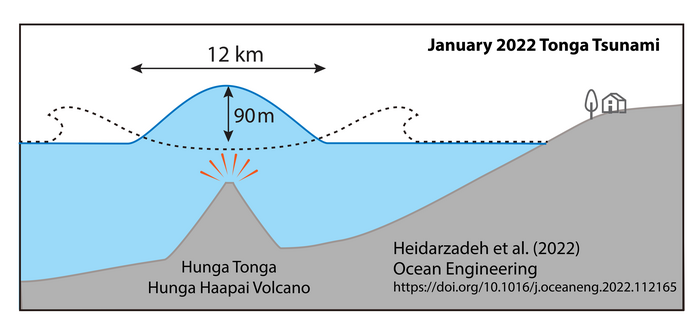
  • The eruption of the Hunga Tonga-Hunga Ha’apai volcano in January created an initial wave 90 metres high – almost the height of the Statue of Liberty (93m)
  • University of Bath tsunami expert calls for better warning systems to detect volcanic eruptions, saying systems are 30 years behind comparable earthquake detection tools

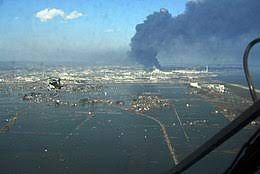
The initial tsunami wave created by the eruption of the underwater Hunga Tonga Ha’apai volcano in Tonga in January 2022 reached 90 metres in height, around nine times taller than that from the highly destructive 2011 Japan tsunami, new research has found.

An international research team says the eruption should serve as a wake-up call for international groups looking to protect people from similar events in future, claiming that detection and monitoring systems for volcano-based tsunamis are ’30 years behind’ comparable tools used to detect earthquake-based events.

Tsunami/en.wikipedia.org

Dr Mohammad Heidarzadeh, Secretary-General of the International Tsunami Commission and a senior lecturer in the University of Bath’s Department of Architecture & Civil Engineering, authored the research alongside colleagues based in Japan, New Zealand, the UK and Croatia.

By comparison, the largest tsunami waves due to earthquakes before the Tonga event were recorded following the Tōhoku earthquake near Japan in 2011 and the 1960 Chilean earthquake, reached 10 metres in initial height. Those were more destructive as they happened closer to land, with waves that were wider.

Dr Heidarzadeh says the Tonga tsunami should serve as a wake-up call for more preparedness and understanding of the causes and signs of tsunamis cause by volcanic eruptions. He says: “The Tongan tsunami tragically killed five people and caused large scale destruction, but its effects could have been even greater had the volcano been located closer to human communities. The volcano is located approximately 70 km from the Tongan capital Nuku’alofa – this distance significantly minimized its destructive power.

“This was a gigantic, unique event and one that highlights that internationally we must invest in improving systems to detect volcanic tsunamis as these are currently around 30 years behind the systems we used to monitor for earthquakes. We are under-prepared for volcanic tsunamis.”

The research was carried out by analysing ocean observation data recordings of atmospheric pressure changes and sea level oscillations, in combination with computer simulations validated with real-world data.

The research team found that the tsunami was unique as the waves were created not only by the water displaced by the volcano’s eruption, but also by huge atmospheric pressure waves, which circled around the globe multiple times. This ‘dual mechanism’ created a two-part tsunami – where initial ocean waves created by the atmospheric pressure waves were followed more than one hour later by a second surge created by the eruption’s water displacement.

The eruption created an initial wave 90 metres high/University of Bath

This combination meant tsunami warning centres did not detect the initial wave as they are programmed to detect tsunamis based on water displacements rather than atmospheric pressure waves.

The research team also found that the January event was among very few tsunamis powerful enough to travel around the globe – it was recorded in all world’s oceans and large seas from Japan and the United States’ western seaboard in the North Pacific Ocean to the coasts within the Mediterranean Sea.

The paper, co-authored by colleagues from New Zealand’s GNS Science, the Association for the Development of Earthquake Prediction in Japan, the University of Split in Croatia and at London’s Brunel University, was published this week in Ocean Engineering.

Dr Aditya Gusman, Tsunami Modeller at the New Zealand-based geoscience service, says: “The 2018 Anak Krakatau volcano and 2022 Hunga Tonga-Hunga Ha’apai volcano eruptions clearly showed us that coastal areas surrounding volcano islands are at risk of being hit by destructive tsunamis. Although it may be preferable to have low-lying coastal areas completely clear from residential buildings, such a policy may not be practical for some places as volcanic tsunamis can be considered infrequent events.”

Co-author Dr Jadranka Šepić, from the University of Split, Croatia, adds: “What is important is to have efficient warning systems, which include both real-time warnings and education on what to do in a case of a tsunami or warning – such systems save lives. In addition, at volcanic areas, monitoring of volcanic activity should be organized, and more high-quality research into volcanic eruptions and areas at hazard is always a good idea.”

Separate research led by the University of Bath atmospheric physicist Dr Corwin Wright published in June found that the Tonga eruption triggered atmospheric gravity waves that reached the edge of space.