
Africa’s ‘land-linked’ economies poised to drive continent’s prosperity

“We stand at a pivotal moment, one that marks a profound shift from viewing these nations as isolated and constrained by geography to recognizing them as dynamic land-linked economies at the heart of Africa’s socio-economic resurgence,” said Samuel Doe, Resident Representative of the United Nations Development Programme (UNDP) in Ethiopia.

A new UNDP position paper – Africa’s Land-Linked Economies: Pathways to Prosperity and Development – explores the new narrative for African LLDCs, “rewriting the story from one of geographic limitation to strategic advantage”.

Mr. Doe, speaking on behalf of UNDP in Africa, presented the paper at a news conference on the margins of the Third UN Conference on LLDCs (LLDC3), which has been under way since Tuesday in Awaza, Turkmenistan.

“For decades, Africa’s LLDCs have been defined by their lack of direct access to the sea, often perceived as a disadvantage that limits trade, growth and development,” he said.

“Today, Africa’s LLDCs are leveraging their strategic centrality and regional connectivity to become vital hubs of economic activity, trade and innovation.”

He cited, among others, Rwanda’s 130,000-hectare Kigali Logistics Platform – a bustling regional hub, connecting Uganda, the Democratic Republic of Congo and Burundi with the coastal economies of Kenya and Tanzania.

In addition, Ethiopia facilitates crucial trade routes from South Sudan to Djibouti – including shortening freight transit by rail from 72 hours to 12 hours – and leverages its national airline, emerging as a vital global air transport connector that bridges Africa with international markets.

Meanwhile, Botswana, Malawi, Zambia and Zimbabwe anchor the pivotal North-South corridor, linking southern Africa to broader continental markets.

Globally, LLDCs account for seven per cent of the world’s population but contribute to only about 1.1 per cent of world trade.

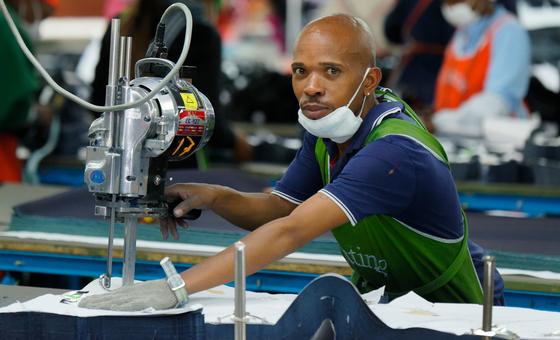
UNDP notes that although African LLDCs’ contribution to global trade may be minimal, they supply regional and continental markets with strategic goods and services, including diamonds, copper, gold, coffee, sugar, as well as textiles and apparel.

‘Land-linked shifts the narrative’

A critical element of the shift taking place on the continent is the African Continental Free Trade Area (AfCFTA), which came into effect in January 2021 and represents the world’s largest free-trade area with a market of 1.2 billion people.

Most African LLDCs are members of the AfCFTA, which is already reducing trade barriers, unlocking vast opportunities for LLDCs to actively participate in and benefit from intra-African and global trade, according to UNDP.

“Land-linked flips the narrative: inland countries become bridges, not barriers. With AfCFTA, LLDCs can turn geography into a competitive edge – moving goods, services, and data faster and more affordably across Africa and beyond,” said Mr. Doe.

The shift also requires coordinated policy reforms, as well as leveraging innovation, inclusive governance, resilience and financing to drive sustainable and inclusive growth.

The paper also cites digital connectivity as a “transformative pathway” for African LLDCs to transcend geographic constraints and establish direct linkages with regional and global markets.

According to the 2024 International Telecommunication Union (ITU) Facts and Figures, 39 per cent of the population in LLDCs is online, with internet access in African LLDCs reaching up to 20 per cent.

The current digital landscape, though challenging, demonstrates that African LLDCs are positioned to leverage innovative connectivity solutions that bypass traditional dependencies on coastal neighbouring countries, according to the UNDP paper. These notwithstanding, LLDCs continue to rely on neighbouring coastal countries for undersea cable access.

“We are also concerned that landlocked developing countries do not have easy access to submarine cables” Cosmas Luckyson Zavazava, Director of the ITU Telecommunication Development Bureau, told reporters in Awaza.

“And for those that are doubly landlocked, it is a bigger challenge because you must have good relations with your neighbours for you to be able to communicate.”

Find all our coverage on LLDC3 here.

Source link

‘Landlocked to landlinked’: UN summit seeks to turn geography into opportunity

And increasingly, climate change is compounding the problem – damaging roads, disrupting supply chains, and threatening already fragile infrastructure with floods, droughts, and extreme weather.

But as global discussions intensify, a UN conference underway in Turkmenistan is aiming to flip the script – to help transform LLDCs from landlocked to landlinked through smarter more climate resilient infrastructure, streamlined logistics, and stronger regional ties.

As day two of the Third UN Conference on the Landlocked Developing Countries (LLDC3) got underway on Wednesday, the atmosphere at the Awaza Congress Center shifted.

With presidents and heads of government having departed after Tuesday’s opening ceremony, security measures relaxed, making it easier for delegates to move around the venue.

But the pace of the conference didn’t slow. Meeting rooms stayed packed, exhibition stands buzzed with activity, and participants navigated long white-carpeted corridors to attend back-to-back events. A large team of multilingual youth volunteers helped guide attendees through the sprawling complex, keeping the energy high and logistics smooth.

Trade troubles and the ‘geography gap’

The day’s discussions focused on overcoming the disadvantages of geography. The main thematic roundtable was devoted to trade, which is a pressing issue for the world’s 32 LLDCs, which lack direct access to seaports. As a result, they must rely on longer, more complex routes to reach international markets, driving up costs and reducing competitiveness.

And geography isn’t the only hurdle. Many LLDCs struggle with outdated infrastructure and limited use of digital tools that could speed up sluggish transport times. 

These roadblocks don’t just delay trade – they hold back economic growth and widen the gap between LLDCs and other developing nations.

On Tuesday, UN Secretary-General António Guterres told reporters in Awaza that “landlocked developing countries need smart logistics, streamlined systems, and stronger partnerships with transit countries,” adding: “We must cut red tape, digitize border operations, and modernize transport networks to reduce delays and costs.”

The numbers tell the story

The impact of geography shows clearly in the numbers.

Landlocked developing countries make up more than seven per cent of the world’s population, yet in 2024 they accounted for just 1.2 per cent of global merchandise trade. It’s a stark reminder of how physical barriers can translate into economic ones.

The Awaza Programme of Action for 2024–2034, adopted by the UN General Assembly last year, aims to change that reality. But turning ambition into results will take bold, coordinated efforts across borders and sectors.

One phrase echoing through the corridors of the Awaza Congress Center is “from landlocked to landlinked” – a rallying call for transforming geographic disadvantage into opportunity.

Mindset matters

Umberto de Pretto, Secretary General of the International Road Transport Union (IRU), told UN News: “There is proof that if you put the right policies in place … you can be landlinked … I think the biggest impediment for landlocked countries is mindset.”

The IRU, founded in 1947, supports sustainable mobility and logistics worldwide and represents over 3.5 million transport operators in more than 100 countries.

As Mr. de Pretto points out, only 11 of the world’s 32 landlocked developing countries have joined the UN-backed TIR system, which allows goods to move from origin to destination in sealed compartments under a mutually recognized customs procedure.

“The biggest user of the system that we run, the UN Convention called TIR, is Uzbekistan, one of the only two double landlocked countries. So, there is evidence that if you put in place the right policies, your country will be landlinked, not landlocked,” he explained.

Digital tools for smoother transit

New technologies offer additional ways to simplify cargo movement.

“How do you go from paper to moving information digitally across to government authorities? We need things like ‘single window’, where you have a single intake point for electronic information so the government can analyze that information and make decisions earlier,” Ian Saunders, Secretary General of the World Customs Organization, explained.

He shared examples of successful initiatives, such as cargo tracking in East and West Africa and the use of electronic TIR carnets – sometimes called a ‘merchandise passport’ – by private companies in Central Asia. These unique documents guarantee the payment of duties and taxes suspended while goods are in transit.

Climate risks and smarter infrastructure

Another example came from Dmitry Maryasin, Deputy Executive Secretary of the UN Economic Commission for Europe (UNECE).

Speaking with UN News, he noted the 2023 adoption of a roadmap for the digitalization of the Trans-Caspian Corridor. Using UN tools and harmonized regulations, the corridor leverages both land and sea transport – including rail and shipping across the Caspian Sea – to move goods between Asia and Europe.

Climate change is also making cargo transport more difficult. “We’re seeing recurrent road flooding, vulnerability to landslides, mudflows, avalanches, and droughts – all of this is now a reality in Central Asia,” Mr. Maryasin said.

In response, UNECE has developed a transport infrastructure stress-testing tool that factors in climate risks. An online platform based on satellite data has also been launched, allowing users to overlay trade routes and climate hazards on a map to support smarter investment decisions.

“Countries are already using it,” Mr. Maryasin said. Efforts are under way to integrate this platform with a similar one developed by the UN’s ESCAP office, covering South and Southeast Asia.

A Day for LLDCs

Wednesday also marked the first observance of the International Day for the Dissemination of Information on the Special Needs of Landlocked Developing Countries. While each LLDC faces unique development challenges, they also share common priorities. And with nearly 600 million people living in these countries, finding shared solutions is essential.

The message from Awaza is clear: isolation is not destiny. With the right mindset, effective policies, and meaningful partnerships, landlocked countries can become landlinked – and thrive.

LLDC3 continues tomorrow, Thursday 7 August, with roundtables and events on a range of topics, as well as a Women’s Forum. Find all our coverage here.

Source link