
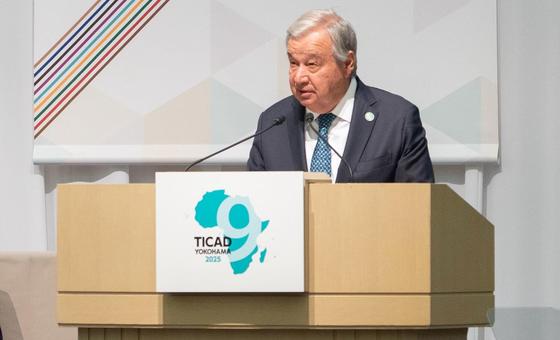
‘Africa is poised for progress’ Guterres tells development conference in Japan

“With the world’s youngest population, abundant natural resources, and a vibrant entrepreneurial spirit, Africa is poised for progress,” he told the 9th Tokyo International Conference on African Development (TICAD) in Yokohama.

He said the meeting’s theme – Co-Create Innovative Solutions with Africa – was a reminder that these same strengths can help shape a more peaceful, prosperous, and sustainable world in Africa and beyond.

Progress and reform

In this regard, he emphasised the need to accelerate progress to achieve the Sustainable Development Goals (SDGs) through investment, reform and partnerships.

Mr. Guterres highlighted five areas for cooperation, starting with his longstanding push to reform institutions of global governance so that they reflect today’s realities.

Africa must have a stronger voice in shaping the decisions that affect its future,” he said.

That includes long-overdue reform of the Security Council, where incredibly, Africa has no permanent member, and other regions remain underrepresented.”

He also called for overhauling the international financial architecture, describing the current system as “unjust and unfair”, as well as bold action on debt relief.

Value chains and renewable energy

The Secretary-General next put the spotlight on investment in sustainable global value chains and regional integration.

“Africa’s path for prosperity must focus on adding value to its raw materials, creating decent jobs, and building resilience, taking profit of the African Continental Free Trade Area,” he said.

He also stressed the need to address “Africa’s energy paradox”, noting that although the continent has enormous potential to produce renewable energy, it receives just two per cent of global investment in the sector.  Meanwhile, some 600 million African lack access to electricity.

“Africa is also home to the critical minerals required to power renewable technologies,” he continued.  “But the countries hosting them must be the ones to benefit first and most, while adding value to local and global value chains.”

Invest in technology, youth and peace 

Turning next to technology, Mr. Guterres called for harnessing digital innovation, including artificial intelligence (AI), for development.

He said Japan’s technological leadership can help close the digital divide, “and ensure that technology helps African countries catch up, with adequate digital public infrastructure, rather than being left behind.”

As “young people are the builders of Africa’s future”, the Secretary-General’s fourth point underscored the need to invest in their skills and education, particularly in STEM (Science, Technology, Engineering and Maths).

Let us invest in women’s full participation across economies, societies and political systems,” he added.

Mr. Guterres concluded by acknowledging the link between peace and prosperity.

“Sustainable development requires sustainable peace,” he said.

“By silencing the guns as the African Union clearly points out. And by ending violence in all its forms and strengthening the social cohesion and stability that can attract investment and business to Africa.”

About TICAD

The Tokyo International Conference on African Development (TICAD) is co-hosted by Japan and the UN, the UN Development Programme (UNDP), the World Bank and the African Union Commission (AUC).

It has been held since 1993 with the aim of promoting Africa’s development, peace and security, through the strengthening of relations in multilateral cooperation and partnership.

“For more than three decades, TICAD has embodied the spirit of multilateralism — grounded in mutual respect, shared responsibility, and a deep belief in Africa’s potential,” the Secretary-General said.

The conference runs from 20-23 August. 
Source link

Africa’s ‘land-linked’ economies poised to drive continent’s prosperity

“We stand at a pivotal moment, one that marks a profound shift from viewing these nations as isolated and constrained by geography to recognizing them as dynamic land-linked economies at the heart of Africa’s socio-economic resurgence,” said Samuel Doe, Resident Representative of the United Nations Development Programme (UNDP) in Ethiopia.

A new UNDP position paper – Africa’s Land-Linked Economies: Pathways to Prosperity and Development – explores the new narrative for African LLDCs, “rewriting the story from one of geographic limitation to strategic advantage”.

Mr. Doe, speaking on behalf of UNDP in Africa, presented the paper at a news conference on the margins of the Third UN Conference on LLDCs (LLDC3), which has been under way since Tuesday in Awaza, Turkmenistan.

“For decades, Africa’s LLDCs have been defined by their lack of direct access to the sea, often perceived as a disadvantage that limits trade, growth and development,” he said.

“Today, Africa’s LLDCs are leveraging their strategic centrality and regional connectivity to become vital hubs of economic activity, trade and innovation.”

He cited, among others, Rwanda’s 130,000-hectare Kigali Logistics Platform – a bustling regional hub, connecting Uganda, the Democratic Republic of Congo and Burundi with the coastal economies of Kenya and Tanzania.

In addition, Ethiopia facilitates crucial trade routes from South Sudan to Djibouti – including shortening freight transit by rail from 72 hours to 12 hours – and leverages its national airline, emerging as a vital global air transport connector that bridges Africa with international markets.

Meanwhile, Botswana, Malawi, Zambia and Zimbabwe anchor the pivotal North-South corridor, linking southern Africa to broader continental markets.

Globally, LLDCs account for seven per cent of the world’s population but contribute to only about 1.1 per cent of world trade.

UNDP notes that although African LLDCs’ contribution to global trade may be minimal, they supply regional and continental markets with strategic goods and services, including diamonds, copper, gold, coffee, sugar, as well as textiles and apparel.

‘Land-linked shifts the narrative’

A critical element of the shift taking place on the continent is the African Continental Free Trade Area (AfCFTA), which came into effect in January 2021 and represents the world’s largest free-trade area with a market of 1.2 billion people.

Most African LLDCs are members of the AfCFTA, which is already reducing trade barriers, unlocking vast opportunities for LLDCs to actively participate in and benefit from intra-African and global trade, according to UNDP.

“Land-linked flips the narrative: inland countries become bridges, not barriers. With AfCFTA, LLDCs can turn geography into a competitive edge – moving goods, services, and data faster and more affordably across Africa and beyond,” said Mr. Doe.

The shift also requires coordinated policy reforms, as well as leveraging innovation, inclusive governance, resilience and financing to drive sustainable and inclusive growth.

The paper also cites digital connectivity as a “transformative pathway” for African LLDCs to transcend geographic constraints and establish direct linkages with regional and global markets.

According to the 2024 International Telecommunication Union (ITU) Facts and Figures, 39 per cent of the population in LLDCs is online, with internet access in African LLDCs reaching up to 20 per cent.

The current digital landscape, though challenging, demonstrates that African LLDCs are positioned to leverage innovative connectivity solutions that bypass traditional dependencies on coastal neighbouring countries, according to the UNDP paper. These notwithstanding, LLDCs continue to rely on neighbouring coastal countries for undersea cable access.

“We are also concerned that landlocked developing countries do not have easy access to submarine cables” Cosmas Luckyson Zavazava, Director of the ITU Telecommunication Development Bureau, told reporters in Awaza.

“And for those that are doubly landlocked, it is a bigger challenge because you must have good relations with your neighbours for you to be able to communicate.”

Find all our coverage on LLDC3 here.

Source link