Keeping sea routes safe today while also addressing emerging challenges was the focus of a debate in the UN Security Council on Monday which was convened by Panama, president for the month of August.
Arsenio Dominguez, Secretary-General of the International Maritime Organization (IMO), told the Council that last year, a workforce of just 1.9 million seafarers moved over 12.3 billion tonnes of goods, essentially “keeping global trade afloat”.
Safety and security fundamental
He said the maritime sector has proved to be “remarkably resilient” in the face of geopolitical challenges.
“Yet resilience cannot breed complacency,” he warned.
“The safety and security of the maritime sector is fundamental to economic stability, sustainable maritime development and to livelihoods.”
Multiple threats
The threats are numerous. Nearly 150 incidents of piracy and armed robbery were reported in 2024 alone. In some regions such as Southeast Asia, incidents are surging, according to the International Criminal Police Organization (INTERPOL).
Beyond piracy, international vessels plying the Red Sea have also come under attack against the backdrop of the war in Gaza.
Meanwhile, trafficking continues – including drugs, endangered wildlife and protected timber – and organized crime groups tap into criminal supply chains to move weapons, operatives and illicit goods to finance their operations.

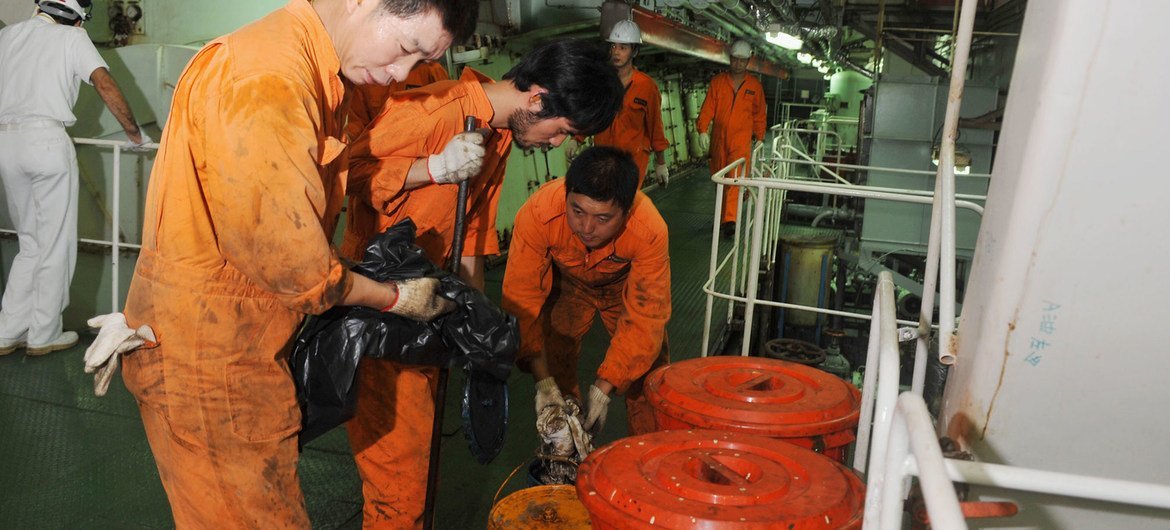
Seafarers work in the engine room of a Chinese registered ship in the Port of Genoa in Italy. (file)
A ‘network’ under attack
Maritime routes were “the world’s first truly global network,” connecting distant shores for thousands of years, said Valdecy Urquiza, INTERPOL Secretary General.
“Today, and more than ever, that same network is exploited by criminals who threaten navigation, trade, communication – and with them, the global stability essential to sustainable development,” he told the Council.
He said the “poly-criminality at sea” is “making criminals more resilient, and enforcement more complex” as new and less visible dangers arise.
“As ports go digital – with automated vessel management, cargo tracking and logistics – vulnerabilities are emerging faster than they can be secured. Ports are facing a wave of cyber intrusions targeting the power, communication and logistics systems they rely on.”
Furthermore, “cybercriminals can weaponise artificial intelligence to attack with greater speed, scale and precision.”
Global coordination, environmental action
In response to the situation, IMO has developed binding mandatory requirements, for example to address international ship and port security as well as cybersecurity threats.
The UN agency has also supported projects to boost regional capacity, including information sharing. This is in addition to establishing partnerships with the UN Office on Drugs and Crime (UNODC), INTERPOL, regional entities and donor States, aimed at strengthening national capabilities and building trust.
“While addressing maritime security, we must not lose sight of our responsibility to protect the ocean,” said Mr. Dominguez.
“Maritime safety and security and environmental stewardship go hand in hand. Support for countries to develop and enhance response capabilities for maritime pollution incidents including from oil spills is ongoing.”
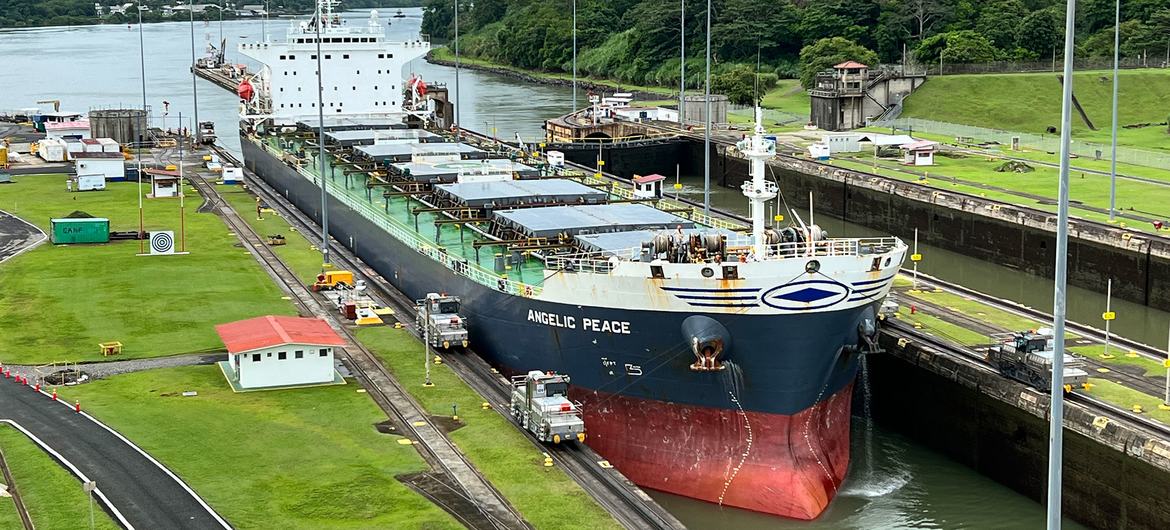
A ship passes through the Panama Canal in Central America. (file)
Perspectives from the Panama Canal
The Council also heard from the agency responsible for the operation of the Panama Canal, one of the world’s most important maritime corridors.
Ricaurte Vásquez Morales, CEO of the Panama Canal Authority, shared perspectives from “one of the most emblematic channels for human cooperation,” highlighting the strength of “principles-based neutrality.”
“The Panama Canal is governed by an international treaty which safeguards equal access to all nations in times of peace or war,” he said, speaking in Spanish.
“This promise, which is incorporated in our Constitution, has enabled a small country to contribute stability to global trade, shielding this infrastructure from geopolitical tensions that also too often stymied progress.”
His remarks also showcased how the Canal has been under Panamanian administration for the last 25 years – a period which saw the completion of a third set of locks in 2016. As a result, the cargo volume transiting its waters increased by 50 per cent, while maintaining the same annual transit of roughly 13,500.
Climate adaptation
Like the IMO chief, Mr. Vásquez Morales also emphasised the need to address climate change. The Panama Canal experienced a drought over the past two years and this “global wake-up call” sparked water conservation efforts, logistical adjustments and the building of an artificial lake.
“Today, the canal boasts technologies that strengthen climate resilience,” he said.
“It creates financial mechanisms and ensures water and environmental security, while at the same time implementing efficient governance to harness the rapid progress in artificial intelligence and collaborating to strengthen cyber security on our roads and our logistics systems.”
Commitment, peace and solidarity
Concluding his remarks, Mr. Vásquez Morales insisted that “the Panama Canal is living proof that global public goods can be administered with equity, responsibility and vision.”
“Through sustained cooperation, constant adaptation and steadfast commitment to the principles of international law, the Canal will remain a safe and efficient route ready to serve not only this generation, but also many more to come,” he said.
“We trust that by working together, we will be able to keep open, not only waterways, but also the channels of understanding peace and solidarity.”