Proposed amnesty law offers political prisoners in Venezuela an ‘opportunity’

The amnesty is aimed at promoting peace, democratic coexistence and national reconciliation as the South American country enters a new era following the seizure of former President Nicolas Maduro by the United States. 

It passed unanimously on 5 February by Venezuelan legislators in the first of two readings.

The amnesty “offers an opportunity to provide justice and alleviate the suffering of the many people who have been unlawfully detained for political reasons in Venezuela,” said Alex Neve, a member of the UN Independent International Fact-Finding Mission for Venezuela.

“This law has the potential to contribute to restoring rights and repairing Venezuela’s social fabric, but the voices of the countless Venezuelans whose rights have been violated in the country’s prisons, as well as the civil society organizations who have assisted and defended them, must be at the centre of this process,” Mr. Neve said.

The broader picture 

Following years of political violence in Venezuela, many politicians, activists and journalists have been charged with crimes such as terrorism or treason – according to human rights groups

According to media reports over 300 political prisoners have been released since 8 January but many political prisoners remain in detention

Transparency essential

The UN human rights experts have raised concerns about how the amnesty will be enacted, stating that its “legitimacy and impact depend on a transparent and inclusive process that is fully grounded in international human rights law.” 

In a statement released by the United Nations Human Rights Council, the investigators warned of the “absence of informed, inclusive, and safe public consultations” and emphasised the need for ‘a transparent process, with meaningful participation from victims, their families and civil society.” 

Calls for participation 

Fact-Finding Mission expert Maria Quintero, stated that it was “advisable for the judicial verification procedure to include the participation of victims and their families, their representatives, and human rights organizations, in order to prevent the law from being instrumentalized or applied in a manner incompatible with international standards.” 

She added, “we must not forget accountability.”

Whilst the draft legislation is debated within Venezuela’s government, UN experts have reiterated their call for the “unconditional” release of all political prisoners, stating that “it is critical that the process of releasing prisoners, already underway, continues without interruption.” 

The Human Rights Council-appointed Independent International Fact-Finding Mission was established to assess alleged human rights violations committed since 2014. 

Source link

Guterres urges countries to ‘seize this historic opportunity’ as renewable energy use grows

The latest push follows the release of two reports on Tuesday which affirmed that the so-called “renewables revolution” is accelerating at unprecedented rates.

For the first time ever, renewable energy has generated more power than coal, according to new analysis by Ember, a global think tank working to speed up the clean energy transition.

Energy shift underway

Solar and wind outpaced the growth in global electricity demand in the first half of this year, resulting in a small decline in coal and gas when compared to the same period in 2024.

This represents “a crucial turning point,” according to Ember’s Senior Electricity Analyst, Małgorzata Wiatros-Motyka.

“Solar and wind are now growing fast enough to meet the world’s growing appetite for electricity. This marks the beginning of a shift where clean power is keeping pace with demand growth,” she said in a press release.

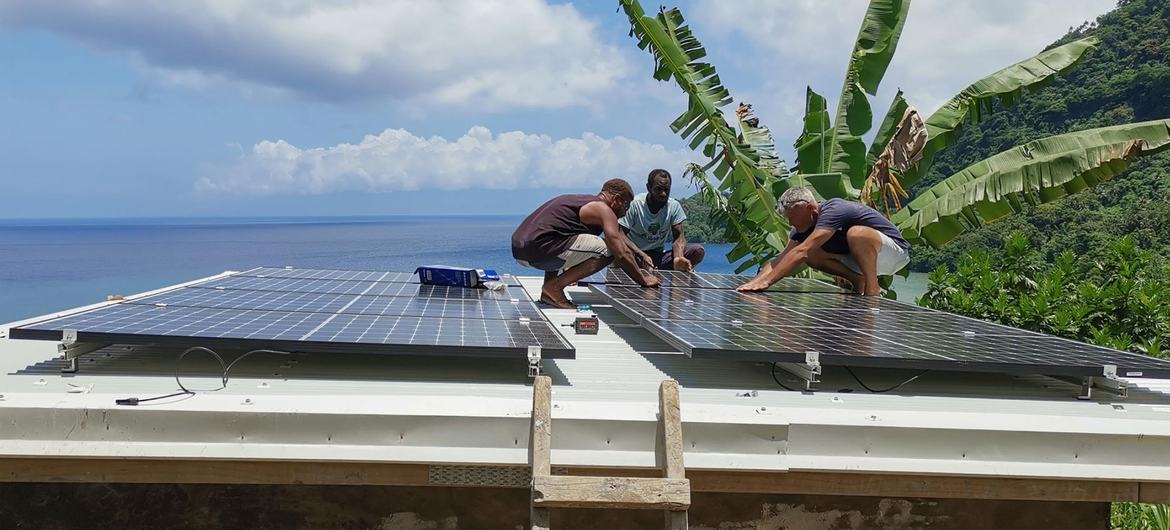
People in Vanuatu in the southwestern Pacific install solar panels on a roof.

Solar-powered success

In a separate report, the International Energy Agency (IEA) revealed how installed renewables power continues to grow and is expected to double by 2030.

Global renewable power capacity is projected to increase by 4,600 gigawatts (GW) – “roughly the equivalent of adding China, the European Union and Japan’s total power generation capacity combined,” the agency said.

Growth is being led by the rapid rise of solar PV (photovoltaic) technology, which converts sunlight into energy.  It will account for around 80 per cent of the increase, followed by wind, hydro, bioenergy and geothermal.

‘A better future for all’

In response to the news, UN Secretary-General António Guterres tweeted that “the clean energy future is no longer a distant promise – it’s here.” 

He urged the international community to “seize this historic opportunity and supercharge the global shift towards a better future for all.”

The reports echo the findings of the Secretary-General’s Moment of Opportunity report, issued in July.

They also reflect messages by world leaders attending his Climate Summit held last month during high-level week as part of the lead-up to the COP30 conference in Brazil this November. 

However, the UN chief has consistently stressed that whilst progress has been made, the energy transition is not yet fast or fair enough

Therefore, efforts need to be stepped up if the world is to meet the goal of limiting global temperature rise to 1.5 degrees Celsius above pre-industrial levels, as outlined in the Paris Agreement on climate change. 

UN says Sri Lanka has ‘historic opportunity’ to end impunity, deliver justice

The 26-year conflict, from 1983 to 2009, pitted Government forces against the separatist Liberation Tigers of Tamil Eelam (LTTE) – more commonly referred to as the Tamil Tigers – who sought an independent state for the island’s Tamil minority in the north and east.

The civil war claimed an estimated 80,000 to 100,000 lives, and thousands more were forcibly disappeared, their fates still unknown. Hundreds of thousands were also displaced from their homes.  

The final months were among the bloodiest, with tens of thousands of civilians killed in indiscriminate shelling, extrajudicial executions, and other violations of international law committed by both sides.

Turn pledges into results

In a new report issued on Wednesday, UN human rights chief Volker Türk said the Government’s pledges to deliver justice, restore the rule of law, and eliminate discrimination and divisive politics must finally yield concrete results.

Today, an opportunity presents itself for Sri Lanka to break from the past,” he said. “It now needs a comprehensive roadmap to translate these commitments into results.

The report follows Mr. Türk’s recent visit to Sri Lanka, where he met officials, civil society, victims’ groups, political parties and religious leaders, and travelled to Trincomalee, Jaffna and Kandy – among the worst-affected areas.

It calls for a clear acknowledgment of the violations, abuses and crimes committed – including during the civil war – and recognition of the State’s responsibility and that of its security forces personnel as well as non-state armed groups, including the LTTE.

The pain and suffering of victims remains palpable and their demands for truth and justice must be addressed,” Mr. Türk stressed.

Call for sweeping reforms

The report recommends comprehensive security sector reform and broader constitutional, legal and institutional changes to meet international human rights obligations. It welcomes the planned creation of an independent Public Prosecutor’s office.

It also urges the establishment of a dedicated judicial mechanism, including an independent special counsel, to handle cases involving serious human rights violations and grave breaches of international humanitarian law.

Other recommendations include the release of military-held land in the north and east, repeal of the Prevention of Terrorism Act (PTA), and the release of long-term PTA detainees – some imprisoned for decades.

The report further calls for amendments or repeal of several restrictive laws, including those relating to data and online safety, NGOs, and civil and political rights.

International support

While the primary responsibility for investigating and prosecuting crimes lies with the Government, the report calls for complementary international support.

It urges UN Member States to contribute to accountability and reconciliation efforts, leveraging OHCHR’s strengthened capacity to undertake related work.

These measures are crucial to realizing the Government’s vision of ‘national unity’ and above all ensuring there can never be recurrence of past violations,” Mr. Türk said.

Source link

‘Landlocked to landlinked’: UN summit seeks to turn geography into opportunity

And increasingly, climate change is compounding the problem – damaging roads, disrupting supply chains, and threatening already fragile infrastructure with floods, droughts, and extreme weather.

But as global discussions intensify, a UN conference underway in Turkmenistan is aiming to flip the script – to help transform LLDCs from landlocked to landlinked through smarter more climate resilient infrastructure, streamlined logistics, and stronger regional ties.

As day two of the Third UN Conference on the Landlocked Developing Countries (LLDC3) got underway on Wednesday, the atmosphere at the Awaza Congress Center shifted.

With presidents and heads of government having departed after Tuesday’s opening ceremony, security measures relaxed, making it easier for delegates to move around the venue.

But the pace of the conference didn’t slow. Meeting rooms stayed packed, exhibition stands buzzed with activity, and participants navigated long white-carpeted corridors to attend back-to-back events. A large team of multilingual youth volunteers helped guide attendees through the sprawling complex, keeping the energy high and logistics smooth.

Trade troubles and the ‘geography gap’

The day’s discussions focused on overcoming the disadvantages of geography. The main thematic roundtable was devoted to trade, which is a pressing issue for the world’s 32 LLDCs, which lack direct access to seaports. As a result, they must rely on longer, more complex routes to reach international markets, driving up costs and reducing competitiveness.

And geography isn’t the only hurdle. Many LLDCs struggle with outdated infrastructure and limited use of digital tools that could speed up sluggish transport times. 

These roadblocks don’t just delay trade – they hold back economic growth and widen the gap between LLDCs and other developing nations.

On Tuesday, UN Secretary-General António Guterres told reporters in Awaza that “landlocked developing countries need smart logistics, streamlined systems, and stronger partnerships with transit countries,” adding: “We must cut red tape, digitize border operations, and modernize transport networks to reduce delays and costs.”

The numbers tell the story

The impact of geography shows clearly in the numbers.

Landlocked developing countries make up more than seven per cent of the world’s population, yet in 2024 they accounted for just 1.2 per cent of global merchandise trade. It’s a stark reminder of how physical barriers can translate into economic ones.

The Awaza Programme of Action for 2024–2034, adopted by the UN General Assembly last year, aims to change that reality. But turning ambition into results will take bold, coordinated efforts across borders and sectors.

One phrase echoing through the corridors of the Awaza Congress Center is “from landlocked to landlinked” – a rallying call for transforming geographic disadvantage into opportunity.

Mindset matters

Umberto de Pretto, Secretary General of the International Road Transport Union (IRU), told UN News: “There is proof that if you put the right policies in place … you can be landlinked … I think the biggest impediment for landlocked countries is mindset.”

The IRU, founded in 1947, supports sustainable mobility and logistics worldwide and represents over 3.5 million transport operators in more than 100 countries.

As Mr. de Pretto points out, only 11 of the world’s 32 landlocked developing countries have joined the UN-backed TIR system, which allows goods to move from origin to destination in sealed compartments under a mutually recognized customs procedure.

“The biggest user of the system that we run, the UN Convention called TIR, is Uzbekistan, one of the only two double landlocked countries. So, there is evidence that if you put in place the right policies, your country will be landlinked, not landlocked,” he explained.

Digital tools for smoother transit

New technologies offer additional ways to simplify cargo movement.

“How do you go from paper to moving information digitally across to government authorities? We need things like ‘single window’, where you have a single intake point for electronic information so the government can analyze that information and make decisions earlier,” Ian Saunders, Secretary General of the World Customs Organization, explained.

He shared examples of successful initiatives, such as cargo tracking in East and West Africa and the use of electronic TIR carnets – sometimes called a ‘merchandise passport’ – by private companies in Central Asia. These unique documents guarantee the payment of duties and taxes suspended while goods are in transit.

Climate risks and smarter infrastructure

Another example came from Dmitry Maryasin, Deputy Executive Secretary of the UN Economic Commission for Europe (UNECE).

Speaking with UN News, he noted the 2023 adoption of a roadmap for the digitalization of the Trans-Caspian Corridor. Using UN tools and harmonized regulations, the corridor leverages both land and sea transport – including rail and shipping across the Caspian Sea – to move goods between Asia and Europe.

Climate change is also making cargo transport more difficult. “We’re seeing recurrent road flooding, vulnerability to landslides, mudflows, avalanches, and droughts – all of this is now a reality in Central Asia,” Mr. Maryasin said.

In response, UNECE has developed a transport infrastructure stress-testing tool that factors in climate risks. An online platform based on satellite data has also been launched, allowing users to overlay trade routes and climate hazards on a map to support smarter investment decisions.

“Countries are already using it,” Mr. Maryasin said. Efforts are under way to integrate this platform with a similar one developed by the UN’s ESCAP office, covering South and Southeast Asia.

A Day for LLDCs

Wednesday also marked the first observance of the International Day for the Dissemination of Information on the Special Needs of Landlocked Developing Countries. While each LLDC faces unique development challenges, they also share common priorities. And with nearly 600 million people living in these countries, finding shared solutions is essential.

The message from Awaza is clear: isolation is not destiny. With the right mindset, effective policies, and meaningful partnerships, landlocked countries can become landlinked – and thrive.

LLDC3 continues tomorrow, Thursday 7 August, with roundtables and events on a range of topics, as well as a Women’s Forum. Find all our coverage here.


Source link

Upcoming elections ‘crucial opportunity’ for Central African Republic, UN top official tells Security Council

December’s local, legislative and presidential elections “represent a crucial opportunity” to strengthen democratic governance, promote reconciliation and consolidate stability, Jean-Pierre Lacroix, Under-Secretary-General for Peace Operations told ambassadors in the Security Council.

The timely holding of presidential and legislative elections is a constitutional requirement, and the Government has consistently demonstrated its commitment to holding local elections, he added.

Although the final electoral roll is currently delayed due to technical difficulties, national authorities, supported by the UN peacekeeping mission, MINUSCA, have made significant efforts to advance the revision of the electoral register through nationwide registration.

“This process took place without major security incidents, reflecting effective collaboration between the Central African national defence forces and MINUSCA, as well as public interest in engaging with the political process,” said Mr. Lacroix.

Challenges remain

Although the 19 April agreement between the government and leaders of various opposition armed groups aimed to end hostilities in the country, violence – primarily perpetrated by armed groups and militias – continues to undermine stability.

“The security situation remains fragile in border regions,” said Mr. Lacroix, noting the spillover effects of the conflict in neighbouring Sudan.

Last week, a Zambian peacekeeper was killed when suspected Sudanese armed elements opened fire on a MINUSCA patrol responding to reports of an attack against civilians in the north-east of the country.

Mr. Lacroix also informed the Security Council of human rights and humanitarian concerns.

Though progress has been made in advancing judicial accountability, notably by the Special Criminal Court, a lack of funding is expected to jeopardise the Court’s operations by September.

In addition, as urgent needs continue to outpace available resources, “the humanitarian situation remains dire,” said Mr. Lacroix, calling for strong support for lifesaving humanitarian assistance.

Source link

US-Houthi ceasefire ‘a welcome opportunity’ to advance peace efforts in Yemen

Ambassadors were briefed by the UN Special Envoy for Yemen, Hans Grundberg, who commended Oman for its efforts to achieve the agreement which came into effect on 6 May.

He said the cessation of hostilities represented an important and necessary de-escalation in the Red Sea following the resumption of deadly US airstrikes on Houthi-controlled areas in Yemen.

Resolve the conflict

However, recent events show that the country is still ensnared in wider regional tensions, he said, pointing to Houthi attacks on Ben Gurion Airport in Israel and Israel’s subsequent strikes on Hudaydah Port, Sana’a Airport, and other locations.

“Nevertheless, the announcement of 6 May provides a welcome opportunity on which we must collectively build to refocus on resolving Yemen’s conflict and advancing a Yemeni-owned peace process,” he said.

The Houthis, also known as Ansar Allah, and Yemeni Government forces, backed by a Saudi-led coalition, have been battling for control of the country for more than a decade.

‘Yemenis want to move forward’ 

“The challenges facing Yemen are immense: from the deep and significant levels of mistrust between the parties, with some still reportedly preparing for war, to near economic collapse,” Mr. Grundberg told the Council

He said the UN will continue to work to bring the sides to the table to identify and agree on solutions that are acceptable to all.

“Yemenis want to move forward – the status quo is untenable,” he insisted.  “And while the frontlines may currently appear relatively stable, what Yemen has now is not peace.”

He stressed the need for continued engagement by the international community to help the Yemeni people realize their desire to build a stable, prosperous and safe country.

Release detained staff

Mr. Grundberg used the briefing to again highlight the plight of personnel from the UN, international and national NGOs, civil society and diplomatic missions, who continue to be arbitrarily detained by the Houthis.

“Not only is their detention in violation of international law, but it has also caused a significant chilling effect throughout the international community, which only has one outcome: undermining support to Yemen, which will sadly impact the Yemenis most in need,” he said.

He welcomed the recent release of staff members from the Dutch Embassy and international organization, saying “this demonstrates what is possible, but these releases are woefully insufficient.”

Message to the people

The Special Envoy concluded his remarks by stating that Yemenis have endured over 10 years of instability, uncertainty and economic collapse.

Speaking directly to the population, he reiterated that “I see you. I hear you. You have not been forgotten – and I won’t relent in my efforts to pursue peace and stability in Yemen.”

He urged the warring parties “to be courageous and choose dialogue,” emphasizing that “the United Nations will not waiver in its commitment to support you in finding a negotiated settlement to this conflict.”

A mother holds her 10-month-old girl who is suffering from stunting and malnutrition in Abyan, Yemen.

Humanitarians ‘running out of time’: Fletcher

UN Emergency Relief Coordinator Tom Fletcher, who also briefed the Council, shared the Special Envoy’s relief at the cessation of hostilities in Yemen.

He stressed, however, that “Yemen is not out of the woods” as the humanitarian situation is deteriorating, with children most affected. 

“Half of Yemen’s children – or 2.3 million – are malnourished. 600,000 of them severely so,” he said.

Childhood killers on the rise

Moreover, “malnutrition is not just about hunger,” he added, as it attacks immunity, leaving children vulnerable to deadly infections like pneumonia and diarrhoea – both leading causes of child mortality in Yemen. 

The country also has one of the worst immunisation rates in the world as only 69 per cent of children under a year old are fully immunized and 20 per cent have received no vaccinations at all.

As a result, diseases such as cholera and measles are rising.  In 2024, Yemen accounted for over a third of global cholera cases and 18 per cent of related deaths, in addition to having one of the highest measles burdens globally.

“Children are not alone in being disproportionately impacted,” said Mr. Fletcher, as malnutrition also affects 1.4 million pregnant and breastfeeding women in Yemen, placing mothers and newborns at grave risk. 

Overall, some 9.6 million women and girls are in severe need of life-saving humanitarian support, he said.

Appeal to the Council

He warned, however, that humanitarians “are running out of time and resources” as their 2025 response plan for Yemen is barely nine per cent funded.

“These shortfalls have very real consequences,” he said. “Nearly 400 health facilities – including 64 hospitals – will stop operating, impacting nearly seven million people.” 

Meanwhile, funding for 700 midwives is quickly running out and 20 therapeutic feeding centres and more than 2,000 therapeutic feeding programmes have already been forced to close down. 

Mr. Fletcher made three requests to the Council, calling first for action to ensure respect for international humanitarian law, including protection of civilians as well as access to all those in need.

He urged ambassadors to also provide scaled-up, flexible funding to sustain critical aid operations.

“Third, and as the Special Envoy has underlined, back efforts towards lasting peace,” he concluded. 

Health, education, opportunity at stake, amid stubborn digital gender divide

Closing this gap is not optional. There were189 million fewer women than men online in 2024.  

The disparity is about more than access, it reflects deeper systemic barriers, according to ​Doreen Bogdan-Martin who heads the UN telecommunications agency, ITU.

That’s too many missed opportunities to learn, to earn and to shape our shared digital future,” she said in a message for Thursday’s International Girls in ICT Day.

She underscored that connectivity alone is not enough to ensure true digital transformation.

“It must be meaningful – being able to afford digital devices and services, having the skills to use technology and feeling safe in online spaces. Everyone deserves the chance to thrive in an increasingly digital world.”

ITU Secretary-General Doreen Bogdan-Martin’s video message.

2025 Theme

Celebrated annually on the fourth Thursday of April, Girls in ICT Day encourages girls to pursue careers in science, technology, engineering and mathematics (STEM).

Since its launch in 2011, more than 417,000 girls and young women have participated in over 11,500 celebrations across 175 countries.

This year’s theme is Girls in ICT for inclusive digital transformation. The ITU is calling for more investment in girls’ digital education and expansion of access to technology.  

More young women need to become creators – not just consumers in the digital world, the agency argues.

“Whether you are an entrepreneur, launching an AI startup, a teacher incorporating digital skills into your classroom or a policymaker shaping our shared digital future, you can help ensure every woman and girl has the chance to connect, create and lead in digital spaces,” Ms. Bogdan-Martin emphasised.

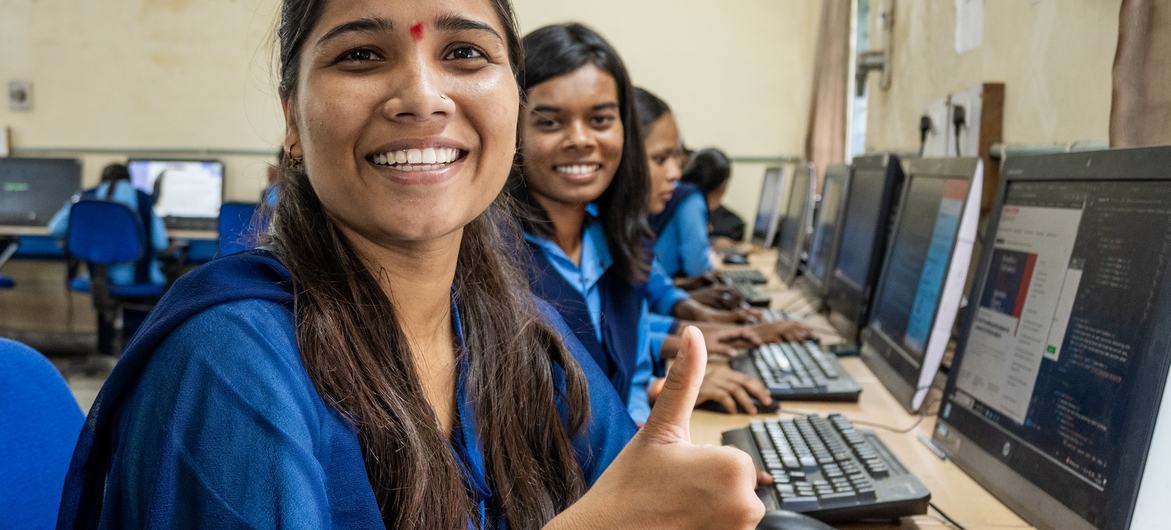
A participant at a UN-supported training on STEM for girls and young women.

Global observance

The 2025 global observance will be co-hosted this year by the Commonwealth of Independent States (CIS) in Eurasia together with States from the Arab region, featuring a live-streamed hybrid event linking Bishkek, Kyrgyzstan and Nouakchott, Mauritania.

The programme includes an intergenerational dialogue bringing together girls, women leaders, and ICT experts to discuss practical strategies for closing the gender gap.

Events are also being organized worldwide, including Girls in ICT in Solomon Islands in the Pacific, the Melon Girls Club in North Macedonia and STEM Supergirls in Croatia.

Source link