Rosemary DiCarlo described Tuesday’s strike in a residential area of the Qatari capital – which targeted Hamas’s political leadership killing several affiliates along with a Qatari security officer – as potentially opening a “new and perilous chapter in this devastating conflict, seriously threatening regional peace and stability.”
The attack occurred on 9 September in residential compounds reportedly housing members of the Hamas’ political bureau, including the son of its chief negotiator, Khalil al-Hayya.
While Hamas leaders survived, the organization said, the incident disrupted ongoing negotiations over a US-mediated ceasefire and hostage release agreement to end the war in Gaza.
Respect sovereignty
“The sovereignty and territorial integrity of any country, including Qatar – a valued partner in advancing peacemaking and conflict resolution – must be respected,” Ms. DiCarlo told ambassadors.
She urged all parties to exercise restraint and reaffirmed the need to preserve negotiation and mediation channels to prevent further suffering in Gaza and the wider region.
Israel claimed responsibility for the strike, with Prime Minister Benjamin Netanyahu describing it as “a wholly independent operation” following a deadly attack on civilians in Jerusalem on 8 September, which Hamas said it carried out.
Qatar, the Gulf Cooperation Council, the League of Arab States, and the Organization of Islamic Cooperation condemned the action and expressed concern over further escalation.
Confidence undermined
Ms. DiCarlo told ambassadors that Israel’s strike came “at the height of ongoing consultations.”
“Any action that undermines the work of mediation and dialogue weakens confidence in the very mechanisms we depend on for conflict resolution,” she said, stressing that durable solutions in the Middle East cannot be achieved through further violence.
She called for renewed commitment to diplomacy, warning that the urgency of a ceasefire and hostage release has never been greater.
“I call on all stakeholders to exercise utmost restraint at this sensitive time and recommit to diplomacy. The urgency of a ceasefire and hostage release deal in Gaza has never been greater. Strike a deal. Free the hostages. End the suffering of the people of Gaza.”
Gaza crisis spiralling
Meanwhile, the humanitarian and security situation in Gaza and the occupied West Bank remains critical.
Since the conflict in Gaza erupted in October 2023 – following attacks by Hamas and other Palestinian armed groups on communities in southern Israel, tens of thousands have died – mostly civilians – infrastructure and basic services are largely destroyed, and the enclave lies in ruins while a new offensive to take Gaza City is ongoing.
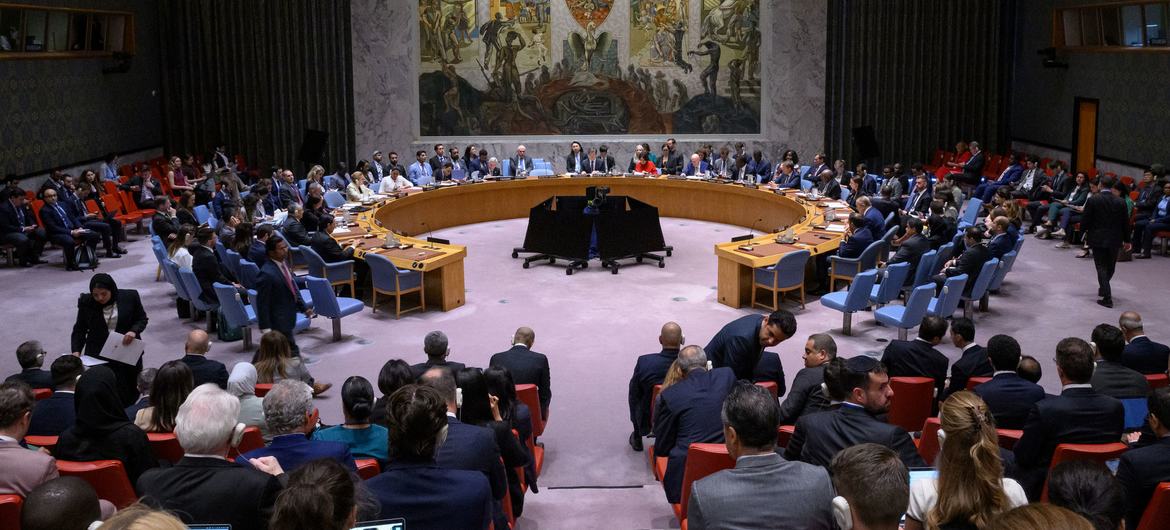
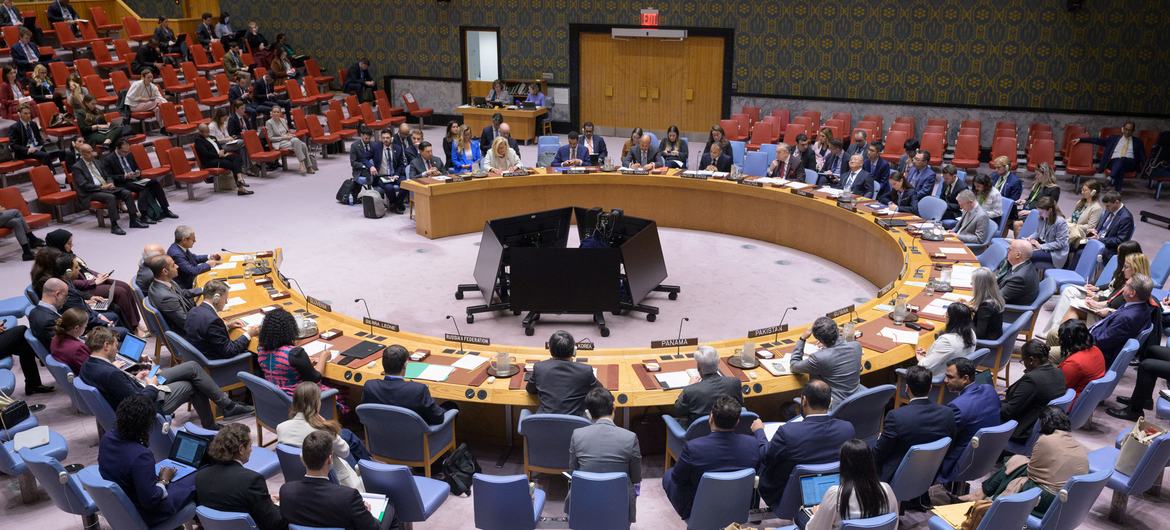
The UN Security Council meets to discuss the situation in the Middle East in the aftermath of an Israeli strike in Doha, the capital of Qatar..
Security Council press statement
Ahead of Thursday’s session, the Security Council issued a press statement expressing condemnation of the strikes in Doha and deep regret over the loss of civilian life.
The statement reaffirmed support for Qatar’s sovereignty and territorial integrity and acknowledges the country’s key role in mediation efforts to end the devastating war, alongside Egypt and the United States.
It emphasised that releasing hostages – including those killed by Hamas – ending hostilities, and ensuring civilian protection in Gaza, remain the Council’s highest priorities.
It also on all parties to seize ongoing diplomatic opportunities for peace.
At least 841 people have been put to death by the Government of Iran since the beginning of the year, with ethnic minorities and migrants “disproportionately targeted”, said OHCHR spokesperson Ravina Shamdasani.
Some executions have been carried out publicly, she added, with seven reported this year based on available information: “The real situation might be different. It might be worse given the lack of transparency in the use of the death penalty.”
Imminent executions
Eleven people now face imminent execution; six have been charged with “armed rebellion” owing to their alleged membership of the Mojahedin-e-Khalq group.
Five others are on death row in connection with their participation in the 2022 protests, following the death in police custody of Mahsa Amini, who was detained by Iran’s so-called morality police for not wearing her hijab correctly.
Ms. Shamdasani reiterated calls from UN rights chief Volker Türk for Iran to impose a moratorium on the application of the capital punishment, as a step towards its abolition.
UN chief warns against ‘playing with fire’ as nuclear test threat looms
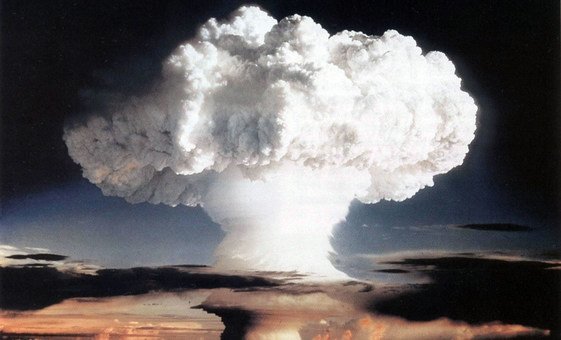
“Stop playing with fire. Now is the time to silence the bombs before they speak again,” he said in his message, which coincides with the 80th anniversary of the first nuclear test on 16 July 1945 – in the New Mexico desert under the Manhattan Project.
A deadly legacy
Since then, more than 2,000 nuclear tests have been carried out worldwide.
Atmospheric tests in the early decades of the nuclear era spread radioactive fallout across continents, contaminating land and seas, displacing communities and leaving survivors facing health crises passed down through generations.
The international day was declared by the UN General Assembly in 2009, following Kazakhstan’s closure of the Semipalatinsk test site.
It has since become a rallying point for governments, civil society and campaigners pressing for an end to nuclear testing and progress towards full disarmament.
Mr. Guterres stressed that nuclear testing remains a grave danger amid rising geopolitical tensions. He urged States to ratify the Comprehensive Nuclear-Test-Ban Treaty (CTBT), adopted by a large majority in 1996 but still not in force nearly three decades later.
“We must never forget the horrific legacy of over 2,000 nuclear tests,” the Secretary-General said. “The world cannot accept this.”
Burkina Faso declares UN Coordinator persona non grata
The UN chief has expressed regret of the decision by authorities in Burkina Faso to declare the UN’s Resident and Humanitarian Coordinator in the country, Carol Flore-Smereczniak, persona non grata.
In a statement on Friday, António Guterres said that the transitional authorities had announced the diplomatic sanction declaring her unwelcome, on 18 August.
The UN chief expressed “full confidence” in her “professionalism and dedication and in the broader United Nations system in Burkina Faso.”
During her tenure, Ms. Flore-Smereczniak – who has now left the country – led UN efforts working closely with the Burkinabe authorities to support development initiatives and provide humanitarian assistance.
UN will continue to support Burkinabe
The statement stresses that the UN Charter makes clear the doctrine of persona non grata does not apply to UN officials, as staff members appointed by the Secretary-General are responsible solely to the Organization, and Member States undertake to respect their exclusively international character.
In line with the Charter, the United Nations enjoys privileges and immunities, including the right of its staff to remain and carry out their mandated work.
“Only the Secretary-General, as the Chief Administrative Officer of the Organization, has the authority to decide – after careful investigation – on the withdrawal of any United Nations official.”
Mr. Guterres reaffirmed the UN’s commitment to continue supporting the people of Burkina Faso, and to keep working with the national authorities.
Referencing the recent quarterly report from the Secretary-General on challenges facing the world’s youngest nation, Ms. Pobee underscored that since March, previous gains in the peace process have been largely eroded.
Military offensives, primarily involving South Sudan’s rival militia which answers to the First Vice President and Government troops loyal to the President, have continued, and trust in the 2018 Revitalized Peace Agreement between the two has been undermined.
Murithi Mutiga, another briefer from the International Crisis Group, explained that the 2018 agreement required President Salva Kiir to work in concord with his rival, First Vice President Riek Machar; thus, the agreement was effectively terminated when President Kiir placed the former Vice President under house arrest on 26 March.
Humanitarian crisis
Ms. Pobee highlighted that recent military offensives have resulted in deaths, displacement and the destruction of civilian infrastructure.
Furthermore, the displacement crisis is a two-way street, Mr. Murtiga explained: the devastating civil war in neighbouring Sudan has driven 1.2 million refugees into South Sudan, straining already-limited resources.
The conflict in Sudan has also disrupted oil flows to the military Government-controlled Port Sudan and the broader market, causing South Sudan to lose most of its valuable oil revenues.
Mr. Murtiga also underscored that this is one of South Sudan’s worst humanitarian crises since independence in 2011, with 9.3 million in need of dire assistance and 7.7 million suffering food insecurity, including 83,000 at risk of catastrophic conditions, all while brutal sexual violence is on the rise.
And funding cuts are leaving millions without lifesaving assistance, Ms. Pobee emphasised. Halfway through 2025, the Humanitarian Needs and Response Plan is only 28.5 per cent funded.
Additionally, challenges to humanitarian access are growing with increased instances of aid workers being attacked, as poor infrastructure and administrative obstacles impede relief efforts.
Call to act
The UN, African Union, regional intergovernmental development body, IGAD, and many others in the international community, have repeatedly called for a cessation of hostilities and a return to dialogue without any concrete response from the warring parties.
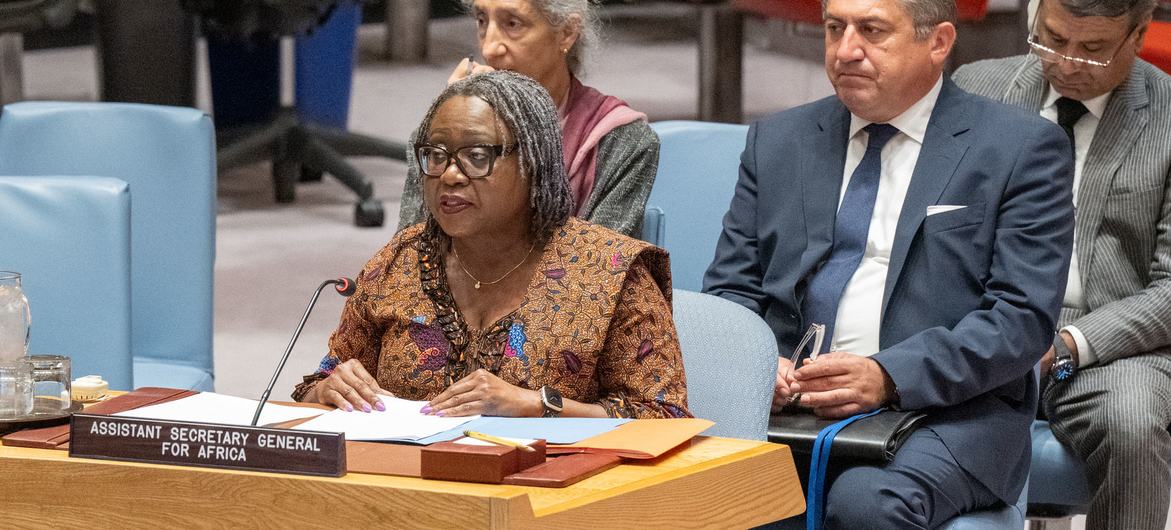
Martha Ama Akyaa Pobee, Assistant Secretary-General for Africa in the Departments of Political and Peacebuilding Affairs and Peace Operations, addresses the Security Council meeting on Sudan and South Sudan.
“While government officials have publicly expressed their commitment to elections by December 2026, the Parties must take steps to return to dialogue and make the necessary decisions to move the country forward. Declarations of commitment are not enough,” Ms. Pobee stressed.
She urged the Security Council to call on all actors and stakeholders to uphold the peace agreement. If they fail to lay the groundwork for peaceful, credible elections in December 2026, the risk of a relapse into violence will rise significantly amid growing regional instability.
It is the shared responsibility of the international community to work with the South Sudanese parties to avoid such a failure, she stressed. “The people of South Sudan are counting on us.”
While the initial 90-day pause on so-called “reciprocal” tariffs offered some relief compared to planned increases of up to 50 per cent, the US imposed a 10 per cent baseline tariff instead, added on top of existing duties. This means many countries – especially developing economies – faced higher costs exporting goods to the US.
The tariff suspension, originally set to expire soon, has now been extended until August 1, further prolonging uncertainty, Pamela Coke-Hamilton, Executive Director of the International Trade Centre (ITC), told reporters at a regular news briefing at the UN Office in Geneva (UNOG).
She warned this move adds to a mounting “dual shock” of rising trade restrictions and deep cuts to development aid, which hit developing countries the hardest.
ITC is a joint United Nations-World Trade Organization (WTO) agency supporting businesses in developing countries.
Real-world consequences
“Economic uncertainty has real-world consequences on countries and sectors,” Ms. Coke-Hamilton said, citing the volatility in gold and precious metals flows as a case in point.
After the US exempted those commodities from the new tariffs, trade volumes surged – with gold imports into Switzerland up 800 per cent year-on-year in May, based on US import data.
Ms. Coke-Hamilton said that since the beginning of the year, ITC has tracked more than 150 new restrictive trade measures globally.
Layered onto existing global trade disruptions since the start of the war in Ukraine, the resulting strain has disproportionately impacted least developed countries (LDCs), which often face the steepest tariffs and the narrowest fiscal space to respond.
A ‘perfect storm’ is brewing
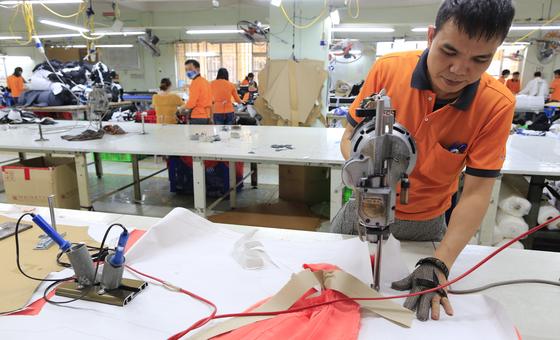
Lesotho, for instance, faces a 50 per cent tariff on apparel exports to the US, threatening its largest industry and tens of thousands of jobs. Viet Nam, though having negotiated a lower tariff, faces a 20 per cent levy – double the current baseline rate – potentially reshaping its $937 million auto and auto-related trade with the US.
Ms. Coke-Hamilton also flagged concerns over cuts in development financing, noting that G7 countries are projected to reduce aid spending by 28 per cent next year – the largest drop in five decades.
“A perfect storm is brewing – just as trade becomes more unpredictable, external support through aid is also shrinking,” she said.
Navigating the challenges
To respond, she urged developing countries to focus on three strategic responses: strengthening regional value chains, investing in value addition to reduce commodity dependence and prioritising small business resilience.
“Stability can come from the ground up,” she said.
“Although uncertainties lie ahead in both the trade and aid landscapes, developing countries can still find ways not only to navigate these challenges, but to take on an active role in bringing about greater stability.”
December’s local, legislative and presidential elections “represent a crucial opportunity” to strengthen democratic governance, promote reconciliation and consolidate stability, Jean-Pierre Lacroix, Under-Secretary-General for Peace Operations told ambassadors in the Security Council.
The timely holding of presidential and legislative elections is a constitutional requirement, and the Government has consistently demonstrated its commitment to holding local elections, he added.
Although the final electoral roll is currently delayed due to technical difficulties, national authorities, supported by the UN peacekeeping mission, MINUSCA, have made significant efforts to advance the revision of the electoral register through nationwide registration.
“This process took place without major security incidents, reflecting effective collaboration between the Central African national defence forces and MINUSCA, as well as public interest in engaging with the political process,” said Mr. Lacroix.
Challenges remain
Although the 19 April agreement between the government and leaders of various opposition armed groups aimed to end hostilities in the country, violence – primarily perpetrated by armed groups and militias – continues to undermine stability.
“The security situation remains fragile in border regions,” said Mr. Lacroix, noting the spillover effects of the conflict in neighbouring Sudan.
Last week, a Zambian peacekeeper was killed when suspected Sudanese armed elements opened fire on a MINUSCA patrol responding to reports of an attack against civilians in the north-east of the country.
Mr. Lacroix also informed the Security Council of human rights and humanitarian concerns.
Though progress has been made in advancing judicial accountability, notably by the Special Criminal Court, a lack of funding is expected to jeopardise the Court’s operations by September.
In addition, as urgent needs continue to outpace available resources, “the humanitarian situation remains dire,” said Mr. Lacroix, calling for strong support for lifesaving humanitarian assistance.
Rafael Mariano Grossi was speaking to reporters in Austria following a briefing to the Government in Vienna.
Israel began launching air and missile strikes against Iranian military and nuclear sites nearly two weeks ago, and the United States carried out surprise bombing raids on three Iranian uranium enrichment facilities this past weekend.
A ceasefire between Iran and Israel, announced on social media by US President Donald Trump on Monday night, is fragile but holding.
However, the extent of damage to Iran’s enriched uranium stockpile remains unclear.
Iran says protective measures taken
Following the initial attacks, Iran informed the IAEA that it would take “special measures” to protect its nuclear materials and equipment.
Mr. Grossi told journalists that he has received a letter from the Iranian Foreign Minister which said protective measures have been taken.
“They did not get into details into what that meant, but clearly that was the implicit meaning of that. So, we can imagine that this material is there,” he said. To confirm this, and to evaluate the situation, “we need to return,” he added.
Inspections vital
On Wednesday, Iran’s parliament approved a bill to suspend cooperation with the IAEA, according to media reports, which has to be approved by the executive branch of the Government.
Mr. Grossi said he wrote to Foreign Minister Abbas Araghchi on Tuesday requesting that they meet “to analyze the modalities” for inspections to continue.
He stressed that the international community “cannot afford” for the inspection regime to be interrupted.
The IAEA chief was also asked about Iran’s plans to withdraw from the Non-Proliferation Treaty (NPT), a key international accord aimed at preventing the spread of nuclear weapons.
The move would be “very regrettable,” he said. “I hope this is not the case. I don’t think this would help anybody, starting with Iran. This would lead to isolation, all sorts of problems.”
“Since the collapse of the ceasefire in March, civilians have constantly come under fire, confined to ever-shrinking spaces, and deprived of lifesaving relief,” she said.
“Israel must halt its devastating strikes on civilian life and infrastructure.”
Risk of famine
With families cut off from aid for weeks on end, and only a fraction of the needed relief now entering the enclave, starvation looms.
“The entire population of Gaza is facing the risk of famine,” Ms. Kaag warned, adding that the limited aid permitted into the enclave is “comparable to a lifeboat after the ship has sunk.”
“Ms. Kaag emphasized that humanitarian aid must not depend on political negotiations, noting that the UN aid operation is prepared to deliver assistance immediately, in accordance with international law.
“Aid cannot be negotiable,” she said.
Full aid access imperative
Ms. Kaag called on Israel to halt its devastating strikes and allow full access for humanitarian aid and commercial goods.
At the same time, she stressed that Israel has the right to live in peace and security.
“This was undeniably shaken by the horrific terror attacks and taking of hostages on 7 October by Hamas and other Palestinian armed groups,” she said, reiterating the call on Hamas and other armed groups to stop rocket attacks against Israel and release all hostages unconditionally.
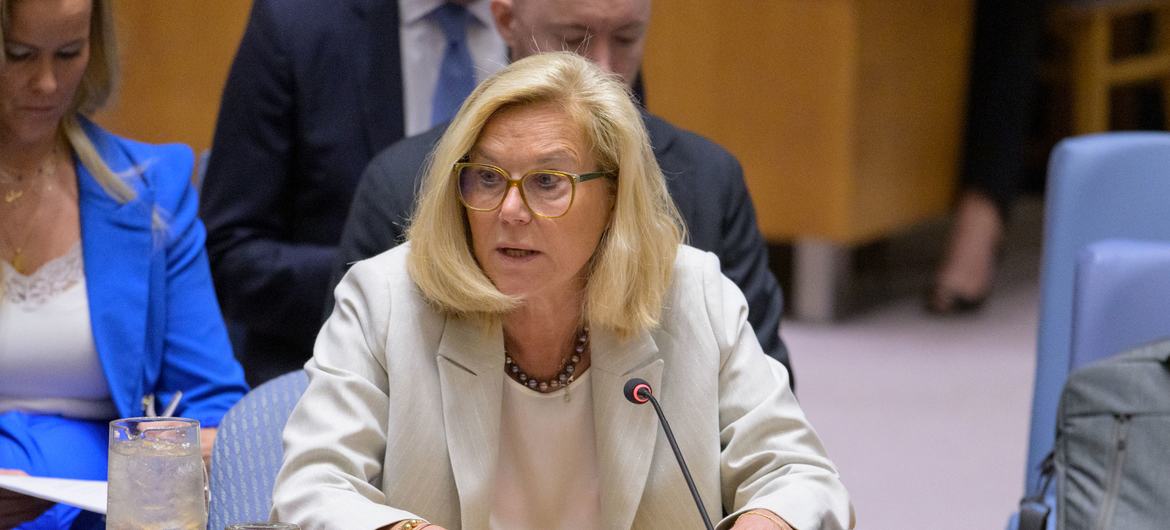
Sigrid Kaag, UN Special Coordinator for the Middle East Peace Process Ad Interim, briefs the Security Council on the situation in the Middle East.
Two-State solution
Ms. Kaag emphasised that durable security “cannot be achieved solely through force”, it must be built on mutual recognition, justice, and rights for all.
“A better path exists that resolves this conflict, de-escalates regional tensions and achieves a shared vision for peace,” she said.
The upcoming high-level international conference in June, co-chaired by France and Saudi Arabia, presents a critical opportunity to relaunch a path toward ending the occupation and realising the two-State solution based on international law, UN resolutions and previous agreements.
“It must not be another rhetorical exercise,” she said.
“We need to pivot ourselves from declarations to decisions. We need to implement rather than adopt new texts.”
‘See you in heaven’
In her briefing, Ms. Kaag described the deep despair of civilians in Gaza, where families now bid farewell not with a “goodbye, see you tomorrow”, but with the words “see you in heaven.”
“Death is their companion. It’s not life, it’s not hope,” she continued, stressing that Gazans deserve more than survival – they deserve a future.
Urging bold political action, she called for adherence to international law, and support for a reformed Palestinian Government that can govern both Gaza and the West Bank.
“Statehood is a right, not a reward,” Ms. Kaag said.
“Let us not be remembered as the generation that let the two-State solution disappear. Let us be the generation that chose courage over caution, justice over inertia and peace over politics. Let us be part of a generation that can make this happen.”
Special Coordinator a.i. Kaag’s briefing to the Security Council.
US ‘fully stands’ with Israel
Speaking for the United States, John Kelley, Political Coordinator at the US Mission to the UN, said that his country has been working tirelessly to free the hostages and bring the war to an end – “one that Hamas brutally started”.
“Hamas continues to reject proposals from the US, Qatar and Egypt that would release the 58 remaining hostages, who have now been cruelly held for 600 days, and bring calm to Gaza,” he said.
“Every day Hamas demonstrates its lack of regard for the Palestinians it claims to represent, all while it violently suppresses protests against its barbaric rule and diverts aid meant for civilians.”
He underscored that the US “fully stands” behind Israel and its right to defend itself, stating that to move forward, “Hamas must be defeated.”
“As Secretary [Marco] Rubio has said – if an ember survives, it will spark again into a fire. There can no peaceful and prosperous Gaza as long as Hamas governs it by force,” Mr. Kelley said.
The horrors must end: Algeria
Algerian Ambassador Amar Bendjama described the deadly impact of the ongoing war in Gaza on children, citing the specific case of the nine children of a Gazan doctor, all killed in an airstrike, while her sole remaining child and husband remain in a critical condition.
“They were not members of a centre for command and control of Hamas,” he said, adding, “the Israeli army killed them, they killed them deliberately.”
He noted that today, no one in Gaza is spared – and three decades after the optimism surrounding the Oslo peace accords between Israel and Palestinian leadership, “the dream of a Palestinian state is vanishing under the boots of the Israeli occupation and the silence of the international community.”
Stating that the “time for indecision” was over, he called for action – “not words of condemnation”.
“These horrors must end,” he said.
Gaza needs a ceasefire, not more bloodshed: United Kingdom
James Kariuki, Deputy Permanent Representative of the UK, said his country has “always supported” Israel’s right to defend itself but cautioned that it “strongly opposes” Israel’s escalating military action in Gaza, “which is wholly disproportionate.”
“An immediate ceasefire, not more bloodshed is the way to secure the release of the hostages and stop the end cycle of violence,” he said.
The level of human suffering in Gaza is intolerable, he continued, stating that the United Nations had warned of the risks of the Israeli Government’s aid delivery plan.
“In Rafah yesterday, we saw this warning become a reality. The Gaza Humanitarian Foundation lost control of its distribution centre, with multiple casualties reported and great distress for those desperately seeking aid,” he said.
“In contrast, the UN has a clear plan to deliver lifesaving aid at scale. It contains robust mitigations against aid diversion. Brave humanitarians stand ready to do their jobs,” he added. “Let aid in and enable the UN to operate now.”
A wide view of the UN Security Council meeting on the situation in the Middle East.
Images of hungry, desperate people ‘gut-wrenching’: Palestine
Riyad Mansour, Permanent Observer of the State of Palestine, said the images of hungry and desperate people trying to get aid supplies in are “gut-wrenching” and “heart breaking.”
“These are people, human beings, deprived of water, food, medicine for so long and hanging to life by a thread,” he said, adding that this is “outraging the Palestinian people – all of them, including me.”
“It is outrageous to see this situation, and still you are not acting,” he said, pointing to Security Council members: “how much more do you want?”
He added that the UN plan for aid, with its proven capacity on the ground remains the only viable plan to deliver relief supplies and it has all necessary safeguards – “if that is the true concern.”
“But the true concern is how to get rid of the Palestinians by killing them, starving them, and destroying Gaza so they have no choice but to leave if they want to live,” Mr. Mansour said.
Israel is facilitating aid into Gaza: Ambassador
Israeli Ambassador Danny Danon said that while the UN “spreads panic and makes declarations detached from reality, the State of Israel is steadily facilitating the entry of aid into Gaza.”
This, he said, is being done via two methods.
“First, under the old framework, via trucks and, second, under the new distribution mechanism developed in coordination with the US and key international partners,” he continued, noting that both mechanisms are “working simultaneously” and will continue to do so for the immediate future.
“We are not only allowing aid in, but we are ensuring that it reaches the people who need it most,” he added.
Aid is already being distributed in Gaza, Ambassador Danon said, despite efforts by Hamas to obstruct people from reaching it by setting up checkpoints and roadblocks.
“Because Hamas knows if it loses control over the aid, it loses control over the people of Gaza,” he said.
According to UNICEF, there are an estimated 300,000 children with disabilities in Lebanon today, although data is limited. To help them access learning opportunities, the UN agency and Lebanese authorities launched a pilot project in 2018 to create inclusive schools in 30 public institutions across all governorates.
Today, that number has grown to 117 inclusive schools nationwide.
Equal right to learning
All children need access to inclusive schools and inclusive environments, Amal El Jabali, an Education Officer with UNICEF Lebanon, told UN News.
“It is not about society including them – it is about society adapting its ways to ensure they are part of the community and have an equal right to be there.”
Under the programme, children with disabilities can receive therapy and gain access to assistive devices at participating schools, creating a more level playing field.
Follow their dreams
At Al Fadila Inclusive Public School in Tripoli, 10-year-old Lama studies alongside her classmates, supported by teachers, paraprofessionals and special educators. She is determined that her dwarfism will not hold her back.
She dreams of becoming a chef and believes that anything is possible, said Ms. El Jabali, adding that with the right support, children like Lama can be empowered to follow their dreams and reach their full potential.
After all, every child has a right to education, UNICEF insists.
Imran Riza made the appeal following a visit to Bint Jbeil and Tyre districts on Tuesday.
“What I saw in South Lebanon was both depressing and inspiring. The scale of destruction – to villages, health facilities, and water systems – is disturbing,” he said in a statement.
Fighting, ceasefire and escalation
The crisis stems from fighting that erupted between Hezbollah militants in Lebanon and Israeli forces following the 7 October 2023 Hamas-led attacks on Israel, which killed some 1,200 people.
Israel launched an incursion into southern Lebanon in late September 2024 and carried out airstrikes across the country that killed thousands and displaced nearly a million people.
Last November, Lebanon and Israel signed a ceasefire agreement to end the fighting.
It called for Israeli forces and Hezbollah militants to withdraw from the south, while the Lebanese military would redeploy to the region to guarantee the peace alongside troops from UN peacekeeping mission UNIFIL, who monitor the Blue Line of separation between the two countries.
Since then, ceasefire violations have occurred and violence has escalated, including recent Israeli strikes on areas of Lebanon’s capital, Beirut, reportedly targeting Hezbollah.
‘No time to lose’
Mr. Riza described the people he met in the south as truly inspiring.
“It’s clear they want to return home, rebuild, and restart their productive lives,” he said.
“Everyone continues to feel a palpable sense of insecurity. Many still lack basics like water and electricity. Too many are still displaced, their homes flattened.”
He said people spoke of their need for peace, safe movement, basic services, and support to rebuild.
“They also shared the trauma they and their children have endured, and the importance of addressing mental health in the wake of what they have lived through,” he added.
The Humanitarian Coordinator stressed the critical need for sustained funding to restore water, electricity, healthcare, and education, and to assist people eager to get on with their lives.
“There is no time to lose – recovery must move ahead,” he said.
Diplomats reinforce support for UN mission
Meanwhile, diplomats from dozens of countries showed their solidarity with UNIFIL’s work in south Lebanon in a visit to the mission’s headquarters in Naqoura on Tuesday.
The diplomatic visit included representatives of 38 countries, including all five permanent members of the UN Security Council.
Peacekeepers from 47 countries currently serve with UNIFIL, which was established in March 1978 to confirm Israel’s withdrawal from Lebanon.
Its mandate was most recently defined in Security Council resolution 1701 (2006), which called for a full cessation of hostilities between Hezbollah and Israel following their 34-day war on Lebanese territory that year.
An encouraging sign
UNIFIL Head and Force Commander, Lt. Gen. Aroldo Lázaro, welcomed the delegation and noted it would have been impossible to host the diplomats just a few months ago.
“Your presence here is an encouraging indication of the increased stability in the south and the progress made since the understanding on a cessation of hostilities came into effect on 27 November 2024,” he said.
“The support of UNIFIL’s troop-contributing countries – and the countries who contribute in other ways – is essential to restoring stability to south Lebanon and along the Blue Line. I thank them and their peacekeepers serving on the ground for their continued contributions.”
The delegation also visited two UNIFIL positions along the Blue Line, near Marwahin and in Labbouneh.
Ambassadors expressed their appreciation for the mission’s important work.