It’s time to end physical punishment of kids once and for all, WHO says

Corporal punishment refers most frequently to hitting children but can refer to any punishments inflicted by parents, caregivers or teachers which are intended to cause some degree of discomfort. It can happen in the home or in more public settings like the school classroom.  

But wherever it happens, this sort of punishment has wide-ranging effects, including increased risk of anxiety and depression in addition to reduced cognitive and socio-emotional development.

[Corporal punishment] offers no benefits to the behaviour, development or well-being of children and no benefit to parents or societies either,” said Etienne Krug, director of WHO’s department of health determinants.

No evidence that it works

Over past decades, many studies have examined the effects of corporal punishment, and not one has found that it has a positive impact on children or their behaviour. In contrast, many have found that it has many long-term negative health impacts on children as individuals – and societies as a whole.  

“There is now overwhelming scientific evidence that corporal punishment carries multiple risks to the health of children,” Ms. Krug said.  

A study conducted across 49 low and middle-income countries found that children who are corporally punished are 24 per cent less likely to be developmentally on track with their peers.  

In addition to causing immediate physical harm, this form of punishment heightens children’s hormonal stress levels which can actually change brain structure and function. In short, the impacts on an individual level can be life-long, according to the report.  

From a societal perspective, children who are themselves physically punished are also more likely to do the same to their own offspring, creating an intergenerational cycle of violence. Similarly, adults who were corporally punished as children are more likely to develop violent, criminal and aggressive behaviours.

The practice [of corporal punishment] also fuels a broader social acceptance of violence, reinforcing harmful cycles across generations,” the report said.  

There is no evidence that corporal punishment is effective at changing children’s behaviours.

Regional differences

While corporal punishment is prevalent across the world and across cultures, regional variations do persist.

For example, in Europe and Central Asia, approximately 41 per cent of children are subjected to corporal punishment in homes compared to 75 per cent in the Middle East and North Africa.  

The disparity is even larger in schools — only 25 per cent of children in the Western Pacific experience corporal punishment during their schooling compared to over 70 per cent in Africa and Central America.  

Girls and boys are almost equally as likely to experience corporal punishment, though they may experience punishment for different behaviours and in different manners.

However, children with disabilities are at a heightened risk for suffering from corporal punishment. Additionally, poorer communities and those which experience economic or racial discrimination are more likely to practice corporal punishment.  

More than policy

The report emphasizes that banning corporal punishment is important but not enough. In fact, studies have found that there is no consistent association between legal bans and decreased rates in physical punishment.  

Currently, 67 countries worldwide have universal bans on corporal punishment, both in the home and in school. In addition to better enforcement of these prohibitions, WHO is calling for new educational campaigns to reinforce the harm it can cause.  

“Continuing use of corporal punishment and persisting belief in the necessity of its use despite legal bans, suggest that efforts to enact and enforce such laws should be accompanied by campaigns to increase awareness,” the report said.

Studies suggest that if parents knew of alternative and more effective methods of punishment for children, they would use them.  

“It’s time to end this harmful practice to ensure that children thrive at home and school,” Ms. Krug said.  

‘Our kids cry for food’: Most Gaza families survive on one meal a day

The meals which families are able to obtain are nutritiously poor — thin broths, lentils or rice, one piece of bread or sometimes just a combination of herbs and olive oil known as duqqa

Adults are routinely skipping meals in order to leave more for children, the elderly and the ill. And still, on average since January, 112 children have been admitted on a daily basis for acute malnutrition.  

“[When my children wake up at night hungry] I tell them ‘Drink water and close your eyes.’ It breaks me. I do the same – drink water and pray for morning,” as one parent said. 

Risking lives for food

Due to these extreme food shortages, people in Gaza are forced to risk their lives on a daily basis to access small amounts of food. Since 27 May, 549 Palestinians have been killed and 4,066 have been injured trying to access food, according to the Ministry of Health (MoH) in Gaza.

“The majority of casualties have been shot or shelled trying to reach US-Israeli distribution sites purposefully set up in militarized zones,” said Johnathan Whittall, head of office for the UN humanitarian affairs agency, OCHA, in the Occupied Palestinian Territories. 

Since the end of May, the US-Israeli backed Gaza Humanitarian Foundation (GHF) has been distributing aid in Gaza, bypassing the UN and established NGOs.

The UN has said Palestinians who seek aid from the GHF face threats of gunfire, shelling and stampedes.

“We don’t want to be out there. But what choice do we have? Our kids cry for food. We don’t sleep at night. We walk, wait, and hope we come back,” one Palestinian told WFP.

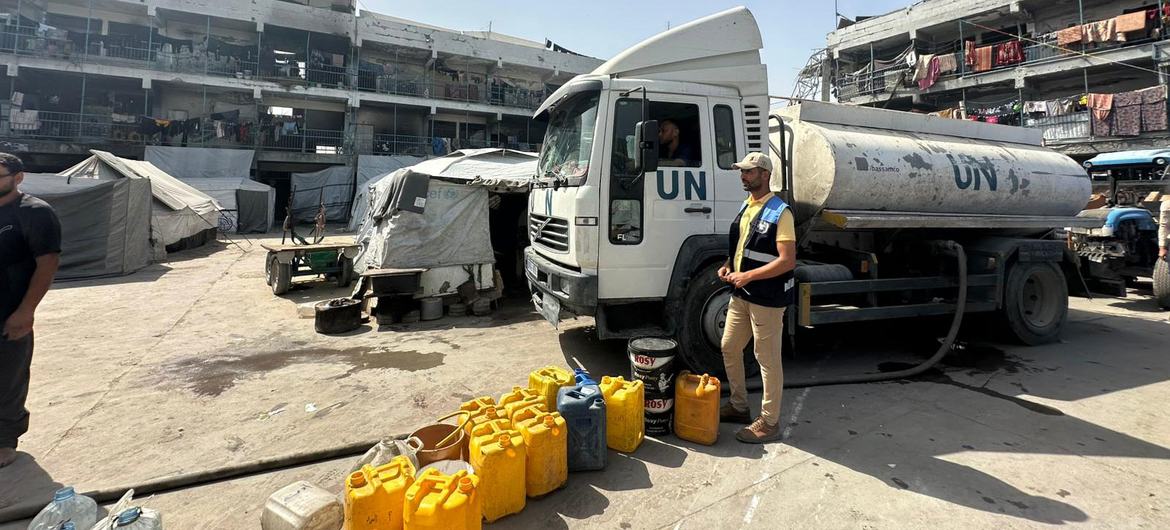
Water is delivered to Gazans sheltering at an UNRWA school.

Systems near collapse

Protracted conflict and bombardment have pushed almost all service systems in Gaza to the brink.

As a result of fuel shortages, only 40 per cent of drinking water facilities are functional and 93 per cent of households face water insecurity. 

The fuel shortage is also negatively affecting the provision of medical services with medical equipment and medicine storage reliant on electricity.

For the first time since the resumption of limited aid entry on 19 May, nine trucks containing medical items offloaded supplies on the Israeli side of the Kerem Shalom crossing on Wednesday.

Displaced, over and over again

Since the resumption of Israeli bombardment in Gaza on 18 March after a 42-day ceasefire, over 684,000 Palestinians have been displaced. And for almost all of them, this is not the first time.

With over 82 per cent of Gaza either designated as an Israeli militarized zone or under a displacement order, there are few places — much less safe places — that the newly displaced can go.

They have been forced to take shelter in overcrowded displacement camps, makeshift shelters, damaged buildings and sometimes just on open streets. Schools are no longer buildings of learning but of shelter.

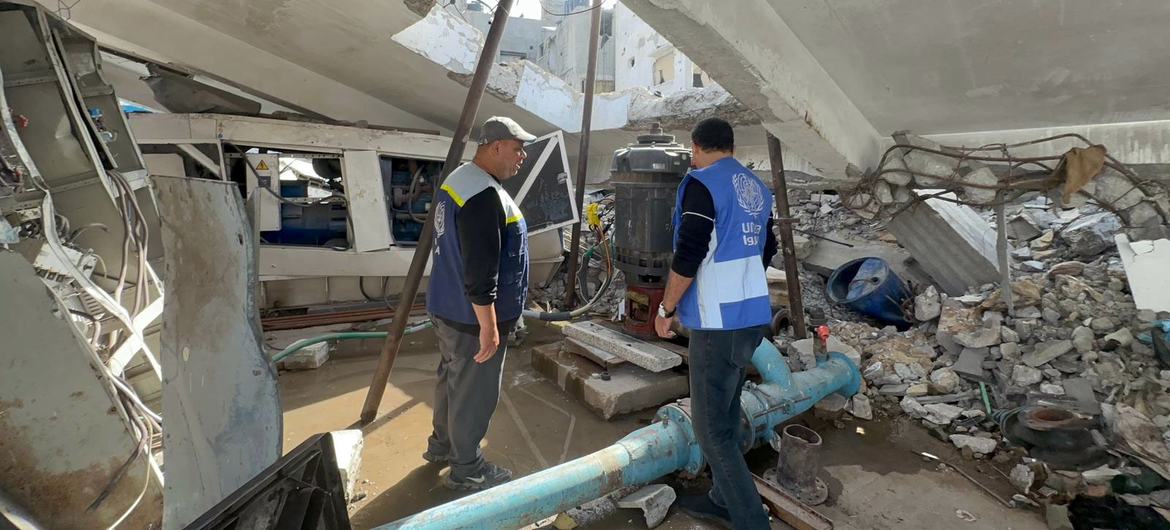
An UNRWA member of staff inspects destroyed infrastructure.

“Schools have transformed into empty shelters, devoid of any elements of a safe learning environment,” said Kamla, a teacher with the UN Relief and Works Agency for Palestinian Refugees in the Near East (UNRWA) in Nuseirat. 

All of these shelters are experiencing rapidly deteriorating conditions as a result of insufficient shelter materials, according to Stéphane Dujarric, spokesperson for the Secretary-General. 

“No shelter materials have entered Gaza since 1 March, before the Israeli authorities imposed a full blockade on aid and any other supplies for nearly 80 days,” he said at a briefing on 19 June.

“While some commodities have subsequently been allowed in small quantities, tents, timber, tarpaulins and any other shelter items remain prohibited.”

The UN and its partners have 980,000 shelter items prepared to dispatch into Gaza once authorization is granted by the Israeli authorities. 

‘Symbols of hope’

Since the beginning of the violence in Gaza, UNRWA has continued to work tirelessly to provide displaced and injured Palestinians with many types of support.

“Despite all this, the eyes and hopes of our community remain fixed on us. UNRWA staff are not merely service providers. In the eyes of people in Gaza, we are pillars of resilience, lifelines of stability and symbols of hope,” said Hussein, an UNRWA worker in Gaza City. 

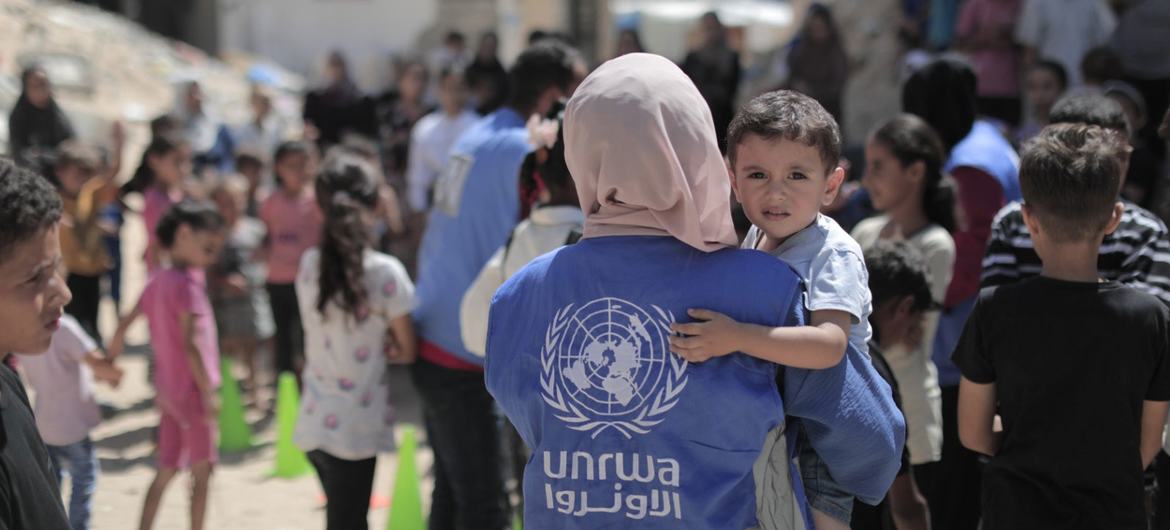
An UNRWA worker carries a young boy in Gaza.

But as fuel shortages continue and only small amounts of humanitarian aid — food, medicine, shelter materials — trickle through the Kerem Shalom border crossing, the job of UNRWA workers and other humanitarians in Gaza is increasingly untenable. 

“We have lost all the tools needed to work, so we have had to adapt,” said Neven, a psychosocial UNRWA worker in Khan Younis.

Dspite their best efforts, the bombardment and devastation of Gaza continues with children going hungry and some even expressing suicidal thoughts. 

“I told my daughter her deceased father is safe, eating and drinking with God,” one mother said. “Now, she cries every day and says, ‘I’m hungry and want to go to my father because he has food to feed us.’” 

Source link

The world pledged to end child labour by 2025: So why are 138 million kids still working?

There are 10,000 children in Madagascar who, like Tenasoa, work in the largely unregulated mica industry. The silicate is used in paints, car parts, and cosmetics – to add a “shimmer” effect. 

Alongside parents and grandparents, these children toil in dangerous conditions, inhaling harmful dust particles and entering structurally unsound tunnels. Many of them have dropped out of school – if they ever went at all. 

If we don’t work, we don’t eat,” Soja, Tenasoa’s grandfather, said. “It’s very simple. Men, women and children must all work to survive.”

In 2015, the United Nations set a goal to end child labour worldwide by 2025 but progress has been slow and halting, according to the Child Labour Report released on Wednesday by the International Labour Organization (ILO) and the UN Children’s Fund (UNICEF).

The report estimates that 138 million children – a 12 million decrease from 2020 – are still engaged in child labour, leading both ILO and UNICEF to call for the rapid acceleration of progress.

The findings of our report offer hope and show that progress is possible … But we must not be blindsided by the fact that we still have a long way to go,” ILO Director-General Gilbert F. Houngbo said.

Hazardous work

Since 2000, the number of children in child labour has been reduced by over 100 million, a promising decrease which proves that the world has a “blueprint” to end child labour. Much work remains, however.

“Far too many children continue to toil in mines, factories or fields, often doing hazardous work to survive,” said Catherine Russell, Executive Director of UNICEF.

Child labour does not refer to all work done by children. Rather, it is work which deprives children of their childhood and is often dangerous to their health and development.

It is important to understand that [child labour] is not household chores, it is not children helping their parents around the house…We are talking about work that is oftentimes hazardous,” Benajamin Smith, an ILO child labour expert told UN News.

Of the 138 million children in child labour, 54 million work in hazardous conditions, including mines.

Honorine, aged 13, is one of these children. She works from 10am to 5pm every day in a gravel quarry in Benin. Paid by the number of buckets of gravel she collects, she is saving her wages, hoping to train to be a hairdresser one day.

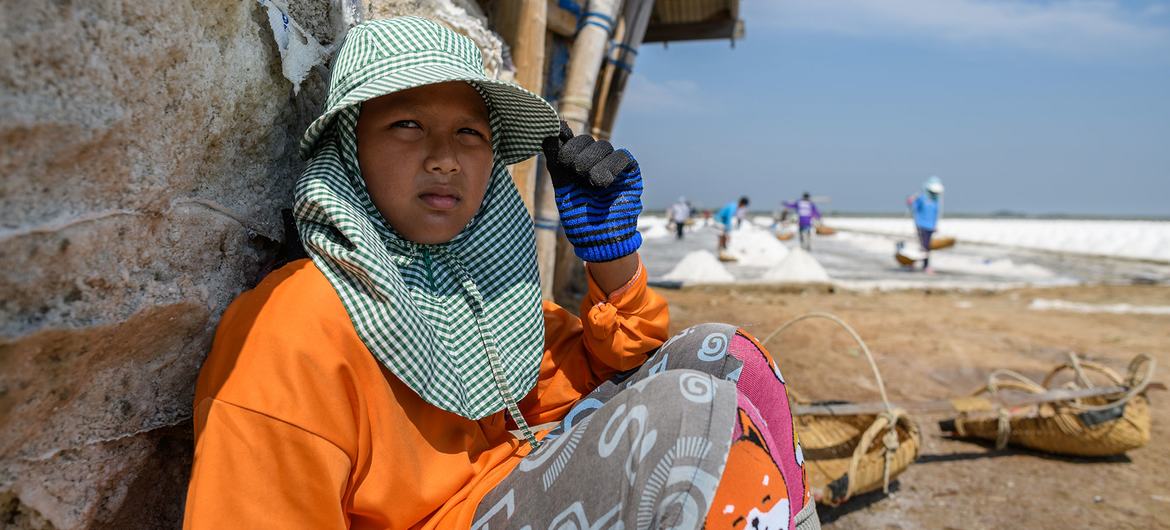
A young boy in Thailand takes a break while working in intense heat as a labourer.

Behind the statistics

The report notes that child labour is intergenerational. Children in child labour systems often struggle to access education, something which in turn compromises their future opportunities and creates a cycle of poverty and deprivation.

Federico Blanco, ILO expert and lead author of the Child Labour Report, noted that it is important to think of child labour as not just statistical.

“Behind every number, let’s remind ourselves that there is a child whose right to education, protection and decent future is being denied,” Mr Blanco said.

Nur, a 13-year-old Rohingya refugee in Bangladesh, was pulled out of school by his parents in order to help support his family financially. A case worker at a nearby UNICEF-funded centre identified Nur and convinced his family to put him back into school.

“I once dreamt of becoming a teacher. I thought I would never be able to become one. But now I feel that I can learn and become a teacher like I always wanted to,” Nur said.

‘A holistic approach’

In the report, UNICEF and ILO called for integrated policy solutions which work across governmental sectors, addressing the problem from an educational, economic and social perspective.

The report also highlighted that ending child labour cannot be accomplished without also thinking about the conditions that drive families to send their children to work – namely, poverty.

Upholding parents’ rights – including the right to collectively bargain, the right to safe work – is also key for ending child labour.

“The ILO looks at [child labour] in quite a holistic way because it is just as important [for] tackling child labour to make sure that the adults have good working conditions because poverty is really at the heart of child labour,” Mr Smith said.

Taking a country-driven approach is especially important due to regional disparities in child labour – the report noted that while all regions saw decreased numbers, Sub-Saharan Africa accounts for two-thirds of child labour worldwide.

Childhood dreams – underfunded and unfulfilled

Attempts to end child labour face significant headwinds as a result of funding shortages.

“Global funding cuts threaten to roll back hard-earned gains. We must recommit to ensuring that children are in classrooms and playgrounds, not at work,” Ms. Russell said.

Adwara, aged 10, dreams of being in class. He attended school for a few years and tried to balance work and school but with eight siblings, helping support his family was non-negotiable. Eventually, his teacher told him not to return – he was missing too much school.

Now, he works in a gold mine in Ethiopia, earning approximately $35 per day: “I’d like to go to school,” he said. “I’d like to become someone.”

Source link

Top marks for Lebanon schools project helping marginalised kids

According to UNICEF, there are an estimated 300,000 children with disabilities in Lebanon today, although data is limited. To help them access learning opportunities, the UN agency and Lebanese authorities launched a pilot project in 2018 to create inclusive schools in 30 public institutions across all governorates.

Today, that number has grown to 117 inclusive schools nationwide.

Equal right to learning

All children need access to inclusive schools and inclusive environments, Amal El Jabali, an Education Officer with UNICEF Lebanon, told UN News.

“It is not about society including them – it is about society adapting its ways to ensure they are part of the community and have an equal right to be there.”

Under the programme, children with disabilities can receive therapy and gain access to assistive devices at participating schools, creating a more level playing field.

Follow their dreams

At Al Fadila Inclusive Public School in Tripoli, 10-year-old Lama studies alongside her classmates, supported by teachers, paraprofessionals and special educators. She is determined that her dwarfism will not hold her back.

She dreams of becoming a chef and believes that anything is possible, said Ms. El Jabali, adding that with the right support, children like Lama can be empowered to follow their dreams and reach their full potential.

After all, every child has a right to education, UNICEF insists.