Israeli strike in Doha marks ‘alarming escalation’, warns top UN official, in call to uphold diplomatic norms

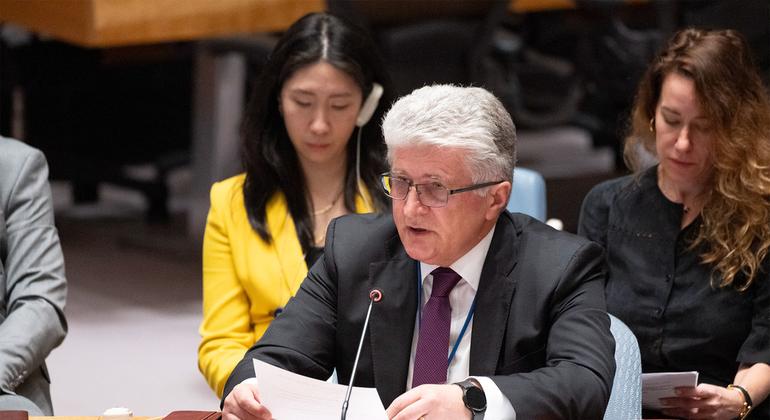
Rosemary DiCarlo described Tuesday’s strike in a residential area of the Qatari capital – which targeted Hamas’s political leadership killing several affiliates along with a Qatari security officer – as potentially opening a “new and perilous chapter in this devastating conflict, seriously threatening regional peace and stability.

The attack occurred on 9 September in residential compounds reportedly housing members of the Hamas’ political bureau, including the son of its chief negotiator, Khalil al-Hayya.

While Hamas leaders survived, the organization said, the incident disrupted ongoing negotiations over a US-mediated ceasefire and hostage release agreement to end the war in Gaza.

Respect sovereignty

The sovereignty and territorial integrity of any country, including Qatar – a valued partner in advancing peacemaking and conflict resolution – must be respected,” Ms. DiCarlo told ambassadors.

She urged all parties to exercise restraint and reaffirmed the need to preserve negotiation and mediation channels to prevent further suffering in Gaza and the wider region.

Israel claimed responsibility for the strike, with Prime Minister Benjamin Netanyahu describing it as “a wholly independent operation” following a deadly attack on civilians in Jerusalem on 8 September, which Hamas said it carried out.

Qatar, the Gulf Cooperation Council, the League of Arab States, and the Organization of Islamic Cooperation condemned the action and expressed concern over further escalation.

Confidence undermined

Ms. DiCarlo told ambassadors that Israel’s strike came “at the height of ongoing consultations.”

Any action that undermines the work of mediation and dialogue weakens confidence in the very mechanisms we depend on for conflict resolution,” she said, stressing that durable solutions in the Middle East cannot be achieved through further violence.

She called for renewed commitment to diplomacy, warning that the urgency of a ceasefire and hostage release has never been greater.

I call on all stakeholders to exercise utmost restraint at this sensitive time and recommit to diplomacy. The urgency of a ceasefire and hostage release deal in Gaza has never been greater. Strike a deal. Free the hostages. End the suffering of the people of Gaza.”

Gaza crisis spiralling

Meanwhile, the humanitarian and security situation in Gaza and the occupied West Bank remains critical.

Since the conflict in Gaza erupted in October 2023 – following attacks by Hamas and other Palestinian armed groups on communities in southern Israel, tens of thousands have died – mostly civilians – infrastructure and basic services are largely destroyed, and the enclave lies in ruins while a new offensive to take Gaza City is ongoing.

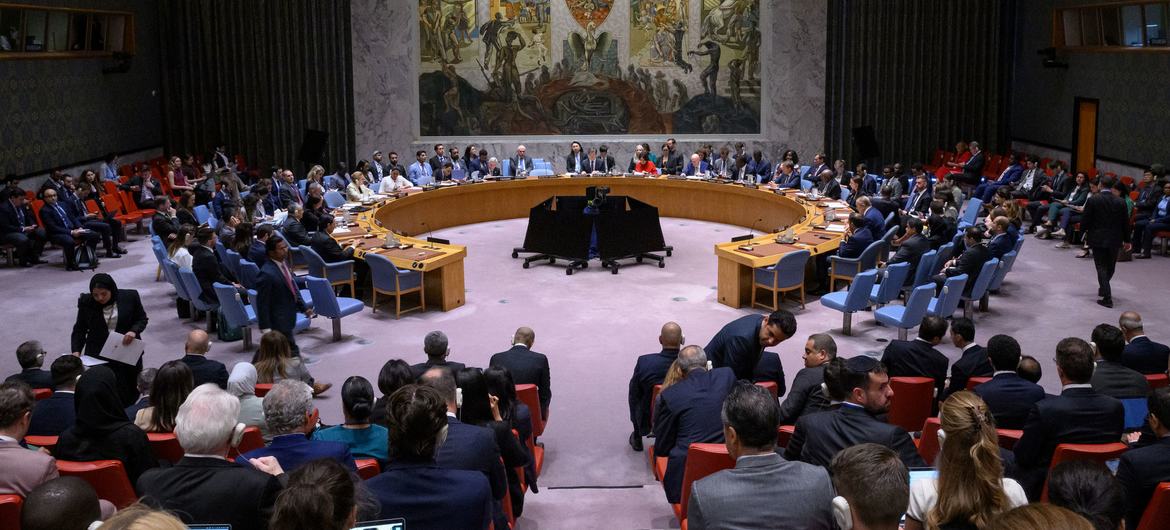
The UN Security Council meets to discuss the situation in the Middle East in the aftermath of an Israeli strike in Doha, the capital of Qatar..

Security Council press statement

Ahead of Thursday’s session, the Security Council issued a press statement expressing condemnation of the strikes in Doha and deep regret over the loss of civilian life.

The statement reaffirmed support for Qatar’s sovereignty and territorial integrity and acknowledges the country’s key role in mediation efforts to end the devastating war, alongside Egypt and the United States.

It emphasised that releasing hostages – including those killed by Hamas – ending hostilities, and ensuring civilian protection in Gaza, remain the Council’s highest priorities.

It also on all parties to seize ongoing diplomatic opportunities for peace.

Source link

Israel’s plan to take over Gaza City marks ‘new and dangerous phase’: Guterres

“Israel’s initial steps to militarily take over Gaza City signals a new and dangerous phase,” he told journalists in New York.

“Expanded military operations in Gaza City will have devastating consequences. Hundreds of thousands of civilians – already exhausted and traumatized – would be forced to flee yet again, plunging families into even deeper peril. This must stop.”

‘Endless catalogue of horrors’

Mr. Guterres was speaking ahead of a Security Council meeting on the situation in Haiti but stopped to brief reporters on the “unfolding tragedy that is Gaza”, where “yet more unconscionable Israeli strikes” have occurred.

Incidents include the two airstrikes on Nasser Hospital in Khan Younis earlier this week which killed civilians, including medical personnel and journalists, “all with the world watching”.

The Secretary-General said “these attacks are part of an endless catalogue of horrors” and called for accountability.  

“Gaza is piled with rubble, piled with bodies, and piled with examples of what may be serious violations of international law,” he said.

“Hostages taken by Hamas and other groups must be released and the atrocious treatment they have been forced to endure must stop. Civilians must be protected.”

© UNICEF/Mohammed Nateel

A displaced family sit outside their tent in Gaza.

Unparalleled destruction and famine

Mr. Guterres stressed that “the levels of death and destruction in Gaza are without parallel in recent times”.

He said that “famine is no longer a looming possibility – it is a present-day catastrophe.”

People are dying from hunger, yet Gaza’s food, water and healthcare systems have been systematically dismantled.

Israel’s obligations

“These are the facts on the ground. And they are the result of deliberate decisions that defy basic humanity,” he said. “Israel, as the occupying Power, has clear obligations.”

He said Israel must ensure the provision of food, water, medicine, and other essentials.  This is in addition to agreeing to and facilitating far greater humanitarian access to Gaza, and protecting civilians and civilian infrastructure.

Mr. Guterres said the International Court of Justice (ICJ) has given binding provisional measures which must be implemented in full and immediately.

They include the obligation to take all steps to ensure unfettered humanitarian and medical assistance to Palestinians throughout the Gaza Strip “without delay and in full cooperation with the United Nations.” 

UN staff killed, aid efforts blocked

Meanwhile, the UN and partners are doing all they can, he said.  This is often at great personal risk, as tragically 366 UN personnel have been killed. 

“Day after day, our efforts are being blocked, delayed, and denied,” he said. “This is unacceptable.”

Settlement expansion in the West Bank

Mr. Guterres also addressed the situation in the West Bank, describing it as “profoundly alarming”.

He said Israeli military operations, settler violence, demolitions, and discriminatory policies are driving displacement and deepening vulnerability. 

Furthermore, the relentless expansion of settlements is fracturing communities and cutting off access to vital resources.

The Israeli authorities recently approved of a plan for the construction of thousands of settlements in the E1 area. He said this would effectively separate the northern and southern West Bank, representing “an existential threat to the two-state solution” between Israelis and Palestinians. 

“I repeat: the Israeli settlements in the occupied West Bank including East Jerusalem have been established – and are being maintained — in violation of international law,” he stressed.   

“Israel must cease such actions and comply with its obligations.”

‘No more excuses’

The Secretary-General concluded his remarks by emphasizing that there is no military solution to the conflict.

“I appeal once again for an immediate and permanent ceasefire, unfettered humanitarian access across Gaza, and the immediate and unconditional release of all hostages,” he said.

“Starvation of the civilian population must never be used as a method of warfare. Civilians must be protected. Humanitarian access must be unimpeded,” he added, ending with a plea for “No more excuses.  No more obstacles.  No more lies.” 

Children are ‘skin and bones’ as Sudan marks a grim milestone

It is a grim milestone for Sudan, the world’s worst humanitarian crisis. But with insufficient funding, lack of access to key regions and intensifying violence, milestones like this have become the grim norm.  

This is not hypothetical. It is a looming catastrophe,” said Sheldon Yett, the UN Children’s Fund (UNICEF) representative in Sudan.

And it is a catastrophe that is unduly affecting women and children, many of whom have been displaced multiple times and lack access to even the most basic of services such as clean water, food and protection.  

“Every day the conflict continues in Sudan, innocent lives are lost, communities are torn apart and trauma continues to haunt generations,” said Radhouane Nouicer, the UN’s designated expert on human rights in Sudan.  

Emotional scar tissue 

Children in Sudan are among those most affected by the crisis – 3.2 million  children under five are projected to suffer from acute malnutrition in the next year.

On a recent trip Jebel Aulia, a locality in Khartoum state which is at extreme risk of famine, Mr. Yett was horrified by what he saw.  

Many of the children are reduced to just skin and bones,” Mr. Yett said.

However, these children are not only contending with malnutrition – some of them have also been displaced four or five times, and over three-quarters of Sudanese children are out of school.  

“The emotional scar tissue is massive – children don’t know where they are going next … often feeling like aliens in their own land,” Mr. Yett said.  

He spoke with one mother in Jebel Aulia whose daughter may be forever changed by the violence.  

Since the war started, my daughter has fallen into a state of silence, and I can feel her heart racing with fear,” one mother said.  

A gendered crisis

Around Sudan, as the food insecurity crisis spirals, women and girls are the “hungriest face of the crisis,” according to Salvator Nkurunziza, the UN Women representative in Sudan.

“With conditions now at near famine thresholds in several regions in the country, it is not just a food crisis but a gender emergency caused by a failure of gender-responsive action,” said Mr. Nkurunziza at a Tuesday press briefing in Geneva.  

A recent report further drove home the gendered nature of the crisis, revealing that women-led households in Sudan are three times more likely to experience severe insecurity than households led by men.  

This is especially concerning as the death, displacement or forced disappearance of men has left more and more women the sole bread winners. In total 75 per cent of women-led households cannot meet basic food needs.

The data is unequivocal: female-headed households are slipping deeper into starvation, with fewer coping mechanisms, less access to income, and even more systemic barriers than last year,” the report said.  

Nevertheless, Mr. Nkurunziza reminded the international community that women are not just victims but also agents of change in crisis settings.  

Women-led organizations are on the frontlines, providing food through soup kitchens and supporting displaced families. And yet, they remain excluded from many of the decision-making processes and exposed to undue risks.  

An unchanged human rights landscape

Food security and displacement are not the only challenges that the Sudanese face. Rather, the human rights situation is also deteriorating, according to Mr. Nouicer who visited Sudan to meet key government officials in July.  

“I remain gravely concerned that civilians in Sudan continue to suffer widespread violations and abuses, including extrajudicial killings, sexual violence, forced displacement and arbitrary detention,” he said.  

He specifically highlighted the unique challenges that women, children and people with disabilities face when confronting displacement and violence.  

“The ongoing war has devastated civilian lives and turned daily survival into a constant struggle.”  

‘Irreversible damage’

Mr Yett said that in his most recent trip, he saw the best and worst of humanity – the devastating impact of violence and inaction coupled with the hopeful possibilities that peace and action could provide.  

We are on the verge of irreversible damage to an entire generation of children, not because we lack the knowledge or the tools to save them but because we are collectively failing to act with the urgency and at the scale this crisis demands,” he said.  

The first step is ensuring access to regions of Sudan like Zamzam which have been cut off from aid. With the rainy season approaching – and some roads already impassable – this is only becoming more difficult.  

Mr. Nouicer highlighted that even if a ceasefire between the warring rival militaries happened, the level of devastation and abuse is so extreme that the future will require more than just peace.  

“The path forward demands more than ceasefires and peace talks. It requires a sustained commitment to justice, accountability, and inclusive governance.” 

Source link

US strikes on Iran’s nuclear sites ‘marks perilous turn’: Diplomacy must prevail, says Guterres

After ten days of airstrikes initiated by Israel aimed at crippling Iran’s nuclear programme which have led to deadly daily exchanges of missile fire between Tehran and Tel Aviv, the UN chief said that diplomacy must now prevail.

We now risk descending into a rathole of retaliation after retaliation,” he said, responding to the US intervention overnight in support of Israel’s military campaign, which targeted three facilities involved in uranium enrichment.

Return to serious negotiations essential

We must act – immediately and decisively – to halt the fighting and return to serious, sustained negotiations on the Iran nuclear programme,” Mr. Guterres added.

He told ambassadors the citizens of the wider Middle East region could not endure yet another cycle of destruction. Demanding a ceasefire, he also put Iran on notice that it must “fully respect” the Non-Proliferation Treaty on the development of nuclear weapons as a cornerstone of peace and security worldwide.

Iran has consistently denied the allegation from Israel and others that its ambitions are to become a nuclear armed State, versus developing atomic energy for purely peaceful purposes.

Israel, the US and Iran face a stark choice. “One path leads to a wider war,” the UN chief continued, “deeper human suffering and serious damage to the international order. The other leads to de-escalation, diplomacy and dialogue.”

Grossi warns of major risks following strikes

The head of the UN’s atomic energy watchdog, the IAEA, warned ambassadors the recent military strikes by Israel and now the US on nuclear sites in Iran have badly compromised safety and could pose serious risks if the situation worsens.

International Atomic Energy Agency Director General Rafael Grossi said the attacks had caused “a sharp degradation in nuclear safety and security”, even though there had been no radiation leaks which could potentially impact the public so far.

The IAEA chief warned ambassadors that if the short window of opportunity to return to dialogue closes then the destruction could be “unthinkable” while the global nuclear non-proliferation regime “as we know it could crumble and fall.”

Mr. Grossi confirmed that Iran’s main enrichment facility at Natanz had suffered major damage, including to key power infrastructure and underground halls containing uranium materials.

He said the main concern inside the site was now chemical contamination, which can be dangerous if inhaled or ingested.

Massive radiation leak still possible

He also listed damage at other nuclear-related sites across the country, including Esfahan, Arak and Tehran, adding that while radiation levels outside remained normal, the attacks had raised alarm over Iran’s operational nuclear plant at Bushehr.

Mr. Grossi warned that any strike on Bushehr could trigger a massive radiation release across the region. “The risk is real,” he said. “Military escalation threatens lives and delays the diplomacy that’s needed to resolve this crisis.”

He urged all sides to show restraint and said the IAEA stood ready to send experts back in to help monitor and protect damaged nuclear sites.

Senior political affairs official: ‘No military solution’

Assistant Secretary-General for Political Affairs Miroslav Jenča told ambassadors that the world is facing “a dangerous moment” following the US bombing mission, as Iran considers potential retaliation.

He warned the council that the region risks being “engulfed in further instability and volatility”, with “no military solution to this conflict”.

Mr. Jenča confirmed extensive damage at Iranian sites, citing open-source satellite imagery and Iranian reports that tunnels and buildings at the Fordow nuclear facility had been hit. He urged Tehran to grant IAEA inspectors access “as soon as safety conditions allow”.

Death toll mounting

Hostilities between Iran and Israel are now into their tenth day, and Mr. Jenča said the humanitarian toll is mounting. “Most [of the 430 killed in Iran] have been civilians,” he noted, while also citing Israeli reports of 25 dead and over 1,300 injured.

He also flagged growing threats from non-State armed groups, including the Houthis in Yemen, warning that their retaliation could widen the conflict. Iran’s parliament, meanwhile, has voiced support for closing the crucial trading route through the narrow Strait of Hormuz.

The world will not be spared from the ramifications of this dangerous conflict,” Mr. Jenča said, urging countries to act in line with international law and the UN Charter.

Source link

Top marks for Lebanon schools project helping marginalised kids

According to UNICEF, there are an estimated 300,000 children with disabilities in Lebanon today, although data is limited. To help them access learning opportunities, the UN agency and Lebanese authorities launched a pilot project in 2018 to create inclusive schools in 30 public institutions across all governorates.

Today, that number has grown to 117 inclusive schools nationwide.

Equal right to learning

All children need access to inclusive schools and inclusive environments, Amal El Jabali, an Education Officer with UNICEF Lebanon, told UN News.

“It is not about society including them – it is about society adapting its ways to ensure they are part of the community and have an equal right to be there.”

Under the programme, children with disabilities can receive therapy and gain access to assistive devices at participating schools, creating a more level playing field.

Follow their dreams

At Al Fadila Inclusive Public School in Tripoli, 10-year-old Lama studies alongside her classmates, supported by teachers, paraprofessionals and special educators. She is determined that her dwarfism will not hold her back.

She dreams of becoming a chef and believes that anything is possible, said Ms. El Jabali, adding that with the right support, children like Lama can be empowered to follow their dreams and reach their full potential.

After all, every child has a right to education, UNICEF insists.