Iran-Israel crisis: IAEA chief urges access to damaged nuclear sites

Rafael Grossi, head of the International Atomic Energy Agency (IAEA), was addressing the agency’s Board of Governors, amid fresh reports of new Israeli missile strikes on Iranian military sites in Tehran and elsewhere earlier on Monday. Iranian weapons fire has also been reported across Israel. 

Mr. Grossi – who also addressed an emergency meeting of the UN Security Council on Sunday – insisted that the agency’s weapons inspectors should return to Iran’s nuclear sites and account for their stockpiles.

There is particular concern about 400 kilogrammes of uranium enriched to 60 per cent by Iran.

Under the terms of a 2015 nuclear deal with the international community, Iran is permitted to enrich the naturally occurring radioactive material to less than four per cent.

“Craters are now visible at the Fordow site, Iran’s main location for enriching uranium at 60 per cent, indicating the use of ground-penetrating munitions; this is consistent with statements from the United States,” he told the IAEA Board of Governors. “At this time, no one including the IAEA, is in a position to have fully assessed the underground damage at Fordow.”

Mr. Grossi said that taking into account the highly explosive payload used in the US attacks, “very significant damage is expected to have occurred” to the highly sensitive centrifuge machinery used to enrich uranium at Fordow.

Several sites hit

Fordow is one of several nuclear-related sites across Iran that are known to have been damaged in the strikes by the United States, including those in Esfahan, Arak and Tehran.

In comments to the UN Security Council in New York on Sunday, the IAEA chief said that although radiation levels remained normal outside these nuclear facilities, deep concerns remained about Iran’s operational nuclear plant at Bushehr.

Any strike on Bushehr could trigger a massive radiation release across the region –  “the risk is real”, Mr. Grossi said.

Eleven days after Israel launched air and missile strikes at Iranian military and nuclear sites, some 430 people are believed to have been killed in Iran, most of them civilians.

According to Israeli reports, 25 people have been killed and more than 1,300 injured by Iranian missile strikes.

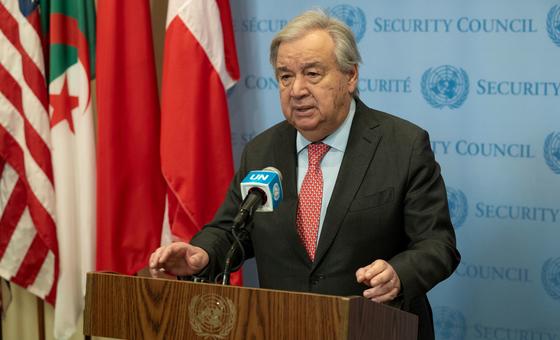
US strikes on Iran’s nuclear sites ‘marks perilous turn’: Diplomacy must prevail, says Guterres

After ten days of airstrikes initiated by Israel aimed at crippling Iran’s nuclear programme which have led to deadly daily exchanges of missile fire between Tehran and Tel Aviv, the UN chief said that diplomacy must now prevail.

We now risk descending into a rathole of retaliation after retaliation,” he said, responding to the US intervention overnight in support of Israel’s military campaign, which targeted three facilities involved in uranium enrichment.

Return to serious negotiations essential

We must act – immediately and decisively – to halt the fighting and return to serious, sustained negotiations on the Iran nuclear programme,” Mr. Guterres added.

He told ambassadors the citizens of the wider Middle East region could not endure yet another cycle of destruction. Demanding a ceasefire, he also put Iran on notice that it must “fully respect” the Non-Proliferation Treaty on the development of nuclear weapons as a cornerstone of peace and security worldwide.

Iran has consistently denied the allegation from Israel and others that its ambitions are to become a nuclear armed State, versus developing atomic energy for purely peaceful purposes.

Israel, the US and Iran face a stark choice. “One path leads to a wider war,” the UN chief continued, “deeper human suffering and serious damage to the international order. The other leads to de-escalation, diplomacy and dialogue.”

Grossi warns of major risks following strikes

The head of the UN’s atomic energy watchdog, the IAEA, warned ambassadors the recent military strikes by Israel and now the US on nuclear sites in Iran have badly compromised safety and could pose serious risks if the situation worsens.

International Atomic Energy Agency Director General Rafael Grossi said the attacks had caused “a sharp degradation in nuclear safety and security”, even though there had been no radiation leaks which could potentially impact the public so far.

The IAEA chief warned ambassadors that if the short window of opportunity to return to dialogue closes then the destruction could be “unthinkable” while the global nuclear non-proliferation regime “as we know it could crumble and fall.”

Mr. Grossi confirmed that Iran’s main enrichment facility at Natanz had suffered major damage, including to key power infrastructure and underground halls containing uranium materials.

He said the main concern inside the site was now chemical contamination, which can be dangerous if inhaled or ingested.

Massive radiation leak still possible

He also listed damage at other nuclear-related sites across the country, including Esfahan, Arak and Tehran, adding that while radiation levels outside remained normal, the attacks had raised alarm over Iran’s operational nuclear plant at Bushehr.

Mr. Grossi warned that any strike on Bushehr could trigger a massive radiation release across the region. “The risk is real,” he said. “Military escalation threatens lives and delays the diplomacy that’s needed to resolve this crisis.”

He urged all sides to show restraint and said the IAEA stood ready to send experts back in to help monitor and protect damaged nuclear sites.

Senior political affairs official: ‘No military solution’

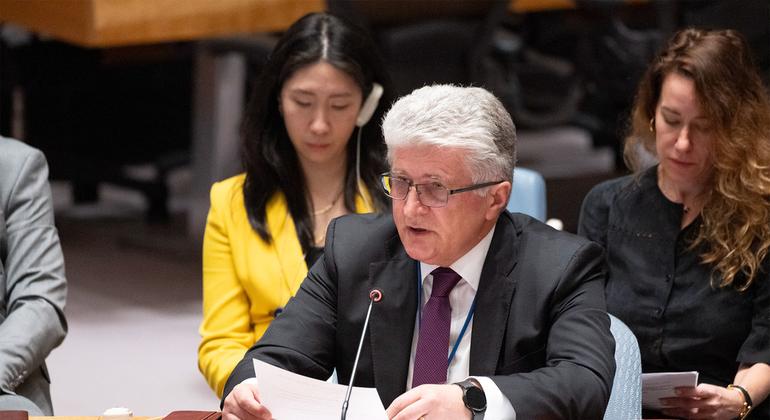
Assistant Secretary-General for Political Affairs Miroslav Jenča told ambassadors that the world is facing “a dangerous moment” following the US bombing mission, as Iran considers potential retaliation.

He warned the council that the region risks being “engulfed in further instability and volatility”, with “no military solution to this conflict”.

Mr. Jenča confirmed extensive damage at Iranian sites, citing open-source satellite imagery and Iranian reports that tunnels and buildings at the Fordow nuclear facility had been hit. He urged Tehran to grant IAEA inspectors access “as soon as safety conditions allow”.

Death toll mounting

Hostilities between Iran and Israel are now into their tenth day, and Mr. Jenča said the humanitarian toll is mounting. “Most [of the 430 killed in Iran] have been civilians,” he noted, while also citing Israeli reports of 25 dead and over 1,300 injured.

He also flagged growing threats from non-State armed groups, including the Houthis in Yemen, warning that their retaliation could widen the conflict. Iran’s parliament, meanwhile, has voiced support for closing the crucial trading route through the narrow Strait of Hormuz.

The world will not be spared from the ramifications of this dangerous conflict,” Mr. Jenča said, urging countries to act in line with international law and the UN Charter.


Source link

UN chief ‘gravely alarmed’ by US bombing of Iranian nuclear sites

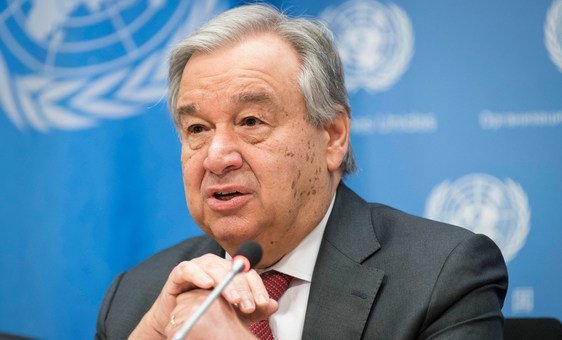
“I am gravely alarmed by the use of force by the United States against Iran today,” said the UN chief, reiterating that there is no military solution.

This is a dangerous escalation in a region already on the edge – and a direct threat to international peace and security.”

President Donald Trump delivered a televised address to the nation from the White House at 10pm local time and said that Iran’s nuclear facilities at Fordo, Natanz and Isfahan had been “totally obliterated” describing the long-range bombing raid as a “spectacular military success.”

President Trump called on Iran’s leadership to now “make peace” and return to negotiations over its nuclear programme or suffer a far greater wave of attacks.

Iranian authorities have yet to confirm the extent of the damage to the three sites in central Iran. Earlier in the day, Iran’s foreign minister reportedly warned the US against any involvement in the Iran-Israel conflict which erupted on 13 June.

Deadly strikes

At least 430 Iranians are believed to have been killed during waves of strikes since then with around 3,500 injured, according to figures from the Iranian health ministry.

In Israel, 24 civilians have died in the retaliatory attacks according to local authorities with more than 400 missiles reportedly fired towards the country.

B-2 bombers were involved in the US strikes, President Trump confirmed, dropping so-called “bunker buster” bombs on the uranium enrichment site at Fordow which is buried deep inside a mountain south of the capital Tehran.

‘Avoid a spiral of chaos’

In his statement, the Secretary-General reiterated his concerns voiced in the Security Council during Friday’s emergency meeting on the crisis that the conflict “could rapidly get out of control – with catastrophic consequences for civilians, the region, and the world.”

He called on all Member States to de-escalate the situation which threatens the stability of the Middle East and beyond, calling for everyone to uphold their obligations under the UN Charter and international law.

At this perilous hour, it is critical to avoid a spiral of chaos,” he added calling for an immediate return to negotiations between the warring parties.

There is no military solution. The only path forward is diplomacy. The only hope is peace.”

Source link

UN rights office ‘horrified’ by deadly violence at Gaza food distribution sites

The UN human rights office (OHCHR) in the Occupied Palestinian Territory on Wednesday called on the Israeli military to cease the use of lethal force near aid convoys and food distribution sites.

It cited “repeated incidents” of Palestinians being shot or shelled while seeking food, warning that such attacks could constitute war crimes under international law.

“We are horrified at the repeated incidents, continuously reported in recent days across Gaza, and we call for an immediate end to these senseless killings,” the office said in a statement.

Hundreds killed

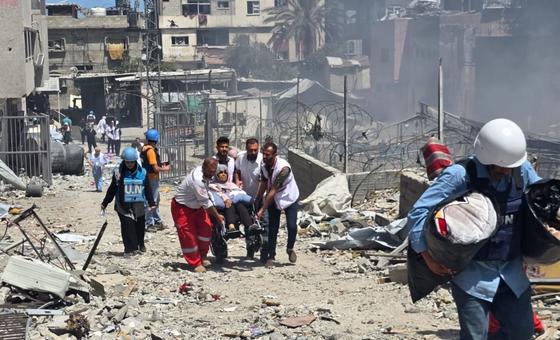
Since 27 May, when the Gaza Humanitarian Foundation (GHF), an initiative backed by Israel and the United States began food distribution in southern Gaza – bypassing the established UN-led system – hundreds have been killed and many more wounded near four distribution points or while waiting to pick up aid.

In one of the deadliest recent incidents, Israeli military reportedly shelled a crowd waiting for UN food trucks in southern Gaza on 17 June, killing at least 51 people and injuring some 200 others, according to Gazan health authorities.

A day earlier, three Palestinians were reportedly killed and several injured in a similar incident in western Beit Lahiya.

There is no information to suggest that the people killed or injured were involved in hostilities or posed any threat to the Israeli military or to staff of GHF distribution points,” OHCHR said.

Protect civilians, aid workers

The UN World Food Programme (WFP), which has managed to dispatch only 9,000 metric tons of food within Gaza over the past month – a fraction of what is required for the 2.1 million people in need – echoed calls for immediate protection of civilians and aid workers.

“Far too many people have died while trying to access the trickle of food aid coming in,” the agency said in a separate statement.

“Any violence resulting in starving people being killed or injured while seeking life-saving assistance is completely unacceptable.”

Massive scale-up needed

The UN emergency food relief agency said the fear of starvation and desperate need for food is causing large crowds to gather along well-known transport routes, hoping to intercept and access humanitarian supplies while in transit.

Only a massive scale-up in food distributions can stabilize the situation, calm anxieties and rebuild the trust within communities that more food is coming,” it said, calling urgently for safer convoy routes, faster permissions, restored communication channels and additional border openings.

“The time to act is now. Delays cost lives. We must be allowed to safely do our jobs,” the agency said.

Source link

Gaza: Guterres urges probe into killings at food distribution sites

More than 30 people were killed and over 100 wounded while waiting in the early morning to get food from two sites in Rafah and Middle Gaza run by the newly established Gaza Humanitarian Foundation (GHF), according to media reports.

The organization is backed by Israel and the United States and uses private US security contractors supervised by the Israeli military. Aid distributions began at the end of May, bypassing the UN and other humanitarian agencies.

Risking their lives

UN chief António Guterres issued a statement on Monday saying he was “appalled” by the reports.

“It is unacceptable that Palestinians are risking their lives for food,” he said.

“I call for an immediate and independent investigation into these events and for perpetrators to be held accountable.”

He stressed that Israel has clear obligations under international humanitarian law to agree to and facilitate humanitarian aid. 

Allow UN operations

“The unimpeded entry of assistance at scale to meet the enormous needs in Gaza must be restored immediately,” he said.

The UN must be allowed to work in safety and security under conditions of full respect of humanitarian principles.

Meanwhile, the Secretary-General continues to call for an immediate permanent, sustainable ceasefire in Gaza and the immediate and unconditional release of all hostages.

“This is the only path to ensuring security for all. There is no military solution to the conflict,” he said.

More to follow… 

Source link