World News in Brief: Afghan quake update, diplomacy continues to end Sudan war, UN honours victims of 9/11

Women and children face heightened risks, while operational challenges – including restrictions on female UN staff – threaten life-saving relief efforts.

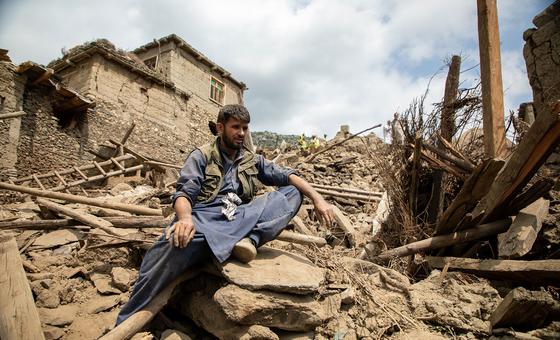
The twin quakes, measuring 6.0 and 6.2, struck on 31 August and 4 September, flattening entire villages in Kunar, Nangarhar, Laghman and Nuristan provinces. Mountainous terrain and landslides blocked key roads, leaving air transport as the only reliable access. 

Assessments indicate over 6,700 homes were destroyed or damaged, forcing most families to shelter in the open without privacy, clean water, or basic services.

Ensuring critical healthcare

UNFPA, the UN reproductive health agency, has deployed health teams to the hardest-hit areas, providing maternal and reproductive healthcare, psychosocial support and counselling. More than 9,500 people have received assistance so far.

“Women and children in particular are extremely traumatized,” said a psychosocial counsellor. “Our goal is to support their emotional and mental health and provide whatever assistance we can, including medicines and dignity kits.”

Among the affected, UNFPA estimates some 11,600 pregnant women face heightened risk due to limited access to health services.

“For pregnant women, a natural disaster can turn an already challenging time into a life-threatening crisis,” said UNFPA Representative Kwabena Asante-Ntiamoah.

World Health Organization (WHO) mobile teams have been deployed to provide trauma care, maternal and child health services, mental health support, immunizations, and emergency nutrition.

The agency has also dispatched 43 tonnes of medical supplies and provided over 4,500 consultations through its clinics.

Sudan: UN envoy heads to region in call for dialogue towards peace

The UN Secretary-General’s Personal Envoy for Sudan, Ramtane Lamamra, has travelled to East Africa to address the ongoing civil conflict there and push for negotiations towards a peace deal.

 In a post on X earlier this week, Mr. Lamamra called on combatants and political actors in Sudan “to engage in constructive dialogue leading to a sustainable solution.”

The goal of the visit is to make progress on the protection of civilians and to strengthen multilateral mediation efforts in the country.

Push for high level consultations

To achieve that, he is working together with the African Union to organize a ministerial-level consultative group meeting in Addis Ababa.

As the rival militaries continue to attack civilians and vital infrastructure, many displaced people and other communities are receiving reduced food assistance, or none at all.

“We continue to reiterate our calls for an end to this conflict that has left 25 million people acutely hungry,” said the UN Secretary General’s Spokesperson Stéphane Dujarric at a press conference on Thursday.

UN honours 9/11 anniversary, stands with New Yorkers

Marking the 24th anniversary of the 11 September terror attacks, the UN reaffirmed its enduring solidarity on Thursday with the people of New York, the city where it has been headquartered for nearly 80 years. 

“New York has hosted the United Nations for 80 years and has been the home to many of our colleagues, as well as to diplomats, staff, and of course all the Secretaries-General. We continue to stand in solidarity with the people of New York, as we did 24 years ago,” said UN Spokesperson Stéphane Dujarric. 

The attacks on the twin towers of the World Trade Center in downtown Manhattan claimed nearly 3,000 lives from over 90 countries and left thousands more injured. 

Decades later, survivors and first responders continue to face long-term health challenges, including respiratory illnesses, cancer, and mental health struggles. 

A place to call home

“New York City has hosted our UN Headquarters for decades and is the place many colleagues call home – so do I,” said Secretary-General António Guterres.

“Today, my thoughts are with everyone who lost loved ones on 9/11, and with all the people of New York City,” he added, in a social media post. 

The UN emphasised its ongoing commitment to commemorate the worst terror attack in US history, honouring the victims, and supporting New Yorkers as the city continues its journey of resilience and healing. 

Source link

UN official decries deadly Ukraine strikes, urges return to diplomacy

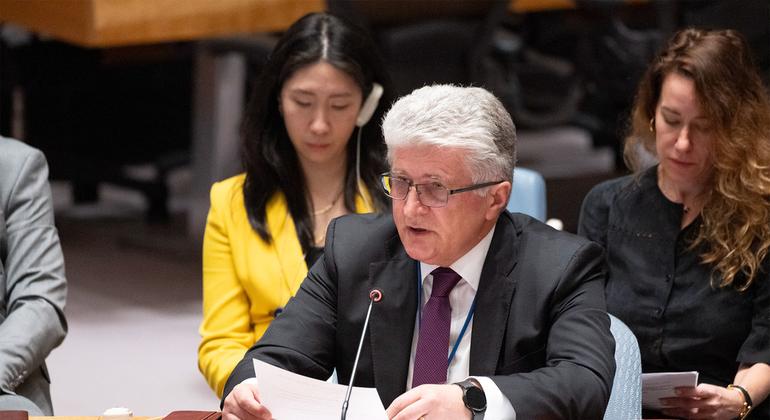
Briefing ambassadors in the Security Council, Miroslav Jenča, Assistant Secretary-General for Europe in the Department of Political and Peacebuilding Affairs (DPPA), renewed the call for an immediate ceasefire and a return to diplomacy to end the devastation.

“Ukrainian people have endured nearly three-and-a-half years of unimaginable horrors, death, devastation and destruction. They urgently need relief from this nightmare,” he said.

He stressed that diplomacy, not fighting, needs to escalate in the coming days and weeks.

“Diplomacy that leads to real, tangible, verifiable and lasting results that would be felt by the long-suffering people on the ground,” he added, reiterating that the UN remains ready to support all efforts toward a just, lasting peace in line with the UN Charter and international law.

ASG Jenča briefs the Security Council.

Brutal attacks continue

Mr. Jenča described the “brutal” scale of the latest attacks.

Overnight between 30 and 31 July, a large-scale Russian aerial assault on Kyiv killed at least 31 people – including five children – and injured 159 others, 16 of them children. It marked the highest number of child injuries in a single night in the capital since the invasion began in February 2022.

The strikes damaged 27 locations across four districts of Kyiv, including a school, a preschool, a paediatric hospital wing, and a university building.

“An entire section of an apartment block was also reportedly destroyed, leaving many trapped beneath the burning rubble,” said Mr. Jenča.

Humanitarian workers, including UN agencies and local partners, responded swiftly, delivering shelter kits, emergency psychosocial support and legal counselling to affected families.

Strikes beyond Kyiv

Beyond Kyiv, attacks were reported across at least seven regions – Vinnytsia, Donetsk, Dnipropetrovsk, Zhytomyr, Zaporizhzhia, Cherkasy and Chernihiv – with a total of at least 120 civilian casualties in a single night.

In Donetsk, two people were reportedly killed and 10 injured; in Kharkiv, one person was killed and seven injured. Additional casualties were confirmed in Sumy, Kherson and Zaporizhzhia.

In Kamianske, a hospital attack left three dead – including a pregnant woman – and 22 injured, many of them medical staff. In Novoplatonivka, Kharkiv region, six were killed while waiting for humanitarian aid.

“These continuing horrendous attacks are simply unacceptable,” said Mr. Jenča.

The UN human rights office, OHCHR, reports that since the start of the full-scale invasion thorugh June this year, more than 13,580 civilians – including 716 children – have been killed, and over 34,000 injured.

Casualties inside Russia

Mr. Jenča also noted civilian casualties inside Russia.

Between 25 and 29 July, Russian authorities reported attacks in Belgorod, Bryansk, Kursk, Leningrad and Rostov regions, resulting in at least six deaths and multiple injuries.

While the UN cannot verify these reports, Mr. Jenča expressed concern and reiterated that “attacks on civilians and civilian infrastructure are prohibited under international law and must stop immediately – wherever they occur.”

Abuses against POWs

He also detailed new allegations of abuse against Ukrainian prisoners of war (POWs).

According to OHCHR interviews with nearly 140 recently released male POWs, “nearly all…reported having been subjected to torture or ill-treatment,” including beatings, electric shocks, and suffocation.

OHCHR also documented credible reports of 106 executions of Ukrainian soldiers in Russian custody.

Source link

‘Peace is a choice’: UN chief urges diplomacy as wars spread from Gaza to Ukraine

This is the only sustainable path to global security, he told ministers at a high-level open debate of the Security Council on Tuesday.

The Secretary-General emphasised that the UN Charter’s tools – negotiation, mediation, conciliation, arbitration and more – remain a lifeline when tensions escalate, grievances fester and states lose trust in each other.

These tools are needed now more than ever, he stressed, as conflicts rage and international law is violated with impunity.

The cost is staggering – measured in human lives, shattered communities and lost futures. We need look no further than the horror show in Gaza – with a level of death and destruction without parallel in recent times.”

The risk of starvation looms and aid operations are being denied the space and safety to function. UN premises, such as the UN Office for Project Services (UNOPS) and the World Health Organization (WHO)’s main warehouse, have been hit despite parties being notified of their locations.

“These premises are inviolable and must be protected under international humanitarian law – without exception,” Mr. Guterres reiterated.

Peace is a choice – make it

From Gaza to Ukraine, from the Sahel to Sudan, Haiti and Myanmar, “conflict is raging, international law is being trampled, and hunger and displacement are at record levels,” he continued, adding that terrorism, violent extremism and transnational crime also remain “persistent scourges” pushing security further out of reach.

Peace is a choice. And the world expects the Security Council to help countries make this choice.

Mr. Guterres pointed to the UN Charter’s bedrock obligation in Article 2.3 that “all Members shall settle their international disputes by peaceful means”, and to Chapter VI, which empowers the Security Council to support “negotiation, enquiry, mediation, conciliation, arbitration, judicial settlement, resort to regional agencies or arrangements, or other peaceful means of their own choice.”

Action 16 of last year’s Pact for the Future urges states to recommit to preventive diplomacy, he said, commending Pakistan – the Council President for July – for tabling a resolution encouraging fuller use of those tools, which was adopted unanimously at the meeting.

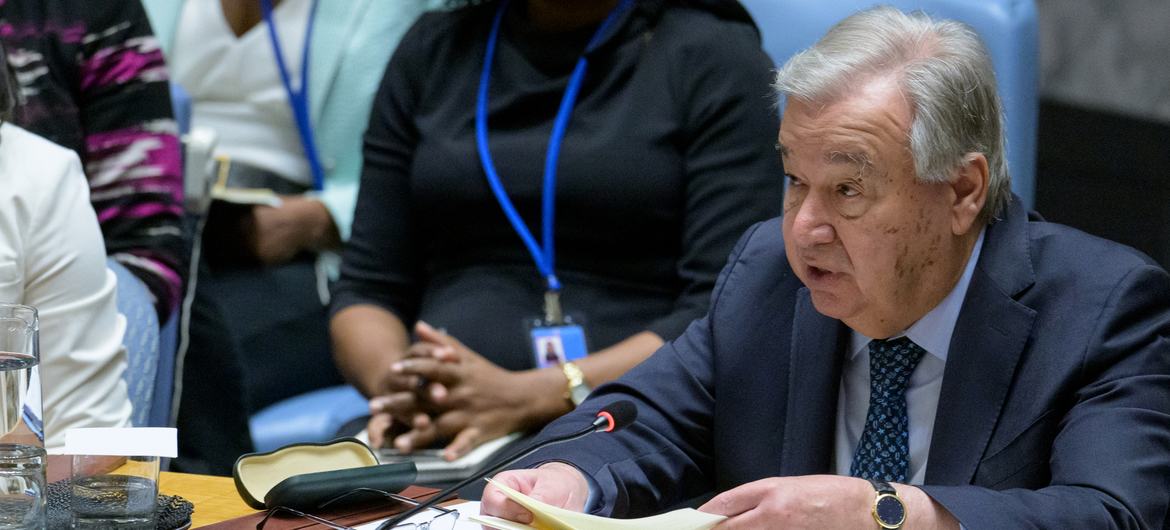
Secretary-General António Guterres addresses the Security Council high-level open debate.

P5 must overcome divisions

Security Council members – “in particular its permanent members” – must overcome divisions, the Secretary-General said, reminding them that even during the Cold War, Council dialogue underpinned peacekeeping missions and humanitarian access, and helped prevent a third world war.

He urged members to keep channels open, build consensus and make the body “more representative” of today’s geopolitical realities with more inclusive, transparent and accountable working methods.

Mr. Guterres also urged deeper cooperation with regional and subregional organizations.

Mediation can work even amid war, he said, noting the third anniversary of the Black Sea Initiative and a related memorandum with Russia that enabled grain movements during the conflict in Ukraine.

Renew commitment to multilateralism

States must honour their obligations under the Charter; international human rights, refugee and humanitarian law, and the principles of sovereignty, territorial integrity and political independence, Mr. Guterres said.

As we mark the 80th anniversary of our Organization and the Charter that gave it life and shape, we need to renew our commitment to the multilateral spirit of peace through diplomacy,” he said.

I look forward to working with you to achieve the international peace and security the people of the world need and deserve.

Security Council open debate

A signature event of the Pakistani presidency, Tuesday’s open debate was chaired by Deputy Prime Minister and Foreign Minister Mohammad Ishaq Dar.

The session aimed to assess the effectiveness of existing mechanisms for pacific dispute settlement, examine best practices and explore new strategies for tackling protracted conflicts.

It also sought to enhance cooperation with regional organizations, boost capacity-building and resource mobilisation, and align future efforts with the conflict-prevention vision outlined in the Pact for the Future.

Source link

UN urges renewed diplomacy on Iran nuclear deal, hails Tehran-Tel Aviv ceasefire as ‘significant achievement’

Amid this relative calm, the United Nations has renewed its call for a diplomatic solution to the Iran nuclear issue, warning that the objectives of the Joint Comprehensive Plan of Action (JCPOA) – and the resolution that endorsed it – remain unmet.

Addressing a planned Security Council meeting on Tuesday to try and revive the deal amid the dramatic military escalation of the past 12 days, UN political affairs chief Rosemary DiCarlo said the fragile ceasefire announced by Donald Trump overnight provided “an opportunity to avoid a catastrophic escalation and achieve a peaceful resolution of the Iran nuclear issue.

The 2015 Iran nuclear deal – more formally known as the JCPOA and backed by the Security Council – offered Tehran sanctions relief in exchange for strict limits on uranium enrichment, stockpile levels and centrifuge use, alongside robust monitoring and verification by the International Atomic Energy Agency (IAEA).

But the accord has remained in limbo since the United States withdrew in 2018, followed by Iran’s rollbacks of its nuclear-related commitments.

With key provisions under resolution 2231 set to expire on 18 October – unless the Council decides otherwise – the UN’s top political official has warned that the window for reviving diplomacy is narrowing.

With less than four months before resolution’s remaining nuclear-related restrictions are set to expire on 18 October – unless extended by the Council – the UN’s top political official warned that the agreement’s key aims remain elusive.

Diplomacy kneecapped?

Ms. DiCarlo told ambassadors the recent surge in violence had significantly undermined diplomatic momentum.

The military escalation between Israel and Iran since 13 June and United States air strikes on Iran’s nuclear facilities on 21 June complicated prospects for achieving full implementation of resolution 2231,” Ms. DiCarlo said.

Iran’s strikes yesterday on a base in Qatar further exacerbated insecurity in an already tense region.

Despite five rounds of bilateral talks between Iran and the US, facilitated by Oman in recent months, Ms. DiCarlo noted that efforts “did not produce a way forward” to restore full JCPOA implementation.

A sixth round of talks was called off due to the outbreak of hostilities.

Meanwhile, the toll from the recent conflict has been sobering. According to Iranian authorities, at least 606 people were killed and more than 5,300 injured since hostilities erupted on 13 June. Israeli officials reported 28 deaths and nearly 1,500 injuries.

Time running out

While divisions persist, Ms. DiCarlo said JCPOA participants – China, France, Germany, Iran, Russia, and the United Kingdom – had all reiterated their commitment to finding a diplomatic solution.

In a joint statement shared with the Secretary-General in March, China, Iran and Russia stressed the importance of resolution 2231’s provisions and timelines. China separately proposed a “step-by-step and reciprocal approach” to settle the nuclear issue.

“Diplomacy, dialogue and verification remain the best option to ensure the exclusively peaceful nature of Iran’s nuclear programme,” Ms. DiCarlo said.

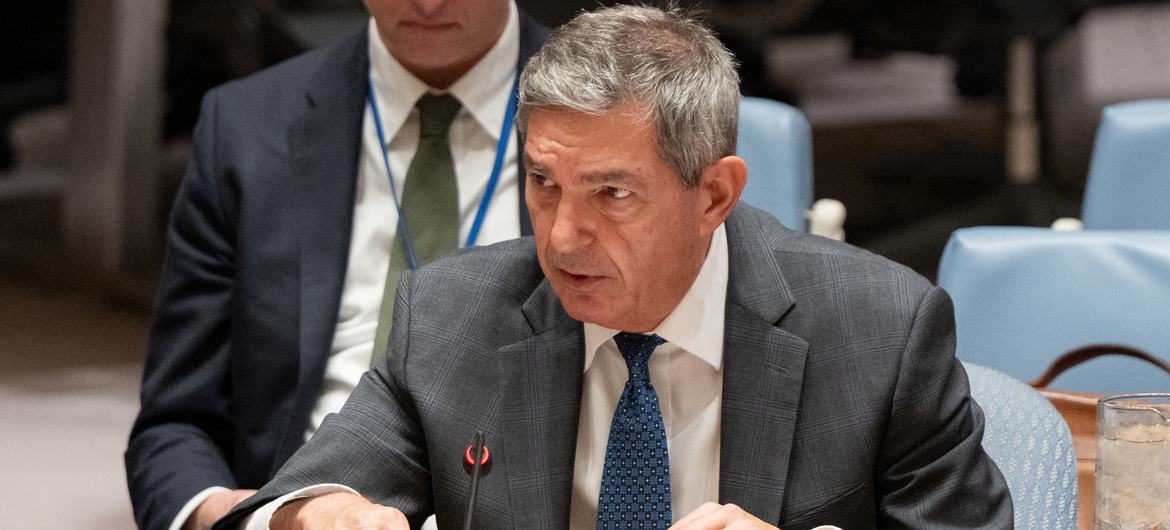
EU Ambassador Stavros Lambrinidis briefs the Security Council as the Coordinator of the Joint Commission established by the JCPOA.

Deal, not force, key to resolution: European Union

Echoing UN appeals for dialogue, the European Union stressed that “a lasting solution to the Iranian nuclear issue can only be through a negotiated deal, not military action.

Briefing the Council on behalf of EU High Representative Kaja Kallas, Ambassador Stavros Lambrinidis underscored the urgent need “to come back to a diplomatic solution.”

Ensuring that Iran does not acquire or develop a nuclear weapon remains a key security priority for the EU, he said.

He added that Iran’s accelerating nuclear activities and the absence of IAEA oversight – compounded by the economic fallout from US sanctions – have severely undermined the JCPOA, despite sustained EU efforts to preserve it through diplomacy.

Mr. Lambrinidis reaffirmed that diplomacy must prevail, with the IAEA remaining central to monitoring and verification efforts going forward.

US urges Iran to return to talks

Ambassador Dorothea Shea, Acting US Representative, said Iran’s increase in nuclear activity lacked “any credible civilian justification.”

Even after the IAEA Board of Governors found it noncompliant with nuclear safeguards, she noted, “it is regrettable that certain members of this Council have opted to turn a blind eye to, if not encourage, Iranian noncompliance.”

The US “will not turn a blind eye to Iran’s noncompliance and ongoing threat to regional stability,” she continued.

Ambassador Shea said the 21 June “precision operation effectively fulfilled our narrow objective – to degrade Iran’s capacity to produce a nuclear weapon,” after which President Trump coordinated a ceasefire between Iran and Israel.

“In this critical moment,” she concluded, “we must all urge Iran to seize this opportunity for peace and prosperity and abide by its international obligations.”

UK calls ceasefire a first step

UK Ambassador Barbara Woodward welcomed the ceasefire brokered by President Trump but warned that “the situation remains extremely fragile.”

Expressing that “now is the time for a return to diplomacy,” she urged Iran to engage in talks without delay, warning that its nuclear programme has exceeded “any credible civilian justification.”

She said all diplomatic levers will be deployed for a negotiated outcome and to “ensure Iran does not develop a nuclear weapon.”

Iran: Diplomacy can and must resolve differences

Iran’s Ambassador, Amir Saeid Iravani, said that his country “never initiated this war” and that “once the aggressors stopped their attacks, Iran stopped its lawful military response as well”.

Mr. Saeid also expressed his country’s strong commitment to diplomacy as the path through which differences can and should be resolved.

“Iran continues to believe that a diplomatic resolution to nuclear and sanction issues is possible,” Mr. Saeid said.

He called on the Security Council to condemn Israel’s and the United States’ attacks on Iran and their IAEA-protected nuclear facilities and work to ensure that they never happen again.

Ambassador Iravani added that Iran upheld Council resolution 2231 and the JCPOA, and that remedial measures were “fully consistent” with these two instruments.

Israel warns diplomacy with Iran has failed

Israeli Ambassador Danny Danon defended his country’s military operation against Iran, describing it as a necessary move to neutralise a “double existential threat” from Tehran’s nuclear and missile programmes.  

He said Israel achieved complete air superiority and removed key regime targets, acting in coordination with the US.

Ambassador Danon accused Iran of deceiving the world for years, using diplomacy as cover to advance its nuclear weapons programme.

“There is still time,” he said, “to take meaningful and decisive action to ensure that the threat of a nuclear Iran does not return stronger than before.”

“We are often told that diplomacy must be given a chance – it was given every chance, every round, every channel, every deadline – but so far it has failed, the regime in Tehran never had any intention of complying.”

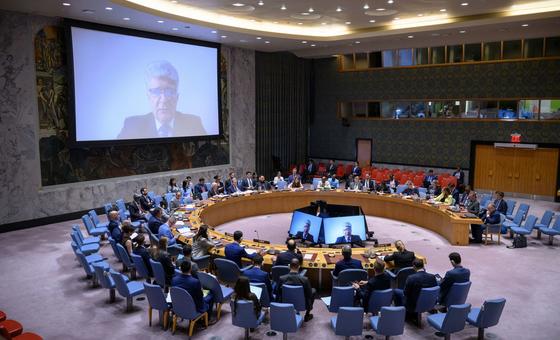
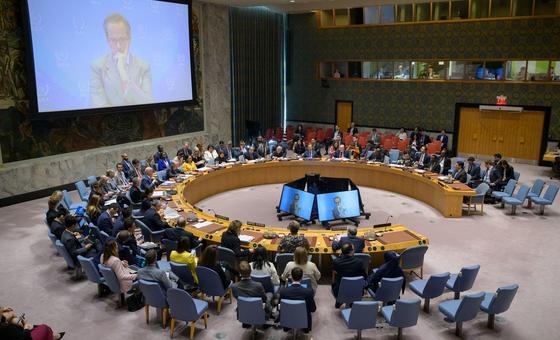
Video feed of the Security Council meeting.

Source link

US strikes on Iran’s nuclear sites ‘marks perilous turn’: Diplomacy must prevail, says Guterres

After ten days of airstrikes initiated by Israel aimed at crippling Iran’s nuclear programme which have led to deadly daily exchanges of missile fire between Tehran and Tel Aviv, the UN chief said that diplomacy must now prevail.

We now risk descending into a rathole of retaliation after retaliation,” he said, responding to the US intervention overnight in support of Israel’s military campaign, which targeted three facilities involved in uranium enrichment.

Return to serious negotiations essential

We must act – immediately and decisively – to halt the fighting and return to serious, sustained negotiations on the Iran nuclear programme,” Mr. Guterres added.

He told ambassadors the citizens of the wider Middle East region could not endure yet another cycle of destruction. Demanding a ceasefire, he also put Iran on notice that it must “fully respect” the Non-Proliferation Treaty on the development of nuclear weapons as a cornerstone of peace and security worldwide.

Iran has consistently denied the allegation from Israel and others that its ambitions are to become a nuclear armed State, versus developing atomic energy for purely peaceful purposes.

Israel, the US and Iran face a stark choice. “One path leads to a wider war,” the UN chief continued, “deeper human suffering and serious damage to the international order. The other leads to de-escalation, diplomacy and dialogue.”

Grossi warns of major risks following strikes

The head of the UN’s atomic energy watchdog, the IAEA, warned ambassadors the recent military strikes by Israel and now the US on nuclear sites in Iran have badly compromised safety and could pose serious risks if the situation worsens.

International Atomic Energy Agency Director General Rafael Grossi said the attacks had caused “a sharp degradation in nuclear safety and security”, even though there had been no radiation leaks which could potentially impact the public so far.

The IAEA chief warned ambassadors that if the short window of opportunity to return to dialogue closes then the destruction could be “unthinkable” while the global nuclear non-proliferation regime “as we know it could crumble and fall.”

Mr. Grossi confirmed that Iran’s main enrichment facility at Natanz had suffered major damage, including to key power infrastructure and underground halls containing uranium materials.

He said the main concern inside the site was now chemical contamination, which can be dangerous if inhaled or ingested.

Massive radiation leak still possible

He also listed damage at other nuclear-related sites across the country, including Esfahan, Arak and Tehran, adding that while radiation levels outside remained normal, the attacks had raised alarm over Iran’s operational nuclear plant at Bushehr.

Mr. Grossi warned that any strike on Bushehr could trigger a massive radiation release across the region. “The risk is real,” he said. “Military escalation threatens lives and delays the diplomacy that’s needed to resolve this crisis.”

He urged all sides to show restraint and said the IAEA stood ready to send experts back in to help monitor and protect damaged nuclear sites.

Senior political affairs official: ‘No military solution’

Assistant Secretary-General for Political Affairs Miroslav Jenča told ambassadors that the world is facing “a dangerous moment” following the US bombing mission, as Iran considers potential retaliation.

He warned the council that the region risks being “engulfed in further instability and volatility”, with “no military solution to this conflict”.

Mr. Jenča confirmed extensive damage at Iranian sites, citing open-source satellite imagery and Iranian reports that tunnels and buildings at the Fordow nuclear facility had been hit. He urged Tehran to grant IAEA inspectors access “as soon as safety conditions allow”.

Death toll mounting

Hostilities between Iran and Israel are now into their tenth day, and Mr. Jenča said the humanitarian toll is mounting. “Most [of the 430 killed in Iran] have been civilians,” he noted, while also citing Israeli reports of 25 dead and over 1,300 injured.

He also flagged growing threats from non-State armed groups, including the Houthis in Yemen, warning that their retaliation could widen the conflict. Iran’s parliament, meanwhile, has voiced support for closing the crucial trading route through the narrow Strait of Hormuz.

The world will not be spared from the ramifications of this dangerous conflict,” Mr. Jenča said, urging countries to act in line with international law and the UN Charter.

Source link

SECURITY COUNCIL LIVE: ‘Diplomacy must prevail’ over Iran following US military intervention, urges Guterres

The UN Secretary-General told the Security Council on Sunday that the bombing of Iran’s nuclear sites by the United States marks a “perilous turn”, warning that the region cannot endure yet another “cycle of destruction.” António Guterres said the must be an immediate ceasefire and returned to “serious, sustained negotiations.” We’ll have live updates from our Meetings Coverage team below and app users can follow here.

Source link

India – Canada ties hit next level of escalation, 6 Canadian diplomats expelled in response

In a quick response to Canada’s move, India expelled six Canadian diplomats on Monday, just hours after announcing the withdrawal of its High Commissioner and other key officials from Canada. The move comes as relations between the two nations deteriorate, with India citing Canadian Prime Minister Justin Trudeau’s ongoing “hostility” towards New Delhi.

The Ministry of External Affairs (MEA) issued a statement confirming the expulsion of the diplomats, who have been instructed to leave India by 11:59 p.m. on Saturday, October 19. Among those expelled are Stewart Ross Wheeler, Acting High Commissioner, and several senior officials, including Patrick Hebert, Deputy High Commissioner, and First Secretaries Marie Catherine Joly, Ian Ross David Trites, Adam James Chuipka, and Paula Orjuela.

India’s decision was conveyed to Stewart Wheeler, Canada’s Charge d’Affaires in New Delhi, who was summoned to the MEA. Indian officials condemned what they called the “baseless targeting” of their diplomats in Canada, and expressed deep concern for the safety of Indian representatives amidst what they described as a hostile environment fostered by the Trudeau government.

“The actions of the Trudeau government have created an atmosphere of extremism and violence, jeopardizing the safety of Indian diplomats,” the MEA statement said. “We have lost confidence in the Canadian government’s ability to ensure their security, and thus have made the decision to withdraw our High Commissioner and other targeted officials.”

India’s diplomatic retaliation comes after Ottawa labeled Indian diplomats as “persons of interest” in an ongoing investigation, a claim New Delhi has strongly rejected as “preposterous.” In a strongly-worded response earlier in the day, India accused the Trudeau government of “consciously” allowing extremists and separatists to operate freely in Canada, leading to harassment and intimidation of Indian officials and community leaders.

The MEA also warned that India reserves the right to take further action in response to what it perceives as Canadian support for extremism, violence, and separatism aimed at undermining India’s sovereignty.

The diplomatic rift marks a new low in India-Canada relations, with both countries now recalling high-ranking officials as tensions continue to simmer over issues of security and sovereignty.

Diplomatic Dinner? Israeli dinner Dessert in a Shoe Shocks Japan PM Abe

Whether intentionally or unintentionally, Israeli Prime Minister Benjamin Netanyahu may have made a faux paux of sort when his renowned and creative chef served visiting Japan Prime Minister Shinzo Abe with desert dishes in a shoe on last week May 2. Shocked Japanese revealed it a week later.

Japanese, like any Asian culture, do not bring shoes inside the home, let alone on the dining table. even inside the Japanese home, shoes are forbidden and only leather covering cloth shoes are preferred.

Unthinkable for Japan PM Shinzo Abe and his wife Akie, the creative chef Segev Moshe, riding high on his latest triumph when he served US President Donald Trump and his host a desert in the shape of a double-headed Trump and Netanyahu, presumed that it was funny but leaving the diplomatic circles in a shock.

The media, which was criticised by Netanyahu for not covering the Japanese PM’s visit last week, has retorted giving the faux pax more due to cover the event.

A Japanese diplomat, not named by the paper Yediot Aharonot, was quoted to have said,“There’s no culture in the world in which you put shoes on the table. What was the distinguished chef thinking? If it was humor, we don’t think it is funny; we were offended on behalf of our prime minister.”

Israel’s Foreign Ministry said the menu was not its decision but said, “We have the utmost respect for the Japanese prime minister.”

Undaunted, Segev has posted the shoe-filled dessert on his Instagram account, with a message: “Chocolate selection from the world by #SegevArt / A metal shoe by @tomdixonstudio”. essentially the chef tried to defend the serving saying the shoe was a sculpture by international artist Tom Dixon, whose works are displayed in major museums around the world.

He said for the first time, it was displayed in Israel at a meal and the vessel is a piece of art made of cast metal in the shape of a shoe; it is not a real shoe.

"You don’t need to know any culture to know that serving shoes at a dinner is WRONG!” said another tweet in a reply.

However, the shocking episode has given enough coverage to the visit by Japan PM and Netanyahu must be feeling happy about it.

Mallya Dose? India approves MoU with UK on return of Illegal Migrants

Indian Cabinet has approved an MoU last month with the United Kingdom and Northern Ireland on the return of illegal migrants, in view of businessman and former MP Vijay Mallya’s escape from the tax dragon in the country.

The MoU will facilitate that the Visa Free Agreement for holders of Diplomatic passports as well as liberalization of UK Visa Regime for those who are travelling to the UK legally, after conclusion of the MoU.

It will ensure the return of persons who have no lawful basis to be in the territory of the other Party after verification of nationality to its satisfaction.

It will help in streamlining the procedure of return of nationals who are caught to be staying illegally, belonging to the other party in a specified time-frame.

The MoU may not facilitate the return of Mallya for now but certainly paves the way for it in the near future.

[category, DIPLOMACY]