UN warns of rising internet shutdowns as digital blackouts spread worldwide

In a statement issued this week, UNESCO said governments are increasingly cutting internet access during protests, elections and times of crisis, despite the central role online connectivity plays in democratic participation and the exercise of basic rights.

The agency noted that 2024 was the worst year on record for internet shutdowns since 2016, citing data from the civil society monitoring group Access Now.

It warned that the trend has continued into 2026, with blanket shutdowns already imposed in several countries facing major demonstrations or electoral processes.

“Access to information is an integral part of the universal right to freedom of expression,” UNESCO said, stressing that internet connectivity is also essential for other rights, including education, freedom of association and assembly, and participation in social, cultural and political life.

It called on governments to adopt policies that facilitate access rather than erect barriers to connectivity.

Internet disruptions also fuel misinformation. When journalists, media outlets and public authorities are cut off from digital channels, verified information becomes harder to access, creating space for rumors and unverified content to spread.

Shutdowns during protests and elections

Recent months have seen a series of high-profile internet shutdowns and digital restrictions imposed amid political unrest.

In January 2026, authorities in Iran imposed a near-total nationwide blackout during renewed protests, sharply curtailing online communications. Connectivity monitors reported traffic falling to minimal levels, disrupting businesses and severely limiting the ability of citizens, journalists and civil society groups to share information.

In Afghanistan, the Taliban ordered a nationwide shutdown in September-October 2025, further constraining humanitarian operations, journalism and access to education, particularly for women and girls.

Elsewhere, governments have increasingly relied on targeted platform bans. In Nepal, authorities suspended access to 26 social media and messaging platforms in September 2025 amid political unrest.

In Sri Lanka, a law adopted in 2024 grants broad powers to restrict online content, raising concerns about shrinking digital civic space.

In Africa, election-related disruptions have remained a recurring feature.

Internet connectivity was significantly disrupted in Cameroon during the October 2025 presidential election, while Tanzania imposed internet restrictions and partial shutdowns around its October 2025 polls, drawing criticism over a wider crackdown on civil freedoms.

Human rights implications

The growing concern echoes warnings from a 2022 report from the UN human rights office (OHCHR), which examined the causes and impacts of internet shutdowns worldwide.

The report detailed how shutdowns can prevent hospitals from contacting doctors in emergencies, deprive voters of information about candidates, cut off small businesses from customers, and leave protesters unable to call for help during violent crackdowns.

It found that internet shutdowns rarely meet international human rights standards, particularly the principles of legality, necessity and proportionality.

Because of their indiscriminate reach, the report said, shutdowns often affect millions beyond the situations they are meant to address, deepening digital divides and undermining social and economic progress.

Source link

‘Peace is a choice’: UN chief urges diplomacy as wars spread from Gaza to Ukraine

This is the only sustainable path to global security, he told ministers at a high-level open debate of the Security Council on Tuesday.

The Secretary-General emphasised that the UN Charter’s tools – negotiation, mediation, conciliation, arbitration and more – remain a lifeline when tensions escalate, grievances fester and states lose trust in each other.

These tools are needed now more than ever, he stressed, as conflicts rage and international law is violated with impunity.

The cost is staggering – measured in human lives, shattered communities and lost futures. We need look no further than the horror show in Gaza – with a level of death and destruction without parallel in recent times.”

The risk of starvation looms and aid operations are being denied the space and safety to function. UN premises, such as the UN Office for Project Services (UNOPS) and the World Health Organization (WHO)’s main warehouse, have been hit despite parties being notified of their locations.

“These premises are inviolable and must be protected under international humanitarian law – without exception,” Mr. Guterres reiterated.

Peace is a choice – make it

From Gaza to Ukraine, from the Sahel to Sudan, Haiti and Myanmar, “conflict is raging, international law is being trampled, and hunger and displacement are at record levels,” he continued, adding that terrorism, violent extremism and transnational crime also remain “persistent scourges” pushing security further out of reach.

Peace is a choice. And the world expects the Security Council to help countries make this choice.

Mr. Guterres pointed to the UN Charter’s bedrock obligation in Article 2.3 that “all Members shall settle their international disputes by peaceful means”, and to Chapter VI, which empowers the Security Council to support “negotiation, enquiry, mediation, conciliation, arbitration, judicial settlement, resort to regional agencies or arrangements, or other peaceful means of their own choice.”

Action 16 of last year’s Pact for the Future urges states to recommit to preventive diplomacy, he said, commending Pakistan – the Council President for July – for tabling a resolution encouraging fuller use of those tools, which was adopted unanimously at the meeting.

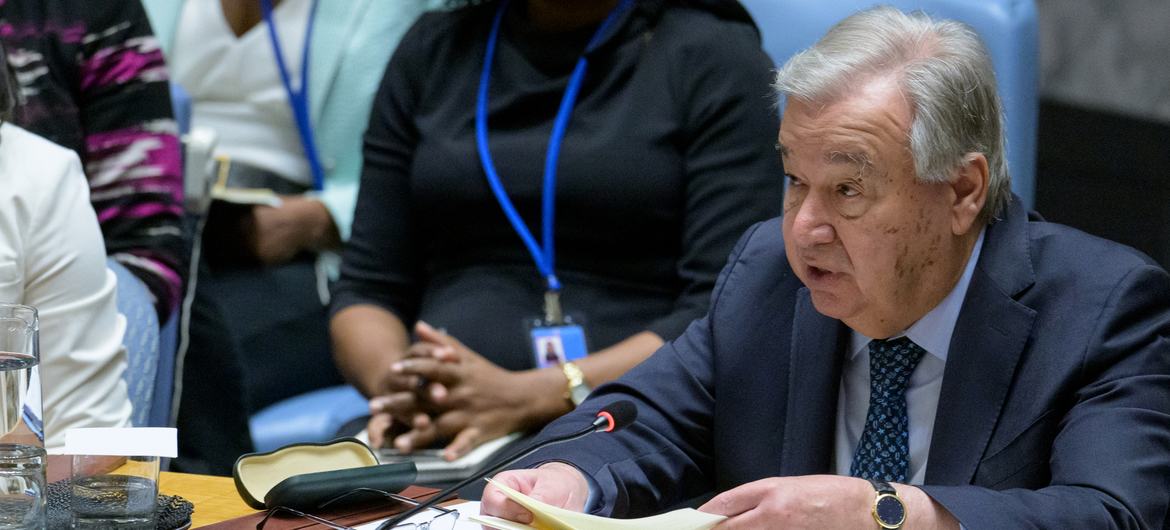
Secretary-General António Guterres addresses the Security Council high-level open debate.

P5 must overcome divisions

Security Council members – “in particular its permanent members” – must overcome divisions, the Secretary-General said, reminding them that even during the Cold War, Council dialogue underpinned peacekeeping missions and humanitarian access, and helped prevent a third world war.

He urged members to keep channels open, build consensus and make the body “more representative” of today’s geopolitical realities with more inclusive, transparent and accountable working methods.

Mr. Guterres also urged deeper cooperation with regional and subregional organizations.

Mediation can work even amid war, he said, noting the third anniversary of the Black Sea Initiative and a related memorandum with Russia that enabled grain movements during the conflict in Ukraine.

Renew commitment to multilateralism

States must honour their obligations under the Charter; international human rights, refugee and humanitarian law, and the principles of sovereignty, territorial integrity and political independence, Mr. Guterres said.

As we mark the 80th anniversary of our Organization and the Charter that gave it life and shape, we need to renew our commitment to the multilateral spirit of peace through diplomacy,” he said.

I look forward to working with you to achieve the international peace and security the people of the world need and deserve.

Security Council open debate

A signature event of the Pakistani presidency, Tuesday’s open debate was chaired by Deputy Prime Minister and Foreign Minister Mohammad Ishaq Dar.

The session aimed to assess the effectiveness of existing mechanisms for pacific dispute settlement, examine best practices and explore new strategies for tackling protracted conflicts.

It also sought to enhance cooperation with regional organizations, boost capacity-building and resource mobilisation, and align future efforts with the conflict-prevention vision outlined in the Pact for the Future.

Source link

Myanmar quake: Ongoing aftershocks spread fear

Aid agencies warned on Tuesday that more than 6.3 million people remain in urgent need of support in the worst-affected central areas around Mandalay.

People [are] forced to sleep outside, safe water is scarce, health services are disrupted,” said UN aid coordination office, OCHA, in an appeal for more support from the international community.

The latest aftershock struck late on Sunday night and measured 4.4 on the Richter scale, said UN partner the International Federation of Red Cross and Red Crescent Societies (IFRC).

This is provoking widespread fear within a population already traumatised and also fear within the responders themselves,” said Nadia Khoury, IFRC Head of Delegation in Myanmar, speaking from Yangon.

Millions impacted

While the attention of the international community has faded, dispossessed families still need help rebuilding their lives, said OCHA’s Christina Powell.

The emergency for most is far from over – it is another crisis on top of the challenges already facing the people of Myanmar,” said Ms. Powell. “People told me they are too afraid to go back into their homes, worried they could collapse at any moment with the ongoing aftershocks.”

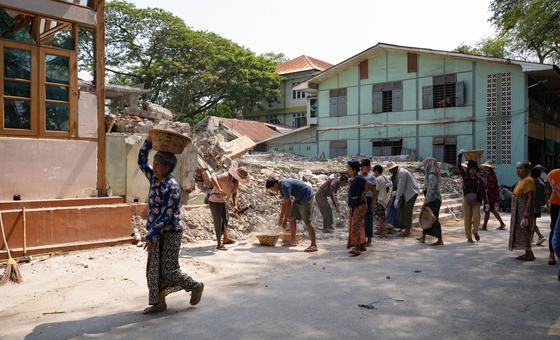
In badly affected areas including Mandalay and Bago in the south of the country, some communities already suffered unprecedented floods last September. The earthquakes brought another wave of devastation.

Assessments indicate that the quakes damaged or destroyed 55,000 homes in the Central Asian nation, where civil war has raged since a military coup in February 2021.

In Mandalay, OCHA reported that locals have continued to deliver food and household items to people still living on the roadside or in community shelters. But needs are widespread and include shelter, food, personal hygiene kits and even toilets, said OCHA’s Tin Aung Thein.

These people are already vulnerable depending solely on their daily wages. For their recovery, international support is greatly needed.”

Over the last month, IFRC has provided life-sustaining support – including safe drinking water, healthcare, tarpaulins for tents and items for women and children – to more than 110,000 people.

The aid organization has also delivered 250 metric tons of aid and helped distribute over 220,000 litres of safe drinking water to Myanmar every day. Its $121 million appeal is only 15 per cent funded.  

Right to live in dignity

Ms. Powell of OCHA urged the international community to step up and support the population’s right to “live in safety and dignity”.

“Additional and quick disbursement of resources and sustained access to all communities are vital to ensure that the situation does not deteriorate even further,” Ms. Powell insisted.