Between fear and survival: Women and girls flee violence in northern Syria

Now eight months pregnant and sheltering in a makeshift camp, the mother of three said her biggest fear isn’t the biting cold – it’s what will happen if she goes into labour. 

“I worry about my health, but I worry more about where to go if something happens,” said Fatima. “Displacement is not just losing your home. It’s losing your privacy, your safety and access to healthcare, especially as a woman.” 

Every step we took felt like it could be our last

She is one of tens of thousands of women and girls affected by the uptick in violence and insecurity around Aleppo in the past few weeks, which has forced large numbers to flee, disrupted essential services and shut down hospitals. 

“We fled under bombardment, with nothing but our fear,” Farida, 39, told the United Nations Population Fund (UNFPA), which is the UN’s sexual and reproductive health agency. 

“Every step we took felt like it could be our last.”

A UNFPA-supported health worker delivers essential healthcare at a clinic in Al-Hassakeh, for women and girls forced to flee Aleppo in Northern Syria.

Unbearable cold 

In Aleppo, some 58,000 are still displaced following recent clashes between the transitional Government’s security forces and the mostly-Kurdish Syrian Democratic Forces (SDF), with insecurity spreading to surrounding areas. 

To make matters worse, winter conditions have only deepened the suffering: thousands are now enduring freezing temperatures, sheltering in makeshift camps, former schools and unfinished buildings across the country. 

Ruhan, a mother of three from Aleppo, fled with only what she could carry. 

 “The cold is unbearable. My biggest fear is keeping my children warm and safe,” she told UNFPA aid workers, who provided her with reproductive health services, counselling and a dignity kit. 

Delivering aid 

More than 890,000 people had been newly displaced as of December 2025 in Syria, adding to almost seven million already displaced inside the country. 

Fourteen years of conflict, climate shocks, and economic decline have left Syria’s recovery fragile and uneven, with immense humanitarian needs and severely damaged healthcare systems.

In response, UNFPA and its partners have sent mobile health teams to reach displaced communities with life-saving sexual and reproductive healthcare, dignity kits with essential hygiene items, and psychosocial counselling. 

Around 400,000 pregnant women in Syria are struggling to access essential maternity services – a situation worsened by deep funding cuts which began last year that have further restricted access.

Women and girls displaced by violence receive reproductive health support and dignity kits in a neighbourhood in Aleppo, Syria.

Source link

Peacekeeping: A lifeline for millions seeking a ‘future without fear’

Governments and civil society organizations have so far submitted more than 60 contributions to a review process mandated under the Pact for the Future, agreed by Member States last year.

The UN has an 80-year legacy that includes deploying multidimensional peacekeeping operations that combine police, troop and civilian personnel; special political missions engaged in conflict prevention, peacemaking and peacebuilding, and electoral support initiatives.

‘A lifeline for millions’

Peacekeeping is the largest and most visible activity in the field, with more than 60,000 men and women from 115 countries currently serving with 11 missions across the globe.

Peacekeeping is not a luxury; it is a lifeline for millions who count on it for a future without fear,” said Jean-Pierre Lacroix, Under-Secretary-General for Peace Operations.

He warned that today, “achieving lasting political solutions seems increasingly challenging.”  Last year, 61 active conflicts raged across the planet, according to the Sweden-based Uppsala Conflict Data Program – the highest number since 1946. 

“Conflicts have become protracted, involving more actors and often proxy forces, making negotiated solutions more difficult to achieve,” he said, indicating that the future will likely see more civilians who will require protection.

“It means the need for peace operations increases, potentially alongside other types of operations, including peace enforcement,” he added, and that “the contexts for deployment may be more uncertain and full success harder to achieve.”

Responsive and adaptable

Mr. Lacroix said the future requires “a UN that is capable and ready to respond through missions that are adaptable and tailored to the needs on the ground, guided by strong political strategies and leveraging the tools, capacities and expertise” of the UN and partners. 

Peace operations must first have “clear and prioritised mandates” that should also reflect the voice of host states, troop and police contributing countries, regional actors, local communities and other stakeholders.

He called for harnessing “the capacities of digital technologies and artificial intelligence to support the analysis of data as well as to assess the effectiveness of our responses through time.” 

Furthermore, pursuing political solutions to conflict should remain a priority, alongside protecting civilians, supporting the strengthening of government accountability.

Promotion and protection of human rights and the advancement of the women, peace and security agenda must also be prioritised. 

Additionally, “sustained and uncompromising efforts to uphold the UN Secretary-General’s zero tolerance policy on SEA (sexual exploitation and abuse)” must continue.

Political solutions crucial

Mr. Lacroix stressed that while “the UN’s ability to deliver on the imperative to protect people is very often the benchmark by which we are judged,” peacekeeping is not meant to be indefinite.

“To advance durable political solutions that enable peacekeeping to withdraw without a relapse into conflict requires the strong, unified and ongoing support of this Council – through the adoption of clear, prioritized mandates, active political engagement and statements of support,” he said.

These actions must be matched by countries continuing to pay the dues they owe the UN “in full and on time,” he added.

New tech ‘weaponised on an industrial scale’

Rosemary DiCarlo, UN Under-Secretary-General for Political and Peacebuilding Affairs, also commented on the current challenging environment.

She said that “conflicts have become more internationalised”, with influence from regional or global actors.  Meanwhile, non-state armed groups continue to proliferate, with many using terrorist tactics with no clear political agenda.

“New technologies, from AI to drones, are being weaponized on an industrial scale, increasing both the lethality of violence and the likelihood of escalation. And transnational drivers, such as organized crime, are now a regular facet of the conflict landscape,” she said.

Changing landscape

To inform the review, her office analysed the history of UN “special political missions” since the Organization’s establishment, identifying three priorities.

She noted that most missions today are deployed in the absence of a comprehensive peace agreement and often in politically volatile situations, even ongoing civil war.

“In such situations, the initial goals of our missions should be more limited – such as preventing a deterioration of violence, achieving a ceasefire, or helping a fragile incipient peace process get off the ground,” she said. 

The second priority should be improving coordination between peace operations and UN country teams, while the third is to end mandates which attempt to provide a one-size-fits-all approach.

Ms. Di Carlo concluded by highlighting how the failure or weak implementation of mandates is often related to lack of political support, whether in countries where missions are deployed, or the wider region, or among Security Council members themselves.

We will therefore need to engage with a laser-like focus on bringing the emphasis back to the political questions at the heart of each conflict and finding multilateral responses to them,” she said. 

Source link

Attacks across Gaza intensify amid fear and hunger: ‘Leave me here,’ injured girl told fleeing family

A 14-year-old girl with cerebral palsy who depends on a wheelchair was among crowds fleeing Israeli military aircraft operations east of Rafah in Gaza on 13 October 2023, said committee member Muhannad Salah Al-Azzeh, who presented a report on the occupied Palestinian territories on Wednesday in Geneva. In the melee, she lost her wheelchair.

She was crawling on the sand and asking her family, telling them ‘you can leave me here’ because she felt that she was slowing them down,” he said.

Indeed, some people are unaware of evacuation orders being given in Gaza due to their disabilities since the start of the nearly two-year-long war triggered by the Hamas-led attack on Israel.

“This is one of the most serious issues because in regular situations, personal disabilities are excluded in emergencies, more excluded,” he said. “It’s more complicated for them.”

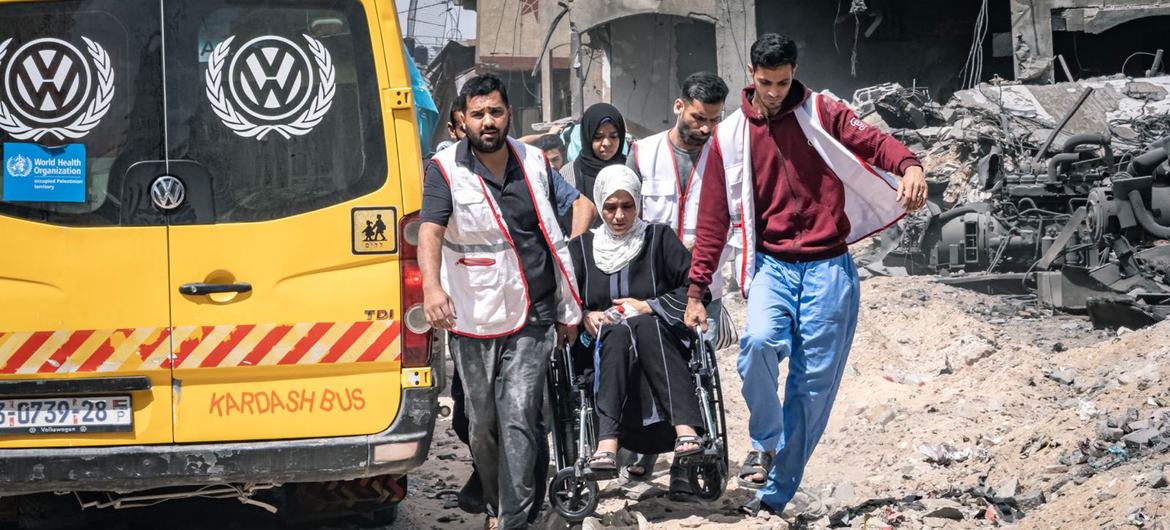
A woman in a wheelchair is carried across rubble.

States fail to protect rights of persons with disabilities

Following extensive interviews with individuals, delegations and organizations working in Gaza and the West Bank, the UN committee submitted a series of recommendations and serious concerns to Israel and the Palestinian Authority.

The situation in Gaza is a grave concern, Mr. Al-Azzeh stated.

“What we are witnessing there is highly concerning for us,” he warned. “We do believe that all the State parties to the Convention on the Rights of Persons with Disabilities, they really failed in one way or another to fulfill their obligations to protect and to ensure the minimum protection of persons with disabilities in the emergency situation.”

Citing grim cases reported to the committee since the start of war, he said in one instance, prolonged electricity shutdowns in Rafah left a mother unable to receive evacuation messages on her mobile phone, and she and her children subsequently died in an Israeli strike.

Nine-year-old Noor’s parents, who are deaf, have heavily relied on her to survive Israeli tank shelling and attacks. She has had to learn new signing vocabulary for the language of war, including tanks, armed quadcopters, shrapnel and aircraft, the committee representative said.

There are dozens of examples of people like Abdulrahman Al-Gharbawi, with cerebral palsy and a lower limb disability, he said. 

All nine times the 27-year-old graphic designer’s family has been forcibly displaced since the start of the war, his mother would carry his wheelchair while his father and brother would carry him.

‘Horrific’ situation in Gaza City

The UN Office for the Coordination of Humanitarian Affairs (OCHA) warned on Wednesday that further intensification of the continued offensive on Gaza City, amid ongoing famine, will push civilians – already battered and bereaved – into an even deeper catastrophe that world leaders must act decisively to prevent.

“Partners supporting displacement sites warned that the escalating hostilities in Gaza City are having horrific humanitarian consequences for people living at these sites, many of whom were previously displaced from North Gaza,” the UN agency said. “They say that many households are unable to move due to high costs and a lack of safe space to move to, with older people and those with disabilities especially affected.”

Partners report that between 14 and 31 August, more than 82,000 new displacements have been recorded, including nearly 30,000 movements from north to south, OCHA stated.

Chronic aid delivery obstacles

Meanwhile, humanitarian efforts continue to face chronic obstacles. While a trickle of aid is getting into the war-torn Gaza Strip, steep challenges remain, according to OCHA’s latest situation report.

Between 17 and 30 August, partners continued daily convoys to uplift humanitarian food aid from the Kerem Shalom and Zikim crossings, bringing more than 6,900 metric tonnes of wheat flour, food parcels and bulk food supplies into Gaza through the UN-coordinated aid mechanism, OCHA reported.

“However, nearly all of this aid was offloaded by hungry crowds or looted by organized groups along convoy routes, preventing targeted household distributions and delivery to partner warehouses,” the UN agency stated.

Since 20 July, when regular food cargo shipments from Gaza’s crossings resumed, less than 40 per cent of the 2,000 metric tonnes of food supplies required daily to meet basic humanitarian food assistance needs could enter the Strip, OCHA said.

Daily, civilians continue to be killed and injured by military forces or due to violence erupting among desperate crowds while trying to access aid, including in the militarised zone near checkpoints waiting for aid convoys and at non-humanitarian militarised distribution sites,” the UN agency reported.

‘Two per cent of food aid reached warehouses’

As of 30 August, 99 kitchens supported by 19 partners were preparing and distributing 468,000 meals daily across the Gaza Strip, with 155,000 in the north and 313,000 in central and southern Gaza, according to the OCHA report.

“Partners relied on the two per cent of food aid that safely reached warehouses, coupled with resources secured locally from markets,” the UN agency said.

“While representing an 80 per cent increase compared to the 260,000 daily meals prepared in early August, this remains far below the over one million meals produced in April with the humanitarian and commercial food stocks and cooking gas entered during the ceasefire.”

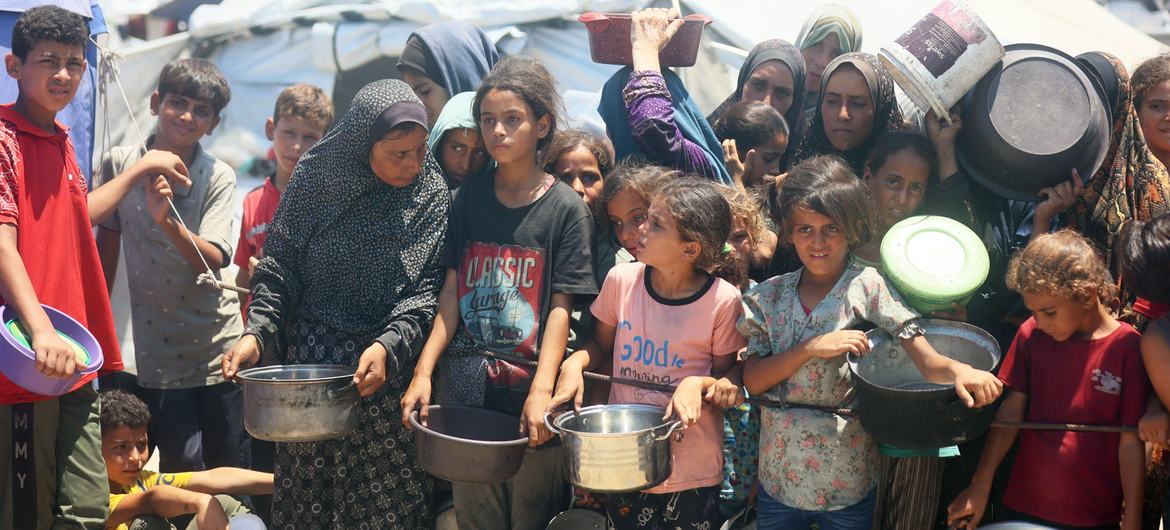
Families and children seeking food from a community kitchen in western Gaza City in late July. (file)

Famine response

The UN and partners continued integrated famine response efforts come on the heels of the UN-backed global hunger experts’ report finding famine conditions in parts of Gaza last month.

Efforts included scaling up cooked meal provision, promoting small-scale home gardening and community oven initiatives, expanding cash and voucher assistance and strengthening real-time monitoring and analysis systems.

“Intense advocacy continues with the Israeli authorities to increase the volume of humanitarian and commercial goods approved for entry, with a focus on fresh produce and fortified food, nutrition, health and cooking gas,” OCHA said in its report.

© UNICEF/Mohammed Nateel

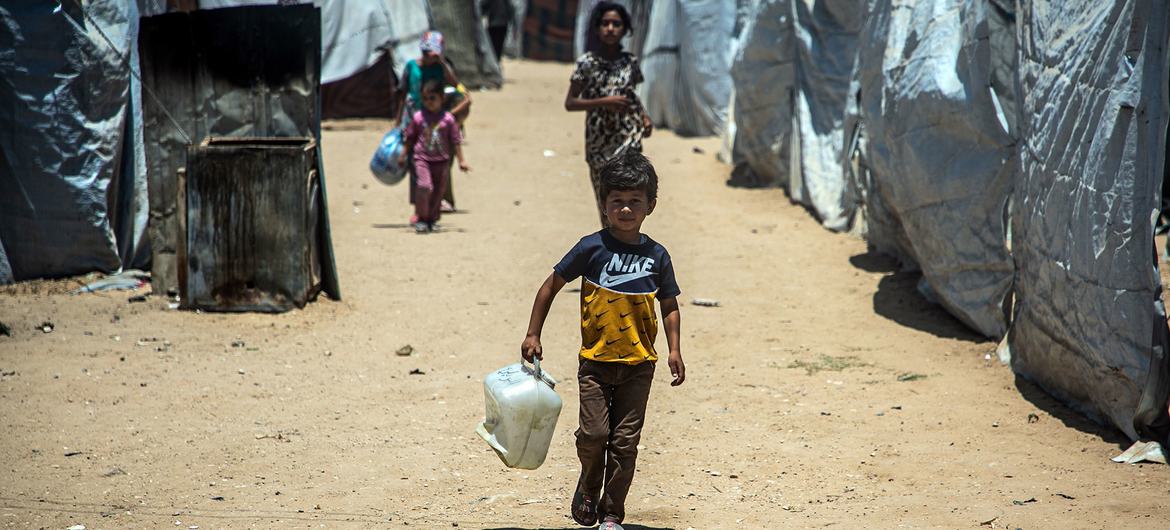
Access to safe drinking water in the Gaza Strip has been severely compromised due to the ongoing war.

New supplies and critical shortages

For the first time in over five months, concentrated fodder for livestock owners entered Gaza. Approximately 60 metric tonnes were distributed to 600 livestock holders in Deir Al-Balah, OCHA said.

However, despite sustained advocacy, cooking gas has not entered Gaza for more than five months and is no longer available in markets, the UN agency stated.

“Firewood has also become increasingly unaffordable,” according to the agency. “Many people are reduced to using waste and scrap wood as alternative cooking sources, exacerbating health and environmental risks.”

Meanwhile, the UN relief agency for Palestine refugees’ (UNRWA) health facilities continue to serve around 132,000 patients with non-communicable diseases despite facing dire shortages of medical supplies. Insulin stocks will be exhausted within one to two weeks, leaving at least 16,000 diabetic patients without an essential part of their treatment, OCHA reported.

Access to clean water is severely limited. At the same time, hospitals remain lacking in essential supplies and continue to face overcrowding as daily attacks are seeing a rise in the numbers of dead and injured.

Source link

Myanmar quake: Ongoing aftershocks spread fear

Aid agencies warned on Tuesday that more than 6.3 million people remain in urgent need of support in the worst-affected central areas around Mandalay.

People [are] forced to sleep outside, safe water is scarce, health services are disrupted,” said UN aid coordination office, OCHA, in an appeal for more support from the international community.

The latest aftershock struck late on Sunday night and measured 4.4 on the Richter scale, said UN partner the International Federation of Red Cross and Red Crescent Societies (IFRC).

This is provoking widespread fear within a population already traumatised and also fear within the responders themselves,” said Nadia Khoury, IFRC Head of Delegation in Myanmar, speaking from Yangon.

Millions impacted

While the attention of the international community has faded, dispossessed families still need help rebuilding their lives, said OCHA’s Christina Powell.

The emergency for most is far from over – it is another crisis on top of the challenges already facing the people of Myanmar,” said Ms. Powell. “People told me they are too afraid to go back into their homes, worried they could collapse at any moment with the ongoing aftershocks.”

In badly affected areas including Mandalay and Bago in the south of the country, some communities already suffered unprecedented floods last September. The earthquakes brought another wave of devastation.

Assessments indicate that the quakes damaged or destroyed 55,000 homes in the Central Asian nation, where civil war has raged since a military coup in February 2021.

In Mandalay, OCHA reported that locals have continued to deliver food and household items to people still living on the roadside or in community shelters. But needs are widespread and include shelter, food, personal hygiene kits and even toilets, said OCHA’s Tin Aung Thein.

These people are already vulnerable depending solely on their daily wages. For their recovery, international support is greatly needed.”

Over the last month, IFRC has provided life-sustaining support – including safe drinking water, healthcare, tarpaulins for tents and items for women and children – to more than 110,000 people.

The aid organization has also delivered 250 metric tons of aid and helped distribute over 220,000 litres of safe drinking water to Myanmar every day. Its $121 million appeal is only 15 per cent funded.  

Right to live in dignity

Ms. Powell of OCHA urged the international community to step up and support the population’s right to “live in safety and dignity”.

“Additional and quick disbursement of resources and sustained access to all communities are vital to ensure that the situation does not deteriorate even further,” Ms. Powell insisted.