Peacekeeping: A lifeline for millions seeking a ‘future without fear’

Governments and civil society organizations have so far submitted more than 60 contributions to a review process mandated under the Pact for the Future, agreed by Member States last year.

The UN has an 80-year legacy that includes deploying multidimensional peacekeeping operations that combine police, troop and civilian personnel; special political missions engaged in conflict prevention, peacemaking and peacebuilding, and electoral support initiatives.

‘A lifeline for millions’

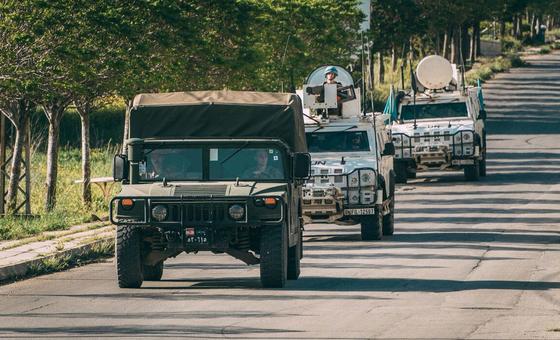
Peacekeeping is the largest and most visible activity in the field, with more than 60,000 men and women from 115 countries currently serving with 11 missions across the globe.

Peacekeeping is not a luxury; it is a lifeline for millions who count on it for a future without fear,” said Jean-Pierre Lacroix, Under-Secretary-General for Peace Operations.

He warned that today, “achieving lasting political solutions seems increasingly challenging.”  Last year, 61 active conflicts raged across the planet, according to the Sweden-based Uppsala Conflict Data Program – the highest number since 1946. 

“Conflicts have become protracted, involving more actors and often proxy forces, making negotiated solutions more difficult to achieve,” he said, indicating that the future will likely see more civilians who will require protection.

“It means the need for peace operations increases, potentially alongside other types of operations, including peace enforcement,” he added, and that “the contexts for deployment may be more uncertain and full success harder to achieve.”

Responsive and adaptable

Mr. Lacroix said the future requires “a UN that is capable and ready to respond through missions that are adaptable and tailored to the needs on the ground, guided by strong political strategies and leveraging the tools, capacities and expertise” of the UN and partners. 

Peace operations must first have “clear and prioritised mandates” that should also reflect the voice of host states, troop and police contributing countries, regional actors, local communities and other stakeholders.

He called for harnessing “the capacities of digital technologies and artificial intelligence to support the analysis of data as well as to assess the effectiveness of our responses through time.” 

Furthermore, pursuing political solutions to conflict should remain a priority, alongside protecting civilians, supporting the strengthening of government accountability.

Promotion and protection of human rights and the advancement of the women, peace and security agenda must also be prioritised. 

Additionally, “sustained and uncompromising efforts to uphold the UN Secretary-General’s zero tolerance policy on SEA (sexual exploitation and abuse)” must continue.

Political solutions crucial

Mr. Lacroix stressed that while “the UN’s ability to deliver on the imperative to protect people is very often the benchmark by which we are judged,” peacekeeping is not meant to be indefinite.

“To advance durable political solutions that enable peacekeeping to withdraw without a relapse into conflict requires the strong, unified and ongoing support of this Council – through the adoption of clear, prioritized mandates, active political engagement and statements of support,” he said.

These actions must be matched by countries continuing to pay the dues they owe the UN “in full and on time,” he added.

New tech ‘weaponised on an industrial scale’

Rosemary DiCarlo, UN Under-Secretary-General for Political and Peacebuilding Affairs, also commented on the current challenging environment.

She said that “conflicts have become more internationalised”, with influence from regional or global actors.  Meanwhile, non-state armed groups continue to proliferate, with many using terrorist tactics with no clear political agenda.

“New technologies, from AI to drones, are being weaponized on an industrial scale, increasing both the lethality of violence and the likelihood of escalation. And transnational drivers, such as organized crime, are now a regular facet of the conflict landscape,” she said.

Changing landscape

To inform the review, her office analysed the history of UN “special political missions” since the Organization’s establishment, identifying three priorities.

She noted that most missions today are deployed in the absence of a comprehensive peace agreement and often in politically volatile situations, even ongoing civil war.

“In such situations, the initial goals of our missions should be more limited – such as preventing a deterioration of violence, achieving a ceasefire, or helping a fragile incipient peace process get off the ground,” she said. 

The second priority should be improving coordination between peace operations and UN country teams, while the third is to end mandates which attempt to provide a one-size-fits-all approach.

Ms. Di Carlo concluded by highlighting how the failure or weak implementation of mandates is often related to lack of political support, whether in countries where missions are deployed, or the wider region, or among Security Council members themselves.

We will therefore need to engage with a laser-like focus on bringing the emphasis back to the political questions at the heart of each conflict and finding multilateral responses to them,” she said. 
Source link

Food lifeline fading for millions in South Sudan hit by conflict and climate shocks

Earlier this month, the UN agency began airdropping emergency food assistance in Upper Nile state after surging conflict forced families from their homes and pushed communities to the brink of famine.

Nationwide, the picture is just as alarming, with half the country’s population – more than 7.7 million people – officially classified as food insecure by UN partner the IPC platform. This includes more than 83,000 face “catastrophic” levels of food insecurity.

“The scale of suffering here does not make headlines but millions of mothers, fathers, and children are spending each day fighting hunger to survive,” said WFP Deputy Executive Director Carl Skau, following a visit to South Sudan last week. 

The worst-hit areas include Upper Nile state, where fighting has displaced thousands and relief access is restricted. Two counties are at risk of tipping into famine: Nasir and Ulang.

South Sudan, the world’s youngest country, gained independence in 2011. This gave way to a brutal and devastating civil war which ended in 2018 thanks to a peace agreement between political rivals which has largely held.

However, recent political tensions and increased violent attacks – especially in Upper Nile state – threaten to unravel the peace agreement and return the nation to conflict.

The humanitarian emergency crisis has been exacerbated by the war in neighbouring Sudan. 

Since April 2023, nearly 1.2 million people have crossed the border into South Sudan, many of them hungry, traumatised, and without support. WFP says that 2.3 million children across the country are now at risk of malnutrition.

Crucial, yet fragile gains

Despite these challenges, the UN agency has delivered emergency food aid to more than two million people this year. In Uror County, Jonglei state, where access has been consistent, all known pockets of catastrophic hunger have been eliminated. Additionally, 10 counties where conflict has eased have seen improved harvests and better food security, as people were able to return to their land.

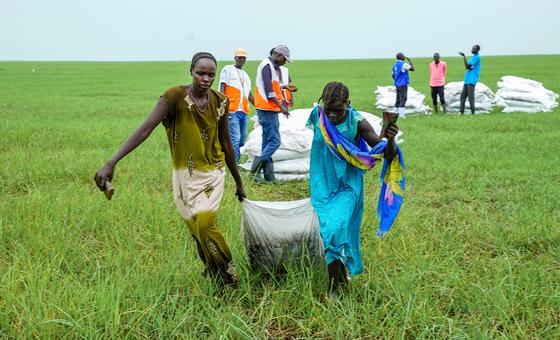
To reach those in the hardest-hit and most remote areas, WFP has carried out airdrops delivering 430 metric tons of food to 40,000 people in Greater Upper Nile. River convoys have resumed as the most efficient way to transport aid in a country with limited infrastructure. These included a 16 July shipment of 1,380 metric tons of food and relief supplies. WFP’s humanitarian air service also continues flights to seven Upper Nile destinations.

At the same time, a cholera outbreak in Upper Nile has placed additional pressure on the humanitarian response. Since March, WFP’s logistics cluster has airlifted 109 metric tons of cholera-related supplies to affected areas in Upper Nile and Unity states.

However, the UN agency says it can currently support only 2.5 million people – and often with just half-rations. Without an urgent injection of $274 million, deeper cuts to aid will begin as soon as September.

“WFP has the tools and capacity to deliver,” said Mr. Skau. “But without funding – and without peace – our hands are tied.” 

Source link

Costa Rica’s refugee lifeline at breaking point amid funding crisis

“Without funding, asylum seekers are left in limbo – undocumented, unsupported and increasingly desperate,” said Ruvendrini Menikdiwela, Assistant High Commissioner for Protection.

Her comments follow a 41 per cent budget cut to the UN agency’s operations in the country that have had devastating consequences. “This is not about luxuries; the assistance we’re cutting is critical and lifesaving,” she insisted.

The Central American nation today hosts more than 200,000 refugees and asylum seekers – adding up to nearly four per cent of its population.

More than eight in every 10 are from Nicaragua, fleeing deepening political and social turmoil linked to serious allegations of “systemic repression”, according to independent rights experts reporting to the Human Rights Council.

Despite economic constraints, Costa Rica has continued to offer safety and hope to those escaping persecution, UNHCR said.

Safe spaces at risk

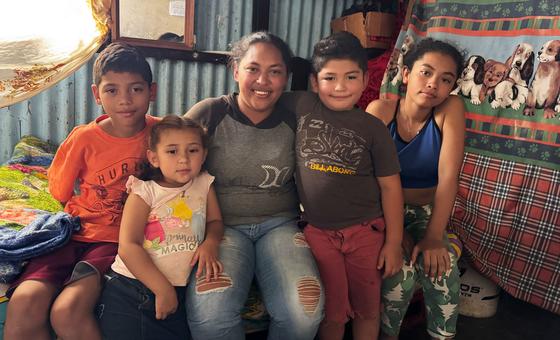
On a recent official tour of Costa Rica, Ms. Menikdiwela described meeting indigenous Miskito women who had fled gender-based violence and established safe spaces, despite language and cultural barriers. “Their courage is humbling,” she said. “But the loss of services threatens everything they’ve tried to rebuild.”

The UN agency  has warned that legal support, mental health services, education, job training and child protection initiatives have already been scaled back or suspended.

Many were tailored to vulnerable women and children in remote areas.

No right to a job, school or healthcare

Because of the cuts, the capacity to register new arrivals has plummeted by 77 per cent. But without documentation, refugees cannot legally work, attend school or access healthcare. With over 222,000 claims backlogged, some cases may now take up to seven years to process.

“The Government’s plea to me was simple,” Ms. Menikdiwela said. “‘Help us to help these people.’”

Costa Rica has long played a leadership role in regional and global refugee protection frameworks. But this solidarity is now stretched to breaking point, the UN agency said, in an appeal for $40.4 million to maintain its operations in the country Rica through 2025.

“This is a stark reminder that protection must be backed by resources,” Ms. Menikdiwela warned. “If the international community does not step up, the consequences will be severe – not just for those already in Costa Rica – but for stability in the wider region as well.”

Source link