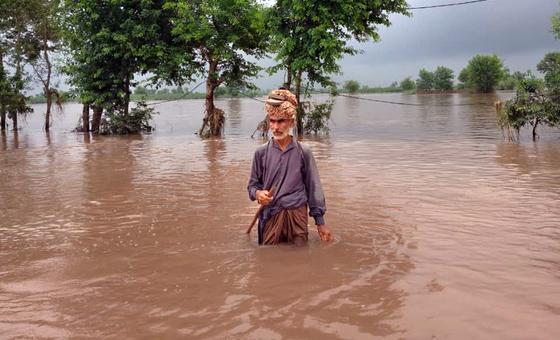

In a statement released by his Spokesperson, the UN chief noted that the disaster driven by severe monsoon conditions had been exacerbated by climate change, impacting around 1.5 million people.
Hundreds of thousands of people need humanitarian aid while more than 3,000 homes, over 400 schools and some 40 health facilities have suffered some level of damage.
Solidarity with the people
“The Secretary-General commends Pakistani authorities for relocating more than one million people in Punjab. He expresses his solidarity with the Government and people of Pakistan, extends his heartfelt condolences to the families of those who have lost their lives, and wishes a swift recovery to those who have been injured.”
The UN and other humanitarian organizations are working closely with the Pakistani authorities to assess the full impact of the floods on communities, identify further needs and also address any gaps in the response.
The UN’s Emergency Relief Coordinator, Tom Fletcher, has released $600,000 from the Regional Humanitarian Pooled Fund for relief and recovery efforts, and discussions are underway with the Government on a specific response plan.
Dozens of countries lag on climate reporting, warns UN climate chief
UN Climate Change Executive Secretary Simon Stiell has warned that 37 countries have yet to submit one or more mandatory reports under the Paris Agreement’s transparency framework, stressing that “no country can be left behind.”
Speaking at the Global Transparency Forum in Songdo, Republic of Korea, the UNFCCC chief said the Enhanced Transparency Framework (ETF) is not just technical bookkeeping but “a vital enabling tool” for stronger climate action.
It helps governments attract investment, design more ambitious policies and accelerate progress on clean energy and resilience, he added.
‘Smart investment’
To date, more than 100 nations have submitted their first Biennial Transparency Reports (BTRs), which Mr Stiell called a “smart investment” bringing economic and social benefits.
Over 10,000 experts from 140 developing countries have received training on the ETF, with 1,200 certified reviewers and 1,400 officials now using its tools.
The first global synthesis of BTRs will be published ahead of November’s COP30 climate change conference in Brazil, offering an early snapshot of progress on mitigation, adaptation and support. Mr Stiell said the findings would guide the next Global Stocktake.
“What is measured can be acted upon. What is reported helps build trust. And what is shared becomes a force for change,” he stressed.
Lebanon: UN voices serious concern over Israeli attack on peacekeepers
The UN has expressed serious concern over an Israeli attack on peacekeepers clearing roadblocks in southern Lebanon on Tuesday.
Briefing reporters in New York on Wednesday, UN Spokesperson Stéphane Dujarric said Israeli military drones had dropped grenades in the vicinity of peacekeepers serving with the UN mission, UNIFIL, “who were carrying out mandated tasks in support of implementation of Security Council resolution 1701.”
That’s the resolution which authorises peacekeepers to monitor the cessation of hostilities agreement between Israel and Hezbollah of 2006 and support the Lebanese armed forces as Israel withdrew from southern Lebanon. UNIFIL patrols the Blue Line of separation.
In a statement on social media, UNIFIL described the drone attack as one of the most serious on its personnel since the cessation of hostilities agreement between the two sides last November. The mission stressed that Israeli forces had been informed in advance of the road clearance work.
Drones crossed into Israel
“One grenade impacted within 20 metres and three within approximately 100 metres of UN personnel and vehicles,” said the UN Spokesperson.
“The drones were then observed returning south of the Blue Line. Thankfully, none of our colleagues were injured.”
The Secretary-General stresses that any acts which endanger peacekeepers’ lives are “completely unacceptable”, Mr. Dujarric continued.
UN chief António Guterres is also demanding that the parties uphold their responsibilities “to ensure the safety and security of the peacekeepers and inviolability of UN premises.”
Funding cuts hampering the work of the Human Rights Council, says President
The Human Rights Council is set to meet on Monday in Geneva – an opportunity for UN Member States to discuss action to address conflicts around the world, as well as other issues of global importance, from climate change to disability rights.
Important as this work is, it’s feared that cost-cutting measures that are already affecting UN agencies and bodies like the Council could limit its reach, President Jürg Lauber told journalists on Wednesday.
This includes independent rights investigators known as Special Rapporteurs, he said: “When the Council decides to have an investigative mechanism or a special rapporteur or an issue, they need resources,” he said.
Research, travel impacted
“They need they get support from the Secretariat to do research, to write reports. They need to travel to a country to see the situation. There’s also less money available, which means they don’t get necessarily all the research and assistance they need to do their work,” he continued.
Mr. Lauber said it was “very clear” that dwindling financial resources were impacting meetings during Council sessions and the basic implementations of investigative mandates.
He added that the funding cuts could also prevent people or groups in countries of concern from sharing their testimonies with investigators.
And he noted that reduced funding could also limit how much technical support and advice the Council is able to give to governments seeking to promote and protect human rights.