Amid ongoing Israeli attacks, ‘the systematic destruction of Gaza City is already underway’: UN rights office

Recent attacks have been particularly devastating in the Az Zaytoun neighbourhood, where airstrikes, artillery shelling and gunfire are continuous and intense, causing a high number of civilian casualties and the large-scale destruction of residential buildings and public facilities, the UN human rights office, OHCHR, in the Occupied Palestinian Territory said in a statement.

Since 8 August, the office has recorded 54 attacks on residential buildings and entire blocks in Gaza City, killing 87 Palestinians, including at least 25 children and entire families.

It also recorded attacks on shelters for internally displaced people, including tents and schools, killing at least 14.

These casualty figures “indicate that the systematic destruction of Gaza City is already underway,” the statement said.

However, OHCHR stressed that these devastating figures are only a portion of the actual toll due to underreporting in such dire circumstances.

Impact of attacks

As a result of recent attacks, hundreds of families have been forced to flee, with nowhere safe to go amid dire humanitarian conditions across the Gaza Strip.

However, those who remain trapped are completely cut off from food, water and medical supplies.

OHCHR emphasised that “Israel’s reported decision to take full control of Gaza City and to forcibly displace its population will lead to mass killings of civilians and destruction of infrastructure vital to the survival of the population.”

The office is seeing the Israeli military repeat means of warfare that caused mass killings, serious injuries, forced displacement, arbitrary detention, starvation and extensive destruction in previous operations in North Gaza and Rafah.

To reportedly prepare for the offensive, the Israeli military has repeatedly called on Palestinians to move to Al Mawasi, west of Khan Younis.

However, Israel has repeatedly struck tents of the displaced in Al Mawasi, where people are struggling to survive with barely any access to food, water and other necessities.

Violations of international law

Under international law, Israel must not destroy civilian property unless it is rendered necessary by military operations. Yet, the widespread destruction of residential buildings in Gaza City is not seen as an imperative military necessity.

Additionally, by forcing the entire population of Gaza City and those remaining in North Gaza into displacement – with no shelter, food or medical provisions and no indication for allowing them to return to their homes in the future – OHCHR is concerned that these are grave breaches of the Fourth Geneva Convention.

Thus, the office is urging States party to the Geneva Conventions to follow their obligation “to exert maximum pressure on Israel to immediately halt this offensive, which risks triggering an unprecedented, life-threatening humanitarian crisis and permanently extinguishing the Palestinian presence in Gaza’s largest urban area.”

Worst-case famine

Meanwhile, the World Food Programme (WFP) welcomed Japan’s life-saving contribution of 500 million yen ($3.3 million) to provide emergency food and nutrition assistance to Palestinians as they face severe food insecurity.

Adding to the assistance, on 4 August, limited commercial truck entries resumed, containing mainly dry food items and a small amount of fresh produce, according to the UN aid coordination office, OCHA.

However, the risk of spoilage and infestation of food supplies has drastically increased due to being stranded for months, heat and impending expiration dates.

Furthermore, cooking gas has not entered Gaza for over five months, and firewood has become increasingly unaffordable, forcing many to use waste and scrap wood as alternative cooking sources, exacerbating health and environmental risks.

Due to such limited aid, WFP underscored that the latest Integrated Food Security Phase Classification report finds that the worst-case scenario of famine is currently occurring in the Gaza Strip.

“I meet families who have lost everything and don’t know where their next meal will come from.” said Antoine Renard, WFP Representative and Country Director in Palestine.

But thanks to this support from Japan, he continued, “WFP can continue procuring life-saving food assistance, but we urgently need a ceasefire and sustained access to reach those most at risk and prevent a full-scale famine.” 

Syria: Ongoing violence fuelling mass displacement in Sweida

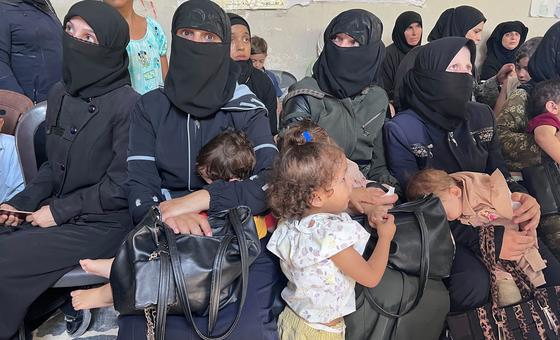
More than 93,000 Syrians have been displaced across Sweida, neighbouring Dar’a governorate and Rural Damascus due to escalating violence in the city,  UN Spokesperson Stéphane Dujarric said at Monday’s daily press briefing in New York.

Most displaced people in Sweida are staying with local communities or in one of 15 reception centres, while around 30 collective shelters have opened in Dar’a.

Infrastructure and services are suffering in the area. Some hospitals and health centres in Sweida are out of service, water infrastructure has been critically damaged, significant cuts to electricity have been reported, and access to food is disrupted.

Initial aid delivery

On Sunday, the first aid convoy deployed by the Syrian Arab Red Crescent reached Sweida and the Salkhad district within the city, where most displaced people are seeking safety.  

The convoy of 32 trucks carried food, water, medical supplies and fuel provided by the World Food Programme (WFP), the UN Children’s Fund (UNICEF) and other partners.

UN Emergency Relief Coordinator Tom Fletcher welcomed this initial delivery on social media, saying it was a “desperately needed first step, but much more relief is needed.”  

Mr. Dujarric stressed that as the UN engages with relevant parties to facilitate humanitarian access and ensure the protection of civilians, the Office for the Coordination of Humanitarian Affairs (OCHA) is working with authorities to facilitate a direct visit to Sweida to deliver assistance when security conditions allow.  

Mr. Fletcher echoed this sentiment, saying OCHA teams “are mobilised to move as much as we can.”

“We continue to urge all parties to protect people who have been caught up in the violence, including by allowing them to move freely to seek safety and medical assistance,” concluded Mr. Dujarric.

Source link

Syria crisis: Hundreds killed in ongoing violence, hospitals overwhelmed

Briefing reporters in Geneva, UN human rights office, OHCHR, spokesperson Ravina Shamdasani highlighted “credible” reports of “widespread violations and abuses, including summary executions and arbitrary killings, kidnappings, destruction of private property and looting of homes” in the city of Sweida.

“Among the reported perpetrators were members of the security forces and individuals affiliated with the interim authorities, as well as other armed elements from the area, including the Druze and Bedouin,” she said.

Many hospitals are struggling to cope with the influx of injured, the UN refugee agency UNHCR also noted.

Forced to flee

On Friday morning, OHCHR colleagues reported that clashes were continuing and that “a lot of people are trying to flee or have fled the area”, Ms. Shamdasani continued.

Latest updates from the UN humanitarian affairs coordination office, OCHA, on Thursday indicated that nearly 2,000 families had been displaced from areas affected by the fighting.

Hundreds have reportedly been killed since sectarian violence involving the Druze and Bedouin communities erupted on 12 July, triggering an intervention by Syrian security forces.

OHCHR’s Ms. Shamdasani highlighted an incident on 15 July in which at least 13 people were killed when “armed individuals affiliated with the interim authorities deliberately opened fire at a family gathering”.

Briefing an emergency meeting of the Security Council in New York on Thursday, UN Assistant Secretary-General Khaled Khiari also referenced reports of “civilians, religious figures and detainees being subjected to extrajudicial executions and humiliating and degrading treatment”. He urged all parties to protect civilians and civilian infrastructure.

Rumours and fact-checking

Ms. Shamdasani stressed that the UN human rights office has been trying to verify the information through “contacts on the ground…families of people who were killed, eyewitnesses”, but that obtaining reliable estimates of the death toll remains challenging.

“There are lots of videos circulating,” she said. “Some claim to be fighters who are in the area filming the abuses and violations they’re carrying out. We are trying to verify some of these videos, but there’s a lot of disinformation out there and a lot of it is being used to incite further violence to inflame tensions.”

The OHCHR spokesperson also expressed concern about reports of civilian casualties resulting from Israel’s airstrikes on Sweida, Dara’a and central Damascus.

“Attacks such as the one on Damascus on Wednesday pose great risks to civilians and civilian objects,” she warned, calling for the strikes to cease.

Israel had launched the strikes pledging to protect the Druze community.

The violence and displacement have sparked “considerable” humanitarian needs, with the health and aid systems struggling to keep up, said William Spindler of the UN refugee agency UNCHR.

“Many of the hospitals have been overwhelmed by the number of people who have been injured in the recent fighting,” he said.

According to OCHA, the UN World Health Organization (WHO) has dispatched enough trauma and emergency surgery kits for 1,750 interventions to the area, but many “remain undelivered due to access constraints”.

Since the displaced had to flee at very short notice, they are in desperate need of essentials – blankets, jerry cans, solar lamps – but providing these items has been a challenge.

Too risky to enter

“We have this in stock and we are ready to deliver them as soon as the security allows it,” Mr. Spindler said. “For now, this has not been possible.”

Mr. Spindler also warned of water shortages due to electricity outages. He said that people are unable to buy bottled water or food because of the insecurity.

UNHCR has an office in rural Sweida and Mr. Spindler expressed concern about the impact of the hostilities on the agency’s operations, infrastructure and personnel.

“We know that humanitarian infrastructure has been affected,” he said, describing an incident on 15 July in which a warehouse of the Syrian Arab Red Crescent was severely damaged by shelling.

The UNHCR spokesperson called on all parties to the conflict to respect and protect humanitarian premises, personnel and assets “in accordance with international humanitarian law”.

Ukraine: UN refugee agency helps repair homes amid ongoing conflict

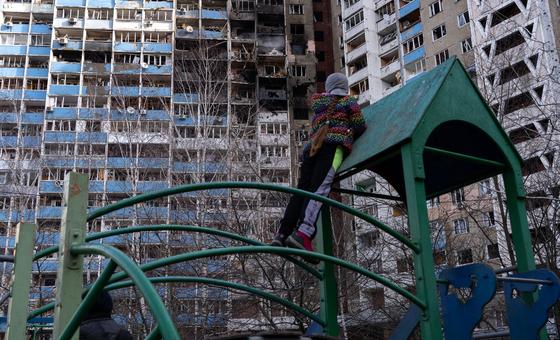
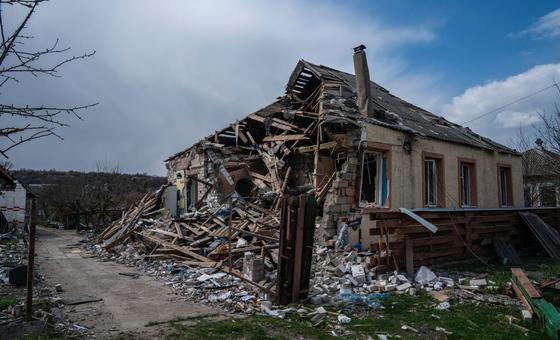
In the fourth year of Russia’s full-scale invasion of Ukraine, housing remains one of the country’s most urgent humanitarian and recovery challenges. The destruction has been widespread and ongoing.

According to the latest Rapid Damage and Needs Assessment, 13 per cent of Ukraine’s housing stock has been damaged since February 2022, impacting an estimated 2.5 million families.

More than buildings 

In coordination with Ukrainian authorities and partners, UNHCR has invested over $114 million in durable housing solutions since July 2022, supporting both durable home repairs and emergency shelter assistance.

“By helping repair houses and apartments, we are enabling people to stay in or return to their homes – places that hold profound meaning, often passed down through generations,” said Karolina Lindholm Billing, UNHCR’s representative in Ukraine.  

“These are not just buildings. These are treasured spaces where couples raised their children, families celebrated milestones, cared for older relatives and built their lives together,” she said.

UNHCR’s support includes a range of solutions: contracting local builders, providing construction materials or offering cash assistance to homeowners. 

Repairs may include roofs, windows, insulation and in some cases, major reconstruction. The agency also helps restore common areas in apartment buildings.

Emergency shelter and long-term needs

UNHCR also provides emergency shelter kits – tarpaulin, wooden boards, nails and other materials – to help protect homes from further weather damage.  

Since 2022, more than 470,000 people have received such kits.

With millions still internally displaced – many from areas under temporary occupation and with little prospect of return – UNHCR supports broader shelter options, including restoring social housing, repairing rural homes and refurbishing collective centres for the most vulnerable. 

Source link

Ongoing Russian strikes continue alarming civilian casualty trend

The toll includes 1,389 casualties in April (221 killed, 1,168 injured) – the highest monthly total so far this year – followed by 1,019 in May (183 killed, 836 injured).

Casualties were reported across 17 out of 24 regions and the city of Kyiv, including areas far from the frontline.

The vast majority of attacks (97 per cent) led to civilian casualties occurred in areas under Ukrainian Government control.

“This year has been devastating for civilians across Ukraine, with significantly more deaths and injuries than during the same period in 2024,” said Danielle Bell, Head of the HRMMU – the monitoring mission set up by the UN rights office, OHCHR, at the invitation of the Ukrainian Government.

“The intensification of long-range attacks with missiles and loitering munitions and frequent attacks with short-range drones along the frontline are a deadly combination for civilians.”   

Weapons and impact

Long-range missile and drone attacks caused the largest proportion of civilian casualties – some 28 per cent of casualties during May.

On the other hand, short-range drones remained the leading cause in frontline areas.

Russian armed forces carried out at least five attacks on port infrastructure in the Odesa region on the Black Sea, resulting in civilian casualties and damage to facilities.

One such attack on 23 May killed three men and injured 12 more, including port workers, according to the report.

Continuing trends in June

The mission noted that long-range attacks have intensified this month. Since 6 June, Russian forces have launched over 1,500 long-range weapons, according to Ukrainian authorities.

The HRMMU is in the process of verifying reports that these attacks (or subsequent falling debris) have killed at least 19 civilians and injured 205 others nationwide in just a five-day span. If confirmed, June could match or surpass April and May in total casualties.

At this pace and scale, further loss of civilian life is not just possible – it is inevitable,” said Ms. Bell.

Source link

Myanmar quake: Ongoing aftershocks spread fear

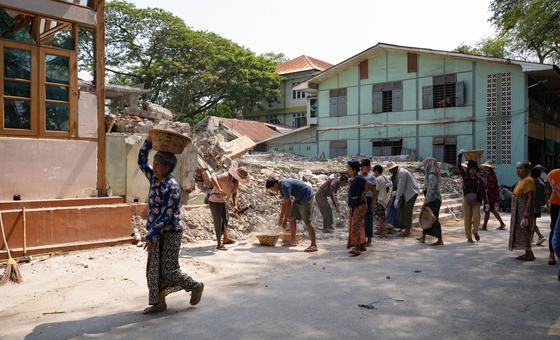
Aid agencies warned on Tuesday that more than 6.3 million people remain in urgent need of support in the worst-affected central areas around Mandalay.

People [are] forced to sleep outside, safe water is scarce, health services are disrupted,” said UN aid coordination office, OCHA, in an appeal for more support from the international community.

The latest aftershock struck late on Sunday night and measured 4.4 on the Richter scale, said UN partner the International Federation of Red Cross and Red Crescent Societies (IFRC).

This is provoking widespread fear within a population already traumatised and also fear within the responders themselves,” said Nadia Khoury, IFRC Head of Delegation in Myanmar, speaking from Yangon.

Millions impacted

While the attention of the international community has faded, dispossessed families still need help rebuilding their lives, said OCHA’s Christina Powell.

The emergency for most is far from over – it is another crisis on top of the challenges already facing the people of Myanmar,” said Ms. Powell. “People told me they are too afraid to go back into their homes, worried they could collapse at any moment with the ongoing aftershocks.”

In badly affected areas including Mandalay and Bago in the south of the country, some communities already suffered unprecedented floods last September. The earthquakes brought another wave of devastation.

Assessments indicate that the quakes damaged or destroyed 55,000 homes in the Central Asian nation, where civil war has raged since a military coup in February 2021.

In Mandalay, OCHA reported that locals have continued to deliver food and household items to people still living on the roadside or in community shelters. But needs are widespread and include shelter, food, personal hygiene kits and even toilets, said OCHA’s Tin Aung Thein.

These people are already vulnerable depending solely on their daily wages. For their recovery, international support is greatly needed.”

Over the last month, IFRC has provided life-sustaining support – including safe drinking water, healthcare, tarpaulins for tents and items for women and children – to more than 110,000 people.

The aid organization has also delivered 250 metric tons of aid and helped distribute over 220,000 litres of safe drinking water to Myanmar every day. Its $121 million appeal is only 15 per cent funded.  

Right to live in dignity

Ms. Powell of OCHA urged the international community to step up and support the population’s right to “live in safety and dignity”.

“Additional and quick disbursement of resources and sustained access to all communities are vital to ensure that the situation does not deteriorate even further,” Ms. Powell insisted.