
Gaza health system ‘catastrophic’ as hospitals overwhelmed and medicines running out, WHO warns

Fewer than half of Gaza’s hospitals and under 38 per cent of primary healthcare centres are partially functioning – or are doing so at minimal levels – said Dr. Rik Peeperkorn, World Health Organization (WHO) Representative for the West Bank and Gaza.

Bed occupancy in major facilities is exceeding limits by large margins – Shifa Hospital is at 250 per cent capacity, Nasser at 180 per cent, Al-Rantisi at 210 per cent and Al-Ahli at over 300 per cent.

Critical supplies running out

“The critical shortage in medications and consumables continue and have only exacerbated, with 52 per cent of the medicines and 68 per cent of consumables at zero stock,” Dr. Peeperkorn told journalists in Geneva, speaking from Jerusalem.

Hospitals are particularly overwhelmed by injuries from food distribution areas, which are also driving persistent shortages of blood and plasma,” he added, noting that since 27 May, at least 1,655 people have been killed in those areas and more than 11,800 injured.

The crisis has been exacerbated by displacement orders in Gaza City that now place WHO’s own warehouse in an evacuation zone. Hospitals, primary care centres and ambulance facilities are also located inside or near these areas, threatening further disruption to services.

Malnutrition worsening

Hunger and malnutrition are worsening rapidly.

Since the start of 2025, 148 people have died from malnutrition, including 49 children – 39 of them under five years old. Nearly 12,000 children under five were diagnosed with acute malnutrition in July, the highest monthly figure to date, with more than 2,500 suffering from the most severe form.

New threat from meningitis

Disease outbreaks are adding to the pressure.

Suspected meningitis cases reached 452 between July and early August – the highest number since the escalation began. Guillain-Barré syndrome, a rare post-infection disorder, has also surged, with 76 suspected cases since June.

Both conditions are harder to treat due to “zero stocks” of vital medicines, including intravenous immuneoglobulin and anti-inflammatories, Dr. Peeperkorn said.

Access challenges

Access for international medical teams and supplies remains a major obstacle.

Dr. Peeperkorn said that international medics face entry denials, while key items such as ICU equipment, anaesthesia machines and cold chain supplies continue to be held back.

Though WHO managed to bring in 80 trucks of medical supplies since June, he stressed that procedures are slow and unpredictable, with many shipments delayed or denied.

We need multiple crossings into Gaza opened, procedures simplified, and access impediments lifted,” he said. “We hear about more humanitarian supplies being allowed in – but it’s not happening, or it’s happening far too slowly.”

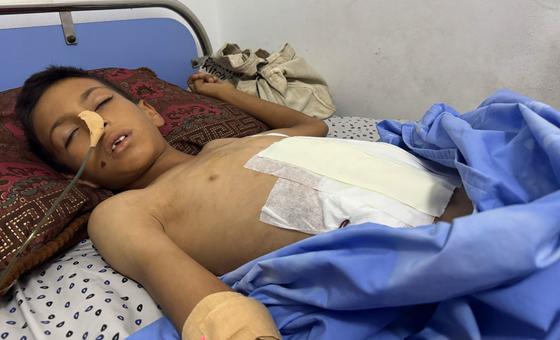
Gaza: Hospitals ‘at near-total collapse’, staff overwhelmed by the injured

Meanwhile, UN agencies confirmed the deaths of three Palestinians from Guillain-Barré Syndrome (GBS), a rare auto-immune disease that can cause sudden muscle weakness and even paralysis.

Before war erupted in Gaza in October 2023, only a handful of cases surfaced every year.

Mass casualties now the norm

“Hospitals are overwhelmed by mass casualty incidents, with an average of eight incidents per day,” said the UN aid coordination agency, OCHA, citing health partners.

In an update on the dire health crisis in Gaza, OCHA noted that specialised rehabilitation facilities were also overstretched handling complex trauma injuries and cases of Guillain-Barré.

To date, three deaths out of around 64 cases of GBS have been confirmed by the health authorities in Gaza. Two of the deceased were children.

According to the UN World Health Organization (WHO), 30 per cent of GBS patients require intensive care but there is no available stock of the primary medication needed to treat it, intravenous immunoglobulin.

Aid-drops are inadequate: WFP

In a related development, the UN World Food Programme (WFP) echoed repeated calls for aid to flood into Gaza, as opposed to the very limited amounts being allowed by the Israeli authorities.

We can’t airdrop our way out of an unfolding famine. Not in Gaza,” insisted Cindy McCain, WFP Executive Director in a social media post late Wednesday.

The UN agency chief underscored that “500,000 people are starving today” and the only way to help them is to get food to them at scale and by land.

“We can’t afford to wait; Gaza is out of food and out of time,” Ms. McCain said.

WHO stocks destroyed

The destruction of WHO’s main medical warehouse in an attack on Deir Al-Balah late last month continues to impact lifesaving care.

In particular, the critical shortage of antibiotics has hampered treatment of meningitis, whose numbers are now in the hundreds – “the highest number recorded since the beginning of the escalation”, the OCHA update noted.

Isolation measures have been implemented, including the separation of the external department at Al Khair Hospital from the Nasser Medical Complex and the establishment of isolation tents at Al Aqsa Hospital to safely manage suspected cases.

Explosive weapons such as bombs and grenades have accounted for 83 per cent of medical consultations, said OCHA.

It cited partner NGO Médecins Sans Frontières (MSF) whose data covered more than 200,000 medical consultations in six MSF-supported health facilities in Gaza in 2024.

It cited partner NGO Médecins Sans Frontières (MSF) whose data covered more than 200,000 medical consultations in six MSF-supported health facilities in Gaza in 2024.

What is Guillain-Barré Syndrome?

Guillain-Barré Syndrome (GBS) is a neurological and autoimmune disease that affects the nervous system and causes progressive muscle paralysis. It is not contagious and is often triggered by a prior infection – viral or bacterial – that  disrupts the immune system.

In most cases, patients can recover fully within a few weeks. But WHO stressed that even in the best healthcare settings, three to five per cent of patients die from complications of the disease, such as respiratory muscle paralysis, sepsis, pulmonary embolism, or cardiac arrest.

There have been several outbreaks of infectious diseases in Gaza since war erupted following Hamas-led terror attacks in Israel, including polio, cholera, hepatitis A and scabies.

Source link

Syria crisis: Hundreds killed in ongoing violence, hospitals overwhelmed

Briefing reporters in Geneva, UN human rights office, OHCHR, spokesperson Ravina Shamdasani highlighted “credible” reports of “widespread violations and abuses, including summary executions and arbitrary killings, kidnappings, destruction of private property and looting of homes” in the city of Sweida.

“Among the reported perpetrators were members of the security forces and individuals affiliated with the interim authorities, as well as other armed elements from the area, including the Druze and Bedouin,” she said.

Many hospitals are struggling to cope with the influx of injured, the UN refugee agency UNHCR also noted.

Forced to flee

On Friday morning, OHCHR colleagues reported that clashes were continuing and that “a lot of people are trying to flee or have fled the area”, Ms. Shamdasani continued.

Latest updates from the UN humanitarian affairs coordination office, OCHA, on Thursday indicated that nearly 2,000 families had been displaced from areas affected by the fighting.

Hundreds have reportedly been killed since sectarian violence involving the Druze and Bedouin communities erupted on 12 July, triggering an intervention by Syrian security forces.

OHCHR’s Ms. Shamdasani highlighted an incident on 15 July in which at least 13 people were killed when “armed individuals affiliated with the interim authorities deliberately opened fire at a family gathering”.

Briefing an emergency meeting of the Security Council in New York on Thursday, UN Assistant Secretary-General Khaled Khiari also referenced reports of “civilians, religious figures and detainees being subjected to extrajudicial executions and humiliating and degrading treatment”. He urged all parties to protect civilians and civilian infrastructure.

Rumours and fact-checking

Ms. Shamdasani stressed that the UN human rights office has been trying to verify the information through “contacts on the ground…families of people who were killed, eyewitnesses”, but that obtaining reliable estimates of the death toll remains challenging.

“There are lots of videos circulating,” she said. “Some claim to be fighters who are in the area filming the abuses and violations they’re carrying out. We are trying to verify some of these videos, but there’s a lot of disinformation out there and a lot of it is being used to incite further violence to inflame tensions.”

The OHCHR spokesperson also expressed concern about reports of civilian casualties resulting from Israel’s airstrikes on Sweida, Dara’a and central Damascus.

“Attacks such as the one on Damascus on Wednesday pose great risks to civilians and civilian objects,” she warned, calling for the strikes to cease.

Israel had launched the strikes pledging to protect the Druze community.

The violence and displacement have sparked “considerable” humanitarian needs, with the health and aid systems struggling to keep up, said William Spindler of the UN refugee agency UNCHR.

“Many of the hospitals have been overwhelmed by the number of people who have been injured in the recent fighting,” he said.

According to OCHA, the UN World Health Organization (WHO) has dispatched enough trauma and emergency surgery kits for 1,750 interventions to the area, but many “remain undelivered due to access constraints”.

Since the displaced had to flee at very short notice, they are in desperate need of essentials – blankets, jerry cans, solar lamps – but providing these items has been a challenge.

Too risky to enter

“We have this in stock and we are ready to deliver them as soon as the security allows it,” Mr. Spindler said. “For now, this has not been possible.”

Mr. Spindler also warned of water shortages due to electricity outages. He said that people are unable to buy bottled water or food because of the insecurity.

UNHCR has an office in rural Sweida and Mr. Spindler expressed concern about the impact of the hostilities on the agency’s operations, infrastructure and personnel.

“We know that humanitarian infrastructure has been affected,” he said, describing an incident on 15 July in which a warehouse of the Syrian Arab Red Crescent was severely damaged by shelling.

The UNHCR spokesperson called on all parties to the conflict to respect and protect humanitarian premises, personnel and assets “in accordance with international humanitarian law”.