
Gaza health system ‘catastrophic’ as hospitals overwhelmed and medicines running out, WHO warns

Fewer than half of Gaza’s hospitals and under 38 per cent of primary healthcare centres are partially functioning – or are doing so at minimal levels – said Dr. Rik Peeperkorn, World Health Organization (WHO) Representative for the West Bank and Gaza.

Bed occupancy in major facilities is exceeding limits by large margins – Shifa Hospital is at 250 per cent capacity, Nasser at 180 per cent, Al-Rantisi at 210 per cent and Al-Ahli at over 300 per cent.

Critical supplies running out

“The critical shortage in medications and consumables continue and have only exacerbated, with 52 per cent of the medicines and 68 per cent of consumables at zero stock,” Dr. Peeperkorn told journalists in Geneva, speaking from Jerusalem.

Hospitals are particularly overwhelmed by injuries from food distribution areas, which are also driving persistent shortages of blood and plasma,” he added, noting that since 27 May, at least 1,655 people have been killed in those areas and more than 11,800 injured.

The crisis has been exacerbated by displacement orders in Gaza City that now place WHO’s own warehouse in an evacuation zone. Hospitals, primary care centres and ambulance facilities are also located inside or near these areas, threatening further disruption to services.

Malnutrition worsening

Hunger and malnutrition are worsening rapidly.

Since the start of 2025, 148 people have died from malnutrition, including 49 children – 39 of them under five years old. Nearly 12,000 children under five were diagnosed with acute malnutrition in July, the highest monthly figure to date, with more than 2,500 suffering from the most severe form.

New threat from meningitis

Disease outbreaks are adding to the pressure.

Suspected meningitis cases reached 452 between July and early August – the highest number since the escalation began. Guillain-Barré syndrome, a rare post-infection disorder, has also surged, with 76 suspected cases since June.

Both conditions are harder to treat due to “zero stocks” of vital medicines, including intravenous immuneoglobulin and anti-inflammatories, Dr. Peeperkorn said.

Access challenges

Access for international medical teams and supplies remains a major obstacle.

Dr. Peeperkorn said that international medics face entry denials, while key items such as ICU equipment, anaesthesia machines and cold chain supplies continue to be held back.

Though WHO managed to bring in 80 trucks of medical supplies since June, he stressed that procedures are slow and unpredictable, with many shipments delayed or denied.

We need multiple crossings into Gaza opened, procedures simplified, and access impediments lifted,” he said. “We hear about more humanitarian supplies being allowed in – but it’s not happening, or it’s happening far too slowly.”

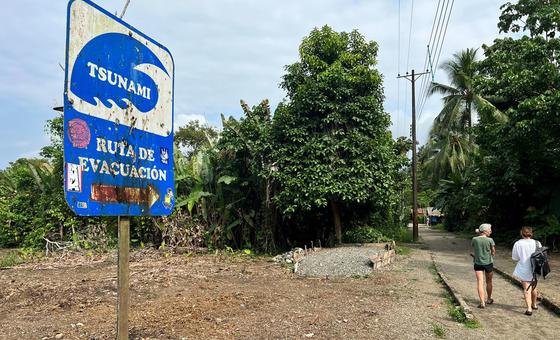
Tsunami alert highlights worth of global early warning system

While the UN-backed International Atomic Energy Agency (IAEA) reported 
that there had been no damage to Japan’s nuclear facilities after an 8.8 magnitude quake was recorded off Russia’s Kamchatka Peninsula, coastal communities have been taking no chances and evacuating to higher ground or moving further inland.

Alerts were sent out within a few minutes of the Russia quake, the UN Office for Disaster Risk Reduction (UNDRR) confirmed. Although the authorities have now downgraded the threat across Japan as waves of 1.3 metres (4ft 2in) have been recorded, the advice is for people to stay in shelters until the danger diminishes from continuing sea surges.

“It is very complex; we are observing the tsunami data in real time, so we need people to stay at the shelter until the tsunami is completed,” said tsunami engineer Professor Fumihiko Imamura from Tohoku University.

Deadly legacy

In the Asian island nation, memories are still raw from the 11 March 2011 Tohoku earthquake and tsunami which killed more than 18,000 people.

Just last year, the 7.6 magnitude Noto quake left approximately 500 dead and damaged 150,000 homes.

The disaster also caused a major accident at the Fukushima Daiichi Nuclear Power Plant, forcing tens of thousands of people from their homes. 

Today’s developments come amid reports that the latest earthquake was among the 10 most powerful ever recorded, hence why the authorities are monitoring its impact so closely.

So far, alerts have been triggered off the west coast of the United States, in South America from Chile to Mexico and from Papua New Guinea to Vanuatu in the Pacific. 

A 8.8 magnitude earthquake is a very large earthquake,” explained Kamal Kishore, Special Representative of the UN Secretary-General for Disaster Risk Reduction. 

“As you go from magnitude eight to nine, or seven to eight, at every step the strength of the earthquake increases exponentially. So, an earthquake which is magnitude eight as opposed to seven would be 30 times bigger.” 

Faster than a jet liner

Speaking to UN News, Mr. Kishore highlighted the huge distances tsunamis can cover, picking up enormous energy they then dump on coastal communities. 

Their progress can be as fast as a passenger jet and can be tracked by deep sea pressure change sensors, or tsunameters, that are connected to surface buoys which relay information in real time to satellites. This data is then modelled by national weather centres, influencing whether alerts are issued.

“It’s a real threat because the tsunamis travel really fast from one coast to the other,” continued Mr. Kishore. “The Indian Ocean tsunami of 2004 was one of the most devastating in our memory, which travelled from all the way from the coast of Indonesia to the Sri Lankan shores within a little over an hour.”

Lessons learned

In addition to the coordination role of UNDRR in the global early warning system, other UN entities also closely involved include the World Meteorological Organization (WMO) and the Intergovernmental Oceanographic Commission of the UN agency for Education, Science and Culture (UNESCO-IOC).  

The IOC’s role is critical in making sure that countries that use tsunami-tracking instrumentation follow the same standard. 

These efforts are in line with the UN Secretary-General’s Early Warnings for All initiative to ensure that everyone on Earth is protected from hazardous weather, water or climate events through lifesaving early warning systems.

Today, one in three people – and mainly in least developed countries and Small Island Developing States – lacks access to adequate multi-hazard early warning systems.

“Tsunami prevention really highlights how important it is to have multilateral action” such as sharing data to run the algorithms behind wave modelling systems, insisted the UN’s Mr. Kishore. 

“There are countries which are separated by thousands of kilometres of ocean, but they are affected by the same hazard,” he continued. 

“If you do not share information on observing these hazards, not just in the location where they have occurred, but on what is happening in the intermediate locations in the ocean…we will not be able to warn our citizens.”  

Source link

Gaza: Health system crumbles amid growing desperation over food, fuel

“Definitely, people get shot,” said Gaza-based medic Dr. Luca Pigozzi, WHO Emergency Medical Team Coordinator. “They are victim of blast injuries as well and bodily injuries.”

The WHO official’s comments follow reports of another mass casualty incident on Thursday, this time involving a strike on a market in the central city of Deir al Balah.

More than 20 people were killed and approximately 70 others were injured, said the UN aid wing, OCHA, with victims rushed to Al Aqsa Hospital, Nasser Medical Complex and two other health facilities.

Hundreds killed seeking food

In addition to the latest deadly incident, at least 410 Palestinians have been killed by the Israeli military while trying to fetch aid from controversial non-UN aid hubs supported by Israel and the United States, the UN human rights office, OHCHRsaid on Tuesday.

Providing high-quality medical care is very difficult in the war-torn occupied enclave today, “particularly because we are speaking about a high volume of patients every time”, Dr Pigozzi insisted.

Health needs are widespread and dramatic, with almost 50 per cent of medical stocks completely depleted.

WHO’s first medical shipment into Gaza on Wednesday was its first since 2 March, when Israel imposed a full blockade on the Strip.

In total, nine trucks carrying essential medical supplies entered the enclave with 2,000 units of blood and 1,500 units of plasma; all transited through the Kerem Shalom crossing. It is “only a drop in the ocean” of what is required, Dr Pigozzi said.

Aid obstacles remain

Speaking to journalists from Jerusalem, WHO’s Dr Rik Peeperkorn highlighted renewed difficulties in securing agreement from the Israeli authorities to allow more UN and partner agencies’ supply trucks into Gaza.

“That’s really unfortunate and should not happen, because you don’t want to see those desperate people, and specifically desperate young men, risking their lives to get some food either,” he said, amid reports of a chaotic rush for supplies at non-UN distribution points and of starving Gazans taking goods directly off lorries.

Before the Israeli blockade, the UN and its humanitarian partners demonstrated that their aid delivery system reached those most in need, insisted Dr Peeperkorn, WHO Representative in the occupied Palestinian territory. Today that is not the case because of repeated refusals by Israeli authorities to allow supplies into Gaza.

“Open the routes and make sure that we can get our supplies in,” he said. “The market needs to be flooded with food and non-food items and water, et cetera, et cetera, and including essential medicines in a most cost-effective manner.”

Denied entry

Since March, aid teams have encountered a 44 per cent denial rate, meaning that for every 10 staff requesting entry, “four to five of them are denied per rotation”, WHO’s Dr Pigozzi said.

Echoing that message, WHO spokesperson Christian Lindmeier insisted that people are starving, sick and dying across Gaza every day.

“They have been killed on the way trying to get medical help, they have been killed inside hospitals. Now, additionally, they are being killed on the way to get food items which are scarcely being provided,” he said.

“We have food and medical help minutes away across the border, sitting there and waiting for weeks and months by now. Just open the door.”

Over 60 per cent of the Arab world still outside the banking system

Even more impressively, the number of Egyptian women with an account increased by 260 per cent, though gender gaps do remain.

But how you widen financial inclusion overall is a question the Arab region is currently grappling with.

A new report from the UN Economic and Social Commission in Western Asia (UNESCWA) published on Thursday highlights the challenge.

Nearly 64 per cent of adults in the 22 countries in the Arab region are still without an account – or “unbanked” – a higher number than all other regions of the world and significantly higher than the 24 per cent global average.

The report warns that this level of financial exclusion will negatively impact economic opportunities and the region’s ability to meet Sustainable Development Goals (SDGs) by 2030.

“The Arab region cannot afford to treat financial services as a luxury. Without inclusive finance, we cannot hope to lift people out of poverty, support small businesses, or achieve equitable growth,” said ESCWA’s Mario Jales, lead author of the report.

The digital divide within the divide’

The report finds that women and disabled people have even less access to financial services – only 29 per cent of women and 21 per cent of disabled people in the region have an account.

Similarly, rural communities and younger and older people also experience lower rates of inclusion in the banking system.

The report also highlighted that access to loans for small and medium-sized businesses is worryingly low, reducing entrepreneurial and other income-producing activities.

In addition to gender disparities, there are variations within the Arab region – 81 per cent of people in low-income countries do not have access to an account in comparison to 67 per cent in middle-income countries and 23 per cent in the high-income bracket. 

As of 2024, 69 percent of Egyptian women have bank accounts, a large increase from 2016.

Models of success

Given that regional rates of financial inclusion remain so low, how do countries work to improve them?

The basis of Egypt’s success was the implementation of a comprehensive national strategy to promote financial inclusion, a strategy which actively worked to target underserved communities, ESCWA points out.

For example, in Egypt, 22 per cent of ATMs in the country have now been equipped with accessibility features including brighter lighting and Braille keyboards.

Other countries in the region have also implemented national strategies which include targeted initiatives.

Jordan, which has the second widest gender gap in the region, implemented a Microfund for Women to provide loans for income-generating activities. There are now 60 branches across the country, serving 133,000 borrowers, 95 per cent of whom are women.

Moreover, some banks in the region have worked to implement financial literacy classes and others have worked to tailor their services to underserved communities including by lowering minimum deposits.

The report concludes that an expansion of all these activities – national policymaking which targets underserved communities and private bank activities which lower barriers to entry and support financial literacy – will be essential in improving financial inclusion.

The path forward exists, but it requires political will, targeted investment and a whole-of-society approach,” the report concludes.