Nearly 40 per cent of cancer cases could be prevented, UN study finds

The study by the UN World Health Organization (WHO) and its International Agency for Research on Cancer (IARC) looks at 30 preventable causes, including tobacco, alcohol, high body mass index, physical inactivity, air pollution and ultraviolet radiation. 

Nine cancer-causing infections – such as human papillomavirus (HPV) which can cause cervical cancer – also are included for the first time. 

Examining patterns for prevention 

Cancer remains a leading cause of morbidity, responsible for nearly 10 million deaths worldwide in 2020, or nearly one in six.  

Projections point to a 50 per cent increase in new cases by 2040 if current trends continue, underscoring the urgent need for effective prevention strategies.

The study was released ahead of World Cancer Day, observed annually on 4 February.

The findings draw on data from 185 countries and 36 cancer types.  Estimates show that 37 per cent of all new cancer cases in 2022, around 7.1 million, were linked to preventable causes.

“By examining patterns across countries and population groups, we can provide governments and individuals with more specific information to help prevent many cancer cases before they start,” said Dr. André Ilbawi, WHO Team Lead for Cancer Control and author of the study. 

Tobacco top cause 

Tobacco is the leading preventable cause of cancer, responsible for 15 per cent of all new cases, followed by infections (10 per cent) and alcohol consumption (3 per cent). 

Lung, stomach and cervical cancer represented nearly half of all preventable cases in both men and women. 

Lung cancer was primarily linked to smoking and air pollution, while stomach cancer was largely attributable to Helicobacter pylori infection. Cervical cancer was overwhelmingly caused by HPV. 

Differences among men and women  

The burden of preventable cancer was substantially higher in men than in women. Among new cancer cases, 45 per cent occur in men compared with 30 per cent in women. 

In men, smoking accounted for an estimated 23 per cent of all new cancer cases, followed by infections (9 per cent) and alcohol (4 per cent).  

Among women, infections accounted for 11 per cent of all new cancer cases, followed by smoking at 6 per cent and high body mass index at 3 per cent. 

Regional picture, risk factors 

Preventable cancers also varied widely between the world’s regions. 

Among women, they ranged from 24 per cent in North Africa and West Asia, to 38 per cent in sub-Saharan Africa.  

Among men, East Asia accounted for the highest burden at 57 per cent, while the lowest incidence was found in Latin America and the Caribbean at 28 per cent.  

These differences are largely due to varying exposure to behavioral, environmental, occupational and infectious risk factors, as well as differences in socioeconomic development, national prevention policies, and health system capacity. 

Prevention strategies 

The report emphasised the need for “context-specific prevention strategies” such as strong tobacco control measures, alcohol regulation, and vaccination against HPV and other cancer-causing infections such as hepatitis B. 

Improved air quality, safer workplaces, healthier food and promoting physical activity are also important. 

Furthermore, “coordinated action across sectors, from health and education to energy, transport and labour, can prevent millions of families from experiencing the burden of a cancer diagnosis,” WHO said. 

The UN agency stressed that addressing preventable risk factors not only reduces cancer incidence but also lowers long-term healthcare costs and improves population health and well-being. 

Listen to an interview with WHO Kenya about the national action plan to eliminate cervical cancer by 2030:

Source link

Attacks on schools surge by ‘staggering’ 44 per cent over the past year

Over 41,000 incidents of violence against school-age children were reported by the UN in 2024.

Countries with the highest levels of violations in were Israel and the Occupied Palestinian Territory, notably the Gaza Strip, the Democratic Republic of the Congo (DRC), Somalia, Nigeria, and Haiti.

In a message to mark the International Day to Protect Education, commemorated annually on 9 September, the UN Secretary-General, António Guterres said that “each violation carries profound consequences, not only for teachers and young learners, but for the future of entire communities and countries,” adding that “no child should risk death to learn.”

The UN chief’s Annual Report on Children and Armed Conflict for 2024 highlights not only an upsurge in attacks on schools but also a 34 per cent increase in rape and other forms of sexual violence perpetrated against children.

In addition, the number of children victims of what the UN calls grave violations increased by 17 per cent as a result of abduction, recruitment, and other types of violence, characterised by the UN as “an alarming escalation in brutality.”

Gaza children deprived of right to education

In Gaza where more than 2.3 million people have been displaced by the two-year-long war, 660,000 children remain out of school and classrooms have been converted into shelters. 

“There is no education now. We live inside the school, where we are displaced, eating and sleeping,” said Diana, a child living in Gaza. 

Despite the ongoing conflict more than 68,000 children in Gaza have been reached through temporary learning spaces offering education and psychosocial support.

The UN Children’s Fund, UNICEF, is also recycling pallets into school furniture and converting supplied boxes into tables and chairs.

© UNICEF/Oleksii Filippov

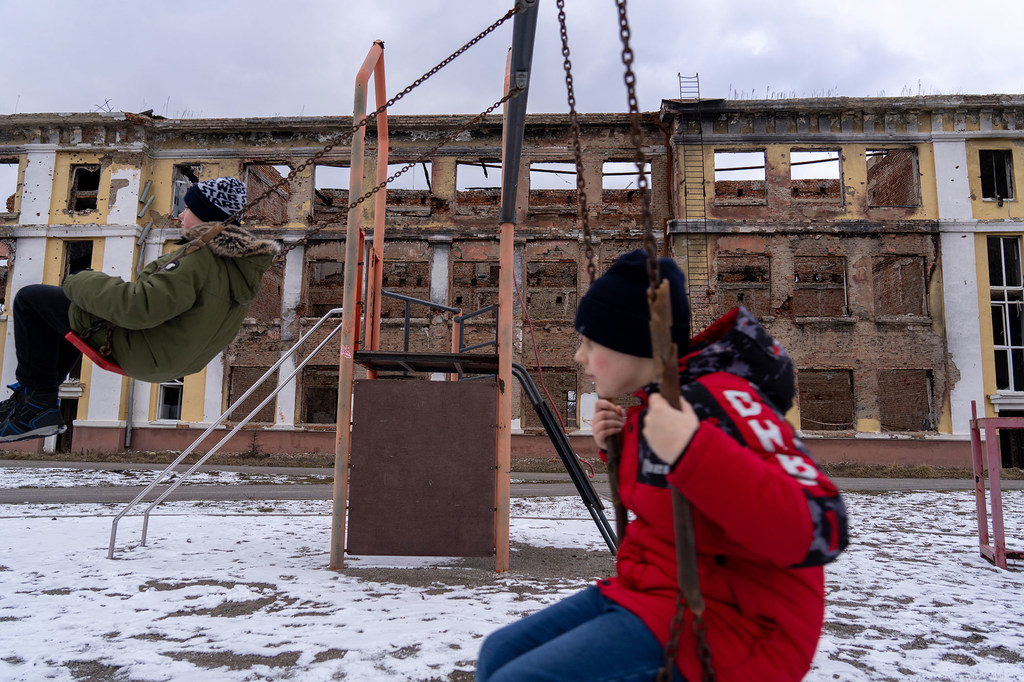
Boys play amidst the ruins of a school in Kharkiv, Ukraine.

Barriers to education in Ukraine

In Ukraine, 5.3 million children face barriers to education, and around 115,000 are completely out of school due to the ongoing war.

“1,850 facilities have been damaged since the beginning of the conflict,” said Nelson Rodrigues, Education Specialist at UNICEF.

With many schools on the front lines either closed or operating remotely, over 420,000 children attend school fully online, while one million use a hybrid model. 

UNICEF has supported the rehabilitation of 57,000 war-affected school facilities, which has allowed a considerable number of children to return to the classroom. 

The UN agency has also provided catch-up and remedial learning, enabling children to recover from disruptions and continue their education. 

Meanwhile, between January and July of this year, the UN and its humanitarian partners have supported 370,000 children and teachers, mainly in front-line and host communities. 

Respect schools 

Parties to conflict anywhere in the world are obliged under international law, to respect schools as places of safety, and hold accountable those responsible for attacks.

“The pen, the book, and the classroom are all mightier than the sword,” said UN Secretary-General Guterres.

“Let’s keep it that way and protect the fundamental right of every child to learn in safety and peace.”  

Source link

Despite Taliban ban, over 90 per cent of Afghans support girls’ right to learn

Four years after the Taliban takeover in August 2021, the scale and severity of the women’s rights crisis continues to intensify. Afghanistan is the only country in the world where girls are prohibited to attend secondary school.

Yet, in a nationwide door-to-door survey of over 2,000 Afghans, more than nine in 10 supported girls’ right to learn.

It is clear: Despite the existing bans, the Afghan people want their daughters to exercise their right to education,” said Sofia Calltorp, UN Women’s Chief of Humanitarian Action, at a press conference in Geneva on Friday.

‘Education is the difference’

A protracted humanitarian crisis continues in Afghanistan coupled with systemic and institutionalised restrictions on women and girls’ rights.

Ms. Calltorp insisted that it is more important than ever to continue investing in Afghan women’s community organizations, which offer healthcare, mental health support and a chance to connect.

In a country where half the population lives in poverty, education is the difference between despair and possibility,” she said, voicing their yearning to be back in a school environment.

This is almost always the first thing girls tell us – they are desperate to learn and just want the chance to gain an education,” said UN Women’s Special Representative in Afghanistan, Susan Ferguson.

A year after the introduction of a stricter so-called morality law codified a sweeping set of restrictions, the new alert highlights the deepening normalisation of the women’s rights crisis.

NGO work ban

The Taliban’s ban on women working for NGOs – announced nearly three years ago – continues to have a devastating impact, said UN Women.

More than half of NGOs in Afghanistan report that it has affected their ability to reach women and girls with vital services.

A UN Women survey conducted in July and August found that 97 per cent of Afghan women said it had negatively impacted them.

Source link

Just 1.5 per cent of Gaza’s agricultural land remains accessible and undamaged

A new report from the Food and Agriculture Organization (FAO) and the UN Satellite Centre (UNOSAT) reveals that just 8.6 percent of cropland in Gaza is still accessible, while only 1.5 per cent of cropland is both accessible and undamaged, as of 28 July.

More than 86 per cent of cropland is damaged, while 12.4 per cent is undamaged but out of reach, as fighting between Israeli forces and militants from Hamas and other armed groups continues.

Ongoing starvation

This report comes as Israel’s offensive inside Gaza continues to restrict aid distribution – and starvation-related deaths rise.  

The local Ministry of Health reported five new malnutrition-related deaths in the past 24 hours on Wednesday, bringing the total to almost 200 starvation-related deaths, half of whom are children.

Healthcare collapse

According to the UN aid coordination office (OCHA), hospitals are overstretched with many patients reduced to lying on the floor or in the streets.

This mass suffering is due to the lack of beds, medical supplies and equipment. Yet, emergency medical teams were again denied entry into Gaza on Tuesday.  

The World Health Organization (WHO) also reported that more than 100 health professionals, such as surgeons and other specialized medical staff, have been barred from entering the enclave since March.

Meanwhile, the limited availability of fuel continues to restrict lifesaving operations. The UN has collected around 300,000 litres from the Kerem Shalom crossing in the past two days, but this is far less than what is needed.

Due to the lack of fuel, UN health partners report that more than 100 premature babies are in imminent danger.

Renewed displacement orders

Additionally, the Israeli military on Wednesday renewed two displacement orders spanning five neighbourhoods in Gaza and Khan Younis governorates.  

Shelter materials have not been allowed to enter Gaza since 2 March when Israel withdrew from the ceasefire deal, and the few materials available on the local market are extremely expensive and limited in quantity, making them inaccessible to most families.  

Entry of commercial goods

On Tuesday, Israeli authorities reportedly allowed the entry of a limited number of trucks carrying commercial goods, including rice, sugar and vegetable oil – but the UN is still seeking more clarity on the situation.

Sugar remains one of the most expensive items on the market, with a two-ounce bag costing some $170. Eggs, poultry and meat have completely disappeared from marketplaces, forcing families to rely on pulses and bread to survive.  

At Wednesday’s daily briefing in New York, UN Deputy Spokesperson Farhan Haq stressed that “the worsening market situation underscores the urgent need for the entry of humanitarian aid and commercial goods at scale – and consistently.” 

Source link

Lifesaver: Study shows vaccine campaigns cut deaths by nearly 60 per cent

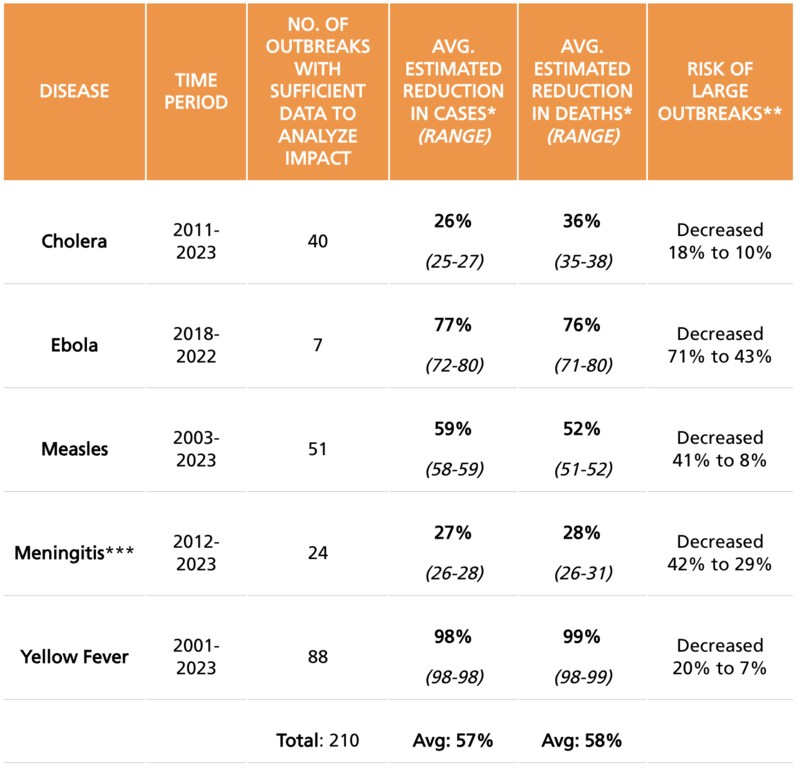
The study, conducted by Gavi, the Vaccine Alliance, in collaboration with Australia’s Burnet Institute, and published in the authoritative British Medical Journal (BMJ) Global Health, analyzed 210 outbreaks across 49 low-income countries over a 23-year period.

It found that rapid vaccine deployment during outbreaks of cholera, Ebola, measles, meningitis and yellow fever, had led to estimated reductions in illnesses and deaths of nearly 60 per cent on average.

For diseases like yellow fever and Ebola, the impact was even more dramatic: yellow fever deaths dropped by 99 per cent, while Ebola fatalities fell by 76 per cent.

The results highlight not only the effectiveness of emergency vaccination, but also the critical role of preparedness and speed in response to emerging threats.

“For the first time, we are able to comprehensively quantify the benefit, in human and economic terms, of deploying vaccines against outbreaks of some of the deadliest infectious diseases,” said Sania Nishtar, CEO of Gavi.

This study demonstrates clearly the power of vaccines as a cost-effective countermeasure to the increasing risk the world faces from outbreaks.

Gavi: A lifesaving partnership

Gavi, the Vaccine Alliance, is a unique global partnership that helps vaccinate nearly half the world’s children against deadly and debilitating diseases.

It brings together developing country and donor governments, the World Health Organization (WHO), UN Children’s Fund (UNICEF), the World Bank, the Bill & Melinda Gates Foundation and other key partners to expand access to immunisation.

Gavi also maintains global vaccine stockpiles for major diseases, managed in coordination with WHO, UNICEF, Médecins Sans Frontières (MSF), and the International Federation of Red Cross and Red Crescent Societies (IFRC).

Working in partnership with Gavi, governments and health authorities, UN agencies support vaccination campaigns in some of the most remote regions of the wrote. Pictured here, a child receives a vaccine in Solomon Islands in the Pacific.

Quantifying lives and costs saved

In addition to reducing deaths and disability-adjusted life years, emergency vaccination during the 210 outbreaks studied generated nearly $32 billion in economic benefits – from averting premature deaths and years of life lost to disability.

The study’s authors say this figure is likely a conservative estimate, as it does not include the broader social and macroeconomic impacts of major outbreaks.

For example, the 2014 Ebola outbreak in West Africa, which occurred before an approved vaccine was available, cost the region an estimated $53 billion. In contrast, later outbreaks responded to with emergency vaccines saw deaths reduced by three-quarters and the threat of regional spread dramatically lowered.

Source: Gavi/Burnet Institute study

Results by disease

Click here for details.

Disease-by-disease gains

The study provides a breakdown of vaccine effectiveness by disease.

Measles, one of the most infectious viruses known, saw cases drop by 59 per cent and deaths by 52 per cent thanks to outbreak response campaigns.

Yellow fever saw the biggest gains, with emergency vaccination nearly eliminating deaths – a 99 per cent drop.

Cholera and meningitis, which often strike communities with limited healthcare access and infrastructure, saw more modest but still meaningful reductions in cases and deaths.

Vaccinations helped reduce cholera cases and deaths by 28 per cent and 36 per cent, respectively, across 40 cholera outbreaks between 2011 and 2023. For meningitis, cases and deaths fell by 27 per cent and 28 per cent respectively, over 10 years.

Vaccines, COVID-19, and future threats

The coronavirus“>COVID-19 pandemic was a stark reminder of the value of vaccines, which saved an estimated 20 million lives globally in the first year of rollout alone, according to the respected and influential Lancet medical journal.

Yet the pandemic also disrupted routine immunisation, leading to dangerous backsliding in coverage rates for diseases like measles and polio. The Gavi study emphasizes that emergency vaccination must be paired with strong routine immunisation systems to prevent future outbreaks.

Looking ahead, Gavi’s 2026-2030 strategy includes expanding stockpiles, accelerating vaccine access for diseases like mpox and hepatitis E, and supporting preventive campaigns in high-risk regions.

Look back: COVID-19 pandemic disrupts vaccinations for children globally.

Over 60 per cent of the Arab world still outside the banking system

Even more impressively, the number of Egyptian women with an account increased by 260 per cent, though gender gaps do remain.

But how you widen financial inclusion overall is a question the Arab region is currently grappling with.

A new report from the UN Economic and Social Commission in Western Asia (UNESCWA) published on Thursday highlights the challenge.

Nearly 64 per cent of adults in the 22 countries in the Arab region are still without an account – or “unbanked” – a higher number than all other regions of the world and significantly higher than the 24 per cent global average.

The report warns that this level of financial exclusion will negatively impact economic opportunities and the region’s ability to meet Sustainable Development Goals (SDGs) by 2030.

“The Arab region cannot afford to treat financial services as a luxury. Without inclusive finance, we cannot hope to lift people out of poverty, support small businesses, or achieve equitable growth,” said ESCWA’s Mario Jales, lead author of the report.

The digital divide within the divide’

The report finds that women and disabled people have even less access to financial services – only 29 per cent of women and 21 per cent of disabled people in the region have an account.

Similarly, rural communities and younger and older people also experience lower rates of inclusion in the banking system.

The report also highlighted that access to loans for small and medium-sized businesses is worryingly low, reducing entrepreneurial and other income-producing activities.

In addition to gender disparities, there are variations within the Arab region – 81 per cent of people in low-income countries do not have access to an account in comparison to 67 per cent in middle-income countries and 23 per cent in the high-income bracket. 

As of 2024, 69 percent of Egyptian women have bank accounts, a large increase from 2016.

Models of success

Given that regional rates of financial inclusion remain so low, how do countries work to improve them?

The basis of Egypt’s success was the implementation of a comprehensive national strategy to promote financial inclusion, a strategy which actively worked to target underserved communities, ESCWA points out.

For example, in Egypt, 22 per cent of ATMs in the country have now been equipped with accessibility features including brighter lighting and Braille keyboards.

Other countries in the region have also implemented national strategies which include targeted initiatives.

Jordan, which has the second widest gender gap in the region, implemented a Microfund for Women to provide loans for income-generating activities. There are now 60 branches across the country, serving 133,000 borrowers, 95 per cent of whom are women.

Moreover, some banks in the region have worked to implement financial literacy classes and others have worked to tailor their services to underserved communities including by lowering minimum deposits.

The report concludes that an expansion of all these activities – national policymaking which targets underserved communities and private bank activities which lower barriers to entry and support financial literacy – will be essential in improving financial inclusion.

The path forward exists, but it requires political will, targeted investment and a whole-of-society approach,” the report concludes.