Lifesaver: Study shows vaccine campaigns cut deaths by nearly 60 per cent

The study, conducted by Gavi, the Vaccine Alliance, in collaboration with Australia’s Burnet Institute, and published in the authoritative British Medical Journal (BMJ) Global Health, analyzed 210 outbreaks across 49 low-income countries over a 23-year period.

It found that rapid vaccine deployment during outbreaks of cholera, Ebola, measles, meningitis and yellow fever, had led to estimated reductions in illnesses and deaths of nearly 60 per cent on average.

For diseases like yellow fever and Ebola, the impact was even more dramatic: yellow fever deaths dropped by 99 per cent, while Ebola fatalities fell by 76 per cent.

The results highlight not only the effectiveness of emergency vaccination, but also the critical role of preparedness and speed in response to emerging threats.

“For the first time, we are able to comprehensively quantify the benefit, in human and economic terms, of deploying vaccines against outbreaks of some of the deadliest infectious diseases,” said Sania Nishtar, CEO of Gavi.

This study demonstrates clearly the power of vaccines as a cost-effective countermeasure to the increasing risk the world faces from outbreaks.

Gavi: A lifesaving partnership

Gavi, the Vaccine Alliance, is a unique global partnership that helps vaccinate nearly half the world’s children against deadly and debilitating diseases.

It brings together developing country and donor governments, the World Health Organization (WHO), UN Children’s Fund (UNICEF), the World Bank, the Bill & Melinda Gates Foundation and other key partners to expand access to immunisation.

Gavi also maintains global vaccine stockpiles for major diseases, managed in coordination with WHO, UNICEF, Médecins Sans Frontières (MSF), and the International Federation of Red Cross and Red Crescent Societies (IFRC).

Working in partnership with Gavi, governments and health authorities, UN agencies support vaccination campaigns in some of the most remote regions of the wrote. Pictured here, a child receives a vaccine in Solomon Islands in the Pacific.

Quantifying lives and costs saved

In addition to reducing deaths and disability-adjusted life years, emergency vaccination during the 210 outbreaks studied generated nearly $32 billion in economic benefits – from averting premature deaths and years of life lost to disability.

The study’s authors say this figure is likely a conservative estimate, as it does not include the broader social and macroeconomic impacts of major outbreaks.

For example, the 2014 Ebola outbreak in West Africa, which occurred before an approved vaccine was available, cost the region an estimated $53 billion. In contrast, later outbreaks responded to with emergency vaccines saw deaths reduced by three-quarters and the threat of regional spread dramatically lowered.

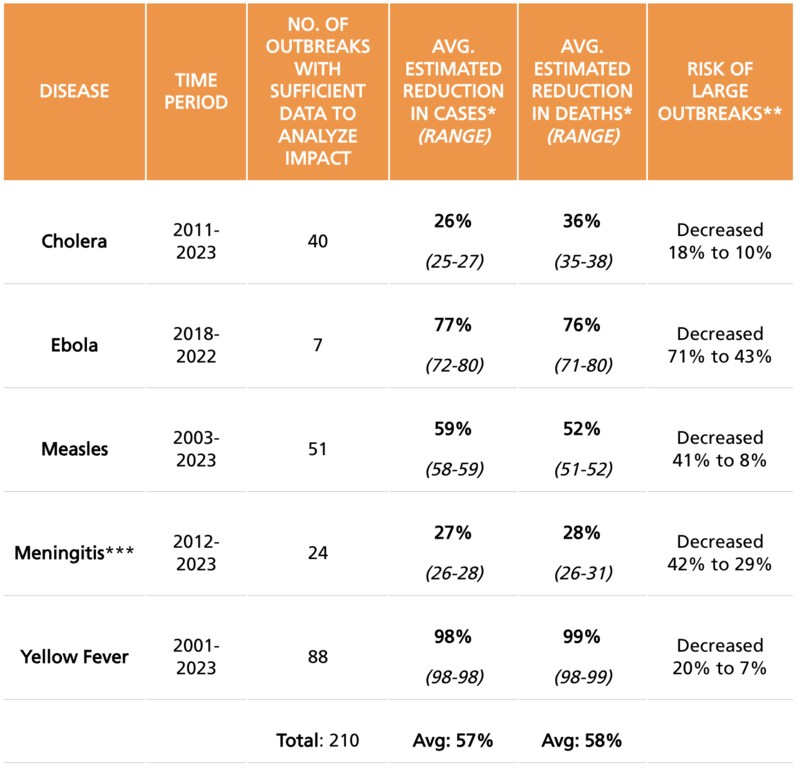
Source: Gavi/Burnet Institute study

Results by disease

Click here for details.

Disease-by-disease gains

The study provides a breakdown of vaccine effectiveness by disease.

Measles, one of the most infectious viruses known, saw cases drop by 59 per cent and deaths by 52 per cent thanks to outbreak response campaigns.

Yellow fever saw the biggest gains, with emergency vaccination nearly eliminating deaths – a 99 per cent drop.

Cholera and meningitis, which often strike communities with limited healthcare access and infrastructure, saw more modest but still meaningful reductions in cases and deaths.

Vaccinations helped reduce cholera cases and deaths by 28 per cent and 36 per cent, respectively, across 40 cholera outbreaks between 2011 and 2023. For meningitis, cases and deaths fell by 27 per cent and 28 per cent respectively, over 10 years.

Vaccines, COVID-19, and future threats

The coronavirus“>COVID-19 pandemic was a stark reminder of the value of vaccines, which saved an estimated 20 million lives globally in the first year of rollout alone, according to the respected and influential Lancet medical journal.

Yet the pandemic also disrupted routine immunisation, leading to dangerous backsliding in coverage rates for diseases like measles and polio. The Gavi study emphasizes that emergency vaccination must be paired with strong routine immunisation systems to prevent future outbreaks.

Looking ahead, Gavi’s 2026-2030 strategy includes expanding stockpiles, accelerating vaccine access for diseases like mpox and hepatitis E, and supporting preventive campaigns in high-risk regions.

Look back: COVID-19 pandemic disrupts vaccinations for children globally.

Covid update: India logs 4,858 new Covid-19 cases, 18 deaths

Sep 19 (IANS) In the last 24 hours, India logged 4,858 new Covid-19 cases and 18 deaths, the Union Health Ministry said on Monday.

The new fatalities have pushed the nationwide death toll to 5,28,355.

The active caseload rose to 48,027, accounting for 0.11 per cent of the country’s total positive cases.

The recovery of 4,735 patients in the last 24 hours took the cumulative tally to 4,39,62,664. Consequently, India’s recovery rate stands at 98.71 per cent.

Meanwhile, the daily and weekly positivity rates stood at 2.76 per cent and 1.78 per cent, respectively.

Covid cases/Ians

Also in the same period, a total of 1,75,935 tests were conducted across the country, increasing the overall tally to over 89.17 crore.

As of Monday morning, India’s Covid-19 vaccination coverage exceeded 216.70 crore.

Over 4.08 crore adolescents have been administered with a first dose of Covid-19 jab since the beginning of vaccination drive for this age bracket.

Covid Update: India reports 5,664 fresh Covid cases, 35 deaths

 Sep 18 (IANS) India on Sunday reported 5,664 fresh Covid cases in the last 24 hrs, against 5,747 Covid cases reported on previous day, said the Union Health Ministry.

In the same period, the country has recorded 35 more Covid related deaths, taking the national fatalities tally to 5,28,337 as per the report.

Meanwhile, the active caseload of the country has marginally risen to 47,922 cases, accounting for 0.11 per cent of the country’s total positive cases.

The recovery of 4,555 patients in the last 24 hours took the cumulative tally to 4,39,57,929. Consequently, India’s recovery rate stands at 98.71 per cent.

Vaccine

Meanwhile, India’s Daily Positivity Rate has been reported to be 1.96 per cent, while the Weekly Positivity Rate in the country currently also stands at 1.79 per cent.

Also in the same period, a total of 2,89,228 tests were conducted across the country, increasing the overall tally to over 89.15 crore.

As of Sunday morning, India’s Covid-19 vaccination coverage exceeded 216.56 crore.

Over 4.08 crore adolescents have been administered the first dose of Covid-19 jab since the beginning of vaccination drive for this age bracket.

India’s first Nasal Vaccine against COVID- 19 gets nod for emergency use

Department of Biotechnology (DBT) and its PSU, Biotechnology Industry Research Assistance Council (BIRAC) has announced approval from DCGI for emergency use authorization first of its kind intranasal COVID-19 Vaccine to Bharat Biotech (BBIL).

Supported by DBT and BIRAC under the aegis of Mission COVID Suraksha, the mission was launched by DBT and implemented by BIRAC to reinforce and accelerate COVID-19 vaccine development efforts. Scientific leadership at various levels of vaccine development was provided by DBT laboratories and BIRAC. This is the fourth success story for the Covid-19 vaccine under mission Covid Suraksha.

BBV154 is an intranasal replication-deficient chimpanzee adenovirus SARS-CoV-2 vectored vaccine. It consists of a replication deficient ChAd vector expressing the stabilized Spike SARS-CoV-2 (Wuhan variant).

DBT’s Autonomous Institute, National Institute of Immunology (NII), New Delhi utilized their “Human Immune Monitoring and T-cell Immunoassay Platform” to examine the vaccine-induced SARS-CoV-2-specific systemic and mucosal cellular immune responses the trial participants.

Interactive Research School for Health Affairs (IRSHA), Pune completed the Plaque Reduction Neutralization Assay (PRNT) to quantify the neutralizing antibody for the virus from three trial sites.

Covid Suraksha

Dr Rajesh S Gokhale, Secretary, DBT, and Chairperson, BIRAC speaking on the subject said that “The Department through Mission COVID Suraksha, is committed to the development of safe and efficacious COVID-19 vaccines.

BBV154 COVID Vaccine is the first intranasal vaccine approved by DCGI for primary immunization against COVID-19 in the 18+ age group for restricted use in emergency situation being developed in the country under Mission COVID Suraksha and adds to India’s COVID-19 vaccine series.

“This is an excellent example of Aatmanirbharta initiative of the Government of India. I congratulate our scientists for partnering with Bharat Biotech and providing scientific leadership throughout the development of first intranasal COVID-19 vaccine,” said Gokhale.

Update on COVID-19 Vaccine Availability in States/UTs

The Union Government is committed to accelerating the pace and expanding the scope of COVID-19 vaccination throughout the country. The nationwide COVID 19 vaccination started on 16th January 2021. The new phase of universalization of COVID-19 vaccination commenced from 21st June 2021. The vaccination drive has been ramped up through availability of more vaccines, advance visibility of vaccine availability to States and UTs for enabling better planning by them, and streamlining the vaccine supply chain.

As part of the nationwide vaccination drive, Government of India has been supporting the States and UTs by providing them COVID Vaccines free of cost. In the new phase of the universalization of the COVID19 vaccination drive, the Union Government will procure and supply (free of cost) 75% of the vaccines being produced by the vaccine manufacturers in the country to States and UTs.

covid vaccines doses

More than 201.88 crore (2,01,88,89,325) vaccine doses have been provided to States/UTs so far through Govt. of India (free of cost channel) and through direct state procurement category.

More than5.58Cr (5,58,87,590) balance and unutilized COVID Vaccine doses are still available with the States/UTs to be administered.