‘We are dying’: Gaza’s cancer patients plead for a way out

“We are dying. Every day, between two and three patients die inside this hospital,” says Munther Abu Foul, a cancer patient lying on his bed in Gaza’s largest hospital. “I can’t get out of bed because of the pain. We want a solution – open the crossings.”

His words capture the reality facing thousands of cancer patients across the Strip, where access to specialist care has collapsed and evacuation for treatment abroad remains out of reach for many.

Local health organisations warn that around 11,000 patients are currently deprived of specialised or diagnostic cancer treatment inside Gaza. 

Some 4,000 patients who received medical referrals to hospitals outside the Strip have been waiting for more than two years to travel.

UN News visited Al-Shifa Hospital in Gaza City, documenting the dire conditions inside its oncology department. Patients crowd corridors and wards, waiting for consultations or treatments that are no longer available. 

Essential medicines and equipment are in short supply, while many patients endure chronic pain that leaves them barely able to move.

A man takes care of his brother, a cancer patient at Al-Shifa hospital in Gaza City.

‘Every day, two or three patients die’

Mr. Abu Foul flips through his medical transfer papers, issued long ago for treatment outside Gaza. He has not been able to travel for more than two years.

“The health situation in the Gaza Strip is dilapidated,” he says. “There is no treatment or medicines, and we are dying. Every day, two to three patients die here inside this hospital. I can’t get out of bed because of the pain.”

He appeals directly for help. “We want a solution. Open the crossings properly so that God will release us from this suffering. Everyone will be held accountable.”

Nearby, Mohamed Hammou tends to his elderly mother, who is also battling cancer. He says families are forced to watch loved ones deteriorate without care.

We want a solution. Open the crossings properly so that God will release us from this suffering – Abu Foul

“This is how we stand in front of a patient who is dying, without treatment or any medical facilities that help them recover,” he says. “This does not please God and it does not satisfy people. We call on Islamic, Arab and international nations to look at the sick with mercy.”

A brother in pain

In another ward, Raed Abu Warda cares for his brother Hamid, whose cancer has worsened after long delays in treatment. What began as a small, benign illness has become a life-threatening condition.

“He has been suffering from cancer for two years,” Raed explains. “He waited all this time for the crossing to open so he could be treated outside. His pain has increased, as you can see.”

He gestures towards a wound that has opened beneath his brother’s chin. “The disease has created this wound, and his condition is getting worse every day. I stand watching my brother and mourning his condition because of the pain.”

The health situation in the Gaza Strip is deteriorating for those suffering from life-threatening cancers, despite the limited opening of the Rafah crossing.

The number of patients seeking care at Gaza’s oncology departments continues to rise, even as hospitals face severe shortages of medicines, equipment and specialised staff. For newly diagnosed patients, the future is increasingly uncertain.

Evacuations far short of needs

With the limited reopening of the Rafah crossing, the World Health Organization (WHO) is supporting the evacuation of patients and their companions from Gaza, focusing on ensuring safe transport. Yet the scale of need far outstrips what is currently possible.

All we ask for is a way to live

More than 18,000 patients – including around 4,000 children – are waiting to be evacuated abroad for medical treatment, according to WHO.

The UN Office for the Coordination of Humanitarian Affairs (OCHA) reported last week that Gaza’s Ministry of Health had recorded more than 1,200 patient deaths while people were waiting for medical evacuation. Around 4,000 cancer patients remain on critical waiting lists, trapped between closed crossings and a health system pushed beyond its limits.

For patients like Munther Abu Foul, time is running out. “We are dying,” he repeats. “All we ask for is a way to live.”

Just 1.5 per cent of Gaza’s agricultural land remains accessible and undamaged

A new report from the Food and Agriculture Organization (FAO) and the UN Satellite Centre (UNOSAT) reveals that just 8.6 percent of cropland in Gaza is still accessible, while only 1.5 per cent of cropland is both accessible and undamaged, as of 28 July.

More than 86 per cent of cropland is damaged, while 12.4 per cent is undamaged but out of reach, as fighting between Israeli forces and militants from Hamas and other armed groups continues.

Ongoing starvation

This report comes as Israel’s offensive inside Gaza continues to restrict aid distribution – and starvation-related deaths rise.  

The local Ministry of Health reported five new malnutrition-related deaths in the past 24 hours on Wednesday, bringing the total to almost 200 starvation-related deaths, half of whom are children.

Healthcare collapse

According to the UN aid coordination office (OCHA), hospitals are overstretched with many patients reduced to lying on the floor or in the streets.

This mass suffering is due to the lack of beds, medical supplies and equipment. Yet, emergency medical teams were again denied entry into Gaza on Tuesday.  

The World Health Organization (WHO) also reported that more than 100 health professionals, such as surgeons and other specialized medical staff, have been barred from entering the enclave since March.

Meanwhile, the limited availability of fuel continues to restrict lifesaving operations. The UN has collected around 300,000 litres from the Kerem Shalom crossing in the past two days, but this is far less than what is needed.

Due to the lack of fuel, UN health partners report that more than 100 premature babies are in imminent danger.

Renewed displacement orders

Additionally, the Israeli military on Wednesday renewed two displacement orders spanning five neighbourhoods in Gaza and Khan Younis governorates.  

Shelter materials have not been allowed to enter Gaza since 2 March when Israel withdrew from the ceasefire deal, and the few materials available on the local market are extremely expensive and limited in quantity, making them inaccessible to most families.  

Entry of commercial goods

On Tuesday, Israeli authorities reportedly allowed the entry of a limited number of trucks carrying commercial goods, including rice, sugar and vegetable oil – but the UN is still seeking more clarity on the situation.

Sugar remains one of the most expensive items on the market, with a two-ounce bag costing some $170. Eggs, poultry and meat have completely disappeared from marketplaces, forcing families to rely on pulses and bread to survive.  

At Wednesday’s daily briefing in New York, UN Deputy Spokesperson Farhan Haq stressed that “the worsening market situation underscores the urgent need for the entry of humanitarian aid and commercial goods at scale – and consistently.” 

Source link

Dreams amid the rubble: Gaza’s women speak of homes, loss and hungry children

In Gaza City, families living in tents reveal a shared, grim reality.

Many have been forced to flee the fighting dozens of times. Most find themselves homeless and hungry while facing an uncertain future.

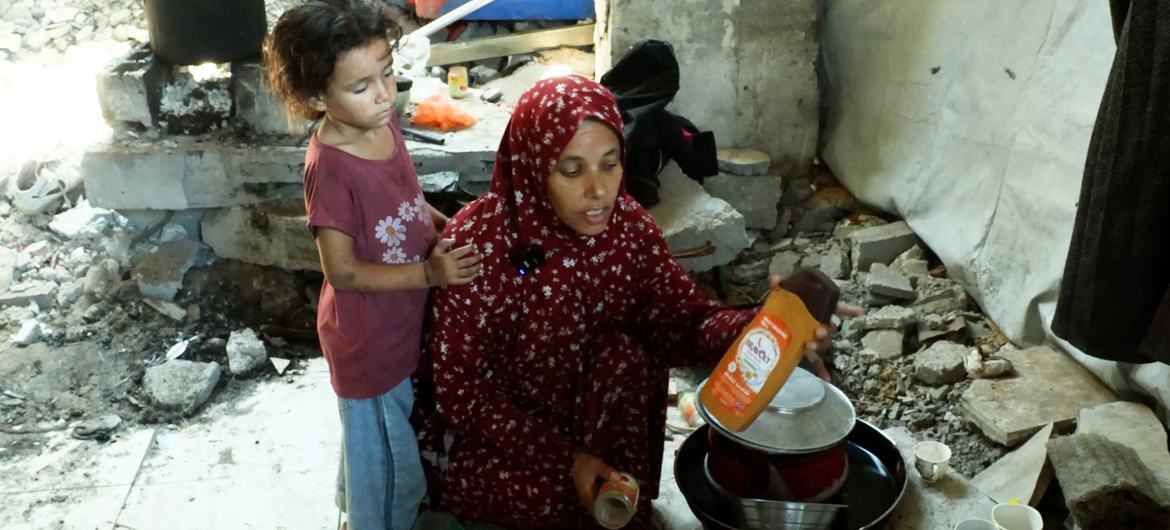
Khadija Manoun and her daughter in the space she uses as a kitchen inside a destroyed building.

Khadija Manoun: Kitchen of life’s leftovers

Khadija Manoun said she and her family have moved more than 20 times, from Jabalia in the northern Gaza Strip to a destroyed building in western Gaza, in search of shelter. She had owned a new fully furnished house, which she had built with a bank loan.

“I furnished my house well, with tiles and electrical appliances,” she said. “It had only been three years since I had the house. Then the war came and everything was lost.”

Today, everything has changed, Ms. Manoun said. Her spacious, fully equipped kitchen is now just a corner in the rubble, where a solitary soap dish borrowed from a neighbour sits. Metal utensils have been replaced with plastic tea containers to serve 10 people.

The bathroom was reduced to a corner covered with pieces of cloth that had been blankets. Her dressing room is now home to tattered suitcases.

“This is now my closet where I put everything,” she said. “I had a bedroom that had cost me 10,000 shekels.”

Her family sleeps on simple mattresses. Clean drinking water is a luxury that Khadija chases after, running between trucks, often returning with empty containers.

Amid all this, she sometimes reminisces, scrolling through photos on her mobile phone of her old home and the meals they used to eat.

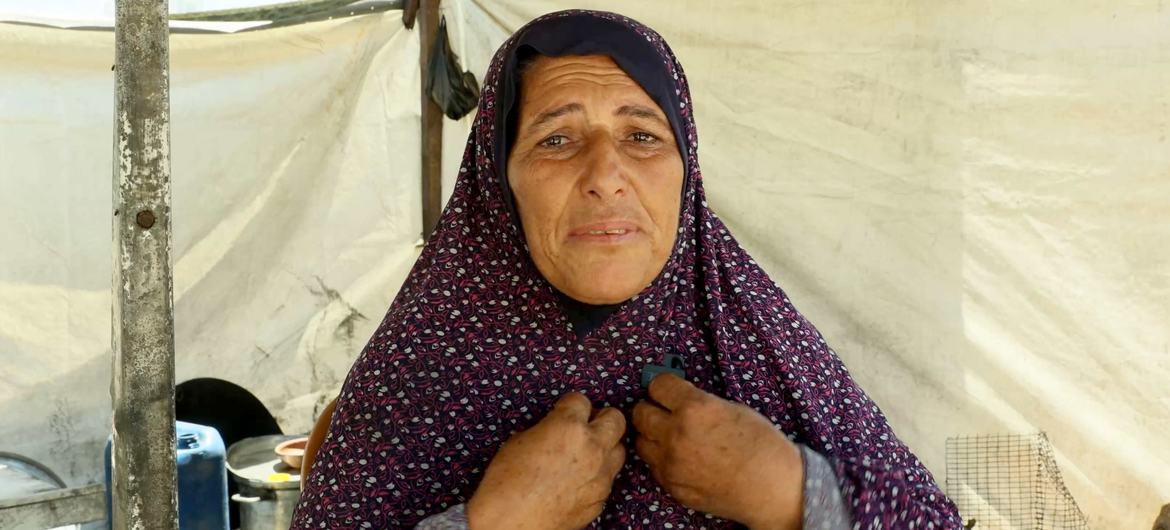
Badriya Barrawi, a displaced person in Gaza, is living among the ruins of destroyed buildings.

Badriya Barawi: Exhausted by hunger

In her modest tent on the beach west of Gaza City, Badriya Barawi, from Beit Lahia, sits, arranging what remains of her life. Tears stream from her eyes.

“Have mercy on us,” she said. “We are fed up and exhausted, mentally and physically. We can’t bear it any longer. How long will this life go on?”

She says her children are crying from the heat and hunger.

“We haven’t had bread for three days. This morning, I fed the children hummus, but is that enough for their stomachs?” said Ms. Barawi, who suffers from high blood pressure and diabetes.

She said she collapses daily from a lack of food.

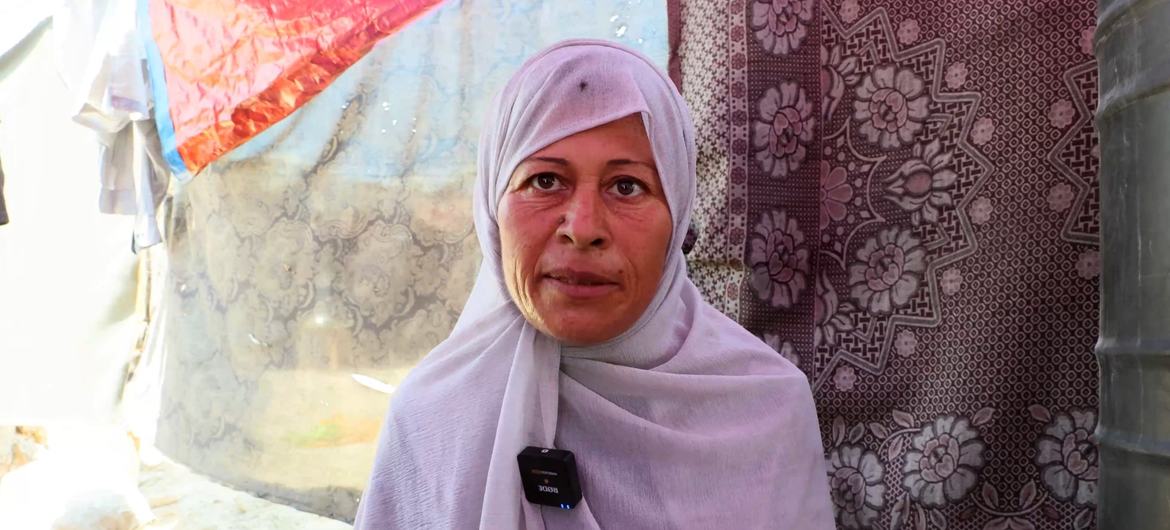
Hiyam Zayed is displaced from Beit Lahia in the northern Gaza Strip.

Hiyam Zayed: Trampled garden of dreams

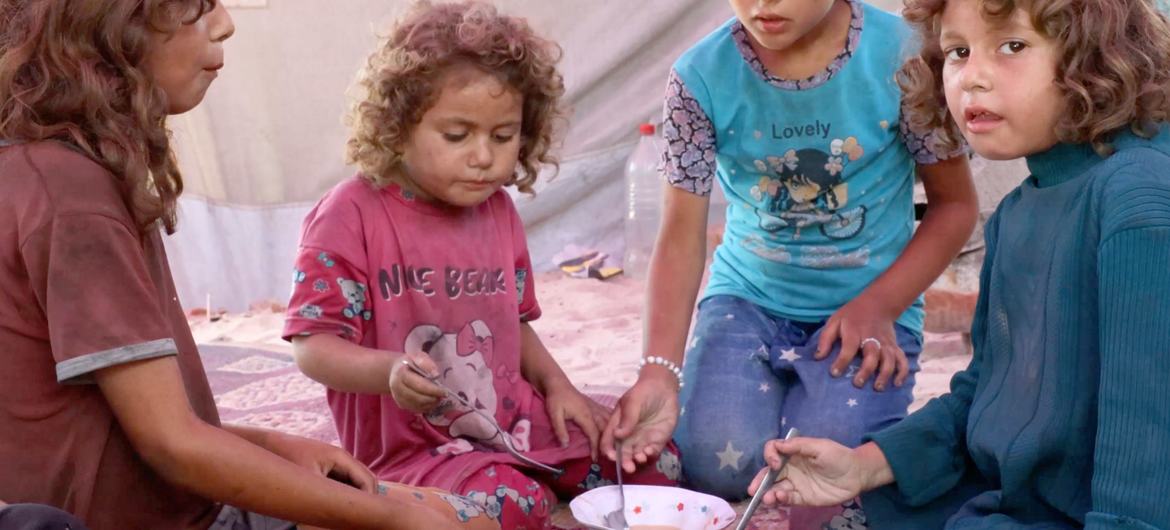
In a nearby tent, Hiyam Zayed and her eight daughters eat lentil soup without bread. Describing her former home, she said there were six rooms and a garden.

“I was happy in my home,” she said. “My daughters and I used to have fun there. They played on the roof or inside the rooms. We had a beautiful garden in front of the house, and we grew plants and ate its produce and raised chickens. My daughters were very happy. We fed them the best food and dressed them in the best clothes.”

She also said she used to have a washing machine, a fully equipped kitchen and a refrigerator “full of goodies”.

Now, everything is gone.

“No food, no washing machine, no feelings: we’ve become depressed,” she added.

“My daughters wear the worst clothes. I can’t find a way to bathe them. I used to turn on the water tap at home and water would run for drinking or bathing. Now, we live in a tent in the sand. I light a fire to cook after I used to have gas. I borrow cooking utensils.”

“How are we to blame for what happened, and who bears responsibility?” Ms. Zayed asked. “What is my fault and my children’s fault when we are displaced from one place to another and they die of hunger?”

Hiyam’s daughters eating a lunch of lentil soup, without bread, where they live, inside a destroyed building.

Mass displacement

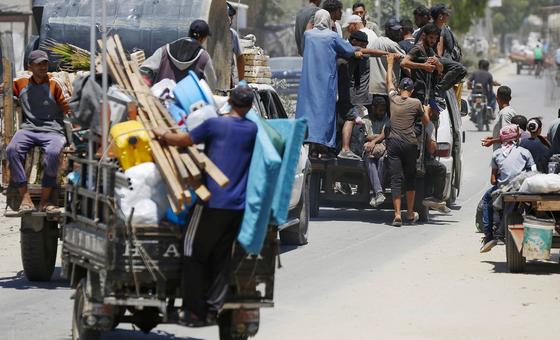
According to UN reports, more than two million Palestinians –the population of Gaza – live in about 15 per cent of the Strip’s area after the war caused widespread destruction of infrastructure and homes.

International organizations have warned that the continuation of the conflict threatens to have “catastrophic consequences” in the near term.

That includes a serious impact on children’s mental and physical health, the spread of disease and the disintegration of social structures.

This amid the absence of any clear path towards a political or humanitarian solution.

Source link

Terror and chaos for Gaza’s people now entering the ‘death phase’

In an alert, the UN agency for Palestine refugees, UNRWA, relayed desperate testimonies from its colleagues who are also struggling to survive in the war-torn enclave.

“We’re in the death phase,” one UNRWA worker said. “Everything around people at the moment is death, whether it’s bombs or strikes, children wasting away in front of their eyes from malnourishment, from dehydration, and dying.”

Doctors and nurses who continue to work in the UN agency’s clinics and medical centres “are watching children disappear and die in front of their eyes, and there’s absolutely nothing that they can do about it,” the worker continued.  

Civilians ‘faced sniper and tank-fire’

The development comes after desperate Gazans seeking aid came under fire at the weekend “from Israeli tanks, snipers and other gunfire”, according to the UN World Food Programme (WFP).

In a detailed statement after the incident on Sunday 20 July, it explained that a 25-truck lorry convoy crossed the Zikim border point in northern Gaza “destined for starving communities”. 

Shortly after passing the final checkpoint after the Zikim crossing point, the convoy encountered large crowds of civilians waiting to access food supplies. This was when the shooting began, leaving “countless” Gazans dead, WFP said, echoing reports by the health authorities.

Condemning the incident, WFP noted that the victims “were simply trying to access food to feed themselves and their families on the brink of starvation”.

The UN agency said furthermore that the violence had happened “despite assurances from Israeli authorities that humanitarian operational conditions would improve; including that armed forces will not be present nor engage at any stage along humanitarian convoy routes.”

Without such fundamental guarantees, it will not be possible to continue providing life-saving support across the Gaza Strip, WPF said, its reaction coming a day after a reported 36 people seeking aid were reportedly killed close to a Gaza Humanitarian Foundation hub run by the Israeli and US in the south of the Strip. 

Deir Al-Balah evacuation shock

In central Gaza’s Deir Al-Balah, meanwhile, 50,000 to 80,000 people have been impacted by a mass displacement order issued by the Israeli military – the first since war erupted on 7 October 2023.

“The new order cuts through Deir Al-Balah all the way to the Mediterranean Sea, further splintering the Strip,” OCHA said. “It will limit the ability of the UN and our partners to move safely and effectively within Gaza, choking humanitarian access when it is needed most.”

UN staff remain in Deir Al-Balah across “dozens of premises” whose coordinates have been shared with the warring parties. “These locations – as with all civilian sites – must be protected, regardless of displacement orders,” OCHA insisted, as  Israeli tanks reportedly moved into southern and eastern areas of the city.

According to reports, this may be where some of the remaining hostages seized in Hamas-led terror attacks on 7 October 2023 in Israel may still be held.

Gaza cut in two

The latest evacuation order means that almost 88 per cent of Gaza is impacted by displacement orders or falls within Israeli-militarized zones. Some 2.1 million civilians who have been uprooted multiple times are now squeezed into the little remaining space, where essential services have collapsed.

“There’s nowhere for [Gazans] to escape. They are trapped,” said UNRWA Senior Emergency Officer Louise Wateridge. “They cannot leave the Gaza Strip. They’re trying to keep their children alive. They’re trying to keep themselves alive.”

In comments to UN News, the veteran humanitarian explained that no food is available and only very limited water, explaining why so many desperate Gazans risk their lives to fetch aid from the few distribution centres and arrival points still operational.

“Children are malnourished, they’re dehydrated, they are dying in front of their [parents’] eyes,” Ms. Wateridge continued. “The bombs and the strikes are continuing; there’s no way to run, there’s nowhere to hide. There’s no way to escape there.” 

Source link

Songs of hope rise from Gaza’s ruins

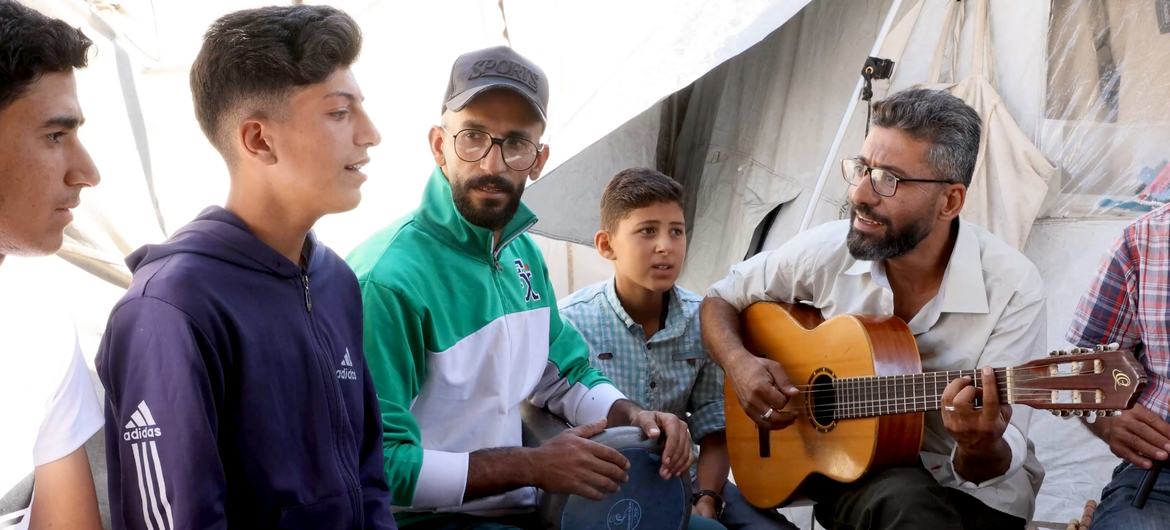
Among them is Ahmed Abu Amsha, a music teacher who has become something of a humanitarian troubadour.

Fleeting moments of joy

Living in a worn tent with his family, he refuses to let despair drown out hope. Instead, he teaches music to displaced children, helping them find moments of joy through rhythm and song.

Originally from Beit Hanoun, Abu Amsha is a guitar instructor and regional coordinator at the Edward Said National Conservatory of Music. Since the war began, his family has been displaced 12 times. Each time they fled, they took their instruments.

“They’re the only thing that keeps us hopeful,” he said, sitting beside bottles of water outside his tent, a guitar resting gently in his lap.

UN Video | Music amid the rubble: A Gazan musician plants seeds of hope

Daily horror

Daily life in the camp is a grind of hardship – narrow alleys, water queues, a constant struggle to survive. Yet within this bleakness, Abu Amsha has created something extraordinary: Gaza Bird Singing (GBS), a musical group made up of displaced children with budding talents.

The idea came during a period of displacement in Al-Mawasi, Khan Younis, where he began training children to sing and play. The group has since performed in various camps, their music echoing on social media and offering a rare glimpse of hope amid rubble.

Clinging to music

His son Moein, who plays the ney – an end-blown wind instrument similar to a flute – carries his instrument wherever they go. “We’ve been displaced more than 11 times, and I always carry my ney with me. It’s the only thing that helps me forget the sound of the bombing,” he said.

Finding a quiet space is hard, but they try to practise inside their tent, cocooned from chaos.

For Yara, a young violinist learning under Abu Amsha’s guidance, each new displacement deepens her anxiety. “But whenever I’m scared, I play. Music makes me feel safe,” she said.

Under the tarpaulin roofs of the camp, children gather to play, plucking strings, blowing wind instruments, tapping rhythms into existence – trying to transcend the horrific soundtrack of war.

Ahmed Abu Amsha (right, with guitar) surrounded by children who play, sing and learn music.

Sacred space

In a place stripped of necessities, the sound of music feels both surreal and sacred.

Yet Abu Amsha remains steadfast in his mission. “We sing for peace, we sing for life, we sing for Gaza,” he says softly, as the melody of the oud rises behind him – a fragile beauty in a scene shattered by war.

Source link