
AI Impact Summit: Long Queues, Brief Evacuation Create Confusion at Pragati Maidan

What was billed as a landmark showcase of India’s AI ambitions descended into disarray on its opening day, with throngs of attendees facing interminable queues, sudden evacuations, and logistical nightmares at the Pragati Maidan venue in the capital.
The India AI Impact Summit, running through February 20, drew sharp online backlash as delegates, startups, and journalists reported overcrowding, inadequate signage, and conflicting access protocols. With an expected footfall of 250,000, the event aimed to position India as a voice for emerging economies in AI governance.
Instead, organizational hiccups threatened to eclipse the government’s narrative of technological prowess under Prime Minister Narendra Modi’s administration.Several participants described a frantic morning, with entry delayed until late, only for the exhibition hall to be abruptly cleared for security sweeps ahead of high-profile arrivals. “Unclear instructions had left many scrambling to reclaim possessions,” one delegate told Reporters, echoing sentiments shared widely on social media.

Venue Evacuated Briefly

The chaos peaked around midday when the venue was evacuated for hours of sanitization, stranding exhibitors and founders outside without water or updates. Punit Jain, founder of developer platform Reskilll, captured the frustration in a viral post on X: “An AI Summit that sidelines its own builders? • 7 AM queues • 9 AM entry • 12 PM full evacuation • Hours of sanitization • PM visit at 5 PM. Day 1 Ends here. Meanwhile, exhibitors, delegates, startup founders left outside. No water. No clarity.”

Jain, who tagged IT Minister Ashwini Vaishnaw and the Prime Minister’s Office, accused organizers of mobilizing the ecosystem only to displace it, calling it “not how we build India’s AI future.”

Journalists fared no better, grappling with mismatched digital QR codes and promised physical passes that never materialized. In a WhatsApp group for media covering the event, reporters lamented a lack of workspaces, with one noting the absence of seating to file stories or conduct interviews.
Sreenivasan R, an education and tech activist, highlighted the disorganization in real-time:

@OfficialINDIAai

@IndiaAiExpo

chaotic entry,

@DiGiyatra

no use. Thousands in 5Queues and one bags scanner. Poor management across. No proper directions. People going in circles. Sessions cancelled, agenda vanishing from App. Labelling wrongly done at rooms.” Sreenivasan, an alumnus of IIM Bangalore and Jawaharlal Nehru University, added that he was “helping wherever” possible amid the confusion.

International Visitors in Dismay

Even international visitors expressed dismay. Raj Vardhan, who traveled from the United States, described his ordeal: “Flew all the way from the US for the AI Summit, only to face chaos on Day 1. Overcrowded, poorly planned, and couldn’t get into a single session. To make it worse, endless political convoys blocking roads turned getting out into a nightmare.”

Vardhan’s post, hashtagged #AISummit and #AIIndia, voiced cautious optimism for Day 2, urging a demonstration of “true AI leadership.” The complaints echoed an earlier vent from Maitreya Wagh, co-founder of AI voice startup Bolna, who found himself locked out of his own booth: “Gates are closed so could not access my own booth at the AI Summit. If you’re also stuck outside and wanted to visit the Bola team, dm me. We may set up a mini-booth at some Connaught Place cafe.”

For now, attendees are bracing for Tuesday’s panels, where some speakers remain in limbo over session confirmations and agendas. Amid the glitches, the summit’s core message, amplifying Global South perspectives on ethical AI, hangs in the balance, overshadowed by the very disorganization it sought to transcend.

Choose peace over chaos, Guterres urges as he sets out final-year priorities

2026 “is already shaping up to be a year of constant surprises and chaos,” he told journalists in New York.

Mr. Guterres – who trained as a physicist before entering public life – said that during times of profound flux, he returns to fixed principles that explain how forces act.

Broadcast of the press conference.

Generating ‘positive reactions’

Among them is Newton’s Third Law of Motion which states that for every action, there is an equal and opposite reaction.

“As we begin this year, we are determined to choose actions that generate concrete and positive reactions,” he said.

“Reactions of peace, of justice, of responsibility, and of progress in our troubled times.”

Chain reaction

Today, impunity is driving conflicts – fueling escalation, widening mistrust, and allowing powerful spoilers to enter from every direction.

“Meanwhile, the slashing of humanitarian aid is generating its own chain reactions of despair, displacement, and death,” as inequalities deepen.

He highlighted climate change – “the most literal and devastating illustration of Newton’s principle” – as actions that heat the planet trigger storms, wildfires, hurricanes, drought and rising seas.

Power shift

The world is also witnessing “perhaps the greatest transfer of power of our times”, namely from governments to private tech companies.

“When technologies that shape behaviour, elections, markets, and even conflicts operate without guardrails, the reaction is not innovation, it is instability,” he warned.

Secretary-General’s opening remarks at the press conference (click here to download from SoundCloud).

Hegemony is not the answer

These challenges are happening as systems for global problem-solving continue to reflect economic and power structures of 80 years ago and this must change.

“Our structures and institutions must reflect the complexity – and the opportunity – of these new times and realities,” he said.

Global problems will not be solved by one power calling the shots. Nor will they be solved by two powers carving the world into rival spheres of influence.”

He stressed the importance of accelerating multipolarity – “one that is networked, inclusive by design, and capable of creating balance through partnerships” – but it alone does not guarantee stability or peace.

“For multipolarity to generate equilibrium, prosperity and peace, we need strong multilateral institutions where legitimacy is rooted in shared responsibility and shared values,” he said.

Shared values

Additionally, in the pursuit of reform, “structures may be out of date – but values are not,” he said.

In this regard, the people who wrote the UN Charter “understood that the values enshrined in our founding documents were not lofty abstractions or idealistic hopes” but “the sine qua non of lasting peace and enduring justice.”

He said that “despite all the hurdles, the United Nations is acting to give life to our shared values” and will not give up.

Peace, reform and development

“We are pushing for peace – just and sustainable peace rooted in international law. Peace that addresses root causes. Peace that endures beyond the signing of an agreement.”

The UN is also pressing to reform and strengthen the Security Council – “the one and only body with the Charter-mandated authority to act on peace and security on behalf of every country.”

Stating that there is no lasting peace without development, he highlighted action to speed up progress to achieve the Sustainable Development Goals (SDGs) and reform the global financial architecture,

“That includes ending the crushing cycle of debt, tripling the lending capacity of multilateral development banks, and ensuring developing countries just participation and real influence in global financial institutions,” he said.

Climate support

On climate action, he stressed the need for deep emissions cuts this decade along with a just and equitable transition from fossil fuels to renewable energy sources.

We are demanding far greater support for countries already confronting climate catastrophe, expanded early warning systems, opportunities for nations rich in critical minerals to climb global value chains,” he said.

The UN is also working urgently towards a framework for technology governance, including through global dialogue, capacity support for developing countries and the new International Scientific Panel on Artificial Intelligence (AI).

The names of 40 proposed panel members will be submitted to the General Assembly soon.

AI for the developing world

Mr. Guterres has also called for the creation of a Global Fund on AI Capacity Development for developing countries, with a target of $3 billion.

“As we begin this year, we are determined to choose actions that generate concrete and positive reactions,” he said.

“Reactions of peace, of justice, of responsibility, and of progress in our troubled times.”

Source link

Terror and chaos for Gaza’s people now entering the ‘death phase’

In an alert, the UN agency for Palestine refugees, UNRWA, relayed desperate testimonies from its colleagues who are also struggling to survive in the war-torn enclave.

“We’re in the death phase,” one UNRWA worker said. “Everything around people at the moment is death, whether it’s bombs or strikes, children wasting away in front of their eyes from malnourishment, from dehydration, and dying.”

Doctors and nurses who continue to work in the UN agency’s clinics and medical centres “are watching children disappear and die in front of their eyes, and there’s absolutely nothing that they can do about it,” the worker continued.  

Civilians ‘faced sniper and tank-fire’

The development comes after desperate Gazans seeking aid came under fire at the weekend “from Israeli tanks, snipers and other gunfire”, according to the UN World Food Programme (WFP).

In a detailed statement after the incident on Sunday 20 July, it explained that a 25-truck lorry convoy crossed the Zikim border point in northern Gaza “destined for starving communities”. 

Shortly after passing the final checkpoint after the Zikim crossing point, the convoy encountered large crowds of civilians waiting to access food supplies. This was when the shooting began, leaving “countless” Gazans dead, WFP said, echoing reports by the health authorities.

Condemning the incident, WFP noted that the victims “were simply trying to access food to feed themselves and their families on the brink of starvation”.

The UN agency said furthermore that the violence had happened “despite assurances from Israeli authorities that humanitarian operational conditions would improve; including that armed forces will not be present nor engage at any stage along humanitarian convoy routes.”

Without such fundamental guarantees, it will not be possible to continue providing life-saving support across the Gaza Strip, WPF said, its reaction coming a day after a reported 36 people seeking aid were reportedly killed close to a Gaza Humanitarian Foundation hub run by the Israeli and US in the south of the Strip. 

Deir Al-Balah evacuation shock

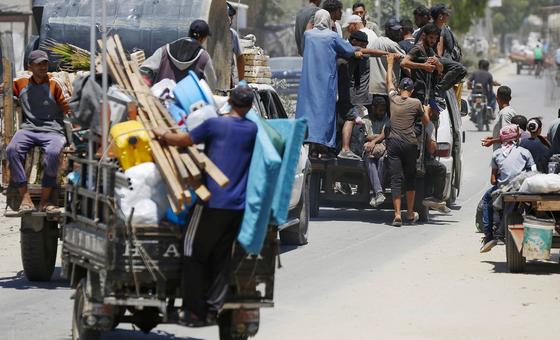
In central Gaza’s Deir Al-Balah, meanwhile, 50,000 to 80,000 people have been impacted by a mass displacement order issued by the Israeli military – the first since war erupted on 7 October 2023.

“The new order cuts through Deir Al-Balah all the way to the Mediterranean Sea, further splintering the Strip,” OCHA said. “It will limit the ability of the UN and our partners to move safely and effectively within Gaza, choking humanitarian access when it is needed most.”

UN staff remain in Deir Al-Balah across “dozens of premises” whose coordinates have been shared with the warring parties. “These locations – as with all civilian sites – must be protected, regardless of displacement orders,” OCHA insisted, as  Israeli tanks reportedly moved into southern and eastern areas of the city.

According to reports, this may be where some of the remaining hostages seized in Hamas-led terror attacks on 7 October 2023 in Israel may still be held.

Gaza cut in two

The latest evacuation order means that almost 88 per cent of Gaza is impacted by displacement orders or falls within Israeli-militarized zones. Some 2.1 million civilians who have been uprooted multiple times are now squeezed into the little remaining space, where essential services have collapsed.

“There’s nowhere for [Gazans] to escape. They are trapped,” said UNRWA Senior Emergency Officer Louise Wateridge. “They cannot leave the Gaza Strip. They’re trying to keep their children alive. They’re trying to keep themselves alive.”

In comments to UN News, the veteran humanitarian explained that no food is available and only very limited water, explaining why so many desperate Gazans risk their lives to fetch aid from the few distribution centres and arrival points still operational.

“Children are malnourished, they’re dehydrated, they are dying in front of their [parents’] eyes,” Ms. Wateridge continued. “The bombs and the strikes are continuing; there’s no way to run, there’s nowhere to hide. There’s no way to escape there.” 

Source link

Gaza: UN warns of ‘weaponised hunger’ and growing death toll amid food chaos

Speaking to journalists in Deir al Balah on Saturday, Jonathan Whittall, who heads the UN humanitarian coordination office (OCHA) in Gaza and the West Bank, said: “The attempt to survive is being met with a death sentence.”

Since Israel eased its total blockade last month, more than 400 people are reported to have died trying to reach food distribution points.

We see a chilling pattern of Israeli forces opening fire on crowds gathering to get food,” Mr. Whittall said, noting many of these sites are in militarised zones. Others have been killed along access routes or while protecting aid convoys.

“It shouldn’t be this way,” he said. “There shouldn’t be a death toll associated with accessing the essentials for life.”

Empty warehouses, overwhelmed hospitals

Conditions across Gaza continue to deteriorate. Water wells have run dry or are located in dangerous areas, sanitation systems have collapsed, and disease is spreading rapidly.

“Our warehouses stand empty,” Mr. Whittall said. “Displaced families flee with nothing – and we have nothing to give them.”

Partially functioning hospitals are overwhelmed by near-daily mass casualty events. Some have been directly hit, while others are choked by fuel shortages and forced evacuation orders.

UNICEF reports more than 110 children are being treated for malnutrition every day. Mr. Whittall said humanitarian agencies are capable of reaching every family in the shattered enclave but are being systematically blocked. “We have a plan…but we are prevented from doing so at every turn.”

Death sentence

He described the situation as “weaponised hunger”, “forced displacement”, and “a death sentence for people just trying to survive”.

“This is carnage,” Mr. Whittall said. “It appears to be the erasure of Palestinian life from Gaza.”

He urged the international community to act: “We need a lasting ceasefire, accountability, and real pressure to stop this. This is the bare minimum.”

Demonetisation: Supreme Court Warns Govt to End Cash Crisis

The Supreme Court on Friday warned the government to find ways to end the cash crisis as people standing in long queues for hours every day may turn violent anytime leading to anarchy.

Brushing aside the government contention, the court made it clear that “It is a serious issue.” Since it affects the entire population, it said, “You cannot deny there is a serious problem. There could be riots.”

The bench consisting of Chief Justice TS Thakur and Justice AR Dave retorted to attorney general Mukul Rohatgi’s plea seeking directive to lower courts to stop hearing cases related to demonetisation. Once the high courts take up legal suits, millions of suits will move the courts seeking intervention to redeem their money.

The bench took exception to limit the daily cash exchange limit to Rs 2,000, after promising to increase it to Rs.4500 creating suspicions in the minds of people about the government’s ability to exchange their money in time.

“The government just did not have the capacity to print new currency notes. They should have taken this into account and taken steps to avoid putting people into untold harassment,” said petitioners.

“Daily labourers are not getting paid, tea garden workers are not getting their salaries, people in rural areas have to walk long distances to reach banks and ATMs only to be told that these have run out of cash. It is a serious situation. Transporters are suffering. Trucks are standing idle without cash. India is a cash-based economy and the government has hurt it badly by freezing cash circulation,” senior advocate Kapil Sibal said in the Supreme Court on Friday on behalf of the petitioners who have questioned the legality of demonetisation.

The next hearing will be on November 25.