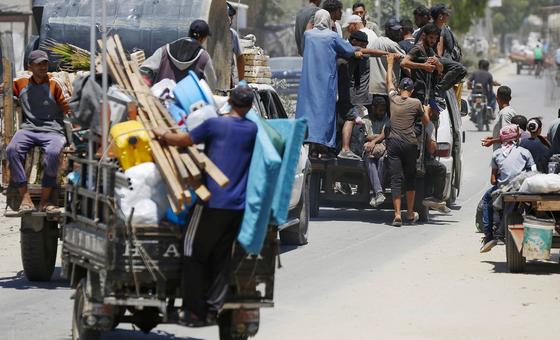
Potential turning point for Gaza as peace plan enters second phase: UN envoy

Ramiz Alakbarov warned that risks of violence escalating again remain high, while the situation in the occupied West Bank continues to deteriorate.

The Deputy Special Coordinator for the Middle East Peace Process said he was addressing ambassadors “at a moment of both profound opportunity and considerable risk,” pointing to cautious diplomatic progress on Gaza alongside deepening instability elsewhere.

“In front of us we see a potential turning point for Gaza, a genuine chance for a better future,” Mr. Alakbarov said. “But many uncertainties remain.”

He heralded the second phase of President Donald Trump’s 20-point Comprehensive Plan as “a critical step in consolidating the ceasefire in Gaza,” alongside the establishment of new transitional bodies, including the National Committee for the Administration of Gaza and the Office of the High Representative for Gaza.

Deputy Special Coordinator Alakbarov briefs the Security Council members via video link.

Monumental task ahead

Mr. Alakbarov said he had just returned from Cairo, where he met members of the National Committee to discuss how the UN could support efforts to restore essential public services, facilitate humanitarian aid and begin planning for reconstruction, in line with Security Council resolution 2803.

He cautioned that the task ahead is “monumental” and will require close coordination among all stakeholders, considering existing systems and capacities.

The UN envoy welcomed the recovery of the remains of the last hostage held in Gaza, expressing condolences to the family of Ran Gvili and said he hoped that with all hostages returned, “the process of healing for the families and all those affected may begin.”

He also said Israel’s announcement that the Rafah crossing would open for pedestrian movement in both directions was encouraging, while stressing that demilitarisation of the Gaza Strip and effective security arrangements remain essential for the next phase to succeed.

Mr. Gvili was among more than 250 Israeli and foreign nationals abducted by Hamas and other Palestinian armed groups during their 7 October 2023 attack on southern Israel, in which more than 1,250 people were also killed.

The ensuing Israeli military offensive in Gaza resulted in widespread devastation and a massive loss of Palestinian life, with tens of thousands reported killed and countless others wounded, many suffering life-long injuries.

Gazans want a better, stable future

Despite continued hardship, Mr. Alakbarov said his recent visit to Gaza underscored the determination of its people.

The people in Gaza are ready and eager to lead the way to a better, more stable future,” he told the Council, describing students taking exams under extreme conditions, farmers finding ways to plant despite shortages, and small business owners adapting to a devastated market.

At the same time, he emphasised that humanitarian needs remain severe. Nearly the entire population of Gaza still requires assistance, with more than 1.5 million displaced people exposed to winter rains and cold temperatures.

Mr. Alakbarov warned that humanitarian operations are still unable to function at scale, citing insecurity, access restrictions and delays at crossings.

Occupied West Bank unravelling

Turning to the occupied West Bank, the senior UN official said the situation is “unravelling,” marked by ongoing violence, settlement expansion, demolitions and displacement.

These trends, he warned, are undermining prospects for peace and could jeopardise progress on implementing the second phase of the ceasefire plan.

The implementation of the second phase of the Gaza ceasefire plan is critical,” Mr. Alakbarov said, urging the Council to act collectively.

He reaffirmed the UN’s commitment to supporting Palestinians and Israelis in advancing toward a two-State solution, in line with international law and UN resolutions.

Click here for in-depth coverage of this meeting, including national and regional positions.

Source link

‘Decisive battle’: Guterres calls for youth power in fight to phase out fossil fuels

On Tuesday in Belém, ministers from Colombia, Germany, Kenya, the Marshall Islands, Sierra Leone, the United Kingdom and several other countries, voiced strong support for Brazil’s proposal to elevate the issue in this year’s round of UN climate negotiations.

The coalition called on negotiators to reinforce language around the fossil fuel transition in the draft text, slated for approval on Wednesday. Their aim: to accelerate action and keep global warming within 1.5°C.

Then a hush fell. The ministers listened as COP30 Youth Champion Marcele Oliveira stepped forward, carrying the urgency of an entire generation.

“Fossil fuels are destroying dreams,” she warned, calling the shift away from them “the most important climate justice mobilization of this generation.”

COP30 Youth Climate Champion, Marcele Oliveira, speaks at the UN Climate Change Conference taking place in Belém, Brazil.

Protecting the future

Speaking with UN News, Ms. Oliveira stressed that children and young people must be at the heart of every COP30 discussion.

“We had a decision from the International Court of Justice stating that countries’ inaction on climate change constitutes an environmental crime. Therefore, we need to pressure countries to make better climate decisions, and this is also a priority,” she told us.

“Of course, we need to move away from fossil fuels, invest in forest protection, and protect those who protect them. And of course, for young people, recognition of collective action at the local level, led by young people, is very important.”

Participants during UN Secretary-General António Guterres’s Youth Roundtable at COP30 in Belém, Brazil.

Guterres: A ‘decisive battle’

Later in the day, UN Secretary-General António Guterres met with youth delegates and offered an apology – one heavy with recognition. Past generations, he said, failed to contain the climate crisis. Scientific projections confirm temperatures will surpass the 1.5°C threshold.

Now, he urged young people to stand with him in what he called the “decisive battle” to ensure that this overshoot is as short as possible.

The transition from fossil fuels to renewables, he emphasized, is essential, and requires confronting powerful lobby groups that “put profits above the well-being of the international community and the planet.” Youth pressure, he said, is indispensable at COP30.

‘We just want to be children!’

Sixteen-year-old João Victor da Silva, from Brazil, told the UN chief: “We don’t want to be activists, we just want to be children and adolescents, but unfortunately adults are not making the right decisions.”

From Aruba, Nigel Maduro shared a painful truth: the beaches where he learned to swim are disappearing. Negotiations, he warned, move slowly – perhaps too slowly for his island nation, which faces soaring temperatures and rising seas.

Youth from several countries echoed the same plea: act now to secure a habitable future.

The Secretary-General agreed that greater youth participation – especially from Indigenous communities – would lead to better outcomes. He acknowledged calls for more direct, less bureaucratic financing for Indigenous peoples and pledged to improve conditions to make that possible.

Children make their voices heard at the UN Climate conference in Belém, Brazil.

‘Protests are a defining feature of COP30’

Indigenous leader Txai Suruí described the youth meeting as one of the most hopeful moments of COP30. But she warned that the Amazon is dangerously close to a tipping point that could push the forest toward desertification.

“The protests are a distinguishing feature of this COP, because [though] some countries may not like them, but Brazil is a democratic country, and the protests also serve to ensure that these leaders actually make decisions in favor of life.”

Ms. Txai noted that corporate lobbying remains larger than all delegations combined – and certainly larger than Indigenous representation – creating an imbalance of voices. Yet she sees growing recognition of Indigenous communities as guardians of nature.  

A ‘just transition’

Meanwhile, for Ms. Oliveira, the transition away from fossil fuels must be just—an approach that “listens to, welcomes, and hears the territories.” Measures such as demarcating Indigenous lands, she said, are essential to ensure this shift does not further harm populations already affected.

UN News is reporting from Belém, bringing you front-row coverage of everything unfolding at COP30. 

Israel’s plan to take over Gaza City marks ‘new and dangerous phase’: Guterres

“Israel’s initial steps to militarily take over Gaza City signals a new and dangerous phase,” he told journalists in New York.

“Expanded military operations in Gaza City will have devastating consequences. Hundreds of thousands of civilians – already exhausted and traumatized – would be forced to flee yet again, plunging families into even deeper peril. This must stop.”

‘Endless catalogue of horrors’

Mr. Guterres was speaking ahead of a Security Council meeting on the situation in Haiti but stopped to brief reporters on the “unfolding tragedy that is Gaza”, where “yet more unconscionable Israeli strikes” have occurred.

Incidents include the two airstrikes on Nasser Hospital in Khan Younis earlier this week which killed civilians, including medical personnel and journalists, “all with the world watching”.

The Secretary-General said “these attacks are part of an endless catalogue of horrors” and called for accountability.  

“Gaza is piled with rubble, piled with bodies, and piled with examples of what may be serious violations of international law,” he said.

“Hostages taken by Hamas and other groups must be released and the atrocious treatment they have been forced to endure must stop. Civilians must be protected.”

© UNICEF/Mohammed Nateel

A displaced family sit outside their tent in Gaza.

Unparalleled destruction and famine

Mr. Guterres stressed that “the levels of death and destruction in Gaza are without parallel in recent times”.

He said that “famine is no longer a looming possibility – it is a present-day catastrophe.”

People are dying from hunger, yet Gaza’s food, water and healthcare systems have been systematically dismantled.

Israel’s obligations

“These are the facts on the ground. And they are the result of deliberate decisions that defy basic humanity,” he said. “Israel, as the occupying Power, has clear obligations.”

He said Israel must ensure the provision of food, water, medicine, and other essentials.  This is in addition to agreeing to and facilitating far greater humanitarian access to Gaza, and protecting civilians and civilian infrastructure.

Mr. Guterres said the International Court of Justice (ICJ) has given binding provisional measures which must be implemented in full and immediately.

They include the obligation to take all steps to ensure unfettered humanitarian and medical assistance to Palestinians throughout the Gaza Strip “without delay and in full cooperation with the United Nations.” 

UN staff killed, aid efforts blocked

Meanwhile, the UN and partners are doing all they can, he said.  This is often at great personal risk, as tragically 366 UN personnel have been killed. 

“Day after day, our efforts are being blocked, delayed, and denied,” he said. “This is unacceptable.”

Settlement expansion in the West Bank

Mr. Guterres also addressed the situation in the West Bank, describing it as “profoundly alarming”.

He said Israeli military operations, settler violence, demolitions, and discriminatory policies are driving displacement and deepening vulnerability. 

Furthermore, the relentless expansion of settlements is fracturing communities and cutting off access to vital resources.

The Israeli authorities recently approved of a plan for the construction of thousands of settlements in the E1 area. He said this would effectively separate the northern and southern West Bank, representing “an existential threat to the two-state solution” between Israelis and Palestinians. 

“I repeat: the Israeli settlements in the occupied West Bank including East Jerusalem have been established – and are being maintained — in violation of international law,” he stressed.   

“Israel must cease such actions and comply with its obligations.”

‘No more excuses’

The Secretary-General concluded his remarks by emphasizing that there is no military solution to the conflict.

“I appeal once again for an immediate and permanent ceasefire, unfettered humanitarian access across Gaza, and the immediate and unconditional release of all hostages,” he said.

“Starvation of the civilian population must never be used as a method of warfare. Civilians must be protected. Humanitarian access must be unimpeded,” he added, ending with a plea for “No more excuses.  No more obstacles.  No more lies.” 

Terror and chaos for Gaza’s people now entering the ‘death phase’

In an alert, the UN agency for Palestine refugees, UNRWA, relayed desperate testimonies from its colleagues who are also struggling to survive in the war-torn enclave.

“We’re in the death phase,” one UNRWA worker said. “Everything around people at the moment is death, whether it’s bombs or strikes, children wasting away in front of their eyes from malnourishment, from dehydration, and dying.”

Doctors and nurses who continue to work in the UN agency’s clinics and medical centres “are watching children disappear and die in front of their eyes, and there’s absolutely nothing that they can do about it,” the worker continued.  

Civilians ‘faced sniper and tank-fire’

The development comes after desperate Gazans seeking aid came under fire at the weekend “from Israeli tanks, snipers and other gunfire”, according to the UN World Food Programme (WFP).

In a detailed statement after the incident on Sunday 20 July, it explained that a 25-truck lorry convoy crossed the Zikim border point in northern Gaza “destined for starving communities”. 

Shortly after passing the final checkpoint after the Zikim crossing point, the convoy encountered large crowds of civilians waiting to access food supplies. This was when the shooting began, leaving “countless” Gazans dead, WFP said, echoing reports by the health authorities.

Condemning the incident, WFP noted that the victims “were simply trying to access food to feed themselves and their families on the brink of starvation”.

The UN agency said furthermore that the violence had happened “despite assurances from Israeli authorities that humanitarian operational conditions would improve; including that armed forces will not be present nor engage at any stage along humanitarian convoy routes.”

Without such fundamental guarantees, it will not be possible to continue providing life-saving support across the Gaza Strip, WPF said, its reaction coming a day after a reported 36 people seeking aid were reportedly killed close to a Gaza Humanitarian Foundation hub run by the Israeli and US in the south of the Strip. 

Deir Al-Balah evacuation shock

In central Gaza’s Deir Al-Balah, meanwhile, 50,000 to 80,000 people have been impacted by a mass displacement order issued by the Israeli military – the first since war erupted on 7 October 2023.

“The new order cuts through Deir Al-Balah all the way to the Mediterranean Sea, further splintering the Strip,” OCHA said. “It will limit the ability of the UN and our partners to move safely and effectively within Gaza, choking humanitarian access when it is needed most.”

UN staff remain in Deir Al-Balah across “dozens of premises” whose coordinates have been shared with the warring parties. “These locations – as with all civilian sites – must be protected, regardless of displacement orders,” OCHA insisted, as  Israeli tanks reportedly moved into southern and eastern areas of the city.

According to reports, this may be where some of the remaining hostages seized in Hamas-led terror attacks on 7 October 2023 in Israel may still be held.

Gaza cut in two

The latest evacuation order means that almost 88 per cent of Gaza is impacted by displacement orders or falls within Israeli-militarized zones. Some 2.1 million civilians who have been uprooted multiple times are now squeezed into the little remaining space, where essential services have collapsed.

“There’s nowhere for [Gazans] to escape. They are trapped,” said UNRWA Senior Emergency Officer Louise Wateridge. “They cannot leave the Gaza Strip. They’re trying to keep their children alive. They’re trying to keep themselves alive.”

In comments to UN News, the veteran humanitarian explained that no food is available and only very limited water, explaining why so many desperate Gazans risk their lives to fetch aid from the few distribution centres and arrival points still operational.

“Children are malnourished, they’re dehydrated, they are dying in front of their [parents’] eyes,” Ms. Wateridge continued. “The bombs and the strikes are continuing; there’s no way to run, there’s nowhere to hide. There’s no way to escape there.” 

Source link