Potential turning point for Gaza as peace plan enters second phase: UN envoy

Ramiz Alakbarov warned that risks of violence escalating again remain high, while the situation in the occupied West Bank continues to deteriorate.

The Deputy Special Coordinator for the Middle East Peace Process said he was addressing ambassadors “at a moment of both profound opportunity and considerable risk,” pointing to cautious diplomatic progress on Gaza alongside deepening instability elsewhere.

“In front of us we see a potential turning point for Gaza, a genuine chance for a better future,” Mr. Alakbarov said. “But many uncertainties remain.”

He heralded the second phase of President Donald Trump’s 20-point Comprehensive Plan as “a critical step in consolidating the ceasefire in Gaza,” alongside the establishment of new transitional bodies, including the National Committee for the Administration of Gaza and the Office of the High Representative for Gaza.

Deputy Special Coordinator Alakbarov briefs the Security Council members via video link.

Monumental task ahead

Mr. Alakbarov said he had just returned from Cairo, where he met members of the National Committee to discuss how the UN could support efforts to restore essential public services, facilitate humanitarian aid and begin planning for reconstruction, in line with Security Council resolution 2803.

He cautioned that the task ahead is “monumental” and will require close coordination among all stakeholders, considering existing systems and capacities.

The UN envoy welcomed the recovery of the remains of the last hostage held in Gaza, expressing condolences to the family of Ran Gvili and said he hoped that with all hostages returned, “the process of healing for the families and all those affected may begin.”

He also said Israel’s announcement that the Rafah crossing would open for pedestrian movement in both directions was encouraging, while stressing that demilitarisation of the Gaza Strip and effective security arrangements remain essential for the next phase to succeed.

Mr. Gvili was among more than 250 Israeli and foreign nationals abducted by Hamas and other Palestinian armed groups during their 7 October 2023 attack on southern Israel, in which more than 1,250 people were also killed.

The ensuing Israeli military offensive in Gaza resulted in widespread devastation and a massive loss of Palestinian life, with tens of thousands reported killed and countless others wounded, many suffering life-long injuries.

Gazans want a better, stable future

Despite continued hardship, Mr. Alakbarov said his recent visit to Gaza underscored the determination of its people.

The people in Gaza are ready and eager to lead the way to a better, more stable future,” he told the Council, describing students taking exams under extreme conditions, farmers finding ways to plant despite shortages, and small business owners adapting to a devastated market.

At the same time, he emphasised that humanitarian needs remain severe. Nearly the entire population of Gaza still requires assistance, with more than 1.5 million displaced people exposed to winter rains and cold temperatures.

Mr. Alakbarov warned that humanitarian operations are still unable to function at scale, citing insecurity, access restrictions and delays at crossings.

Occupied West Bank unravelling

Turning to the occupied West Bank, the senior UN official said the situation is “unravelling,” marked by ongoing violence, settlement expansion, demolitions and displacement.

These trends, he warned, are undermining prospects for peace and could jeopardise progress on implementing the second phase of the ceasefire plan.

The implementation of the second phase of the Gaza ceasefire plan is critical,” Mr. Alakbarov said, urging the Council to act collectively.

He reaffirmed the UN’s commitment to supporting Palestinians and Israelis in advancing toward a two-State solution, in line with international law and UN resolutions.

Click here for in-depth coverage of this meeting, including national and regional positions.

Source link

Belém COP30 delivers climate finance boost and a pledge to plan fossil fuel transition

  • Climate disinformation: Commitment to promote information integrity and counter false narratives.

The final decision emphasises solidarity and investment, setting ambitious financial targets while leaving energy transition for later discussion. The burning of fossil fuels emits greenhouse gases that are by far the largest contributors to global warming, making this omission a point of concern for many nations, including negotiators from South America and the EU, as well as civil society groups.

Expectations were high that COP30’s final decision would include explicit reference to phasing out fossil fuels. More than 80 countries backed Brazil’s proposal for a formal ‘roadmap.’

A draft text had included it – until the final hours of talks. The adopted outcome refers only to the ‘UAE Consensus’, the COP28 decision calling for “transitioning away from fossil fuels.”

Before the final plenary, Brazilian scientist Carlos Nobre issued a stark warning: fossil fuel use must fall to zero by 2040 – 2045 at the latest to avoid catastrophic temperature rises of up to 2.5°C by mid-century. That trajectory, he said, would spell the near-total loss of coral reefs, the collapse of the Amazon rainforest and an accelerated melt of the Greenland ice sheet.

A closer look

After two weeks of intense negotiations, the adopted text calls for mobilizing at least $1.3 trillion per year by 2035 for climate action, alongside tripling adaptation finance and operationalizing the loss and damage fund agreed at COP28.  

It also launches two major initiatives – the Global Implementation Accelerator and the Belém Mission to 1.5°C – to help countries deliver on their nationally determined contributions (NDCs), or national climate action plans, and adaptation plans.

For the first time, the decision acknowledges the need to tackle climate disinformation, pledging to promote information integrity and counter narratives that undermine science-based action.  

Last week, Brazil’s President, Luiz Inácio Lula da Silva, opened the summit declaring it would be known as “the COP of truth,” and this landmark decision marks a significant step toward safeguarding public trust in climate policy – even as the absence of fossil fuel transition language underscores the complexity of energy negotiations.

Two new roadmaps

In the closing meeting, COP30 President André Corrêa do Lago acknowledged what was left out of the deal:  

“We know some of you had greater ambitions for some of the issues at hand,” he said, adding, “I know the youth civil society will demand us to do more to fight climate change. I want to reaffirm that I will try not to disappoint you during my presidency.”  

Reflecting on President Lula’s call at the opening of COP30 for ambition, Mr. do Lago announced plans to create two roadmaps: one to halt and reverse deforestation; and another to transition away from fossil fuels in a just, orderly and equitable manner, mobilizing resources for these purposes in a “just and planned manner.”

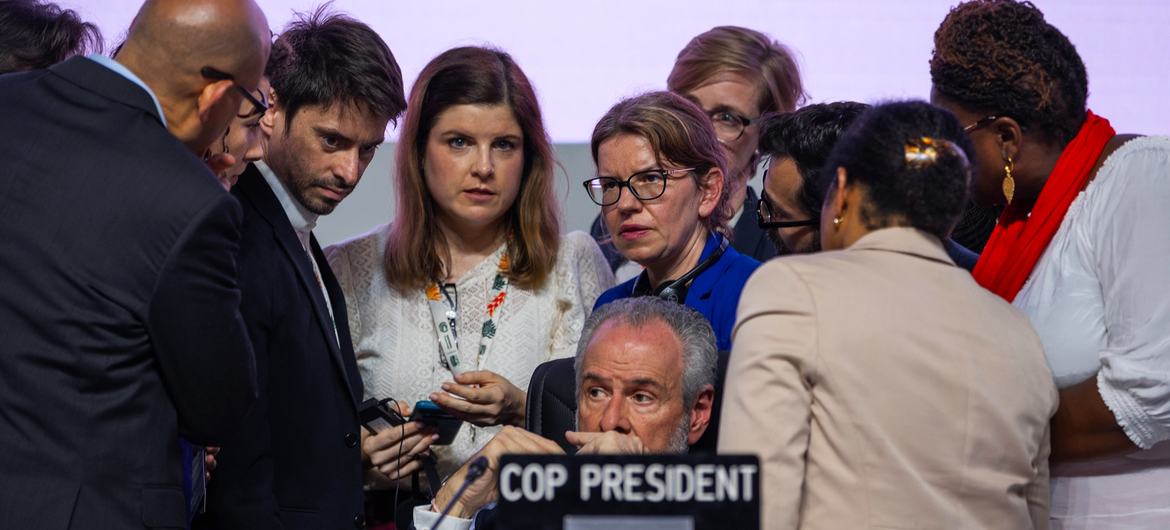
COP30 President André Corrêa do Lago (centre) confers with his team at the closing of the UN Climate Conference.

The road to consensus

The road to consensus at the latest Conference of the Parties to the UN Framework Convention on Climate Change (UNFCCC), as the annual COPs are formally known, was anything but smooth.  

Late last week, Indigenous groups staged blockades demanding stronger protections for the Amazon, and late Thursday afternoon, a fire at the conference venue disrupted talks during a critical phase. 

Negotiators worked through the night on Friday – to bridge gaps on finance and ambition, with Brazil’s presidency steering discussions toward a politically workable outcome focused on support and implementation of agreements from past COPs.

‘Multilateralism is alive’

From the G20 Summit in Johannesburg, UN Secretary-General António Guterres sent a clear message to COP30: At the gateway of the Amazon, Parties reached an agreement that shows nations can still unite to confront challenges no country can solve alone.  

The UN chief said that COP30 delivered progress, such as the launch of the Global Implementation Accelerator to close ambition gaps and reaffirmed the UAE Consensus, including a just, orderly and equitable transition away from fossil fuels.

“But COPs are consensus-based – and in a period of geopolitical divides, consensus is ever harder to reach. I cannot pretend that COP30 has delivered everything that is needed.” Overshoot of 1.5°C is a stark warning: deep, rapid emission cuts and massive climate finance are essential. “COP30 is over, but the work is not,” he said.  

Mr. Guterres vowed to keep pushing for higher ambition and solidarity, urging all who marched, negotiated and mobilized: “Do not give up. History – and the United Nations – are on your side.

Holding the line at 1.5 in ‘turbulent geopolitical waters’

UN climate chief Simon Stiell pointed to a series of major gains as COP30 closed in Belém: new strategies to accelerate Paris Agreement implementation, a push to triple adaptation finance, and commitments toward a just energy transition.

And despite what he called “turbulent geopolitical waters” – marked by polarization and climate denial – 194 nations stood together, “keeping humanity in the fight for a livable planet, determined to hold the line at 1.5°C.”

At the heart of this momentum is COP30’s flagship outcome: the Mutirão text, a sweeping deal that bundles four contentious negotiation tracks – from mitigation to finance and trade barriers – into a single, consensus-based agreement. Seventeen additional decisions were adopted alongside it.

The final document declares that the global shift toward low-emissions and climate-resilient development is “irreversible and the trend of the future.” It reaffirms that the Paris Agreement is working – and must “go further and faster” – strengthening the role of multilateral climate cooperation.

The text also recognizes the economic and social benefits of climate action, from growth and job creation to improved energy access, security and public health. Mr. Stiell pointed to a decisive trend: investments in renewable energy now outpace fossil fuels two to one – “a political and market signal that cannot be ignored,” he said.

A robust action agenda beyond negotiations

The Brazilian Presidency underscored that COP30’s success extends beyond negotiated agreements, highlighting a wave of voluntary commitments under the Action Agenda.

Among them:

  • Tropical Forests Forever Fund: Raised $5.5 billion and now includes 53 participating countries; at least 20 per cent of resources go directly to Indigenous Peoples and local communities.
  • Belém Health Action Plan: The first global initiative targeting climate-related health threats, launched with $300 million from 35 philanthropic organizations.
  • UNEZA Alliance: Public utility companies pledged $66 billion annually for renewable energy and $82 billion for transmission and storage.
  • Cities, regions and companies: A coalition spanning 25,000 buildings reported cutting over 850,000 tons of CO₂ in 2024.

Climate justice at the forefront

Countries also agreed to develop a just transition mechanism, enhancing cooperation, technical support and capacity-building.

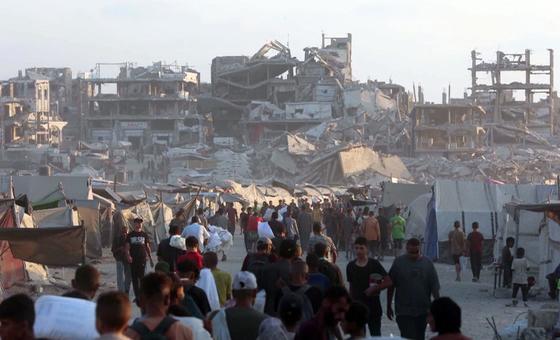
Israel’s plan to take over Gaza City marks ‘new and dangerous phase’: Guterres

“Israel’s initial steps to militarily take over Gaza City signals a new and dangerous phase,” he told journalists in New York.

“Expanded military operations in Gaza City will have devastating consequences. Hundreds of thousands of civilians – already exhausted and traumatized – would be forced to flee yet again, plunging families into even deeper peril. This must stop.”

‘Endless catalogue of horrors’

Mr. Guterres was speaking ahead of a Security Council meeting on the situation in Haiti but stopped to brief reporters on the “unfolding tragedy that is Gaza”, where “yet more unconscionable Israeli strikes” have occurred.

Incidents include the two airstrikes on Nasser Hospital in Khan Younis earlier this week which killed civilians, including medical personnel and journalists, “all with the world watching”.

The Secretary-General said “these attacks are part of an endless catalogue of horrors” and called for accountability.  

“Gaza is piled with rubble, piled with bodies, and piled with examples of what may be serious violations of international law,” he said.

“Hostages taken by Hamas and other groups must be released and the atrocious treatment they have been forced to endure must stop. Civilians must be protected.”

© UNICEF/Mohammed Nateel

A displaced family sit outside their tent in Gaza.

Unparalleled destruction and famine

Mr. Guterres stressed that “the levels of death and destruction in Gaza are without parallel in recent times”.

He said that “famine is no longer a looming possibility – it is a present-day catastrophe.”

People are dying from hunger, yet Gaza’s food, water and healthcare systems have been systematically dismantled.

Israel’s obligations

“These are the facts on the ground. And they are the result of deliberate decisions that defy basic humanity,” he said. “Israel, as the occupying Power, has clear obligations.”

He said Israel must ensure the provision of food, water, medicine, and other essentials.  This is in addition to agreeing to and facilitating far greater humanitarian access to Gaza, and protecting civilians and civilian infrastructure.

Mr. Guterres said the International Court of Justice (ICJ) has given binding provisional measures which must be implemented in full and immediately.

They include the obligation to take all steps to ensure unfettered humanitarian and medical assistance to Palestinians throughout the Gaza Strip “without delay and in full cooperation with the United Nations.” 

UN staff killed, aid efforts blocked

Meanwhile, the UN and partners are doing all they can, he said.  This is often at great personal risk, as tragically 366 UN personnel have been killed. 

“Day after day, our efforts are being blocked, delayed, and denied,” he said. “This is unacceptable.”

Settlement expansion in the West Bank

Mr. Guterres also addressed the situation in the West Bank, describing it as “profoundly alarming”.

He said Israeli military operations, settler violence, demolitions, and discriminatory policies are driving displacement and deepening vulnerability. 

Furthermore, the relentless expansion of settlements is fracturing communities and cutting off access to vital resources.

The Israeli authorities recently approved of a plan for the construction of thousands of settlements in the E1 area. He said this would effectively separate the northern and southern West Bank, representing “an existential threat to the two-state solution” between Israelis and Palestinians. 

“I repeat: the Israeli settlements in the occupied West Bank including East Jerusalem have been established – and are being maintained — in violation of international law,” he stressed.   

“Israel must cease such actions and comply with its obligations.”

‘No more excuses’

The Secretary-General concluded his remarks by emphasizing that there is no military solution to the conflict.

“I appeal once again for an immediate and permanent ceasefire, unfettered humanitarian access across Gaza, and the immediate and unconditional release of all hostages,” he said.

“Starvation of the civilian population must never be used as a method of warfare. Civilians must be protected. Humanitarian access must be unimpeded,” he added, ending with a plea for “No more excuses.  No more obstacles.  No more lies.” 

Iraq unveils historic migration plan to boost development and stability

Unveiled on Wednesday, it creates new opportunities for work, education and family reunification, while strengthening migration governance and placing migration at the heart of stability and economic development.

It is being led by Iraq’s ministry for migration and the displaced, with the support of the International Organization for Migration (IOM) and the Government of the Netherlands – translating Iraq’s global commitments into national action.

Migration minister Evan Faeq Gabro said that it represents a “vision for Iraq’s future that upholds human dignity”, serves national interests, and supports the Global Compact for Migration.

Iraq is setting an example for the region and beyond, showing how national leadership and genuine partnership can turn migration into an engine for dignity, opportunity, and development,” said Ugochi Daniels, IOM’s  Deputy Director General for Operations.

Origin and destination

Iraq is both a country of origin and destination, with some two million nationals currently living abroad, while thousands more are weighing emigration.

In the past seven years, over 58,000 people have returned to Iraq, rebuilding their lives at home.

Meanwhile, the country also hosts some 370,000 migrant workers, mainly engaged in semi-skilled sectors such as construction and domestic work.

Iraq’s five-year National Plan to Promote Safe, Orderly and Regular Migration emphasises data-driven decision-making, stronger institutional coordination and calls for closer private sector involvement.

Stability and development

“This national plan demonstrates that when policies are grounded in evidence and shaped by people’s needs, migration can benefit migrants, communities, and the country as a whole,” said Ms Daniels.

Th new policy responds to Iraq’s current migration realities, framing migration as a tool for national development and stability, says IOM.

“Today, we are here to commit ourselves to ensuring that migration is about dignity, safety, and opportunity for migrants, their families, and the communities they join,” said Claudio Cordone, UN Deputy Special Representative in Iraq.

The plan outlines a vision for a future that upholds human dignity and serves the national interest.

Israeli plan to take complete control of Gaza must stop now, says UN rights chief

“A complete military takeover of the occupied Gaza Strip must be immediately halted,” insisted Volker Türk, UN High Commissioner for Human Rights, after the Israeli security cabinet approved a plan for a full-scale Israeli military takeover in the battered enclave.

The development runs contrary to international law, Mr. Türk continued, referring to a ruling of the International Court of Justice that Israel must end its occupation and achieve a two-State solution giving Palestinians the right to self-determination.

Any further escalation of the conflict between Hamas and Israel that has devastated Gaza and killed tens of thousands “will result in more massive forced displacement, more killing, more unbearable suffering, senseless destruction and atrocity crimes”, the UN rights chief said.

Aid access call

In a short statement, Mr. Türk insisted that rather than intensifying the conflict, “the Israeli Government should put all its efforts into saving the lives of Gaza’s civilians by allowing the full, unfettered flow of humanitarian aid”.

At the same time, all hostages must be immediately and unconditionally released by Palestinian armed groups, he continued, adding that Palestinians arbitrarily detained by Israel must also also be released.

“The war in Gaza must end now. And Israelis and Palestinians must be allowed to live side by side in peace,” the High Commissioner said.

Little change in dire aid situation 

Since war erupted in Gaza after Hamas-led deadly terror attacks in Israel in October 2023, aid agencies have warned repeatedly that Israeli bombardment, mass evacuation orders and relief restrictions have created a humanitarian catastrophe.

Even UN staff who are still working in the enclave report being unable to find enough to eat, according to the UN agency for Palestinian refugees, UNRWA. Despite Israel’s 27 July announcement of daily military pauses in western Gaza “to improve humanitarian responses”, far too little aid is getting through, humanitarians insist. 

According to the UN human rights office, OHCHR, since 27 May, at least 1,373 Palestinians have been killed while seeking food; 859 in the vicinity of the non-UN aid distribution organization the Gaza Humanitarian Foundation (GHF); another 514 victims died along the routes of food convoys.

Echoing widespread concerns for the people of Gaza, the head of the UN World Health Organization (WHO), warned that other Gazans have only limited access to basic services and food, while malnutrition is widespread and hunger-related deaths are rising.

“In July, nearly 12,000 children under five years were identified as suffering from acute malnutrition, the highest monthly figure ever recorded,” said Tedros Adhanom Ghebreyesus.

In comments to journalists on Thursday, the WHO chief said that so far this year, 99 people have died from malnutrition, including 29 children under five, adding that these reported numbers are likely underestimates. 

Source link

Sudan: UN scales up response plan as humanitarian needs spiral in Tawila

Over 380,000 people are currently displaced there, and the plan aims at increasing assistance for communities over the next three months.

It focuses on food, healthcare, water, sanitation, shelter and protection, and requires $120 million for implementation, according to the UN Office for Humanitarian Coordination (OCHA). 

Spread of diseases

The health situation in North Darfur has also been deteriorating, with humanitarian partners on the ground warning that cholera, measles, malaria and trauma cases are surging in El Fasher and other displacement camps in the region.

As insecurity has forced the over 32 health facilities in the region to close, the lack of rapid diagnostic tests and the widespread Internet outage in the El Fasher area are also severely hindering disease surveillance.

Critical shortages of surgical supplies, essential medicines and vaccines are “pushing the health system to the brink, leaving thousands without access to the care that they need to stay alive,” UN Spokesperson Stéphane Dujarric said during his daily press briefing from New York.

Deadly civilian toll

Displacement continues to take a deadly toll on civilians seeking safety, with markets in South Darfur reeling from sharp price increases due to flooding and seasonal rivers cutting off supply routes from Chad and Northern State.  

Meanwhile, the UN remains “deeply concerned over escalating violence in the Kordofan region,” Mr. Dujarric said, after five civilians were reportedly killed and several others injured in drone strikes on fuel markets in Al Fula and Abu Zabad towns in West Kordofan state.

The UN called for an immediate cessation of hostilities, the protection of civilians and humanitarian personnel, unimpeded access across conflict lines and borders, and increased international support to address the spiraling humanitarian needs across Sudan.

Source link

Ukraine: UN and partners launch Winter Response Plan amid escalating hostilities

Amidst escalating hostilities and continued strikes on critical infrastructure, Ukraine is once again bracing for another harsh winter.  

As the cold season brings heightened risks, especially for people near the frontline, displaced persons living in collective sites, and other vulnerable populations, the Winter Response Plan aims to deliver essential multisectoral humanitarian assistance to over 1.7 million people from October through March.  

Serving as a tool for advocacy, resource mobilisation and coordination with Government authorities, the plan caters to the most vulnerable groups, including older people, persons with disabilities, and children.  

Life-saving assistance

“As temperatures drop, millions across Ukraine will struggle to keep warm -especially in communities near the front line and among vulnerable displaced people,” said Mathias Schmale, the UN Humanitarian Coordinator for Ukraine.  

Humanitarian organizations will help insulate and repair damaged homes, provide heaters, fuel, blankets, and warm clothing, prepare shelters for extreme cold, deliver cash for heating and utilities, and coordinate services in high-risk areas.  

Additional strain

“Every winter puts additional strain on people already worn down by years of war,” Mr. Schmale said.  

Areas most affected by cold in the winter are predominantly concentrated in northern and eastern Ukraine along the frontline.  

People in these areas are exposed to harsh winter conditions, compounded by heightened vulnerability, and severely damaged infrastructure resulting from ongoing conflict and persistent airstrikes.

Displaced people residing in collective sites are also among the most vulnerable during winter, as recent monitoring of such sites indicates that nearly 60 per cent of these sites continue to face winter-related gaps.  

Source link

Gaza: UN agencies calls for aid ‘surge’ as Israeli distribution plan begins

After nearly three months of complete blockade by Israel, a “vastly insufficient” amount of aid was finally allowed into the war-ravaged enclave in the last week, insisted Jens Laerke, spokesperson for the UN aid coordination office, OCHA.

“We have not stopped operating,” he said, referring to staff still inside Gaza, who are tasked with liaising with the Israeli authorities to retrieve supplies allowed into Gaza from Israel, via the Kerem Shalom crossing.

Mr. Laerke insisted that the UN is not participating in the Israeli aid plan known as the Gaza Humanitarian Fund: “It is a distraction from what is actually needed, which is a reopening of all the crossings into Gaza, a secure environment within Gaza and faster facilitation of permissions and final approvals of all the emergency supplies that we have just outside the border; [aid] needs to get in.”

The veteran humanitarian stressed the ongoing dangers and obstacles that have prevented aid teams from picking up and dispatching lifesaving supplies via the UN’s existing delivery network in Gaza.

“We are not always able to collect what is being dropped off on the other side because of the insecure routes that are being assigned to us by the Israeli authorities to use,” he told journalists in Geneva.

‘Cherry-picking’ warning

All types of aid must be allowed through and not “cherry-picked”, Mr. Laerke stressed: “The bottom line again is that we are talking about a vastly insufficient amount of aid that eventually enters Gaza at the moment. That’s why we need [the] opening of more crossings, we need all types of aid – not that aid that is cherry-picked by the Israeli side that we are allowed to get in.”

In an update, the UN World Food Programme (WFP) said that as of Monday, 294 trucks have reached Kerem Shalom from Port Ashdod. On Tuesday, media reports indicated that protesters attempted to block lorries loaded with aid from leaving the Israeli port.

“While desperately needed aid is finally trickling into Gaza, the pace is far too slow to meet the overwhelming needs,” WFP said. “Gaza families are at a breaking point, amid intensified fighting, waves of evacuation orders and population displacement.”

Crossing the line

The UN agency noted that it has “more than 130,000 metric tonnes of food in the pipeline as well as a functioning delivery network ready to provide assistance. An immediate surge in daily aid trucks and unrestricted access to safely collect and distribute food inside Gaza are critical before it is too late.”

The UN agency for Palestinian refugees, UNRWA, meanwhile, explained that “no supplies whatsoever” prepared by the agency have reached Gaza since the Israeli siege began on 2 March.

This is despite UNRWA having readied more than 3,000 trucks carrying food and medicines in Jordan and Egypt which will perish soon.

“We have clinics, we have pharmacies that the agency runs and there we normally would distribute medicines against chronic diseases…but also basic medicines, things like paracetamol and then childhood diseases and these are the medicines that we’re running out of,” said Juliette Touma, UNRWA Director of Communications.

Evidence call to Israel

The development comes as UNRWA Commissioner-General Philippe Lazzarini urged the Israeli Government to provide proof to back up its unsubstantiated allegations that the UN agency’s staff were involved in the Hamas-led terror attacks in Israel that sparked the war in October 2023.

Investigations carried out internally by the UN last year found sufficient evidence that nine active UNRWA staff had been involved.

A separate independent probe commissioned by the UN Secretary-General found that the agency’s rules, mechanisms and procedures were the most “elaborate” within the UN, reflecting the complex and sensitive demands associated with working in the Occupied Palestinian Territories.

“It’s been over 20 months of these claims coming our way, harming the agency’s reputation of course, but more importantly, putting the lives of our staff, especially those working in the Occupied Palestinian Territory, at risk,” said Ms. Touma.

Despite numerous requests by UNRWA to the Israeli Government for evidence to substantiate “numerous accusations”, no evidence has been shared to back up the claims against the agency and its personnel, Ms. Touma continued.

Source link

Guterres calls on Israel to accept UN’s ‘detailed, principled’ aid plan for Gaza

Addressing reporters outside the Security Council, António Guterres called once again for a permanent ceasefire to end the fighting between Israeli forces and Hamas militants, the immediate and unconditional release of all hostages and full humanitarian access so aid can flow in following nearly 80 days of Israeli blockade.

‘Cruellest phase’

He said Palestinians in the enclave are now “enduring what may be the cruellest phase of this cruel conflict,” with families being “starved and denied the very basics,” as Israel intensifies its offensive and promotes a new privatised aid distribution network reportedly due to begin on Sunday which would bypass the UN and partner organizations’ aid operation.

Israel has clear obligations under international humanitarian law to treat civilians in Gaza humanely, Mr. Guterres added, and “must not forcibly transport, deport or displace the civilian population of an occupied territory.”

He noted that despite authorising a “trickle of aid” to enter in recent days, supplies from only 115 out of 400 trucks have been cleared for collection and distribution – while nothing has reached the besieged north.

UN ‘working round the clock’

“We are working around the clock to get whatever aid we can to people in need,” the UN chief said, but “needs are massive – and the obstacles are staggering.”

Israel is causing unnecessary delays, imposing quotas on distribution and barring essentials such as fuel, shelter, cooking gas, and water purification supplies – are prohibited.

Furthermore, the lives of UN and other humanitarian staffers are being placed at risk if they continue to be prevented from distributing food parcels and flour to those in desperate need, the UN chief continued.

He said absent rapid, reliable, safe and sustained aid access, more Gazans will die – with profound long-term consequences.

Without making direct reference to the US-backed Israeli plan to create new distribution sites overseen by private contractors in coordination with the military, Mr. Guterres said the UN had been clear: “We will not take part in any scheme that fails to respect international law and the humanitarian principles of humanity, impartiality, independence and neutrality.”

5-point aid plan

Instead, he said the UN and partners had “a detailed, principled, operationally-sound 5-stage plan” – supported by UN Member States.

  1. Ensure the delivery of aid to Gaza
  2. Inspect and scan aid at crossing points
  3. Transport aid from crossing points to humanitarian facilities
  4. Prepare aid for onward distribution
  5. And transport aid to people in need

“We have the personnel, the distribution networks, the systems and community relationships in place to act,” said the UN chief. “The supplies – 160,000 pallets, enough to fill nearly 9,000 trucks – are waiting.

“This is my appeal for life-saving aid for the long-suffering people of Gaza: Let’s do it right.  And let’s do it right away.”

Source link

Gaza: UN agencies reject Israeli plan to use aid as ‘bait’

UN Children’s Fund (UNICEF) spokesperson James Elder insisted that the Israeli proposal to create a handful of aid hubs exclusively in the south of the Strip would create an “impossible choice between displacement and death”.

The plan “contravenes basic humanitarian principles” and appears designed to “reinforce control over life-sustaining items as a pressure tactic”, he told journalists in Geneva. “It’s dangerous to ask civilians to go into militarized zones to collect rations…humanitarian aid should never be used as a bargaining chip”.

The Gaza Strip has been under a complete aid blockade for more than two months and humanitarians have warned repeatedly that food, water, medicines and fuel have been running out.

Kids and elderly at risk

If the Israeli plan were to happen, Gaza’s most vulnerable individuals – the elderly, children with disabilities, the sick and the wounded who cannot travel to designated distribution zones – would face “horrendous challenges” retrieving aid, the UNICEF spokesperson maintained.

The Israeli aid distribution blueprint presented to UN humanitarians envisages only 60 aid trucks per day entering Gaza – “one-tenth of what was being delivered during the ceasefire” between Israel and Hamas which held from 19 January to 18 March.

“It’s not nearly enough to meet the needs of 1.1 million children, 2.1 million people,” Mr. Elder insisted. “There is a simple alternative: lift the blockade, let humanitarian aid in, save lives.”

Thousands of trucks in limbo

Stressing the success of the UN-led aid scale up during the ceasefire, humanitarian affairs coordination office spokesperson Jens Laerke urged the Israeli authorities to “facilitate the aid that we and our partners have available just a few kilometres away” just outside Gaza.

UNRWA, the largest aid provider in the Strip, said that the UN agency has “over 3,000 trucks of aid” that are stuck outside Gaza.

Juliette Touma, Director of Communications, deplored the fact that such a “big dollar figure” was going to waste, when the food could be reaching hungry children and when medicine could be used to treat people with chronic diseases.

“The clock is ticking. The gates must reopen, the siege must be lifted as soon as possible,” she insisted, while calling for the release of Israeli hostages and a return to a standard flow of humanitarian supplies.

Inside Gaza, aid teams warn that the situation is desperate. “Even those [food] lines are now gone because food is running out,” said UNRWA’s Ms. Touma.

Nothing left to queue for

In an update on Thursday, OCHA said that more than 80 community kitchens have been forced to shut since late April, owing to the lack of supplies. This number is rising “by the day”, fuelling “widespread” hunger in Gaza, the UN aid coordination office said.

Rebutting Israeli allegations that aid reaching Gaza has been diverted by militant groups, both Ms. Touma and UN World Health Organization (WHO) spokesperson Dr. Margaret Harris described “end-to-end” systems put in place to counter this risk.

“Our supplies are reaching the health facilities they’re meant to serve,” said Dr. Harris, adding that the UN health agency had not witnessed any aid diversion within the health care system.

“It is not about failure of aid delivery within Gaza. It is about not being allowed to bring it in,” Dr. Harris concluded.

In a further note of caution about the Israeli plan, UNICEF’s Mr. Elder insisted that the proposed use of facial recognition as a precondition to access aid ran against all humanitarian principles to “screen and monitor beneficiaries for intelligence and military purposes”.

He recalled that the ceasefire earlier this year had resulted in a “huge” improvement in children’s nutrition.

“It meant food in the markets, repaired water systems…It meant people could access health care safely. It meant health care facilitators had medicines that they need.”

‘Boastful’ denials of aid

Fast forward to today and food, water, medicines – “everything for a child to survive” – is being blocked, Mr. Elder said — “and in many ways, boastfully blocked”.

The UNICEF spokesperson also expressed concern that the Israeli plan risks separating family members “while they move back and forth to try and get aid” from the designated locations in a territory that “lacks any safety” amid ongoing bombardments.

Source link