Keeping people warm amid hostilities and harsh winter weather in Ukraine

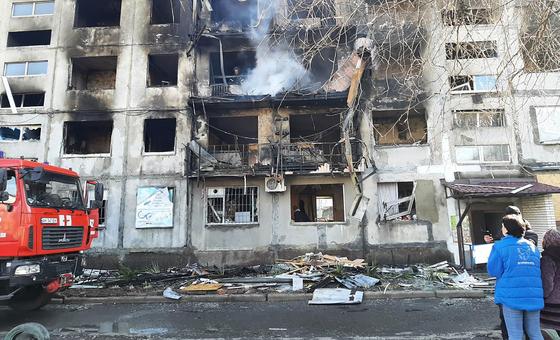
Russian forces continue to attack Ukraine’s energy grid, leaving families without electricity and heating as temperatures plummet to -20° Celsius. 

Since 2022, the Government has established so-called “Invincibility Points” – located in tents or public buildings such as schools and libraries – where people can go to escape the cold, charge electronic devices and receive basic support.  

Additional initiatives have also been launched, including mobile heating points operated by the State Emergency Services and Ukraine Red Cross Society. Humanitarian partners have supported these efforts with equipment, hot meals and technical assistance. 

A ‘very tough’ winter 

A UN team led by the Humanitarian Coordinator in Ukraine, Matthias Schmale, recently visited various heating points and mobile kitchens in Boryspil, a town in the Kyiv region. 

They met residents, authorities, first responders, as well as aid organizations, at an Invincibility Point in a tent. 

“This winter has been very tough for us,” said Kateryna, a mother of two young children who lives on the outskirts of the town.  

“We have no electricity at home. We came here to warm up, charge our phones and the children’s devices. It was very cold in our house.” 

© UNOCHA/Ximena Borrazas

UN Humanitarian Coordinator in Ukraine Matthias Schmale (left) meets with staff and volunteers of the Ukrainian Red Cross.

Food, warmth and support 

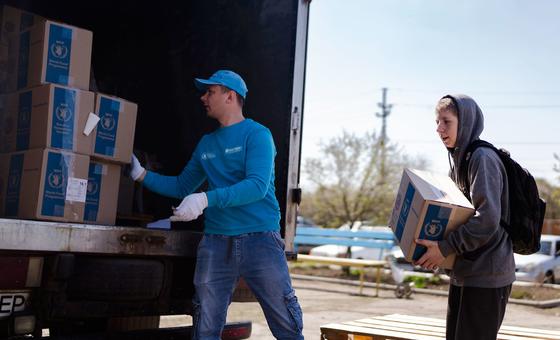
A large food truck was set up near the tent where the NGO Food Without Borders prepared hot meals in a mobile kitchen so that people affected by the cold and power outages could get something to eat.  

The group provided similar services after attacks last November in Shostka, located in the Sumy region. 

“This is one of many remarkable initiatives supporting people across Ukraine during this harsh winter,” said Mr. Schmale.  

“As attacks on energy infrastructure continue, many people face prolonged outages of electricity, heating and water, as well as limited ability to prepare hot food.” 

Falling temperatures 

Mr. Schmale also visited a heating point set up by the Ukrainian Red Cross in Boryspil town. Viktor, a volunteer at the site, described the harsh conditions many people there are facing.  

“In some apartments, the temperature drops to as low as five degrees Celsius,” he said. 

“People spend long hours in our warm tent, especially in the evenings, when temperatures fall even further at night.” 

© UNOCHA/Viktoriia Andriievska

A woman helps herself to a hot meal in a heated tent in Boryspil.

Families left freezing 

Humanitarians are also carrying out activities under a winter response plan launched last year which aims to reach 1.7 million people across Ukraine between October and March.  

Despite these efforts, the rapidly evolving situation – including large-scale and sustained attacks on energy infrastructure – has caused service disruptions that far exceed the scenarios the plan anticipates. 

Frequent power disruptions leave many families in freezing conditions. Many older persons and people with disabilities are often stuck in their homes, in high-rise apartment buildings, without electricity and heating, unable to cook hot meals or recharge their devices to stay connected. 

Families with children are also left wondering how to keep them safe and healthy. 

The UN and partners are seeking $2.3 million to help 4.1 million of the most vulnerable people in Ukraine this year. 

For families contending with the harsh winter weather, having a place where you can warm up, eat a hot meal and recharge a phone can mean the difference between coping and serious health risks. 

Source link

Sudan: Intensifying hostilities bring new displacement, more casualties

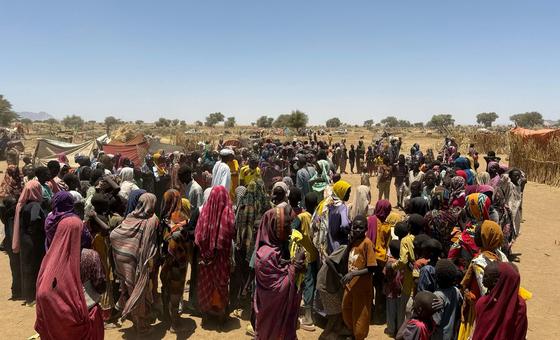
Hostilities have been intensifying between the Sudanese Armed Forces (SAF) and two armed groups – the rival Rapid Support Forces (RSF) militia that has been battling the military government for control since April 2023 and the Sudan People’s Liberation Movement-North.

Over the weekend, drone attacks targeted a UN base killing six peacekeepers from the UNIFSA mission, while another six people were killed in a hospital attack in South Kordofan State, according to initial information from the UN human rights office (OHCHR).

Meanwhile, OCHA said artillery shelling was reported on Monday, posing further threats to civilians.

I urge all parties to the conflict and States with influence to ensure an immediate ceasefire and to prevent atrocities,” said UN human rights chief Volker Türk in a statement.

Mr. Türk also cautioned that medical facilities are protected under international humanitarian law.

New displacement

The UN International Organization for Migration (IOM) estimates that more than 1,700 people were displaced between Thursday and Saturday from multiple towns in South Kordofan.

Meanwhile, in North Darfur State, displacement continues to rise from the besieged El Fasher into Tawila, where the UN is delivering emergency aid.

More than 25,000 people in Twila have been registered since late October, after fleeing along insecure routes where they face extreme danger.

Despite severe access and logistical constraints, the World Food Programme (WFP) assisted about half a million people in Tawila in November and has consistently reached some 2 million people every month across the Darfur region.

Attacks against peacekeepers

Providing an update at Tuesday’s noon briefing in New York, UN Deputy Spokesperson Farhan Haq said that the wounded peacekeepers who underwent lifesaving surgery in Kadugli, Sudan, were evacuated to the UN mission headquarters in the disputed Abyei region on Tuesday morning.

Other injured personnel were also evacuated there, and four of them have since been sent to Nairobi, Kenya, for further medical treatment.

The remains of the six fallen soldiers have been transported to Entebbe, Uganda, and arrangements are underway for their repatriation to Bangladesh.

Mr. Haq underscored that “attacks targeting United Nations peacekeepers may constitute war crimes under international law and call for accountability.”

ALSO READ:

London’s Far-Right Rally Sends Shockwaves Through South Asian Communities

World News in Brief: Thailand-Cambodia border hostilities, humanitarian efforts in Syria and attacks across Ukraine

The dispute dates to 1953 when France first mapped the border, but tensions resurfaced in May after the death of a Cambodian soldier in a border skirmish.

Secretary-General António Guterres is “following with concern” reports of the clashes, his Deputy Spokesperson Farhan Haq told journalists in New York.

“The Secretary-General urges both sides to exercise maximum restraint and address any issues through dialogue and in a spirit of good neighbourliness, with a view to finding a lasting solution to the dispute,” he said.

Inter-agency humanitarian assistance in Syria

The Office for the Coordination of Humanitarian Affairs (OCHA) led an inter-agency visit to Rural Damascus governorate in Syria on Thursday to assess needs and provide assistance to more than 500 families displaced by recent violence in nearby Sweida governorate.

The UN agencies visited the Sayyeda Zeinab community and plan to visit the neighbouring Dar’a Governorate in the coming days, where humanitarians are supporting tens of thousands of people displaced by violence.

In Rural Damascus and Dar’a, OCHA and its partners are expanding protection services for displaced people. This includes psychosocial first aid and case management support for children.

Also on Thursday, the World Food Programme (WFP) distributed urgent food assistance to displaced families. The agency additionally continues to provide assistance across the country, including to Syrians returning home after a decade of conflict.

Limited access to Sweida

On Wednesday, a second convoy from the Syrian Arab Red Crescent (SARC) arrived in Sweida, with UN agencies providing support.

The convoy included food, wheat flour, fuel, medicines and health supplies. Medical supplies were delivered to the Sweida national hospital, and wheat flour was dispatched to bakeries.

Across Sweida, Rural Damascus and Dar’a governorates, the UN has distributed over 1,600 dignity kits to displaced women and girls. UN partners are also providing recreational activities, awareness sessions on gender-based violence and support for women and children.

But despite efforts in neighbouring governorates and increasing support in Sweida, full and direct access to the conflict-ridden governorate itself is limited due to security constraints.

Nonetheless, the UN is continuing dialogue with Syrian authorities to facilitate direct access to Sweida.

Nationwide attacks in Ukraine

OCHA further reported that at least five civilians were killed, and 46 others injured, in attacks across several regions of Ukraine over the past two days.

Kharkiv in the northeast was one of the more affected regions, where a glide bomb strike injured at least 16 people on Thursday, and fighting killed three and injured five others on Wednesday.

Additionally, overnight attacks in central Ukraine injured seven people in Cherkasy and four in Odesa City, damaging homes, health centres, schools, shopping areas and a market.

Civilians in the southern Kherson region, the eastern Donetsk region and the southeast Zaporizhzhia region were also affected.

Evacuations and humanitarian response

Following the overnight attacks in Cherkasy and Odesa, aid workers assisted first responders by providing first aid, meals, shelter materials, hygiene kits, emotional support and legal assistance to affected families.

Amid the hostilities, nearly 600 people were evacuated from the Donetsk region, and, in the past day, another 24 were evacuated from the northeastern region of Sumy.

Source link

Ukraine: UN and partners launch Winter Response Plan amid escalating hostilities

Amidst escalating hostilities and continued strikes on critical infrastructure, Ukraine is once again bracing for another harsh winter.  

As the cold season brings heightened risks, especially for people near the frontline, displaced persons living in collective sites, and other vulnerable populations, the Winter Response Plan aims to deliver essential multisectoral humanitarian assistance to over 1.7 million people from October through March.  

Serving as a tool for advocacy, resource mobilisation and coordination with Government authorities, the plan caters to the most vulnerable groups, including older people, persons with disabilities, and children.  

Life-saving assistance

“As temperatures drop, millions across Ukraine will struggle to keep warm -especially in communities near the front line and among vulnerable displaced people,” said Mathias Schmale, the UN Humanitarian Coordinator for Ukraine.  

Humanitarian organizations will help insulate and repair damaged homes, provide heaters, fuel, blankets, and warm clothing, prepare shelters for extreme cold, deliver cash for heating and utilities, and coordinate services in high-risk areas.  

Additional strain

“Every winter puts additional strain on people already worn down by years of war,” Mr. Schmale said.  

Areas most affected by cold in the winter are predominantly concentrated in northern and eastern Ukraine along the frontline.  

People in these areas are exposed to harsh winter conditions, compounded by heightened vulnerability, and severely damaged infrastructure resulting from ongoing conflict and persistent airstrikes.

Displaced people residing in collective sites are also among the most vulnerable during winter, as recent monitoring of such sites indicates that nearly 60 per cent of these sites continue to face winter-related gaps.  

Source link

Sudan: Humanitarian needs deepen amid rising hostilities and heavy rains

Nearly 27 months have passed since fighting broke out between the Sudanese Armed Forces (SAF) and a former ally, the paramilitary Rapid Security Forces (RSF), creating an unprecedented humanitarian crisis.

The UN voiced grave alarm over escalating hostilities in El Fasher, the besieged capital of North Darfur state. 

Serious risk of renewed violence

Large numbers of RSF fighters reportedly entered the city on Friday for the first time since the siege began over a year ago.

Local sources report that recent fierce fighting, particularly in the southwest and east of El Fasher, has led to civilian casualties.

“The situation remains highly volatile and unpredictable, with a serious risk of renewed violence, as well as further displacement and disruption of humanitarian operations – which are already under severe strain,” OCHA said.

Insecurity in North Kordofan state

Meanwhile, in North Kordofan State, growing insecurity forced 3,400 people to flee their homes over the weekend, according to the UN International Organization for Migration (IOM). 

Local reports indicate that at least 18 civilians were killed, and homes were burned in several villages.

OCHA reminded all parties that attacks on civilians and civilian infrastructure are prohibited under international humanitarian law, and that civilians must be protected at all times.

Rainy season constraints

Meanwhile, heavy rains have been reported in West and Central Darfur states, which may affect road conditions in some locations and worsen the challenges humanitarians are already facing in accessing people in need.

“With the rainy season continuing through October, the risk of floods, access constraints and disease outbreaks is growing – especially during this critical lean season, a time between harvests when food stocks traditionally run low,” OCHA warned.

Families return to West Darfur

The agency said that despite the crisis, signs of small-scale returns are visible in West Darfur state, where displaced families have been returning from Chad to three localities – Sirba, Jebel Moon and Kulbus – to cultivate their farms. 

Furthermore, local authorities report about 40 people returning daily to Kulbus, with 300 arriving over the past week.

OCHA urged all parties to enable safe and unimpeded access to all people in need across Sudan, and for donors to step up their support.

Some 30 million people nationwide – more than half the population – need vital aid and protection this year. 

Source link

Ukraine: Increasing hostilities displace civilians, limit humanitarian access

Donetsk, Kherson and Sumy regions sustained the most damage, with several civilians reportedly killed, and many displaced, UN Spokesperson Stéphane Dujarric told reporters at a regular news briefing on Thursday.

“Our humanitarian colleagues tell us that food insecurity remains a concern in front-line and border regions,” he added.

According to a recent assessment by the UN World Food Programme (WFP) and the Food and Agriculture Organization (FAO), the conflict has devastated livelihoods and quadrupled poverty levels, leaving the most vulnerable – particularly displaced people – at greatest risk.

Food insecurity on the front-line

WFP Executive Director Cindy McCain described the challenges.

“This frontline stretches 700 miles and countless towns and villages are still without the basics for survival,” she said. 

This has made the work of humanitarians even more vital, with over 400,000 people in Donetsk and Kherson receiving food and agricultural support in addition to cash-based assistance.

In total, over 130 humanitarian organizations have distributed food and livelihood assistance to over 1.8 million people across the country.  

Aid challenges

But with hostilities becoming increasingly deadly, humanitarian access remains limited. Since the start of the year, there has been a 50 per cent increase in civilian deaths when compared to the same period last year.  

Authorities continue to urge the 10,000 people who remain in the front-line region to evacuate for their own safety.  

“For those who stayed or those who came back, there are no jobs, no income and no opportunity,” Ms. McCain said. 

Source link

UN warns of mounting humanitarian toll as Israel-Iran hostilities continue

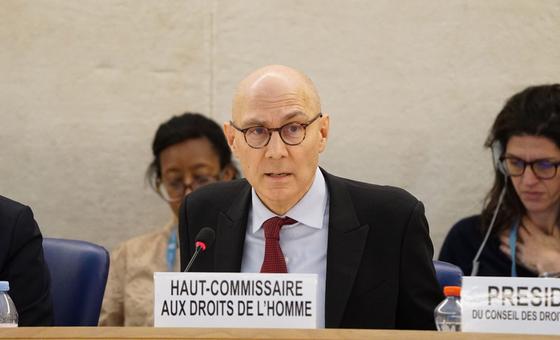
UN High Commissioner for Human Rights Volker Türk on Thursday called for “maximum restraint” and reiterated that both Israel and Iran are bound by international humanitarian law.

“The widescale, continuing attacks by Israel across Iran, and the missile and drone strikes launched in response by Iran, are inflicting severe human rights and humanitarian impacts on civilians, and risk setting the whole region ablaze,” he said in a statement.

The only way out of this spiralling illogic of escalation is maximum restraint, full respect for international law, and return in good faith to the negotiating table,” he stressed.

Appalling collateral damage

The UN rights chief also expressed deep concern over the impact on civilians.

It is appalling to see how civilians are treated as collateral damage in the conduct of hostilities,” he said, adding that threats and inflammatory rhetoric by senior officials on both sides suggest a “worrying intention” to inflict harm on civilians.

The airstrikes, missile and drone attacks – launched by both Israel and Iran since 13 June – have caused heavy damage to civilian infrastructure and claimed hundreds of lives.  

According to Iranian authorities, at least 224 people have been killed, while human rights groups report significantly higher figures. In Israel, officials report 24 deaths and more than 840 injuries so far.

Widespread panic

Warnings from both governments have also prompted widespread panic among civilians.

Israel’s call for civilians to evacuate on Tuesday triggered panic across Tehran, resulting in heavy traffic jams on highways. Movement has reportedly been hampered across the country by fuel shortages, leading to hours-long queues at petrol stations.

Concern for refugees

The Office of the UN High Commissioner for Refugees (UNHCR) expressed grave concern over the deteriorating humanitarian situation, adding that it is monitoring reports that people are on the move within Iran and that some are leaving for neighbouring countries.

UNHCR Spokesperson Babar Baloch cautioned that the situation remained fluid and hard to verify.

Iran has long hosted the largest Afghan refugee population in the world. Now, its own people are experiencing devastation and fear,” Mr. Baloch added.

He also emphasised the principle of non-refoulement, calling on neighbouring countries to grant protection to anyone fleeing violence, and not turn them back.

UNHCR Spokesperson Baloch on the crisis.

Iran hosts an estimated 3.5 million refugees and those in refugee-like situations, including some 750,000 registered Afghans and over 2.6 million undocumented individuals.

Regional worries

There is already regional fallout, with missile launches from Yemen towards Israel and the Occupied Palestinian Territory and heightened tensions reportedly involving armed groups in Iraq, according to OCHA.

This escalation takes place as the region already grapples with mounting humanitarian needs, sharply reduced funding, and constrained operational space for humanitarian action,” the Office said in a flash update issued on Wednesday.

“De-escalation is vital to preventing further suffering of civilians and population displacements,” OCHA underscored.

Source link