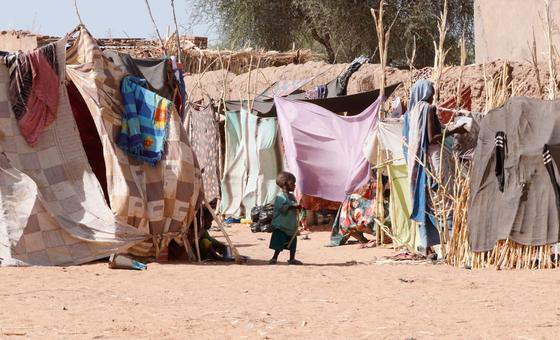
UN calls for decisive steps to end conflict as Gaza and West Bank crises deepen

“Today the world looks on in horror as the situation in the Occupied Palestinian Territory continues to deteriorate to levels not seen in recent history,” said Ramiz Alakbarov, UN Deputy Special Coordinator for the Middle East Peace Process, speaking from Jerusalem.

He began by focusing on Gaza, which is “sinking deeper into disaster, marked by rapidly mounting civilian casualties, mass displacement, and, now, famine”, with no end in sight to the conflict.

Worst fears becoming reality

He said that “unthinkably, Gaza’s population is now facing yet another deadly escalation” following Israel’s announcement of its decision to take over Gaza City, which is ongoing.

“For a population already struggling to survive, Palestinians in Gaza are seeing their worst fears become reality in front of their eyes,” he said.

“Expanded military operations in Gaza City will have catastrophic consequences, including displacing hundreds of thousands.” 

Air strikes intensify

Mr. Alakbarov briefed the Council alongside Joyce Msuya, UN Assistant Secretary-General for Humanitarian Affairs, and two guests: Inger Ashing, Chief Executive Officer at Save the Children International, and Ilana Gritzewsky, an Israeli hostage who survived Hamas captivity in Gaza.

He reported that Israeli military strikes have intensified throughout the Strip, hitting tents housing displaced people, schools, hospitals, and residential buildings.  

Since 23 July, at least 2,553 Palestinians have been killed, according to the health authorities. Of this number, some 271 were reportedly killed attempting to collect aid, including in the vicinity of militarized distribution sites.  

Additionally, over 240 journalists have been killed since the war began on 7 October 2023 following deadly Hamas-led attacks on Israel. 

Although the UN and partners are working tirelessly to assist the people in Gaza, “the security risks are extremely high, and current mitigation measures are woefully insufficient,” he said.

“On my recent visit to Gaza, I was stunned at the scale of the destruction and suffering. I met humanitarian workers risking their lives to deliver aid, while themselves living in intolerable conditions,” he added.

Meeting with survivors and families of hostages

The UN official also visited affected communities in Israel and met survivors of the 7 October terror attacks and family members of some of the hostages. 

“I saw the shattered homes of Nir Oz, where one in four residents was either murdered or abducted on 7 October. I met survivors who carry unbearable loss and trauma,” he said.

Around 50 people, including one woman, are still being held by Hamas and other Palestinian armed groups in Gaza, and 28 are believed to be deceased. 

Videos released by Hamas and Palestinian Jihad depicting emaciated Israeli hostages were deeply disturbing, he said, stressing that ill-treatment and abuse of hostages constitute a blatant violation of international law.

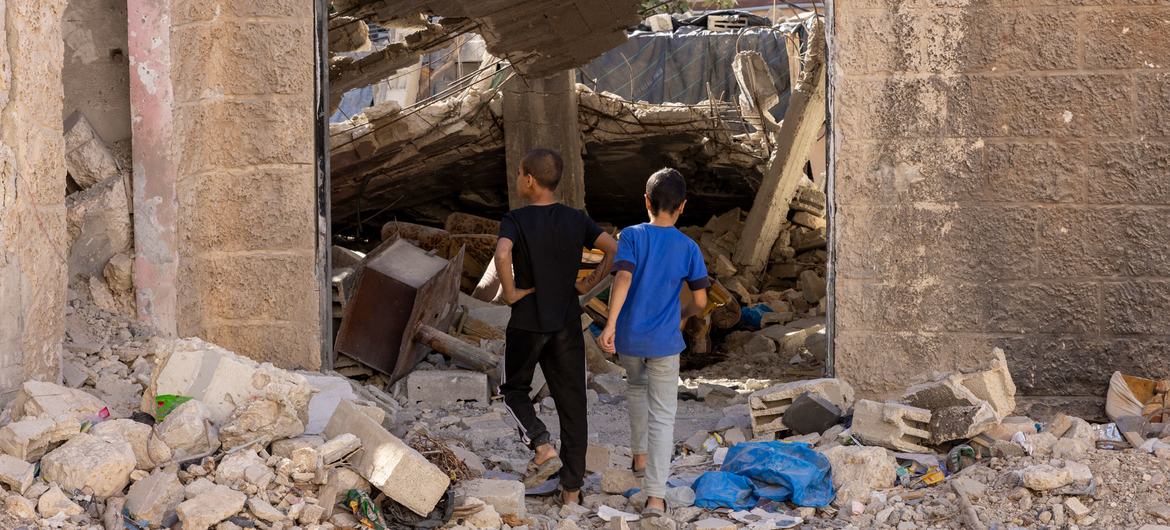
Children in the Jenin refugee camp in the West Bank looking at the destroyed shelters following recent military operations. (file)

West Bank violence

Meanwhile, the situation in the occupied West Bank, including East Jerusalem, “continues to spiral dangerously downward” and “the territory envisioned for a future Palestinian State is shrinking, while a one-State reality of unlawful occupation and perpetual violence is rapidly advancing.”

Israeli security forces have continued operations in northern cities and refugee camps, displacing more than 32,000 people. Furthermore, security forces killed nine Palestinians, four of them children, during the three-month reporting period. 

Attacks by Israeli settlers also have continued, resulting in three Palestinians killed, damage to Palestinian property and displacement.  At the same time, attacks by Palestinians against Israelis have also continued, with no fatalities reported in the last month.

Settlement expansion 

Since the start of the war in Gaza, settler attacks have escalated in frequency and become more violent and deadly.  They have increasingly led to forced displacement, with settlers then moving in and establishing outposts. At the same time, Israel is “fast-tracking settlement expansion, including in the most highly strategic areas.”

Mr. Alakbarov recalled that the Israeli High Planning Committee recently approved a plan for the construction of more than 3,400 housing units in the E1 area.  

“If implemented, the move would effectively sever the connection between the northern and southern West Bank. As such, it would further undermine the possibility of a viable and contiguous Palestinian state,” he warned. 

Israeli authorities also continued to demolish Palestinian-owned structures, he added, and 175 Palestinians, including 70 children, have been displaced.

Regional tensions

Mr. Alakbarov noted that the developments in the Occupied Palestinian Territory are taking place amid a volatile regional context, with more exchanges of fire between Houthi rebels in Yemen and Israel forces occurring this week, along with continued Israeli strikes in Lebanon and an incursion in Syria.

Stressing the need for a ceasefire in Gaza and the release of all hostages, he said “what is needed now is bold action to resolve the conflict, end the occupation and re-establish a political horizon.”

In this regard, he welcomed the High-Level Conference on the Implementation of the Two-State Solution co-chaired by France and Saudi Arabia, held at UN Headquarters in June. 

Uphold the two-State solution

“The message from the international community is clear: the two-State solution remains the only viable path toward a just and lasting resolution of the Israeli-Palestinian conflict,” he said.

He urged the international community to work collectively to advance practical steps, including through engagements during the high-level week of the UN General Assembly in September.

“With Gaza immersed in a situation so horrendous that it defies basic humanity and with the West Bank facing genuine threats to its long-term existence, we can no longer wait,” he said. 

Gaza famine ‘a created catastrophe’

Ms. Msuya’s briefing centered around the recent Integrated Food Security Phase Classification (IPC) analysis confirming that famine is occurring in Gaza governorate – phase 5 conditions – and is expected to spread in the coming weeks.

She drew attention to some of the numbers, saying over half a million people currently face starvation, destitution and death, which could exceed 640,000 by the end of September.  

Approximately one million Gazans are in emergency phase 4 and over 390,000 face phase 3 crisis conditions, she continued.

At least 132,000 children under five are expected to suffer from acute malnutrition between now and the middle of next year, while the number of those who risk dying has tripled to over 43,000. 

Among pregnant and breastfeeding women, the number is predicted to rise from 17,000 to 55,000.

“Let us be clear: This famine is not a product of drought or some form of natural disaster,” she said. “It is a created catastrophe – the result of a conflict that has caused massive civilian death, injury, destruction and forced displacement.”

End this ‘human-made crisis’

Ms. Msuya urged the Council to ensure an immediate and sustained cessation of hostilities to save lives and stop famine from spreading.

She also called for the immediate and unconditional release of all hostages and for civilians and critical infrastructure to be protected.

Furthermore, safe, rapid and unimpeded humanitarian access through all entry points must occur, and aid – including food, medicine, water, fuel and shelter – has to be delivered to all people in need.

Her final request was for the restoration of commercial flows of essential goods at scale, market systems, essential services and local food production.

Ending this human-made crisis demands that we act as if it were our mother, our father, our child, our family trying to survive in Gaza today,” she said. 

A former hostage’s appeal

Ms. Gritzewsky recalled the moment her life was brutally changed on 7 October 2023.

She was grabbed by the hair, punched in the stomach, thrown against a wall, and “touched everywhere,” all while being filmed by the terrorists.  Taken to Gaza, she fainted at the time of her sexual assault.

“Nothing will be the same again,” she said, referring in particular to her broken jaw and pelvis.

Ms. Gritzewsky said she received no medication and did not see a doctor during the 55 days of captivity, even though she had raised concerns about her anaemia and colitis.

She is now fighting for the release of the hostages, particularly her partner, Matan, and made a passionate appeal to the Security Council to act for the release of all those still being held.  

Source link

Sudan: Humanitarian needs deepen amid rising hostilities and heavy rains

Nearly 27 months have passed since fighting broke out between the Sudanese Armed Forces (SAF) and a former ally, the paramilitary Rapid Security Forces (RSF), creating an unprecedented humanitarian crisis.

The UN voiced grave alarm over escalating hostilities in El Fasher, the besieged capital of North Darfur state. 

Serious risk of renewed violence

Large numbers of RSF fighters reportedly entered the city on Friday for the first time since the siege began over a year ago.

Local sources report that recent fierce fighting, particularly in the southwest and east of El Fasher, has led to civilian casualties.

“The situation remains highly volatile and unpredictable, with a serious risk of renewed violence, as well as further displacement and disruption of humanitarian operations – which are already under severe strain,” OCHA said.

Insecurity in North Kordofan state

Meanwhile, in North Kordofan State, growing insecurity forced 3,400 people to flee their homes over the weekend, according to the UN International Organization for Migration (IOM). 

Local reports indicate that at least 18 civilians were killed, and homes were burned in several villages.

OCHA reminded all parties that attacks on civilians and civilian infrastructure are prohibited under international humanitarian law, and that civilians must be protected at all times.

Rainy season constraints

Meanwhile, heavy rains have been reported in West and Central Darfur states, which may affect road conditions in some locations and worsen the challenges humanitarians are already facing in accessing people in need.

“With the rainy season continuing through October, the risk of floods, access constraints and disease outbreaks is growing – especially during this critical lean season, a time between harvests when food stocks traditionally run low,” OCHA warned.

Families return to West Darfur

The agency said that despite the crisis, signs of small-scale returns are visible in West Darfur state, where displaced families have been returning from Chad to three localities – Sirba, Jebel Moon and Kulbus – to cultivate their farms. 

Furthermore, local authorities report about 40 people returning daily to Kulbus, with 300 arriving over the past week.

OCHA urged all parties to enable safe and unimpeded access to all people in need across Sudan, and for donors to step up their support.

Some 30 million people nationwide – more than half the population – need vital aid and protection this year. 

Source link

Short-range drone attacks deepen crisis on Ukrainian frontlines

According to the rights mission, while the majority (89 per cent) of civilian casualties were documented in Ukrainian-controlled territory as a result of attacks by the Russian armed forces, the remaining occurred in territory occupied by Russian authorities, including in attacks that struck public transport and clearly marked ambulances.

While individually less destructive than artillery or missiles, “the sheer scale and increasing frequency of short-range drone attacks have made them one of the deadliest weapons in Ukraine,” said Danielle Bell, Head of HRMMU.

Not compliant with laws of war

Forcing residents to drastically restrict their movements, limiting access to essential goods and affecting livelihoods, the large number of short-range drone attacks exacerbated an already dire humanitarian situation.

Most short-range drones have on-board cameras that provide operators with a real-time view of potential targets.

However, the high number of civilian casualties resulting from drone attacks suggests that these weapons have been deployed in ways that violate international humanitarian law, in particular the principles of distinction and precaution, HRMMU noted.

In some instances, drone operators appear to have intentionally attacked civilians or civilian objects, including medical transport and personnel, which would amount to war crimes, it added.

“It is clear that these weapons are not being used in compliance with the laws of war,” Ms. Bell said.

Call for accountability

Information verified by the mission showed that the number of civilian casualties from short-range drones steadily increased in late 2023 and early 2024, before spiking in July 2024 and reaching record numbers in April 2025.

Casualties continued in May and June, such as during a strike on a minibus in Kostiantynivka, Donetsk region, on 23 June, in which the 65-year-old driver was killed.

On 22 May, a 58-year-old woman, a local volunteer, was killed in a frontline village in Kharkiv region when a drone dropped a munition on the balcony of a two-story residential building, according to the HRMMU.

“Each of these attacks must be investigated,” Ms. Bell said.

“Those responsible for targeting civilians and humanitarian personnel must be held to account.”

Source link

UN warns of ‘catastrophic’ human rights crisis in Myanmar as violence and economic collapse deepen

Published ahead of the Human Rights Council’s upcoming session, the report highlighted the worsening situation since the military coup in 2021, which derailed Myanmar’s democratic transition and ignited widespread armed resistance.

In the years since, military forces have targeted civilian populations with airstrikes, artillery bombardments and other forms of violence, while anti-military armed groups have gained ground, particularly in Rakhine state.

The country has endured an increasingly catastrophic human rights crisis marked by unabated violence and atrocities that have affected every single aspect of life,” said UN High Commissioner for Human Rights Volker Türk.

Grim toll

The report documents a grim toll: military operations killed more civilians in 2024 than in any previous year since the coup.

In Rakhine, the Arakan Army seized control of most of the state, displacing tens of thousands, while Rohingya civilians were caught between warring factions, facing killings, torture, arbitrary arrests and widespread destruction of villages.

Some Rohingya armed groups have also been drawn into the conflict, according to reports.

Economic crisis deepening

The escalating violence has had a cascading effect on Myanmar’s economy, worsening already dire humanitarian conditions.

Myanmar’s economy has lost an estimated $93.9 billion since the coup, with the gross domestic product (GDP) not expected to recover to pre-pandemic levels before 2028.

Inflation has surged, the kyat has lost 40 per cent of its value, and over half the population now lives below the poverty line, facing food insecurity and soaring prices.

The March earthquakes further exacerbated the crisis, leaving thousands more displaced, homeless and without basic services.

Military control of revenue

Meanwhile, the military continues to control key revenue sources, including the central bank and state-owned enterprises, particularly in the extractive sector.

While targeted international sanctions slowed some revenue streams, the junta has maintained its financial lifelines through forced currency conversion, import restrictions, and a crackdown on informal money transfers.

Myanmar has also become the world’s largest producer of opium and synthetic drugs, with transnational criminal networks thriving under military rule.

Multifaceted approach needed

The report urged a multifaceted response to the crisis, including urgent humanitarian support, cross-border aid for displaced populations and increased political engagement with Myanmar’s democratic forces and emerging governance structures.

It also emphasised the need for accountability through international justice mechanisms, including a referral of the situation to the International Criminal Court (ICC).

The report also identified key “constituents for change” in the country’s future – women, youth, ethnic minorities, civil society and pro-democracy actors – and highlighted the work of communities who have established local institutions and forms of governance, often with increased participation from women.

Buildings lie in ruins in Mandalay region, central Myanmar, following the devastating 7.7 magnitude earthquake that struck in March.

Hopes for a peaceful future

The report underscored the importance of planning for the day-after, ensuring human rights are central to a future Myanmar – from rebuilding systems to restoring fundamental freedoms.

There are strong, resourceful and principled individuals and groups rallying and creating the conditions for an inclusive and democratic future,” High Commissioner Türk said. “They are a shining example of hope for a peaceful future.

The report will be formally presented to the UN Human Rights Council in Geneva on 1 July.