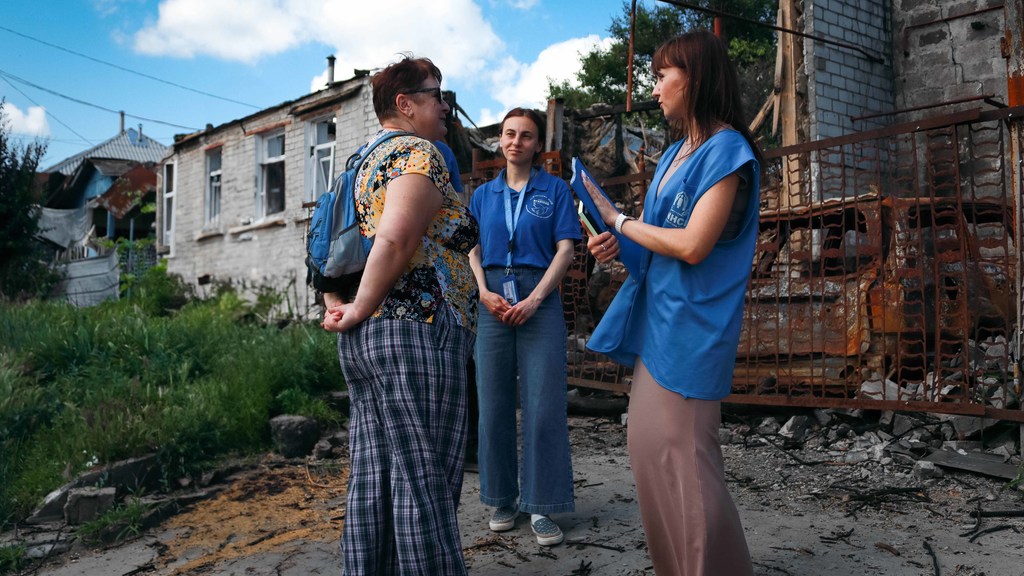
Ukraine: UN aid convoy reaches frontlines in Dnipro

UN Spokesperson Stéphane Dujarric told reporters that access to the town had been “extremely difficult due to the continued fighting.” Of the 10,000 people who lived there before the full-scale invasion in February 2022, only about 500 remain, “most of them older people and people with disabilities.”

According to Ukrainian authorities, hostilities between Tuesday and Wednesday morning caused several civilian deaths and injuries, including children. The regions of Donetsk, Dnipro, Sumy and Kherson were reported to be the hardest hit.

In Zaporizhzhia region, a hospital and a pre-school were damaged, and thousands of people were left without heating following an attack, underscoring the strain on essential services as winter conditions persist.

Drone strike devastates family

Meanwhile, a Russian drone strike killed a father and three young children and left a pregnant woman critically injured in the town of Bohodukhiv in the Kharkiv region, humanitarian workers said on Wednesday.

The attack occurred around midnight Tuesday into Wednesday, completely destroying the family home, according to Olena Labzeva of the Humanitarian Mission Proliska.

The father, who had a disability, and the couple’s three children – including toddlers aged one and two – were killed.

A neighbour who heard the explosion pulled the injured woman from the burning rubble. She remains in an extremely serious physical and psychological condition in hospital.

Damage costs exceed $176 billion

Amid the ongoing violence, UN agencies are also supporting longer-term recovery efforts.

The UN Development Programme (UNDP) said it has now helped clear one million tonnes of debris since the start of the full-scale invasion, restoring safe access to more than 200 public locations and enabling reconstruction at over 1,600 heavily damaged sites – including homes, schools and hospitals.

Direct damage to Ukraine’s buildings and infrastructure was estimated at $176 billion by the end of 2024, with debris posing a major obstacle to rebuilding and the return of residents.

Health system under severe strain

At the same time, the war’s devastation is placing additional pressure on the health system.

Repeated strikes on energy facilities have disrupted electricity, heating and water supplies, complicating care for pregnant women and newborns, particularly during freezing winter temperatures.

According to the UN reproductive health agency, UNFPA, doctors and nurses have reported power outages during complex surgical procedures.

They are also seeing more potentially life-threatening obstetric emergencies, including hypertension and uterine rupture, signalling a maternal health system under severe strain.

Just under 12 per cent of babies are born preterm in frontline areas – nearly double the national rate.

UNFPA is supplying maternity hospitals with back-up energy systems and life-saving reproductive health supplies, while calling for sustained international support.

Source link

First Person: On Ukraine’s frontlines, humanitarians risk all to bring hope

“Sometimes it feels like we’re swimming against a current that never slows down,” says Ms. Tiutiunnyk, a protection specialist working in Ukraine for the UN Refugee Agency (UNHCR). Viktoria herself is a displaced person from Luhansk, forced to flee following the onset of hostilities.

“I was not a part of the humanitarian community”, she recalls, speaking about the early days of the invasion, ahead of World Humanitarian Day.

“I was not with the UNHCR at that time. I was a civil servant, but I think those events that occurred in my life and the life of the whole country were the trigger for me: I switched to the humanitarian sector, and I joined UNHCR.”

With evacuations ongoing in eastern Ukraine, Ms. Tiutiunnyk is now helping support evacuees and newly displaced people in the Dnipro region, as well as those who remain in frontline areas.

Since 1 August last year, more than 192,000 people have left the region, either on their own or with support from authorities and volunteers – and UNHCR is providing them with much-needed assistance. 

Viktoria Tiutiunnyk, a protection associate working in Ukraine for the UN Refugee Agency, UNHCR.

‘I’m where I’m meant to be’

“When I meet those people after an attack or at a site where they are currently staying, it reminds me why I do this work,” says Ms. Tiutiunnyk, who recently returned from a field mission. “When they open up, when they share their stories, what they’ve gone through, it moves me so deeply. And at that moment, I truly feel like I’m where I’m meant to be.”

Many displaced people are under extreme stress; their lives are filled with fear and anxiety. Some fled in a hurry without passports and other essential documents, while others urgently need money to buy food and medicine.

UNHCR’s emergency response includes psychological support, legal aid, and cash assistance. “We also provide support to some of the collective sites where people can stay for a while until they find other places,” explains Ms. Tiutiunnyk.

With the war now in its fourth year and 3.7 million people internally displaced, humanitarian needs continue to escalate. “The war goes on, the attacks continue, the needs keep growing,” she says.

‘This should not be the new normal’

Providing assistance on the frontlines often means working under dangerous conditions, including drone attacks and aerial strikes: as she spoke to UN News, an air-raid siren blared in the background.

“It is stressful for sure. For a lot of people, now it’s their daily life. They are remaining in the frontline areas despite daily shelling and attacks. Why? Because this is their home.”

If I can bring them hope, it fills my life with some meaning

In their work, Ms. Tiutiunnyk and her colleagues speak daily with people who are deeply traumatized and anxious – many of them plead with humanitarian workers not to abandon them.

“I’m the same. I’m also displaced, and if I can bring them that hope, that small assistance, contribute at least to stabilizing their situation, it fills my life with some meaning.

“Some people say they get used to the air-raid alerts and the situation in general. But you cannot get used to this, right? This is not normal. It shouldn’t be the new normal,” she adds.

When asked what keeps her going, Ms. Tiutiunnyk says she draws inspiration from her colleagues – people she often spends more time with than her own family – and from her managers, who, as she puts it, “work around the clock.”

“When I see that they can continue, why can’t I continue? You need to think, are we pursuing a common goal? Yes, we are. So, we’re in the right place.”


Source link

Short-range drone attacks deepen crisis on Ukrainian frontlines

According to the rights mission, while the majority (89 per cent) of civilian casualties were documented in Ukrainian-controlled territory as a result of attacks by the Russian armed forces, the remaining occurred in territory occupied by Russian authorities, including in attacks that struck public transport and clearly marked ambulances.

While individually less destructive than artillery or missiles, “the sheer scale and increasing frequency of short-range drone attacks have made them one of the deadliest weapons in Ukraine,” said Danielle Bell, Head of HRMMU.

Not compliant with laws of war

Forcing residents to drastically restrict their movements, limiting access to essential goods and affecting livelihoods, the large number of short-range drone attacks exacerbated an already dire humanitarian situation.

Most short-range drones have on-board cameras that provide operators with a real-time view of potential targets.

However, the high number of civilian casualties resulting from drone attacks suggests that these weapons have been deployed in ways that violate international humanitarian law, in particular the principles of distinction and precaution, HRMMU noted.

In some instances, drone operators appear to have intentionally attacked civilians or civilian objects, including medical transport and personnel, which would amount to war crimes, it added.

“It is clear that these weapons are not being used in compliance with the laws of war,” Ms. Bell said.

Call for accountability

Information verified by the mission showed that the number of civilian casualties from short-range drones steadily increased in late 2023 and early 2024, before spiking in July 2024 and reaching record numbers in April 2025.

Casualties continued in May and June, such as during a strike on a minibus in Kostiantynivka, Donetsk region, on 23 June, in which the 65-year-old driver was killed.

On 22 May, a 58-year-old woman, a local volunteer, was killed in a frontline village in Kharkiv region when a drone dropped a munition on the balcony of a two-story residential building, according to the HRMMU.

“Each of these attacks must be investigated,” Ms. Bell said.

“Those responsible for targeting civilians and humanitarian personnel must be held to account.”

Source link