World News in Brief: Child deaths in Pakistan, Ukrainian rail station attack, new UN-India development partnership

The children picked up the unexploded ordnance in a nearby field, mistaking it for a toy, and brought it back to their village where it later detonated, UNICEF said.

The ordnance is likely one of the many unexploded shells left over from the military clashes between Pakistan and India in May, according to news reports.

Extending condolences to those affected, the agency stressed that “no child should fall victim to landmines or unexploded ordnance.”

The organization denounced the presence of explosive remnants of war, as they continue to pose deadly risks to children and communities in conflict zones – and former conflict areas – worldwide. 

Ordnance risk education

Since January, UNICEF has collaborated with the Government to educate 9,500 children on the risks posed by leftover munitions in the Khyber Pakhtunkhwa province.

The agency called on Pakistan to increase support for lifesaving explosive ordnance risk education.  

Five dead in attack on Ukrainian rail station

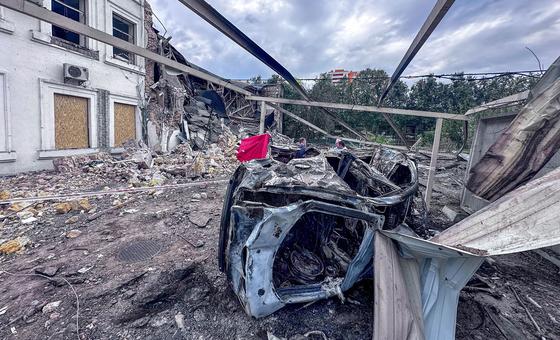
Amid a wave of record civilian casualties, an overnight strike early Tuesday on a railway station in the city of Lozova, in Ukraine’s frontline Kharkiv region, killed five civilians and workers, injuring several others.

According to a social media post from the UN humanitarian aid agency (OCHA) in Ukraine, the railway station was heavily damaged, and surrounding homes were also affected.

According to news reports, the attack triggered fires across the city and disrupted rail traffic in Lozova, a strategically important transport hub.

Emergency assistance is ongoing, with aid workers on site providing emergency repair materials and psychological support.

UN-India partnership launches SDG projects across Global South

At Tuesday’s daily press briefing in New York, UN Deputy Spokesperson Farhan Haq highlighted the launch of a new UN-India partnership to facilitate cooperation across the Global South and advance the Sustainable Development Goals (SDGs).

The UN-India Global Capacity-Building Initiative, will showcase successful innovations to countries across the Global South, tailored to national priorities.

The Gates Foundation and the Indian Technical and Economic Cooperation (ITEC) programme are also supporting the projects, which will be implemented with national partners in the Caribbean, Laos, Nepal, South Sudan and Zambia.

The projects aim to enhance digital health, food security, census preparedness and vocational skills training.  

India and UN join forces for South-South Cooperation to accelerate the SDGs.

Source link

Russian attack on Ukrainian capital kills at least 11 civilians

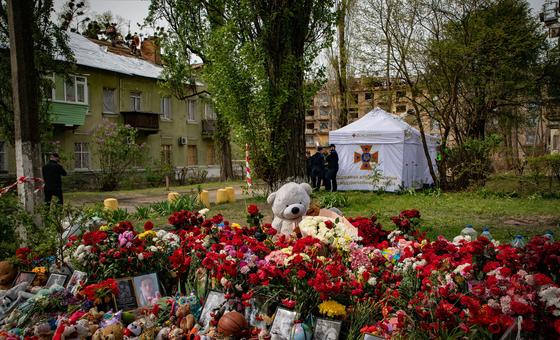
Among the confirmed dead is a six-year-old boy. At least 10 of the injured were children, the mission said, and news reports indicate that figure is rising.

City-wide damage

Russia reportedly launched 309 drones and eight cruise missiles during the night,  and despite air defences managing to destroy many of them, the damage across the capital was severe.  

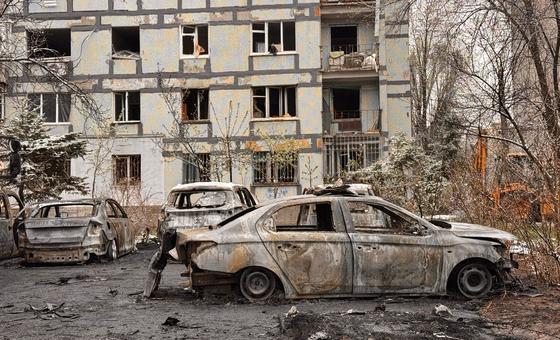
At least 27 locations across Kyiv were hit by the attack, with the heaviest damage seen in the Solomianskyi and Sviatoshynskyi districts, where UN rescue efforts are ongoing.  

In the Sviatoshynskyi district, a missile destroyed a section of a nine-story apartment building.

In the Solomianskyi district, a five-story apartment building was severely damaged, and at least two people were killed.

UN Ukraine reported that witnesses described shock at the strike, which happened so quickly that they did not have time to seek shelter.

“Homes, businesses and public buildings are being destroyed, and it may take years to rebuild them. And each new attack compounds the psychological toll on people who have to spend night after night in shelters,” said Danielle Bell, Head of HRMMU.

More than 100 buildings were reportedly damaged in the capital, including homes, schools, kindergartens, medical facilities and universities, according to news reports.  

Unprecedented civilian toll

This attack follows a wave of violence close and far from the frontline, including weekend assaults that killed at least 20 civilians and injured over 120, a prison attack on Monday that killed 16 inmates, a hospital strike that killed three and the death of five civilians in the east on Tuesday.

This violent pattern continues from June, when HRMMU reported that Russia launched 10 times more missile and loitering munitions attacks against Ukraine compared with June 2024, killing 232 and injuring 1,343.

The UN Humanitarian Coordinator for Ukraine, Matthias Schmale, stressed on social media that “international humanitarian law must be respected. All efforts must be taken to protect civilians. They are not a target.” 

Source link

Russian attack on Ukrainian prison kills 16: UN rights monitors

Meanwhile, another attack on Tuesday reportedly killed five civilians and injured three in the Kharkiv region, located in eastern Ukraine.

According to authorities, Russian armed forces dropped several powerful glide bombs on Bilenkivska Penal Colony No. 99 on 28 July. The prison is located about 25 kilometres from the frontline in the Zaporizhzhia region.

All those killed were prisoners, according to HRMMU. The mission plans to visit the site as soon as possible to gather additional information.

Russia has denied responsibility for the attack.

Violation of international law

“Prisoners are civilians, and they must be protected under international humanitarian law,” said Danielle Bell, head of HRMMU.

International humanitarian law stipulates that attacks must only be directed at military objectives, not at civilians or civilian objects. Since a prison is a civilian object, it should not be attacked unless it is being used for military purposes.

Deadly civilian attacks

Also on Monday, Russian forces reportedly struck near a hospital in Kamianske in the Dnipropetrovsk region. The attack damaged the hospital and its maternity ward, killing three and injuring 22, according to authorities.

At least two of the dead were reportedly patients, including a woman who was seven months pregnant.

Source link

Short-range drone attacks deepen crisis on Ukrainian frontlines

According to the rights mission, while the majority (89 per cent) of civilian casualties were documented in Ukrainian-controlled territory as a result of attacks by the Russian armed forces, the remaining occurred in territory occupied by Russian authorities, including in attacks that struck public transport and clearly marked ambulances.

While individually less destructive than artillery or missiles, “the sheer scale and increasing frequency of short-range drone attacks have made them one of the deadliest weapons in Ukraine,” said Danielle Bell, Head of HRMMU.

Not compliant with laws of war

Forcing residents to drastically restrict their movements, limiting access to essential goods and affecting livelihoods, the large number of short-range drone attacks exacerbated an already dire humanitarian situation.

Most short-range drones have on-board cameras that provide operators with a real-time view of potential targets.

However, the high number of civilian casualties resulting from drone attacks suggests that these weapons have been deployed in ways that violate international humanitarian law, in particular the principles of distinction and precaution, HRMMU noted.

In some instances, drone operators appear to have intentionally attacked civilians or civilian objects, including medical transport and personnel, which would amount to war crimes, it added.

“It is clear that these weapons are not being used in compliance with the laws of war,” Ms. Bell said.

Call for accountability

Information verified by the mission showed that the number of civilian casualties from short-range drones steadily increased in late 2023 and early 2024, before spiking in July 2024 and reaching record numbers in April 2025.

Casualties continued in May and June, such as during a strike on a minibus in Kostiantynivka, Donetsk region, on 23 June, in which the 65-year-old driver was killed.

On 22 May, a 58-year-old woman, a local volunteer, was killed in a frontline village in Kharkiv region when a drone dropped a munition on the balcony of a two-story residential building, according to the HRMMU.

“Each of these attacks must be investigated,” Ms. Bell said.

“Those responsible for targeting civilians and humanitarian personnel must be held to account.”

Source link

UN condemns deadly Russian strikes on Ukrainian capital as civilian toll mounts

According to the UN Human Rights Monitoring Mission in Ukraine (HRMMU), more than 30 locations across seven districts of Kyiv were struck in what it described as “the deadliest attack” on the Ukrainian capital in nearly a year.

Last night’s attack exemplifies the grave threat posed by the tactic of deploying missiles and large numbers of drones simultaneously into populated areas,” said Danielle Bell, Head of HRMMU.

Humanitarian Coordinator for Ukraine, Matthias Schmale, also strongly condemned the attacks, which extended to Odesa, Zaporizhzhia and other areas.

“The people of Ukraine should not have to take cover in shelters night after night,” he said. “Each day, the war takes a devastating toll on civilians.”

In the southern port city of Odesa, strikes reportedly injured several civilians and damaged a kindergarten and a centre for children with special needs – places where children should feel safe. In Zaporizhzhia, residential buildings were hit.

First responders and humanitarian agencies are already on the ground, providing emergency care and supplies while assessing further needs.

Human toll rising

The barrage included 440 long-range drones and 32 missiles launched by Russian forces, HRMMU noted in a news release citing information from Ukrainian authorities, of which 175 drones and 14 missiles targeted Kyiv.

It marked the fourth time this month that more than 400 munitions were fired in a single night – far surpassing the 544 total launched during the entire month of June 2024.

Even before this latest attack, the human toll of such tactics had been rising sharply. HRMMU had already verified at least 29 civilian deaths and 126 injuries from long-range weapons in June alone.

The overall civilian casualty count in the first five months of 2025 is nearly 50 per cent higher than in the same period last year.

Mr. Schmale reiterated that attacks on civilians and civilian infrastructure are prohibited under international humanitarian law.

Civilians, including children, must never be a target,” he said. “We must not normalize the war.”

Refugee crisis deepens

Meanwhile, the broader humanitarian crisis continues to deepen. The intense conflict, now in its third year since Russia’s full-scale invasion, has driven more than 6.3 million Ukrainians to seek refuge across Europe.

Most are women, children, and older persons, many of whom rely on temporary protection directives extended by host countries like the European Union (EU) and Moldova, according to a report released on Tuesday by Office of the UN High Commissioner for Refugees (UNHCR).

Noting the volatile situation in Ukraine, the agency urged the respective governments to maintain legal status for refugees until conditions allow for safe, dignified, and sustainable returns.

Source link