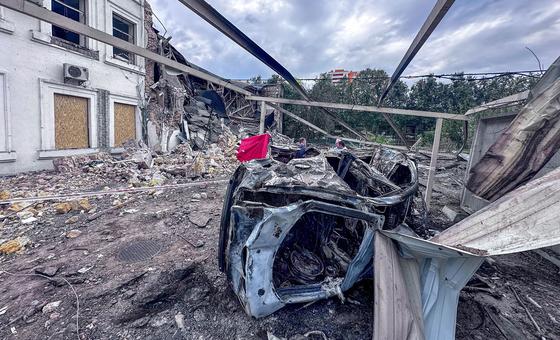
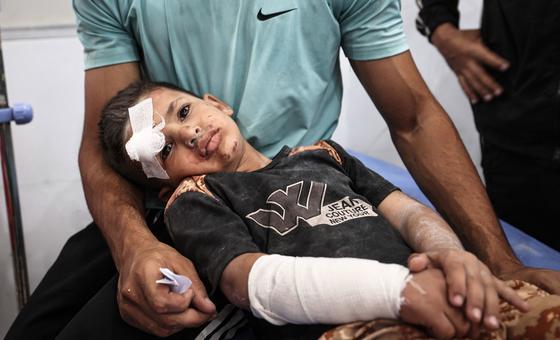
Guterres condemns escalating violence in South Sudan as aid operations come under fire

In a statement issued by his Deputy Spokesperson, Farhan Haq on Saturday, the UN chief said nearly 10 million people – “more than two thirds of the population” – now require life-saving humanitarian assistance and “continue to bear the brunt of the conflict”.

He expressed grave concern over fighting, attacks and looting affecting humanitarian and health facilities, as well as movement restrictions and insecurity along key supply routes. 

These conditions, the statement said, are “crippling humanitarian operations and shutting down essential services, placing civilians, including aid workers, at serious risk”.

Healthcare services attacked

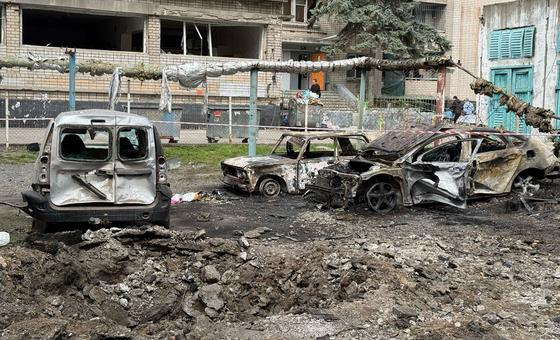
Since late December, at least 11 healthcare facilities have been attacked in Jonglei State alone, disrupting critical services for communities already under severe strain. The assaults have also involved the seizure of 12 vehicles, including an ambulance.

“In the past week alone,” the statement noted, incidents have included “repeated attacks on a World Food Programme (WFP) convoy, an airstrike on a hospital run by the leading NGO Médecins Sans Frontières, and the burning of a Save the Children field office and destruction of its health centre”.

The Secretary-General said that “this clear disregard for medical and humanitarian operations is unacceptable and must stop”, stressing that such work “must be facilitated and respected”.

The violence has driven mass displacement, with more than 370,000 people reportedly forced from their homes so far this year, including over 280,000 in Jonglei State, amid a rapidly worsening cholera outbreak.

South Sudan, the world’s youngest nation, gained independence from Khartoum in 2011 but soon descended into a brutal civil conflict marked by political rivalry, ethnic violence and repeated peace deal breakdowns. 

‘Immediate and decisive’ end to fighting needed

Despite a 2018 agreement, insecurity and localised fighting have continued to undermine stability and recovery.

The UN chief called on all parties to “immediately and decisively halt all military operations”, de-escalate tensions through dialogue, uphold international law, protect civilians and ensure safe, sustained humanitarian access, including the security of aid workers and UN peacekeepers.

Source link

Pakistan: Guterres condemns deadly suicide bombing at Islamabad mosque

In a statement issued by his spokesperson, Secretary-General António Guterres said he condemned the bombing “in the strongest terms.”

Call for accountability

The Secretary-General reiterates that attacks against civilians and places of worship are unacceptable,” the statement said, stressing that those responsible “must be identified and brought to justice.”

Mr. Guterres extended his condolences to the families of the victims and wished “a full and speedy recovery to those injured.” He also reaffirmed “the solidarity of the United Nations with the Government and people of Pakistan in their efforts to combat terrorism and violent extremism.

Attack during Friday prayers

According to media reports, at least 31 people were killed and more than 160 injured when a suicide bomber detonated the explosive device at a Shia mosque in the Tarlai area of Islamabad.

Police said the attacker opened fire at the gates of the mosque before triggering the explosion after being confronted by security guards.

A state of emergency has been declared in the capital and hospitals have appealed for blood donations. The attack has been described as the deadliest of its kind in Islamabad in over a decade.

‘Deeply shocked and saddened’

The UN Resident Coordinator in Pakistan, Mo Yahya, said he was “deeply shocked and saddened by the horrifying attack at an Imambargah in Islamabad, where people were gathered for Friday prayers.”

“I extend my deepest sympathies to the victims and their families,” he said, adding: “We should stand together in opposing such senseless violence.

Source link

World News in Brief: UN condemns attack on civilians in Nigeria, updates from Gaza and West Bank, relief flights to resume in Yemen

In a statement issued by his spokesperson, António Guterres conveyed his “heartfelt condolences to the families of the victims and to the people and Government of Nigeria,” and wished a speedy recovery to those injured.

“The Secretary-General reiterates the solidarity of the United Nations with the Government and people of Nigeria in their efforts to fight terrorism and violent extremism and stresses the importance of bringing the perpetrators to justice,” the statement said.

Death toll may rise

According to media reports, armed groups attacked two rural villages in Kwara state on 3 February, with the death toll expected to rise as bodies continue to be discovered.

Many victims were reportedly shot at close range, while homes and shops were set ablaze, forcing residents to flee into nearby bushland.

The attack was the deadliest recorded in the area in recent months, amid a sharp rise in violence across Nigeria’s northwest and north-central regions, where armed groups have increasingly targeted civilians.

The worsening security situation has also contributed to a deepening humanitarian crisis, with large-scale displacement and growing hunger and malnutrition across affected areas.

Civilians deaths and injuries continue due to Gaza attacks

Despite the shaky ceasefire, dozens of civilian deaths and injuries continued to be reported in Gaza over the past 24 hours, as well as ongoing displacement in the West Bank, according to UN agencies.

Many people remained inaccessible to emergency teams, UN Spokesperson Stéphane Dujarric told journalists, citing reports from the UN aid coordination office OCHA.

He reiterated that all parties must comply with international humanitarian law, including the obligation to protect civilians and civilian infrastructure.

Mr. Dujarric said UN teams overnight received 25 additional returnees crossing through Rafah, who were transported by the UN Development Programme (UNDP) to Nasser Hospital in Khan Younis.

There, UN partners continue operating a reception area providing medical, psychological and protection support.

He added that the World Health Organization (WHO) and partners supported the medical evacuation of 15 patients and 31 companions from Gaza to Egypt over the past two days.

Record spike in West Bank attacks

Attacks by Israeli settlers against Palestinians in the occupied West Bank have seen a massive spike since 2021, with more than 50 Israeli settler attacks recorded between 20 January and 2 February.

The attacks resulted in casualties, property damage or both.

According to OCHA, since the beginning of 2026, more than 900 Palestinians have been forced out of their homes or communities, mostly due to settler violence and access restrictions, followed by demolitions.

OCHA said it is carrying out preliminary assessments of damage and needs following these incidents, to inform the humanitarian response.

Yemen: Aid flights set to resume to Houthi-controlled capital

The UN has confirmed that its aid flights to Yemen’s opposition-held capital will resume, after being blocked for more than a month.

UN Humanitarian Air Service flights are a vital provider of relief amid overwhelming needs across Houthi-held areas, including the capital city, Sana’a, and other locations across Yemen, which has been at war since 2014.

Boost to aid delivery

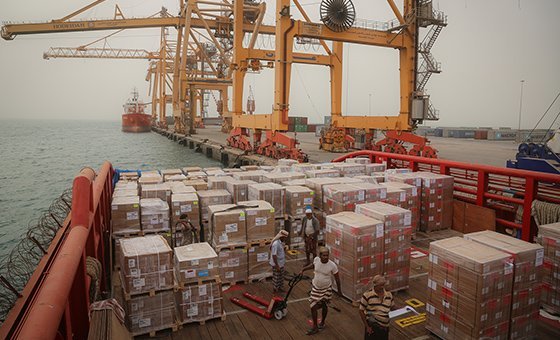
Julien Harneis, the UN Resident and Humanitarian Coordinator for Yemen, said in a statement that the agreement reached earlier this week will allow NGOs to enter and exit Sana’a, which is a prerequisite to providing assistance for millions of people in need in Houthi-controlled areas.

Years of conflict between separatists and the internationally recognised government have left more than 19.5 million people needing humanitarian assistance and more than 4.8 ‎million internally displaced.

Funding is only available to meet around 25 per cent of needs, meaning that millions ‎are not getting lifesaving assistance, including health care, shelter, water, sanitation ‎and hygiene.

Source link

Cold and dark: UN rights chief condemns Russian strikes on Ukraine’s power grid

Volker Türk said he was outraged by renewed overnight attacks that knocked out power and heating in major cities – including Kyiv and Odesa – as temperatures plunged well below zero and civilians bear the brunt of what he described as unlawful assaults on civilian infrastructure.

He said the Russian strikes “can only be described as cruel. They must stop. Targeting civilians and civilian infrastructure is a clear breach of the rules of warfare.

According to Ukrainian authorities, the latest long-range attacks triggered emergency power and heating outages across several regions.

In Kyiv alone, the city’s mayor reported that 5,635 multi-storey residential buildings were left without heating on Tuesday morning, nearly 80 per cent of which had only recently had heating restored after similar strikes earlier this month.

Since October last year, Russian armed forces have renewed systematic large-scale attacks against Ukraine’s energy infrastructure, with strikes recorded in at least 20 regions of the country.

Mr. Türk called on Russian authorities to immediately halt the attacks, warning that continued strikes on essential civilian infrastructure risk compounding human suffering.

Humanitarian consequences

“This means that hundreds of thousands of families are now without heating and several areas, including a significant part of Kyiv, are also without water,” Mr. Türk said, warning that the impact falls most heavily on children, older people and persons with disabilities.

The humanitarian toll was underscored by Matthias Schmale, the UN Humanitarian Coordinator for Ukraine, who said that over the past 48 hours tens of thousands of civilians once again woke to freezing homes and severe disruptions to basic services.

Parents cannot prepare hot meals for their children, and many older people have been left isolated in cold homes yet again,” he said. “The hideous strikes on energy that have such a huge negative impact on the lives of the civilian population violate international humanitarian law and should end immediately.”

Nuclear safety risks

The attacks have also raised fresh concerns over nuclear safety. The International Atomic Energy Agency (IAEA) said several electrical substations vital for nuclear safety were affected.

Chernobyl Nuclear Power Plant temporarily lost all off-site power, while power lines to other nuclear facilities were also impacted. “The IAEA is actively following developments in order to assess impact on nuclear safety,” Director General Rafael Grossi said.

Chernobyl was the site of the world’s worst nuclear accident in April 1986, when a reactor explosion released massive amounts of radioactive material across Ukraine, Europe and beyond.

Although the plant has long ceased power generation, it requires a stable electricity supply to maintain cooling systems, radiation monitoring and the safe management of nuclear waste, making uninterrupted power critical to preventing new safety risks.

Source link

UN Condemns ‘Deadly Escalation’ of Fight in Gaza City

The situation “is having an appalling impact on civilians enduring suffering and starvation,” he told journalists in New York.

“The United Nations condemns the deadly escalation of the Israeli military offensive which took place over the weekend across Gaza City, with scores of people reportedly killed or injured,” he said.

“We reiterate our call for the protection of civilians and humanitarian personnel and full respect for international law.” 

70,000 more uprooted

In a post on X on Sunday, the head of the UN agency for Palestine refugees, UNRWA, said that 10 of its buildings in Gaza City had been hit in the past four days alone, including seven schools and two clinics which were being used as shelters.

Almost 70,000 displaced people have headed south in the past few days, while UN partners counted 150,000 movements from north to south this past month.

Partners further reported that one third of malnutrition treatment facilities in Gaza City have shut down due to forced displacement orders, while the Ministry of Health today reported 425 deaths overall due to malnutrition and starvation in Gaza, about a third of which were children.

A call for ‘unimpeded humanitarian access’

Over the past few days, UN partners have managed to distribute 40,000 additional meals each day. As of Saturday, 558,000 daily meals were prepared and distributed by 20 UN partners to 116 kitchens.

“However, health services continue to be heavily constrained, since clinics have suspended their services due to insecurity and displacement orders,” warned Mr. Dujarric, adding that in Deir Al-Balah, only a few ambulances remain in order and are able to serve the thousands of people in need.

Additionally, 77 per cent of the road networks in Gaza have been damaged and according to UN aid coordination office OCHA, humanitarian aid continues to be obstructed.

On Sunday, only four of the 17 missions that the UN coordinated with the Israeli authorities were facilitated. Seven missions were denied, one of which was meant to deliver water tanks to the north, while another four were impeded in the field, and two were cancelled by the organisers.

Nevertheless, three humanitarian missions were accomplished, including the collection of fuel and food cargo from the Kerem Shalom/Karem Abu Salem crossing.

“Our humanitarian colleagues continue to call for unimpeded humanitarian access,” stressed Mr. Dujarric. “Aid should flow at scale through multiple crossings into and within Gaza, including the north.”

Source link

UN’s Guterres condemns gang attack in Haiti that killed at least 40

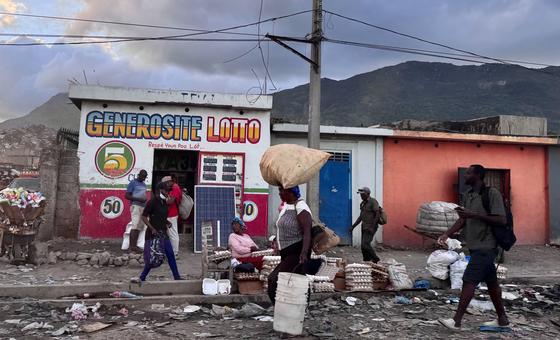
Representational Picture: Civilians left with no space safe to live in Haiti

The overnight assault on September 11 is the latest in a string of brutal incidents and ongoing gang violence that have plagued Haiti since last year.  In a statement issued by his spokesperson, Mr. Guterres expressed “condolences” to the victims’ families and urged Haitian authorities to pursue justice.

“The Secretary-General is alarmed by the levels of violence rocking Haiti,” said Stéphane Dujarric. “He calls on Member States to expedite support for the Multinational Security Support mission to assist the Haitian National Police.”

Just two weeks ago, Mr. Guterres addressed the UN Security Council, painting a grim picture of Haiti’s unraveling state. “State authority is crumbling,” he said, as armed groups tighten their grip on Port-au-Prince and surrounding regions, forcing families to flee and disrupting daily life.

With six million people in need of aid and 1.3 million displaced, Haiti’s humanitarian crisis is deepening. Yet less than 10 percent of the $908 million appeal has been funded. “Shamefully overlooked and woefully underfunded,” the UN chief said, warning that 1.7 million people may receive no assistance at all.

Violence unabated turns risky in future

The latest massacre in Labodrie, where dozens were killed this week, underscores the growing brutality of gangs such as Viv Ansanm, which now dominate major neighborhoods and supply routes. Kidnappings, extortion, and targeted attacks have surged, forcing families to abandon homes and seek refuge in makeshift shelters.

Since the 2021 assassination of President Jovenel Moïse, Haiti has struggled to restore political order. A Transitional Presidential Council governs today, but its legitimacy is widely questioned. Elections have been repeatedly delayed, fueling frustration and allowing gangs to fill the vacuum.

The Haitian National Police remain outnumbered and outgunned, even as international backers try to bolster its capacity. A U.N.-authorized security mission led by Kenya has deployed, but with limited personnel and resources, its ability to restore order remains in doubt. Proposals to expand the force to 5,500 troops are still under discussion.

The humanitarian fallout is staggering. According to U.N. estimates, nearly 1.3 million Haitians are displaced within the country. Food insecurity has reached emergency levels, with shortages worsened by blocked roads, gang control of supply chains, and inflation that has put basic staples out of reach for many. Hospitals and clinics are closing or operating at half capacity due to insecurity and lack of supplies.

International donors, including the United States, Canada, and members of CARICOM, have pledged support, but relief has been slow to materialize on the ground. Washington sees the crisis not only as a humanitarian catastrophe but also as a potential migration trigger that could push thousands toward U.S. shores.

Analysts warn that without a decisive and coordinated effort, Haiti risks sliding further into state collapse. “The longer the vacuum persists, the more gangs will consolidate power and the harder it will be to rebuild institutions,” a regional expert noted.

For now, ordinary Haitians face the brunt of the crisis, caught between a fragile state, predatory gangs, and an international community struggling to mount an effective response.


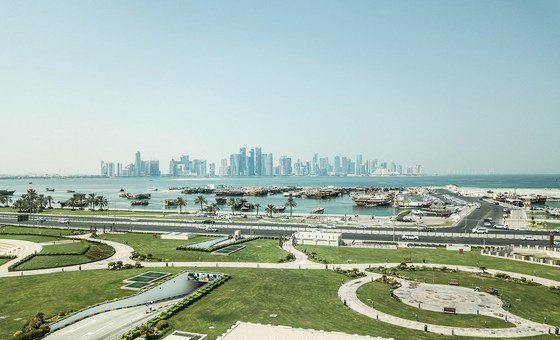
Guterres condemns Israeli strike on Hamas leaders in Qatar as ‘flagrant violation’

In a statement, António Guterres spoke out against what he called a “flagrant violation” of Qatari sovereignty and territorial integrity.

He insisted that all parties must focus on achieving a permanent ceasefire in Gaza, “not (on) destroying it”.

No senior leaders killed, claims Hamas

Hamas reported that six people had been killed, including the son of one of its exiled leaders from the Gaza Strip – but added that its senior negotiators and top officials had all survived.

Prime Minister Benjamin Netanyahu said that the attack had been Israel’s sole responsibility, although the White House Spokesperson said that the President of the United States had been informed in advance and directed his officials to alert Doha – but the message was conveyed too late to stop the attack.

President Donald Trump said in a social media post that bombing Qatar, a “sovereign nation and close ally” of the US, does not advance the goals of either Israel or the US.

‘Blatant violation’: Qatar

The Qatari Government condemned the attack as a “blatant violation of international law” and the Qatari Prime Minister said at a press conference that “there must be a response from the entire region to such barbaric actions.”

Qatar – alongside the US and Egypt – had brokered extensive efforts to end the Gaza war which began on 7 October 2023 when Hamas and other militants attacked settlements in southern Israel.

Source link

World News in Brief: UN chief condemns Russian attacks on Ukraine, Gaza crisis continues, protecting civilians in DR Congo

Secretary-General António Guterres said it marked a “further escalation” of the conflict.

Authorities reported more than 80 civilian casualties, including a national non-governmental organization (NGO) worker and her two-month-old son in Kyiv.

Other affected cities included Zaporizhzhia, Odesa, Chernihiv, Kharkiv, Kremenchuk, Kryvyi Rih and Kherson. Energy infrastructure was also hit, causing temporary power and water outages ahead of winter, with repair crews working to restore services.

“Attacks against civilians and civilian infrastructure violate international humanitarian law. They are unacceptable and must end immediately,” UN Spokesperson Stéphane Dujarric said Monday at the regular news briefing in New York.

“The Secretary-General reiterates his call for a full, immediate and unconditional ceasefire as a first step towards a just, comprehensive and sustainable peace in Ukraine, one that fully upholds Ukraine’s sovereignty, independence and territorial integrity, in line with the UN Charter, international law and relevant UN resolutions,” he added.

Meanwhile, humanitarian support continues. On 5 September, UN agencies and partners delivered medical kits and hygiene supplies to roughly 1,000 people in several Donetsk villages, marking the tenth convoy to the region this year.

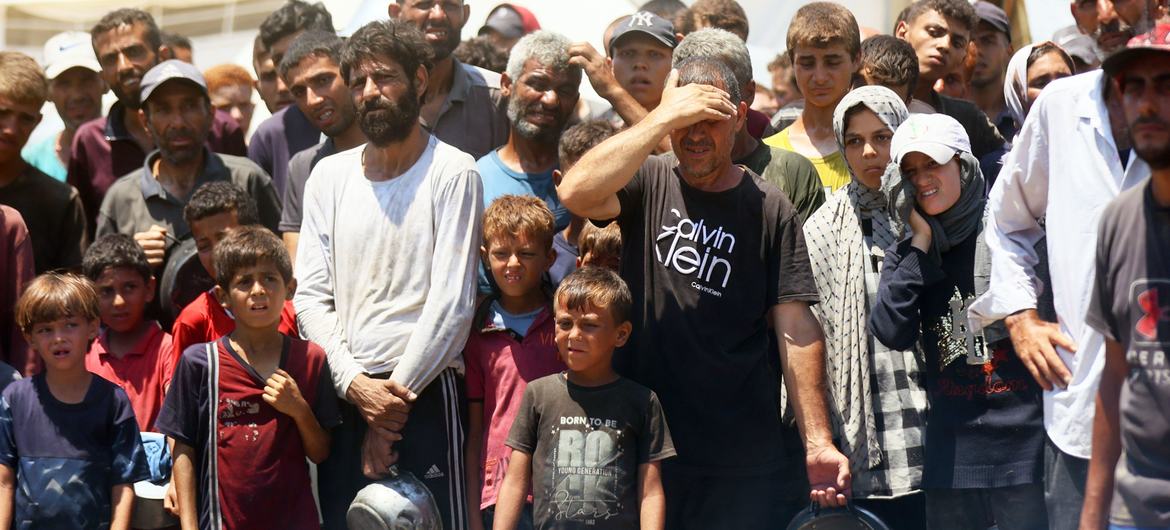
People seek food at a community kitchen in western Gaza City.

Gaza: Civilian toll continues to climb

Civilians in Gaza continue to face mounting deaths, displacement and famine as hostilities continue, with UN agencies warning that the window to prevent widespread starvation is closing.

According to local health authorities, some 67 people were killed and 320 injured in the past 24 hours, Mr. Dujarric said, adding that since the end of the ceasefire in mid-March nearly 12,000 people have died amid repeated displacement and attacks.

“We continue to condemn all killings of civilians,” he said.

The humanitarian situation remains dire. The UN aid coordination office, OCHA, noted urgent needs for food, water and shelter.

“Our colleagues remind us that over 80 per cent of Gaza is either under displacement orders or within militarized areas,” Mr. Dujarric added.

The Gaza Ministry of Health reported that over 100 people, a quarter of them children, have died from malnutrition since famine was confirmed in Gaza governorate.

Humanitarian operations remain heavily constrained.

Only 11 of 24 coordinated missions were facilitated on Sunday, including fuel collection at crossings, while others were denied or cancelled. Humanitarians were able to distribute water in northern Gaza and collect food shipments from Kerem Shalom, Karem Abu Salem and Zikim crossings.

UN peacekeepers in DR Congo continue to protect population against ‘grave danger’

Hundreds of thousands of people fleeing conflict in the eastern Democratic Republic of the Congo (DRC) continue to be protected against “grave danger” by United Nations peacekeepers, according to the head of UN Peace Operations.

Jean-Pierre Lacroix was speaking at the end of a mission to the DRC, where he visited the troubled Ituri and North Kivu regions.

Mr. Lacroix emphasised that hundreds of thousands of Congolese people, including displaced people, rely on the UN peacekeeping mission, MONUSCO for daily protection, particularly in the areas of Fataki and Beni, in North Kivu, where joint operations with the Congolese armed forces continue against armed groups.

USG Lacroix on the role of MONUSCO

Dire situation continues

The security situation in the eastern DRC remains dire, despite diplomatic efforts to bring lasting peace to the country.

The DRC is currently facing one of the most acute humanitarian emergencies in the world, with food insecurity on the rise and 5.9 million Congolese currently internally displaced.

“People are protected here by our MONUSCO colleagues, and they are provided with humanitarian support and protection”, said Mr. Lacroix adding that the UN remains committed to supporting government efforts towards peace and stability in the country.

Source link

Guterres strongly condemns terror attack in Jerusalem

UN Secretary-General António Guterres strongly condemned the terror attack, his Spokesperson said in a statement.

“He conveys his heartfelt condolences to the families of the victims and wishes a full and speedy recovery to those who were wounded,” it said.

The incident took place at a busy intersection in Ramot, located in the northern outskirts of Jerusalem, on Monday morning.

Shot waiting for the bus

The gunmen reportedly opened fire on passengers waiting to board buses. Video footage from the scene showed that several buses had been hit extensively during the assault.

The attackers were identified by authorities as two Palestinians from the occupied West Bank. They were killed by a soldier and a civilian who were at the scene.

A Spanish national was among the victims, according to the country’s foreign ministry.

The shooting took place against the backdrop of the ongoing war in Gaza which has killed more than 63,000 Palestinians and injured more than 161,000 others, according to the local health authorities.


Source link

World News in Brief: Afghanistan quake update, Guterres in Papua New Guinea, Ebola returns to DR Congo, UN condemns attack on peacekeepers in South Sudan

Since the initial earthquake on Sunday in eastern Nangarhar province, landslides and several strong aftershocks have disrupted the work of rescue teams.

In an update, the UN Children’s Fund, UNICEF, said that access routes remain blocked in various locations including the districts of Chawkay and Nurgal, both in Kunar province, although the authorities have deployed earth-moving machinery to restore access.

Latest estimates indicate that approximately half a million people have been affected – including 263,000 children – while at least 5,000 homes have suffered partial or total damage.

Tremors continue

Among the UN agencies operating there, UN Habitat noted that the earthquake had caused massive upheaval in a remote region where recent returnees from Pakistan and Iran were just beginning to settle.

“There are still more earthquakes every day in the region, causing landslides and making access even harder,” said UN Habitat’s Stephanie Loose in the capital, Kabul.

She noted that women and girls were the main victims because of strict rules preventing them from leaving their homes alone.

“Many of them, due to cultural norms or restrictions imposed, didn’t dare to leave their houses; nor are there sufficient female doctors in the country, and I understand they are not able to reach the women who would need it,” Ms. Loose said.

Papua New Guinea’s on the frontline of climate change, warns Guterres

Papua New Guinea and the Pacific islands are climate change’s “Ground Zero” whose precious rain forests and ecosystems deserve the world’s support to ensure they’re protected, the UN Secretary-General said on Thursday.

Speaking from Papua New Guinea where he visited the world’s third largest rainforest and sat down with civil society representatives, António Guterres highlighted the challenges brought about by climate change in the region.

It’s the first ever visit to the southwest Pacific nation by a sitting Secretary-General.

Earlier, he repeated his warning that the 1.5 degree limit on the rise in global temperatures agreed to under the 2015 Paris Agreement remains in jeopardy.

And although scientists say that it is still possible to limit global warming, the UN chief urged countries to unveil their new national climate plans to reduce emissions and “seize the opportunities” arising from the renewable energy revolution.

New Ebola outbreak declared in DR Congo

Health authorities in the Democratic Republic of the Congo (DRC) have declared an outbreak of Ebola virus disease in Kasai province where 28 suspected cases and 15 deaths – including four health workers – have been reported as of Thursday.

The outbreak is concentrated in the Bulape and Mweka health zones in Kasai Province, in the south-central region of DRC. Symptoms of the rare – but severe – and often fatal illness, include fever, vomiting, diarrhoea and haemorrhaging.

Samples tested on 3 September at the country’s National Institute of Biomedical Research in the capital Kinshasa confirmed the cause of the outbreak as the Ebola Zaire strain.

Experts deployed

A national Rapid Response Team assisted by UN World Health Organization (WHO) experts in epidemiology, infection prevention and control – as well as case management – has been deployed to Kasai province.

Communication experts have also been deployed to reach communities and help them understand how to protect themselves.

Additionally, WHO is delivering two tonnes of supplies including personal protective equipment, mobile laboratory equipment and medical supplies.

The area is difficult to reach and at least a day’s drive from the provincial capital Tshikapa, with few air links.   

“We’re acting with determination to rapidly halt the spread of the virus and protect communities,” said Dr Mohamed Janabi, WHO Regional Director for Africa.

“Banking on the country’s long-standing expertise in controlling viral disease outbreaks, we’re working closely with the health authorities to quickly scale up key response measures to end the outbreak as soon as possible.”

Cases likely to rise

Case numbers are likely to increase as transmission is ongoing.

The country has a stockpile of treatments, as well as 2,000 doses of the Ervebo Ebola vaccine already prepositioned in the capital city Kinshasa that will be quickly moved to Kasai to vaccinate contacts and frontline health workers.   

The DRC’s last outbreak affected the northwestern Equateur province in April 2022.

It was brought under control in under three months thanks to the robust efforts of the health authorities. In Kasai province, previous outbreaks of Ebola virus disease were reported in 2007 and 2008. In the country overall, there have been 15 outbreaks since the disease was first identified in 1976.

UN condemns attack on peacekeepers in South Sudan

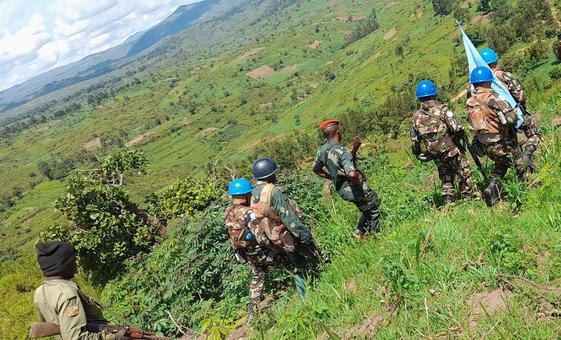
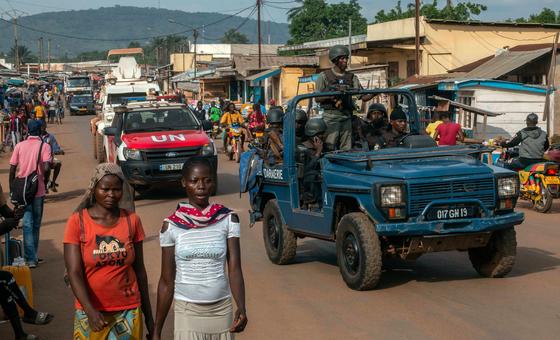
The UN peacekeeping mission in South Sudan, UNMISS, has condemned an attack by a local armed group which targeted “blue helmets” in Western Equatoria state.

The militants subsequently seized a small cache of weapons and ammunition. The incident occurred while peacekeepers were conducting a patrol between Tambura and Mapuse.

“We emphasise that any attack against peacekeepers may constitute a war crime,” UN Spokesperson Stéphane Dujarric said at the daily press briefing in New York on Thursday.

“These peacekeepers are deployed to protect civilians at a time when access and security remain fragile across Western Equatoria,” he added.

Meanwhile, widespread flooding is also impacting hundreds of thousands of people in several parts of the world’s youngest nation, which became embroiled in civil war soon after gaining independence in 2011.

A fragile 2018 peace accord is in danger of unravelling amid fresh offensives and deteriorating humanitarian conditions.

Flooding affects 270,000

Local reports suggest that over 270,000 people are affected by flooding in 12 counties across four states.

These areas were already grappling with floods, displacement, food security and cholera, said Mr. Dujarric, with farmland, homes and humanitarian facilities now submerged, disrupting access to education, health, nutrition and water services.

UN humanitarians say overcrowding at relocation sites has led to tensions among displaced families at the same time, reports of waterborne diseases and snake bites are increasing public health risks.

Peacekeepers serving with the UN Mission in South Sudan (UNMISS) have increased their presence and intensified vehicle patrols, navigating treacherous, rain-soaked routes both day and night.


Guterres condemns detention of more UN staff in Yemen

He said the Houthis entered the premises of the World Food Programme (WFP) in the capital, Sana’a, and seized UN property, in addition to attempting to enter other UN premises in the city.

The Houthis, also known as Ansar Allah, have been battling Yemeni Government forces, backed by a Saudi-led coalition, for control of the country for over a decade.

Since October 2023, they also have been targeting Israel as well as commercial ships in the Red Sea, in solidarity with the Palestinian cause in Gaza.

Release all detained personnel

Mr. Guterres strongly reiterated his demand for the immediate and unconditional release of the staff members and all other personnel from the UN, international and national non-governmental organizations, civil society and diplomatic missions, who have been arbitrarily detained for over a year and those held since 2021 and 2023.

“The personnel of the UN and its partners must never be targeted, arrested or detained while carrying out their duties for the UN,” he said.

“The safety and security of UN personnel and property as well as the inviolability of UN premises must be guaranteed at all times.”

The Secretary-General added that the UN will continue to work tirelessly to secure the release of the detained staff members and, together with its partners, will continue to support the people of Yemen and their aspirations for a just and lasting peace.

UN envoy concerned

Meanwhile, the UN Special Envoy for Yemen said on Sunday that he was “following with great concern” recent developments in the country, where Houthi-controlled areas have continued to be subject to Israeli strikes following Ansar Houthi attacks against Israel.

Hans Grundberg reiterated that Yemen cannot afford to become a battleground for a broader geopolitical conflict, stressing that these attacks need to stop.

The Special Envoy continues to urge all sides to use available diplomatic channels to de-escalate the situation.

Mr. Grundberg was also deeply concerned by the civilian deaths and injuries in the recent Israeli attacks. Additionally, according to Houthi statements, several senior Houthi officials and political interlocutors were killed and injured.

He called on all sides to protect civilians and civilian infrastructure, in line with international law.

Source link

Gaza: UNESCO condemns ‘unacceptable’ killing of journalists

“I condemn the killing of journalists Anas Al-Sharif, Mohammed Qreiqeh, Ibrahim Zaher, Mohammed Noufal, Moamen Aliwa, and Mohammed Al-Khaldi and call for a thorough and transparent investigation,” UNESCO’s Director-General, Audrey Azoulay, said in a statement on Tuesday.

Five of the six worked for the influential Qatari-based media organization, Al Jazeera: Anas Al-Sharif and Mohammed Qreiqeh were on air correspondents, while Ibrahim Zaher, Mohammed Noufal and Moamen Aliwa worked as camera operators. Mohammed Al-Khaldi was a freelance photojournalist.  

They were reportedly killed by an Israeli attack on a tent used by media personnel at the entrance of Al-Shifa Hospital in Gaza City.

Blatant, premeditated attack

The Israeli Defense Forces (IDF) alleged that 28-year-old correspondent Anas al-Sharif was a serving Hamas operative. Al Jazeera strongly denies this, describing the attack as an “assassination” and “yet another blatant and premeditated attack on press freedom.”

The UN Human Rights Council-appointed independent expert on freedom of expression issued a statement on 31 July denouncing an Israeli military spokesperson’s “repeated threats” and “unfounded accusations” against Mr. Anas Al-Sharif, flagging it as “a blatant attempt to endanger his life and silence his reporting” in Gaza.  

Condemning the attack in the strongest possible terms on Tuesday, two special rapporteurs described the killings as “an attempt to silence reporting on the ongoing genocide and starvation campaign” in Gaza.

“It is outrageous that the Israeli army dares to first launch a campaign to smear Anas Al-Sharif as Hamas in order to discredit his reporting and then kill him and his colleagues for speaking the truth to the world,” the experts said, demanding an immediate investigation into the killings and full access to international media, which Israel currently bars from entering Gaza.

Special Rapporteurs and other independent experts are appointed by and report regularly to the Human Rights Council. They work in their individual capacity, are not UN staff and receive no payment for their work.

Violation of international law

UNESCO chief Ms. Azoulay stressed that targeting journalists reporting on conflicts is unacceptable and violates international law.  

She also reiterated her call to respect UN Security Council Resolution 2222, which was unanimously adopted in 2015 to protect journalists, media professionals and associated personnel in conflict situations.

Since October 2023, UNESCO has reported at least 62 journalists and media workers killed in the line of duty in Palestine, excluding deaths in circumstances unrelated to their work, while OHCHR reports that at least 242 Palestinian journalists have been killed in the same time frame. 

UN condemns deadly attack on worshippers in DR Congo

Elements of the ADF, an Islamic State-affiliated insurgent group that originated in neighbouring Uganda, carried out the attack in Komanda town, Irumu territory, Ituri province.

At least 49 civilians were killed, including nine children. Several other people were injured and abducted, and shops and homes were set on fire. 

Most of the victims were reportedly worshippers killed with bladed weapons during a night vigil at a church.

The incident comes after ADF attacks earlier in the month killed 82 civilians in Ituri and North Kivu provinces, which MONUSCO condemned on 23 July. 

The group has committed grave human rights violations against civilians since its founding in 1995 and has been under UN sanctions since June 2014.

‘Deep outrage’ over attacks

MONUSCO expressed “deep outrage at these heinous acts of violence, which constitute serious violations of international humanitarian law and infringements on human rights.” 

The peacekeeping mission also extended condolences to the bereaved families, urged Congolese authorities to investigate these killings, and reiterated the UN Secretary-General’s call for all foreign armed groups to lay down their weapons unconditionally and return to their countries of origin.

“These targeted attacks against defenceless civilians, particularly in places of worship, are not only appalling but also in violation of all human rights standards and international humanitarian law,” said Vivian van de Perre, Deputy Special Representative of the UN Secretary-General for Protection and Operations and Acting Head of MONUSCO. 

She added that the Mission “will continue to work tirelessly alongside the Congolese authorities to protect the population in line with its mandate.”

Response on the ground

MONUSCO is supporting local authorities in their response by organising burials and providing medical care to the wounded. 

The peacekeeping mission is also intensifying security efforts in and around the city of Komanda. 

The Mission is committed to working with Congolese authorities and communities “to help prevent future attacks, protect civilians, reduce tensions, and contribute to the stabilization of areas affected by armed violence.” 

Source link

Gaza: Guterres condemns killing of people seeking food as humanitarian conditions deteriorate

Stéphane Dujarric was speaking to reporters at UN Headquarters in New York a day after dozens of Palestinians were killed seeking food aid.

He said the Secretary-General deplored the growing reports of both children and adults suffering from malnutrition and strongly condemned the ongoing violence, including the shooting, killing and injuring of people attempting to get food.

Not a target

Civilians must be protected and respected, and they must never be targeted,” said Mr. Dujarric, noting that the population in Gaza remains gravely undersupplied with the basic necessities of life.

He stressed that “Israel has the obligation to allow and facilitate by all the means at its disposal the humanitarian relief provided by the United Nations and other humanitarian organizations.” 

Mr. Dujarric said the Secretary-General noted that the recent intensification of hostilities comes as the humanitarian system in Gaza is being impeded, undermined and endangered.

New evacuation orders

He pointed to a new evacuation order issued for parts of Deir Al-Balah, which is pushing people into more desperate conditions and sparking further displacement, while restricting the UN’s ability to deliver aid.

He reported that two UN guesthouses in Deir Al-Balah were struck, despite the parties being informed about their locations. 

“They suffered damage,” he said, responding a reporter’s question. “The UN staff inside was, to say the least, rattled.”

Mr. Dujarric underscored that the UN intends to remain in Deir Al-Balah.

Ceasefire now

The Secretary-General reiterated his urgent call for the protection of civilians, including humanitarian personnel, and for the provision of essential resources to ensure their survival.

He once again called for the immediate and unconditional release of all hostages.

Mr. Dujarric said the UN stands ready to significantly scale up its humanitarian operations in Gaza, adding “the time for a ceasefire is now.” 

People dying from malnutrition 

Amid the ongoing shelling, displacement and destruction in Gaza, humanitarians continue to receive reports of severely malnourished people arriving at medical points and hospitals in extremely poor health. 

More than a dozen people, including children, have reportedly died from hunger in the last 24 hours, according to the Gaza health agencies. 

The UN Office for the Coordination of Humanitarian Affairs (OCHA) recalled that roughly 88 per cent of Gaza is now under displacement orders or within displacement zones. 

Shelter and fuel 

Gaza’s population is some 2.1 million and about 1.35 million need shelter and household items.  However, no shelter supplies have been allowed to enter for more than four months.   

The dire fuel crisis also continues, with humanitarians continuing to warn that the limited quantities that have been allowed to enter in recent days are hardly sufficient. 

Traditional aid systems critical: UN official 

Meanwhile the new UN Humanitarian Coordinator for the Occupied Palestinian Territory, Ramiz Alakbarov, has met with the Prime Minister of the State of Palestine, Mohammad Mustafa, in Ramallah.  

At a press conference, Dr. Alakbarov called for an immediate and permanent ceasefire, the unconditional release of the hostages, and the lifting of all restrictions on access to people in Gaza.         

He said to address immediate needs, humanitarian organizations must be able to use the traditional systems of aid delivery. 

He noted that these systems are currently undermined by violence, including armed looting and recurrent shootings at civilians seeking aid. which he said must be independently investigated.   

UN rights chief condemns the killing of scores of civilians in Sudan

Since 10 July, the UN human rights office, OHCHR, has verified that the Rapid Support Forces

 (RSF) have killed at least 60 civilians in North Kordofan’s Bara locality, while civil society groups have reported that up to 300 were killed.

The Sudanese Armed Forces (SAF) also hit two villages in West Kordofan from 10 to 14 July, killing at least 23 civilians and causing more than 30 injuries.

Most recently, on Thursday, an SAF airstrike in Bara killed at least 11 civilians who were all members of a single family.

According to the High Commissioner’s statement, these deaths come amid worrying reports that the RSF is mobilising for an offensive on the capital of North Kordofan state, El Obeid.  

Continued concern for El Fasher  

At another major hotspot in the Sudan conflict, the besieged city of El Fasher in North Darfur state, the RSF has conducted multiple attacks recently. They include a ground attack on 11 and 12 July, which reportedly resulted in civilian casualties.  

The High Commissioner subsequently “expressed continued concern for the safety of civilians in El Fasher.”

“Callous disregard for civilians’ lives and safety”

The statement stressed that the High Commissioner “deplored the killing of dozens of civilians by both parties.”

“It is distressing that more than two years since the conflict began parties to the conflict in Sudan continue to demonstrate callous disregard for civilians’ lives and safety,” he said.  

“An escalation of hostilities in North Darfur and Kordofan will only further aggravate the already severe risks to civilians and the dire humanitarian situation in a conflict that has already wrought untold suffering on the Sudanese people,”  

Mr. Türk urged those with influence to prevent further escalation and ensure parties uphold their obligations under international law, including the protection of civilians.  

The High Commissioner renewed his calls for the warring parties to ensure safe and unimpeded access to humanitarian aid and to prevent violations of international law.  

“All alleged violations must be fully and independently investigated and those responsible brought to justice,” he concluded. 

Source link

Sudan: UNICEF condemns weekend attacks that killed 35 children

At least 24 boys, 11 girls and two pregnant women reportedly were among the victims of the violence, which occurred over the weekend in communities around the city of Bara, including the villages of Shag Alnom and Hilat Hamid. 

UNICEF fears that with dozens more injured and many still missing, the number of child casualties could rise further.

‘A complete disregard for human life’

“These attacks are an outrage,” Executive Director Catherine Russell said in a statement issued on Tuesday.

“They represent a terrifying escalation of violence, and a complete disregard for human life, international humanitarian law, and the most basic principles of humanity.”

Former allies turned rivals – the Sudanese Armed Forces (SAF) and the paramilitary Rapid Support Forces (RSF) – have been battling for control of the country since April 2023 and fighting has intensified recently in the Kordofan region which encompasses three states.

End the violence now

“UNICEF condemns the attacks in the strongest possible terms,” said Ms. Russell.

She called on all parties to end the violence immediately and to uphold their obligations under international law, including international humanitarian law, as well as the principles of distinction, proportionality and precaution.

The UNICEF chief stressed that civilians – particularly children – must never be targeted. Furthermore, all alleged violations must be independently investigated, and those responsible held to account.

Impunity cannot be tolerated for violations of international law, especially when children’s lives are at stake,” she said.

Ms. Russell extended the agency’s deepest condolences to the families of the victims, and to anyone impacted by this heinous violence.

No child should ever experience such horrors,” she said. “Violence against children is unconscionable and must end now.” 

Source link

UN chief condemns latest Houthi attacks on Red Sea shipping

According to news reports, the Yemen-based rebel group – which has been battling the internationally-recognised Government for control of the country since the early 2010s – attacked the Liberian-flagged, Greek-operated Eternity C on Monday and again on Tuesday, causing it to sink on Wednesday morning.

Four crew members are reported to have died.

With 15 crew still missing as of Friday, the group also reportedly took an unspecified number of the seafarers to what rebels described as a “safe location.”

Weekend assault

This came after the Houthis launched missiles and drones at another Liberian-flagged, Greek-operated cargo ship in the Red Sea on Sunday, Magic Seas. The crew was forced to abandon ship, but all 22 members were rescued, according to reports.

Since the start of the war in Gaza in October 2023, the Houthis have targeted Israeli and commercial ships in the Red Sea deemed to be en route to Israel, in solidarity with Palestinians in the enclave.

In May, following US airstrikes on Houthi strongholds and missile infrastructure, the group agreed a deal with Washington to stop targeting US warships – however, they did not pledge to end attacks on other vessels allegedly linked to Israel.

Strong condemnation: Guterres

UN Spokesperson Stéphane Dujarric read a statement from Secretary-General António Guterres on Friday at UN Headquarters, saying the UN chief “strongly condemns the resumption of Houthi attacks on civilian vessels transiting the Red Sea, especially the attacks that took place over 6 to 8 July 2025.”

Mr. Guterres said the “unacceptable” attacks endangered the safety and security of crewmembers, violated freedom of navigation, disrupted maritime transport, and posed serious environmental, economic, and humanitarian risks.

Mr. Guterres also emphasised that international law must be respected by all parties, stressing that UN Security Council resolution 2768 related to Houthi attacks against merchant and commercial vessels must be fully respected.

The United Nations remains committed to continuing its efforts towards broader de-escalation in the region as well as continued engagement with Yemeni, regional and international actors to secure a sustainable and peaceful resolution to the conflict in Yemen,” he concluded.

Source link

UN chief condemns Russian strikes on Ukraine, warns of nuclear safety risk

In a statement issued by his spokesperson, António Guterres expressed alarm over the dangerous escalation and the rising toll on civilians.

He reiterated that attacks against civilians and critical infrastructure are prohibited under international law and called for an immediate and unconditional ceasefire.

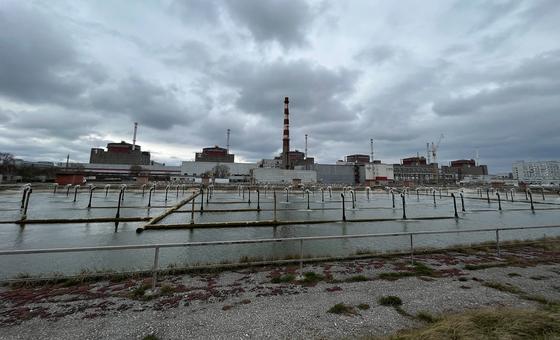
“These strikes disrupted the power supply to the Zaporizhzhia Nuclear Power Plant, once again underlining the ongoing risks to nuclear safety,” UN Spokesperson Stéphane Dujarric said.

“The Secretary-General reiterates his call for a full, immediate and unconditional ceasefire in Ukraine as a first step towards a just, comprehensive and sustainable peace, in line with the UN Charter, international law and relevant UN resolutions.”

Fragile situation

The airstrikes on Friday severed the nuclear plant’s last external power connection, forcing the ZNPP to rely on emergency diesel generators for more than three hours, according to the International Atomic Energy Agency (IAEA).

Power was eventually restored, but the incident marked the ninth time the plant has lost all off-site electricity since the full-scale invasion began in 2022.

Rafael Mariano Grossi, Director General of the nuclear watchdog, warned that the situation remains extremely fragile.

“What was once virtually unimaginable – that a major nuclear power plant would repeatedly lose all of its external power connections – has unfortunately become a common occurrence,” he said.

Nuclear safety deterioration

Located in southern Ukraine, the Zaporizhzhia plant is the largest nuclear power facility in Europe. Although its six reactors have been in cold shutdown since 2024, they still require electricity to cool reactor cores and spent fuel pools to prevent overheating and potential radioactive release.

During the blackout, 18 diesel generators were activated to maintain critical cooling functions. The plant has enough diesel on site for at least ten days, with contingency plans in place to secure further supplies if needed, IAEA reported.

The ZNPP has become dramatically more vulnerable since the war began. Prior to the conflict, it had access to ten external power lines; it now relies on just one.

IAEA teams remain based at the site and continue to monitor the situation closely.

Source link

UN rights mission condemns civilian toll in deadly missile strikes on Ukraine

At least 24 people were reported killed and over 300 injured – including 32 children – when ballistic missiles struck Ukraine’s Dnipro and Odesa regions on Monday and Tuesday, the UN Human Rights Monitoring Mission in Ukraine (HRMMU) said on Wednesday.

The attacks destroyed homes, schools, hospitals, and other civilian infrastructure, and left hundreds wounded.

“The attacks struck during the day when civilians were at work, on trains, or at school,” said Danielle Bell, head of HRMMU.

“The timing alone made the high number of civilian casualties entirely foreseeable.”

On 23 June, two ballistic missiles launched by Russian forces hit Lyceum No. 1, a middle school in Bilhorod-Dnistrovskyi, Odesa region. Although the school year had ended, staff and students were present for administrative work. The strike killed three educators and injured 14 others, including two boys.

The school, which served over 700 students, sustained critical damage.

No military objective

HRMMU, which visited the attacks sites, reported no evidence of military presence at the school, and people confirmed that no military presence had been stationed there.

“The school in Bilhorod-Dnistrovskyi was not a military objective,” Ms. Bell said.

“Yet it was hit by two ballistic missiles, killing educators and injuring children.”

The following day, 24 June, missiles struck an industrial area of Dnipro city at around 11 AM local time. The blast shattered windows in nearby schools, hospitals and residential buildings.

HRMMU confirmed that two dormitories were hit, injuring numerous residents. A nearby passenger train was also impacted – windows blown out by the shockwave – injuring more than 20 travellers, according to a UN monitor onboard.

A troubling trend

These strikes followed a series of other attacks in June that have resulted in significant civilian harm, including in Kyiv city on 17 and 23 June, according to the human rights mission.

Civilian casualties in the first five months of 2025 were nearly 50 percent higher than during the same period last year, with increases typically seen during the summer months.

“Ballistic missiles, when used in densely populated areas, cause predictable and widespread harm to civilians, as demonstrated by these recent attacks,” Ms. Bell said.

“The rising civilian casualties reflect the severity of that risk.”

Source link

Guterres condemns Iran attack on Qatar

It comes in the wake of reports that Iran launched missiles at an American military base in Qatar in retaliation for the US bombing three of its nuclear facilities this past weekend.

Iran reportedly fired seven missiles at Al Udeid Air Base, where some 10,000 troops reportedly are stationed.  All but one were intercepted by Qatar and no casualties were reported, according to international media.

End the fighting

The development marks the latest step in more than a week of missile strikes between Iran and Israel, and the situation has escalated with US involvement.

From the outset of the crisis, the Secretary-General has repeatedly condemned any military escalation in this conflict, including today’s attack by Iran on the territory of Qatar. He further reiterates his call on all parties to stop fighting,” the statement said.  

The Secretary-General urged all Member States to uphold their obligations under the UN Charter and other rules of international law. 

Source link