West Bank: New Israeli measures further erode prospects for two-State solution

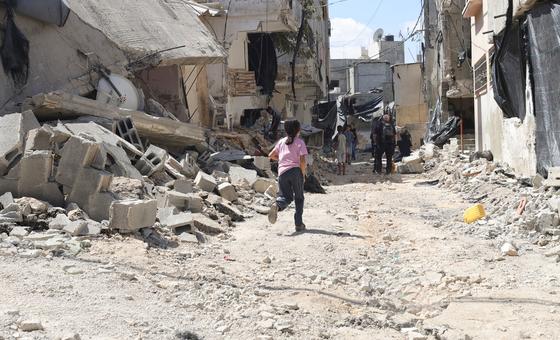
The measures would make it easier for Jewish settlers to take over Palestinian land, thus expanding Israel’s power in the territory, according to media reports. 

The UN chief warned that the current trajectory on the ground – including this decision – is eroding the prospect for the two-State solution, according to a statement issued by his Spokesperson. 

Settlements are illegal 

He reiterated that all Israeli settlements in the occupied West Bank, including East Jerusalem, and their associated regime and infrastructure, have no legal validity and constitute a flagrant violation of international law, including relevant UN resolutions. 

“Such actions, including Israel’s continued presence in the Occupied Palestinian Territory are not only destabilizing but – as recalled by the International Court of Justice – unlawful,” the statement said. 

 The Secretary-General called on Israel to reverse the measures. 

He also urged all parties “to preserve the only path to lasting peace, a negotiated two-State solution, in line with relevant Security Council resolutions and international law.” 

Heading off course 

UN Spokesperson Stéphane Dujarric was asked about the statement during his regular briefing to journalists in New York. 

“These decisions are not moving us in the right direction,” he said. 

“They are driving us further and further away from a two-State solution and from the ability of the Palestinian authority and the Palestinian people to control their own destiny.” 

Ongoing aid efforts in Gaza 

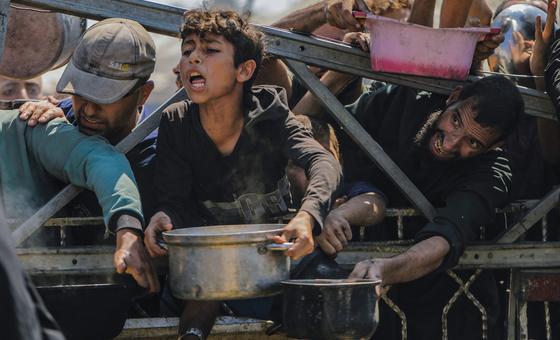
Meanwhile, humanitarians in the Gaza Strip continue to respond to the immense needs of the population despite impediments and a challenging operating environment. 

The UN and partners are serving hundreds of thousands of meals each day, in addition to providing digital cash and monthly rations, Mr. Dujarric said. 

Colleagues report that Gaza City continues to face a severe shortage of drinking and domestic water despite the recent re-opening of the valve on the Mekorot supply line there that connects Israel to Gaza for fresh water.  

Water and hygiene support 

Currently, only 6,000 cubic metres of water are reaching people in Gaza City every day, with significant losses in hard-to-reach areas.  

“To mitigate this shortfall, we and our partners have increased water production and trucked deliveries from groundwater wells and private sector desalination plants,” he said. 

Aid partners have distributed over 100,000 water jerry cans across the Gaza Strip since late January, he added. 

They have also provided over 700,000 bars of soap, over 25,000 hygiene kits, over 400 household latrines, and 250 anti-lice kits 

Explosive ordnance threat 

Since Wednesday, humanitarians working in mine action have conducted over 200 assessments of potential explosive hazards in support of the removal of debris. 

They reached over 10,000 children and adults last week with education warning them of the risks of explosive ordnance which remains a major threat.  

Thirty-three explosive ordnance incidents have been reported since the ceasefire came into effect last October, resulting in nine deaths and 65 injuries.  

Restrictions and limitations 

UN aid coordination office, OCHA, noted that humanitarians continue to be hampered by restrictions, including limitations on the entry of so-called “dual use” items and those listed as non-humanitarian in nature. 

This includes spare parts and certain shelter materials.  

Humanitarian operations are also being undermined by Israel’s de-registration of some international non-governmental organizations (NGOs) and restrictions imposed on the UN agency that assists Palestine refugees – UNRWA – and sister agencies. 

Source link

World News in Brief: UN condemns attack on civilians in Nigeria, updates from Gaza and West Bank, relief flights to resume in Yemen

In a statement issued by his spokesperson, António Guterres conveyed his “heartfelt condolences to the families of the victims and to the people and Government of Nigeria,” and wished a speedy recovery to those injured.

“The Secretary-General reiterates the solidarity of the United Nations with the Government and people of Nigeria in their efforts to fight terrorism and violent extremism and stresses the importance of bringing the perpetrators to justice,” the statement said.

Death toll may rise

According to media reports, armed groups attacked two rural villages in Kwara state on 3 February, with the death toll expected to rise as bodies continue to be discovered.

Many victims were reportedly shot at close range, while homes and shops were set ablaze, forcing residents to flee into nearby bushland.

The attack was the deadliest recorded in the area in recent months, amid a sharp rise in violence across Nigeria’s northwest and north-central regions, where armed groups have increasingly targeted civilians.

The worsening security situation has also contributed to a deepening humanitarian crisis, with large-scale displacement and growing hunger and malnutrition across affected areas.

Civilians deaths and injuries continue due to Gaza attacks

Despite the shaky ceasefire, dozens of civilian deaths and injuries continued to be reported in Gaza over the past 24 hours, as well as ongoing displacement in the West Bank, according to UN agencies.

Many people remained inaccessible to emergency teams, UN Spokesperson Stéphane Dujarric told journalists, citing reports from the UN aid coordination office OCHA.

He reiterated that all parties must comply with international humanitarian law, including the obligation to protect civilians and civilian infrastructure.

Mr. Dujarric said UN teams overnight received 25 additional returnees crossing through Rafah, who were transported by the UN Development Programme (UNDP) to Nasser Hospital in Khan Younis.

There, UN partners continue operating a reception area providing medical, psychological and protection support.

He added that the World Health Organization (WHO) and partners supported the medical evacuation of 15 patients and 31 companions from Gaza to Egypt over the past two days.

Record spike in West Bank attacks

Attacks by Israeli settlers against Palestinians in the occupied West Bank have seen a massive spike since 2021, with more than 50 Israeli settler attacks recorded between 20 January and 2 February.

The attacks resulted in casualties, property damage or both.

According to OCHA, since the beginning of 2026, more than 900 Palestinians have been forced out of their homes or communities, mostly due to settler violence and access restrictions, followed by demolitions.

OCHA said it is carrying out preliminary assessments of damage and needs following these incidents, to inform the humanitarian response.

Yemen: Aid flights set to resume to Houthi-controlled capital

The UN has confirmed that its aid flights to Yemen’s opposition-held capital will resume, after being blocked for more than a month.

UN Humanitarian Air Service flights are a vital provider of relief amid overwhelming needs across Houthi-held areas, including the capital city, Sana’a, and other locations across Yemen, which has been at war since 2014.

Boost to aid delivery

Julien Harneis, the UN Resident and Humanitarian Coordinator for Yemen, said in a statement that the agreement reached earlier this week will allow NGOs to enter and exit Sana’a, which is a prerequisite to providing assistance for millions of people in need in Houthi-controlled areas.

Years of conflict between separatists and the internationally recognised government have left more than 19.5 million people needing humanitarian assistance and more than 4.8 ‎million internally displaced.

Funding is only available to meet around 25 per cent of needs, meaning that millions ‎are not getting lifesaving assistance, including health care, shelter, water, sanitation ‎and hygiene.

Source link

UN rights office worried over escalation in Gaza City, annexation plans for West Bank

Ajith Sunghay, Head of OHCHR’s Office in the Occupied Palestinian Territory (OPT), told UN News that the escalation has caused extensive destruction to residential buildings in southern parts of North Gaza governorate and in northeastern areas of Gaza City.

This has led to further civilian casualties and forced displacement.  Local health authorities reported that 816 Palestinians were killed between 26 August and 1 September – nearly double the number of fatalities compared to the previous week.

Nowhere to go

Roughly one million Palestinians reportedly remain in northern Gaza, and he said they are being pushed into increasingly smaller areas in the west of the enclave.

Many are unable to relocate – there are no safe areas and movement is dangerous. Others are still trapped in eastern Gaza City, with humanitarian workers unable to reach them,” he said.

Meanwhile, Israeli military attacks on people seeking aid continued across the Gaza Strip, where humanitarians are still struggling to bring in desperately needed supplies.  

OHCHR has recorded over 2,146 deaths in the vicinity of sites run by the US and Israel-backed Gaza Humanitarian Foundation (GHF), which began operations in late May, and along convoy routes.

West Bank warning

Mr. Sunghay also pointed to increasing reports of Israeli Government plans to “extend sovereignty” over the occupied West Bank or effectively annex parts of it.

He recalled that last July, the International Court of Justice (ICJ) “very clearly stated” that Israel has already incorporated large parts of the OPT – particularly East Jerusalem and Area C, where most settlements are located – into its territory, concluding that this amounts to annexation.

Israel “has done so, and continues doing so, with the unabated building of settlements and outposts and related infrastructure and with the forcible transfer of thousands of Palestinians from large swathes of the West Bank now controlled by the Israel forces and settlers,” he said.

“It has done so also by reshaping the West Bank with an extensive network of checkpoints, and gates which ensure freedom of action to settlers while segregating Palestinian towns and villages.”

Further expulsion threat

He warned that “any declaration of extension of sovereignty over the West Bank will have further catastrophic consequences on Palestinians” – not only on their right to self-determination but also on daily life. 

It would facilitate a further, massive expansion of settlements and legalization of existing outposts, and allow Israel to take full control of natural resources there without any restrictions.

“Further, Israel’s objectives to formally annex ‘as much as land possible with the least Palestinians in it’ as declared by some of its leaders, would clearly place Palestinians in the annexed areas at imminent risk of expulsion through increased settler violence, deprivation of political rights, expropriation of land and mass home demolitions,” he said.  

Source link

‘Our livelihoods have been cut off’, say West Bank farmers ahead of olive harvest

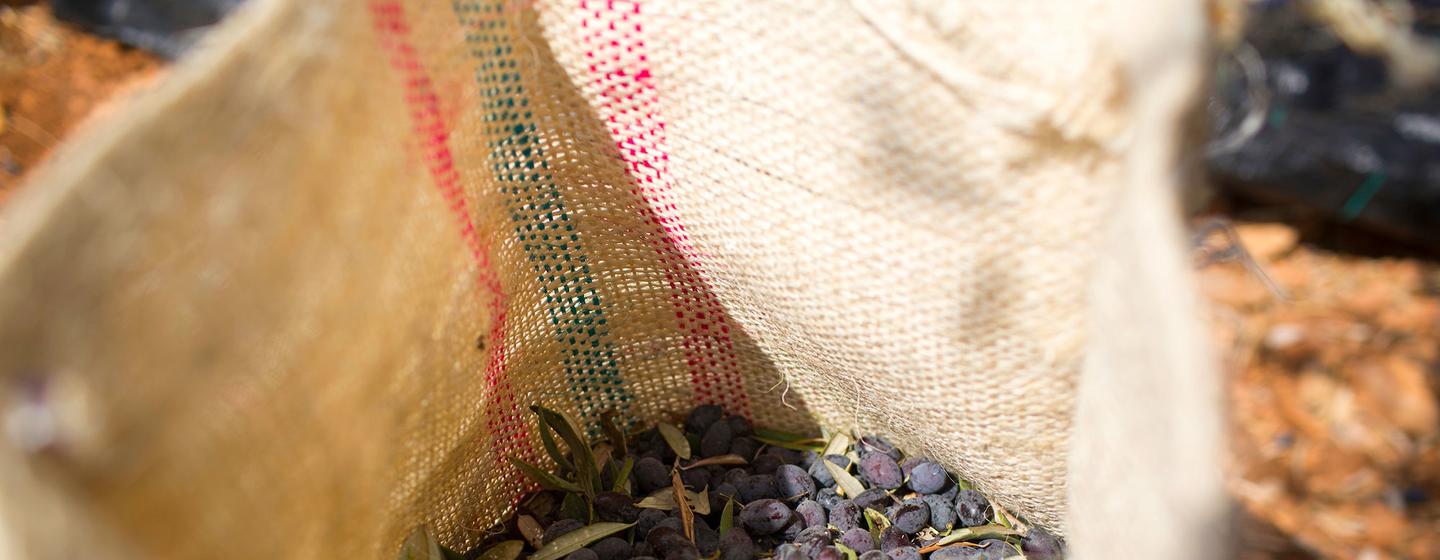
Like thousands of Palestinian farmers, he faces growing restrictions from Israeli forces and settlers, who have made the olive harvest season – running from September to November – a time of uncertainty and struggle.  

In recent years, the UN Food and Agriculture Organization (FAO) has supported olive farmers and cooperatives to improve access to and management of land and water resources, introduced sustainable practices such as intercropping, and helped them increase food production and income by using natural resources more efficiently.

The olive harvest is both a primary source of livelihood for thousands of families and an integral part of Palestinian heritage.

Yet, attacks on the harvest threaten such heritage and hinder Palestinian farmers’ work and way of life – as settler attacks reach their highest level in at least two decades, according to the UN aid coordination office, OCHA.

‘Unprecedented’ risks

“As the West Bank gears up for the annual olive harvest, the message from farmers is clear: This year’s harvest season is marked by uncertainty, and livelihoods are under unprecedented risk,” said Ciro Fiorillo, FAO’s Head of Office in the West Bank and Gaza Strip.  

The combination of State policies and settler violence has prevented Palestinians from accessing tens of thousands of dunums of farmland and pasture, one dunum equating 1,000 square meters.

These restrictions have contributed to the destruction of the local economy and the displacement of thousands of Palestinian herders and farmers, in conditions that may amount to forcible transfer, according to the UN human rights office (OHCHR).

Olives and olive oil production in the West Bank are a cornerstone of Palestinian culture.

“Our livelihoods have been cut off. Olive crops are the primary source of income for farmers,” a Palestinian farmer from Kufr Qaddum village, told UN News.

Land access denied

“For two years now, we have been denied access to our lands,” Yousef, a Palestinian farmer from Kufr Qaddum told UN News. All land in the northern area of the village has been sealed off with an iron gate following the most recent escalation between Iran and Israel.

Yousef’s family owns over 300 dunums of land, primarily cultivated with olive trees, located near the Israeli Kedumim settlement, in Qalqiliya Governorate.  

Since Hamas’s attack on Israel in 2023, they have had no access to their land, including during the harvesting season.  

“These lands cover approximately four to five thousand dunams. We have been prevented from accessing them,” Yousef said, adding that “this issue [affected] all farmers across the entire West Bank.”   

Mohammed, a Palestinian farmer from Kifl Harris, a village located near the Israeli Ariel settlement in Salfit Governorate, has been denied access to over 3,000 dunums of olive-cultivated land located within the settlement boundary. This restriction has completely cut off the ability of Kifl Harris’s farmers to tend to and harvest their groves.  

“The olive season is our main economic lifeline as farmers and employees in both the public and the private sectors,” Mohammed told UN News, adding that Palestinian farmers had not been given a reason for being denied access.

“After settlers installed a caravan on our family’s land, access to more than 200 dunums of farmland, much of it planted with olive trees, was restricted,” Ahmed, a farmer from Khalet Al Luza told OCHA.  

Harassment from settlers

“We have endured all kinds of harassment from settlers and the [Israeli] army,” Yousef from Kufr Qaddum told us.  

In an advisory opinion from July 2024, the International Court of Justice (ICJ) concluded that Israel’s continued presence in the Occupied Palestinian Territory is unlawful and that it is under an obligation to end its unlawful presence “as rapidly as possible”.

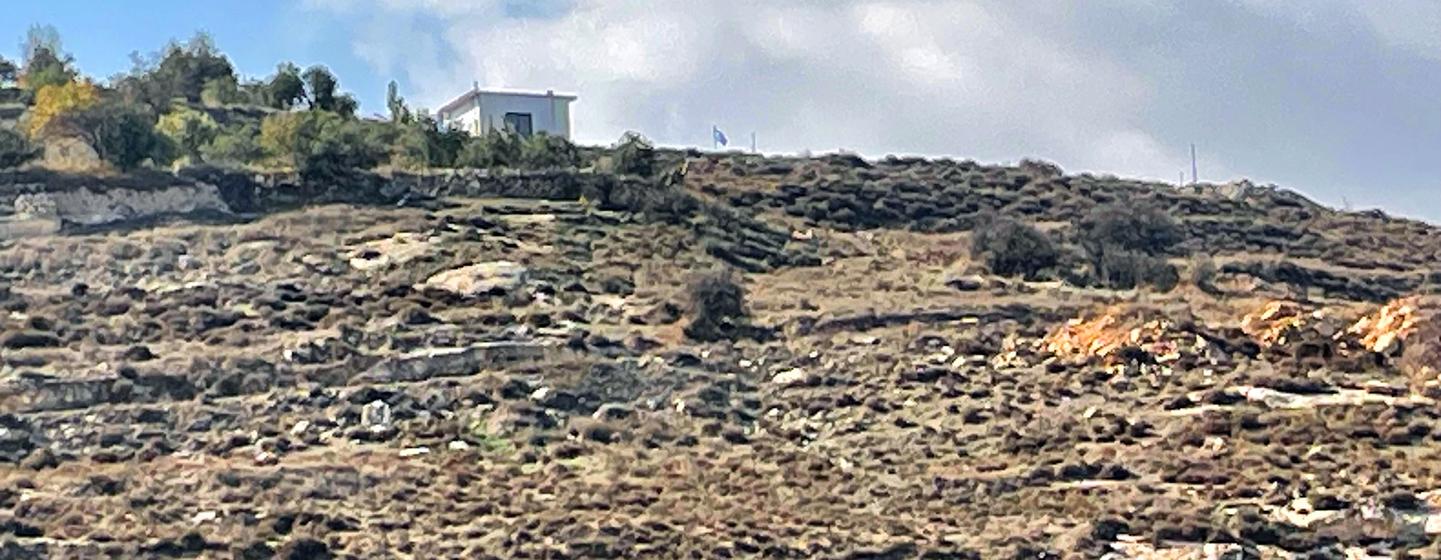
Settlers installed a caravan on a Palestinian family’s land in Khalet Al Luza, West Bank.

“Settler attacks have affected all farmers. I, personally, have been prevented from reaching my land, and we’ve been subjected to repeated attacks by settlers and the army, including theft of olive crops, theft of olive harvesting equipment, vehicle vandalism, cutting down olive trees, and threats,” Yousef said.  

In a statement published on 30 July, the UN human rights office (OHCHR) warned of escalating Israeli settler violence “with the acquiescence, support, and in some cases participation” of Israeli forces.

It stated that Israeli Government “policy and legislative actions appear aimed at emptying certain areas of the West Bank of the Palestinian population, advancing the settlement enterprise, and consolidating the annexation” of large parts of the West Bank.  

“We urge you to work with international institutions through peaceful means to achieve a result that enables us to access our lands safely and harvest the fruits of our olives and trees,” Yousef pleaded.

“Together with our resource partners, FAO is committed to continuing supporting local olive cultivation, which is as important to livelihoods and food security as it is to Palestinian culture and tradition,” said Mr. Fiorillo. 

*Names in this story have been changed to protect the identities of those featured.

Source link

UN calls for decisive steps to end conflict as Gaza and West Bank crises deepen

“Today the world looks on in horror as the situation in the Occupied Palestinian Territory continues to deteriorate to levels not seen in recent history,” said Ramiz Alakbarov, UN Deputy Special Coordinator for the Middle East Peace Process, speaking from Jerusalem.

He began by focusing on Gaza, which is “sinking deeper into disaster, marked by rapidly mounting civilian casualties, mass displacement, and, now, famine”, with no end in sight to the conflict.

Worst fears becoming reality

He said that “unthinkably, Gaza’s population is now facing yet another deadly escalation” following Israel’s announcement of its decision to take over Gaza City, which is ongoing.

“For a population already struggling to survive, Palestinians in Gaza are seeing their worst fears become reality in front of their eyes,” he said.

“Expanded military operations in Gaza City will have catastrophic consequences, including displacing hundreds of thousands.” 

Air strikes intensify

Mr. Alakbarov briefed the Council alongside Joyce Msuya, UN Assistant Secretary-General for Humanitarian Affairs, and two guests: Inger Ashing, Chief Executive Officer at Save the Children International, and Ilana Gritzewsky, an Israeli hostage who survived Hamas captivity in Gaza.

He reported that Israeli military strikes have intensified throughout the Strip, hitting tents housing displaced people, schools, hospitals, and residential buildings.  

Since 23 July, at least 2,553 Palestinians have been killed, according to the health authorities. Of this number, some 271 were reportedly killed attempting to collect aid, including in the vicinity of militarized distribution sites.  

Additionally, over 240 journalists have been killed since the war began on 7 October 2023 following deadly Hamas-led attacks on Israel. 

Although the UN and partners are working tirelessly to assist the people in Gaza, “the security risks are extremely high, and current mitigation measures are woefully insufficient,” he said.

“On my recent visit to Gaza, I was stunned at the scale of the destruction and suffering. I met humanitarian workers risking their lives to deliver aid, while themselves living in intolerable conditions,” he added.

Meeting with survivors and families of hostages

The UN official also visited affected communities in Israel and met survivors of the 7 October terror attacks and family members of some of the hostages. 

“I saw the shattered homes of Nir Oz, where one in four residents was either murdered or abducted on 7 October. I met survivors who carry unbearable loss and trauma,” he said.

Around 50 people, including one woman, are still being held by Hamas and other Palestinian armed groups in Gaza, and 28 are believed to be deceased. 

Videos released by Hamas and Palestinian Jihad depicting emaciated Israeli hostages were deeply disturbing, he said, stressing that ill-treatment and abuse of hostages constitute a blatant violation of international law.

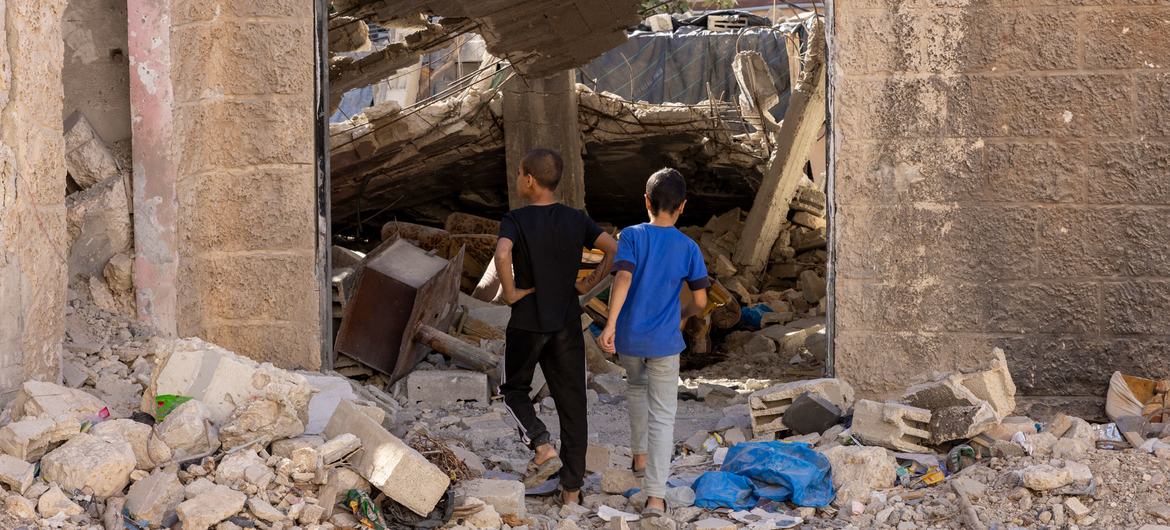
Children in the Jenin refugee camp in the West Bank looking at the destroyed shelters following recent military operations. (file)

West Bank violence

Meanwhile, the situation in the occupied West Bank, including East Jerusalem, “continues to spiral dangerously downward” and “the territory envisioned for a future Palestinian State is shrinking, while a one-State reality of unlawful occupation and perpetual violence is rapidly advancing.”

Israeli security forces have continued operations in northern cities and refugee camps, displacing more than 32,000 people. Furthermore, security forces killed nine Palestinians, four of them children, during the three-month reporting period. 

Attacks by Israeli settlers also have continued, resulting in three Palestinians killed, damage to Palestinian property and displacement.  At the same time, attacks by Palestinians against Israelis have also continued, with no fatalities reported in the last month.

Settlement expansion 

Since the start of the war in Gaza, settler attacks have escalated in frequency and become more violent and deadly.  They have increasingly led to forced displacement, with settlers then moving in and establishing outposts. At the same time, Israel is “fast-tracking settlement expansion, including in the most highly strategic areas.”

Mr. Alakbarov recalled that the Israeli High Planning Committee recently approved a plan for the construction of more than 3,400 housing units in the E1 area.  

“If implemented, the move would effectively sever the connection between the northern and southern West Bank. As such, it would further undermine the possibility of a viable and contiguous Palestinian state,” he warned. 

Israeli authorities also continued to demolish Palestinian-owned structures, he added, and 175 Palestinians, including 70 children, have been displaced.

Regional tensions

Mr. Alakbarov noted that the developments in the Occupied Palestinian Territory are taking place amid a volatile regional context, with more exchanges of fire between Houthi rebels in Yemen and Israel forces occurring this week, along with continued Israeli strikes in Lebanon and an incursion in Syria.

Stressing the need for a ceasefire in Gaza and the release of all hostages, he said “what is needed now is bold action to resolve the conflict, end the occupation and re-establish a political horizon.”

In this regard, he welcomed the High-Level Conference on the Implementation of the Two-State Solution co-chaired by France and Saudi Arabia, held at UN Headquarters in June. 

Uphold the two-State solution

“The message from the international community is clear: the two-State solution remains the only viable path toward a just and lasting resolution of the Israeli-Palestinian conflict,” he said.

He urged the international community to work collectively to advance practical steps, including through engagements during the high-level week of the UN General Assembly in September.

“With Gaza immersed in a situation so horrendous that it defies basic humanity and with the West Bank facing genuine threats to its long-term existence, we can no longer wait,” he said. 

Gaza famine ‘a created catastrophe’

Ms. Msuya’s briefing centered around the recent Integrated Food Security Phase Classification (IPC) analysis confirming that famine is occurring in Gaza governorate – phase 5 conditions – and is expected to spread in the coming weeks.

She drew attention to some of the numbers, saying over half a million people currently face starvation, destitution and death, which could exceed 640,000 by the end of September.  

Approximately one million Gazans are in emergency phase 4 and over 390,000 face phase 3 crisis conditions, she continued.

At least 132,000 children under five are expected to suffer from acute malnutrition between now and the middle of next year, while the number of those who risk dying has tripled to over 43,000. 

Among pregnant and breastfeeding women, the number is predicted to rise from 17,000 to 55,000.

“Let us be clear: This famine is not a product of drought or some form of natural disaster,” she said. “It is a created catastrophe – the result of a conflict that has caused massive civilian death, injury, destruction and forced displacement.”

End this ‘human-made crisis’

Ms. Msuya urged the Council to ensure an immediate and sustained cessation of hostilities to save lives and stop famine from spreading.

She also called for the immediate and unconditional release of all hostages and for civilians and critical infrastructure to be protected.

Furthermore, safe, rapid and unimpeded humanitarian access through all entry points must occur, and aid – including food, medicine, water, fuel and shelter – has to be delivered to all people in need.

Her final request was for the restoration of commercial flows of essential goods at scale, market systems, essential services and local food production.

Ending this human-made crisis demands that we act as if it were our mother, our father, our child, our family trying to survive in Gaza today,” she said. 

A former hostage’s appeal

Ms. Gritzewsky recalled the moment her life was brutally changed on 7 October 2023.

She was grabbed by the hair, punched in the stomach, thrown against a wall, and “touched everywhere,” all while being filmed by the terrorists.  Taken to Gaza, she fainted at the time of her sexual assault.

“Nothing will be the same again,” she said, referring in particular to her broken jaw and pelvis.

Ms. Gritzewsky said she received no medication and did not see a doctor during the 55 days of captivity, even though she had raised concerns about her anaemia and colitis.

She is now fighting for the release of the hostages, particularly her partner, Matan, and made a passionate appeal to the Security Council to act for the release of all those still being held.  

Source link

Record starvation and malnutrition in Gaza; more West Bank displacement

That warning comes from the UN World Food Programme (WFP) in a tweet posted on Tuesday, calling for more aid to be allowed into the enclave by Israeli authorities. 

Gaza’s Ministry of Health reported that five people died over the past 24 hours due to malnutrition and starvation, the UN Office for the Coordination of Humanitarian Affairs (OCHA) said in its latest update.

This brings the total number of malnutrition-related deaths to 227, including 103 children, since October 2023.  

Still not enough aid

Humanitarians continue to decry the low level of supplies entering Gaza, which remains a fraction of what is needed to meet the immense needs of the roughly 2.1 million people living there.

One third of the population is not eating for days on end, and half a million are on the brink of starvation, WFP emphasised.

The agency is calling for at least 100 trucks a day to be allowed into Gaza, much faster approvals and clearances, and for no armed presence or shooting near humanitarian convoys and food distribution sites, among other measures.

Humanitarian missions face obstructions

Although the UN and partners continue to do everything possible to bring assistance in, humanitarian movements still face significant delays and other challenges. 

UN Spokesperson Stéphane Dujarric outlined the situation for journalists attending the regular media briefing at Headquarters in New York. 

He said on Monday humanitarians had formally asked Israel to coordinate 16 missions – including the collection of food, medical supplies and fuel – from the Kerem Shalom and Zikim border crossings, the only two aid corridors in operation.

Other missions involved moving goods and personnel within Gaza, from south to north and within the southern part of the Strip. 

‘Precious time’ wasted

Out of the 16 missions, four were facilitated and three were denied; another four were impeded but eventually were fully accomplished,” he said.

Of the remaining missions, two were cancelled by the respective organizations and two more that involved collection of food and health supplies from the Kerem Shalom crossing were impeded and unable to be completed.  Another mission was impeded but was still ongoing.

“Efforts to coordinate humanitarian movements often drag on for hours due to unpredictable clearances by the Israeli authorities, wasting precious time,” he added. 

West Bank unrest

OCHA also updated on the situation in the occupied West Bank, where another Palestinian Bedouin community was displaced on Monday due to violence by Israeli forces and settlers. 

Israeli forces raided the community of Ein Ayoub in Ramallah governorate and ordered the immediate eviction of its roughly 100 Palestinian residents.

Many of these people have no alternative means of shelter, OCHA said. 

Source link

UN rights office sounds the alarm over forced displacement in the West Bank

Israeli authorities have stepped up measures to transfer large numbers of people from long-standing Palestinian towns and communities, according to OHCHR’s office in the Occupied Palestinian Territory.

On 18 June, the High Planning Council in the Israeli Civil Administration issued a directive to reject all building and planning permits submitted by Palestinians in Masafer Yatta, South Hebron Hills, in the area referred by the Israeli authorities as Firing Zone 918.

The decision was based on the grounds that the Israeli army needs the area for “military training,” the rights office said.

Demolitions on the rise

In recent months, Israel has dramatically ramped up home demolitions, as well as the arbitrary arrest and ill-treatment of Palestinians and human rights defenders. This is happening alongside intensifying movement restrictions in and around Masafer Yatta, to force Palestinians out, the office noted.

At the same time, Israeli settlers from nearby outposts have carried out daily attacks and harassment of Palestinians, including older people, women and children, to force them to leave.

“The recent directive by the Israeli Civil Administration effectively paves the way for the Israeli army to demolish existing structures in the area and expel the approximately 1,200 Palestinians, who have been living there for decades,” OHCHR said.

“This would amount to forcible transfer, which is a war crime. It could also amount to a crime against humanity if committed as part of a widespread or systematic attack directed against any civilian population, with knowledge of the attack.”

Some 6,463 Palestinians have been forcibly displaced following the demolition of their homes by Israel between 7 October 2023 and 31 May 2025, according to the UN humanitarian affairs office, OCHA,

This figure does not include the approximately 40,000 Palestinians displaced from three refugee camps in Jenin and Tulkarem as a result of intensive Israeli operations in the northern West Bank since January.

During the same period, over 2,200 Palestinians were forcibly displaced by settler attacks and access restrictions.

More communities at risk

OHCHR added that countless other Palestinian communities face the same fate of forced displacement. It said that on 10 June, the Jerusalem municipality reportedly issued demolition notices for the entire village of An Nu’man, home to 150 people. 

The village, which is located near Bethlehem, was cut off from the rest of the West Bank by the construction of the separation wall and incorporated into Israel’s unilaterally declared boundaries of the Jerusalem municipality. Most Palestinians were not provided with Jerusalem identification cards, effectively rendering them unable to access services in either East Jerusalem or the rest of the West Bank. 

“These demolition notices appear to be another step by Israel to compound the coercive environment and forcibly transfer Palestinians from the village and consolidate the annexation of this land,” the office said.

Evictions in East Jerusalem

Meanwhile, Palestinians in occupied East Jerusalem also face the ongoing threat of forced eviction from their homes and lands. 

OHCHR said that on 16 and 22 June, the Israeli Supreme Court endorsed the eviction of five Palestinian families, 37 people, from their homes in the Batn El Hawa neighbourhood of Silwan based on discriminatory laws that permit Jewish individuals to reclaim property lost in the 1948 war, while denying Palestinians the same rights. 

Additionally, the Israel Land Authority issued eviction notices on 11 June for residencies in Umm Tuba.  The 150 Palestinians affected were informed that the land was registered to the Jewish National Fund under the “settlement of land title”. 

“These evictions form part of a concerted campaign by the Israeli State and settler organisations, which target Palestinian neighbourhoods to seize Palestinian homes and expand Jewish settlements,” OHCHR said.

The office stressed that these acts violate international law, which prohibits the confiscation of private property in occupied territory, as highlighted by the advisory opinion of the International Court of Justice (ICJ) last July. 

Source link

UN alarmed after warning shots fired at foreign diplomats in the West Bank

Media reports said soldiers fired warning shots near the diplomats, who were on an official visit to view humanitarian conditions around the camp where a major Israeli military operation has been ongoing since January. 

The mission was hosted by the Palestinian Authority and approved by Israel, however it strayed from the approved route, media reports said, citing a statement by the Israel Defense Forces (IDF). 

Diplomats from more than 20 countries were in the group, along with staff from the UN agency that assists Palestine refugees, UNRWANo injuries were reported.

Diplomats must be respected

UN Spokesperson Stéphane Dujarric was asked about the incident during his regular media briefing from New York.  

He said Secretary-General António Guterres was alarmed by reports that “the IDF fired what they called warning shots” at diplomatic and UN personnel.

“It is clear that diplomats who are doing their work should never be shot at, attacked in any way, shape or form, and their safety, their inviolability, must be respected at all times,” he said.

Any use of force against them is unacceptable, and we urge the Israeli authorities to conduct a thorough investigation, to share those findings with us, and to take any measures that would prevent any other such incident to take place.”

‘Lax use of excessive force’

UNRWA Director of Affairs in the West Bank, Roland Friedrich, spoke out against the Israeli military’s actions.

This incident is a stark reminder of the lax use of excessive force routinely deployed by Israeli Security Forces in the West Bank, often with lethal consequences,” he said in a tweet.

He noted that “while the West Bank is not a war zone,” 137 Palestinians have been killed there since January in occupation-related violence.

“The IDF has said they are investigating the incident. However, claims such as ‘mistakenly identifying [the delegation] as a threat’ and firing ‘warning shots’ do not fully capture the severity of today’s events,” he said.

“This raises serious concerns over the way rules of engagement are applied to unarmed civilians,” he added.

Meanwhile, several countries have voiced their condemnation. Germany’s foreign ministry issued a statement calling for Israel to investigate the matter.

“The Federal Foreign Office strongly condemns this unprovoked fire. We can count ourselves lucky that nothing more serious occurred,” it said.

Jenin camp situation

The UN continues to highlight the situation at the Jenin camp and elsewhere in the West Bank.  

Mr. Friedrich said access to the camp “has been near-impossible” since Israel launched Operation ‘Iron Wall’ on 21 January. All residents have been forcibly displaced and UNRWA services there have been fully suspended. 

He called for safe humanitarian access to the camp to be restored, while those displaced must be allowed to return immediately.  

End senseless killings in the West Bank: UN rights office

OHCHR has urged Israel to stop all extrajudicial executions and other unlawful use of force and ensure all those responsible are brought to justice.

Over the last two weeks, Israeli security forces killed two Palestinian men in planned summary executions, while seven others were killed in conditions that raise concerns over the use of unnecessary or disproportionate lethal force, the office said in a statement.

On 8 May, Israeli undercover forces appear to have summarily executed a 30-year-old Palestinian man who was being sought in the old city of Nablus.  

CCTV footage suggests that an undercover officer killed the man while he tried to surrender and then shot him again as he lay on the ground, seemingly to “confirm the killing”, OHCHR said.

No evidence of threat

Moreover, the video evidence appears to contradict claims that the man was armed and posed a threat to the officers.

In another incident in Nablus, disguised Israeli security forces chased and killed a 39-year-old Palestinian man they were seeking out in Balata refugee camp on 2 May.  

“Although Israeli security forces claimed that they found a gun and cartridges in his car, they made no claim that he posed a threat to life at the moment he was shot,” the statement noted.

This past Wednesday, Israeli security forces reportedly fired live ammunition and injured a young Palestinian man near the Qalandiya Refugee Camp in Jerusalem. A video shows two Israeli soldiers repeatedly kicking him in the head while he lay injured on the floor from a wound to the thigh.

OHCHR said the soldiers then walked away, without carrying out an arrest or providing medical assistance to the man. 

End collective punishment

The pregnant Israeli woman, 30, was reportedly shot and killed by armed Palestinians while on the highway near Brukhin settlement, west of Salfit, on Thursday.

She was on the way to the hospital to give birth and was being driven by her husband, who was badly injured, according to media reports.

Following the incident, Israeli security forces closed several checkpoints in the northern and central West Bank. 

They also imposed severe movement restrictions particularly around Burqin and Salfit, while an Israeli minister called for the “flattening” of Palestinian villages in response. 

OHCHR said Israeli security forces must ensure that measures adopted following the attack comply with international law, including the prohibition of collective punishment.

UN deplores ‘criminalisation’ of education

Meanwhile, the UN agency that assists Palestine refugees, UNRWA, reported that its schools in East Jerusalem remain empty after Israeli forces enforced their closure last week, affecting nearly 800 students.

“Schools that have been providing education for decades now stand silent, and the daily life of these children has been shattered,” the Director of UNRWA Affairs for the West Bank, Roland Friedrich, said in a tweet on Friday.

He said Israeli forces returned to the schools at the Shu’fat camp and forced their way inside “in a clear attempt to verify that no educational activities were taking place.”

Heavily armed personnel also roamed the schoolyards searching for children and teachers, he added.

“The criminalisation of education at UN schools in East Jerusalem by Israeli authorities is reprehensible at all levels,” said Mr. Friedrich, calling for classrooms to be re-opened immediately.