World News in Brief: Gaza humanitarian update, more killings in Sudan, ending impunity in Myanmar

Multiple strikes overnight into Friday were reported in the Jabalya Al Balad and An Nazla neighbourhoods, the UN Office for the Coordination of Humanitarian Affairs (OCHA) said in its latest update.

As a result, around 900 people reportedly fled towards the Sheikh Radwan neighbourhood and western Gaza City.

Safe passage, more aid

The UN and partners again reminded parties to the conflict of their obligation to protect civilians, in line with international law, including humanitarian workers and people who cannot or choose not to move. 

“Those fleeing must be allowed to do so safely. They must also be allowed to return if they wish to do so, as the situation allows,” OCHA said.

The agency underscored the need to ensure that people have access to aid and basic services, whether they leave or stay.

Supplies also must be allowed to enter the Gaza Strip through all available crossings and corridors, and humanitarians must have safe, predictable and sustained access to deliver aid at scale.

Hospitals under strain

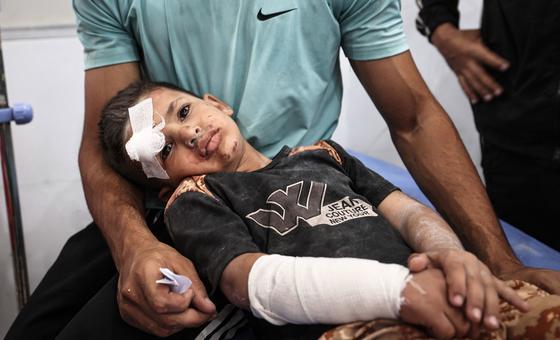
Meanwhile, as strikes continue to intensify across the enclave, casualties are flooding hospital emergency departments.  

Humanitarians warned that the expansion of military operations would further cripple the collapsing healthcare system. 

Nearly half of all hospitals and field hospitals are located in Gaza City, accounting for some 40 per cent of bed capacity in the entire enclave.  Additionally, many medical facilities in the south are operating several times over their bedspace capacity.

Humanitarians stressed that access to healthcare must be immediately restored to avert more preventable deaths. 

Sudan: UN rights office horrified by recent killings in El Fasher 

Recent brutal attacks by the paramilitary Rapid Support Forces (RSF) in Sudan have left at least 89 people dead in North Darfur state, the UN human rights office, OHCHR, said on Friday

The RSF have been battling the Sudanese Armed Forces (SAF) for control of the country for more than two years.

OHCHR said RSF attacks on the besieged North Darfur capital El Fasher and the adjoining Abu Shouk camp for displaced people resulted in the killing of at least 89 civilians, though the actual number could be higher.

The attacks took place over a 10-day period ending on 20 August.

Apparent summary executions 

At least 32 civilians were killed in attacks between 16 and 20 August, while at least 57 were killed in previous attacks on 11 August.

OHCHR was particularly horrified that 16 of the most recent killings appear to have been summary executions, Spokesman Jeremy Laurence told journalists in Geneva.

“Most of the victims were killed in Abu Shouk camp and belonged to the African Zaghawa tribe, according to information gathered by our Office,” he said.

“In another case in the El Fasher area, a victim was asked which tribe he belonged to. He was killed after responding that he was from the African Berti tribe.” 

Meanwhile, the humanitarian situation in El Fasher has reached a critical stage after more than a year of siege, and there is growing risk of famine in the city and other areas of North Darfur.

OHCHR was appalled by two separate attacks on UN humanitarian convoys in North Darfur this month and in June, saying such attacks only worsen the human rights situation for civilians.

© UNICEF/Ilvy Njiokiktjien

Ending impunity for violence critical for Rohingya in Myanmar

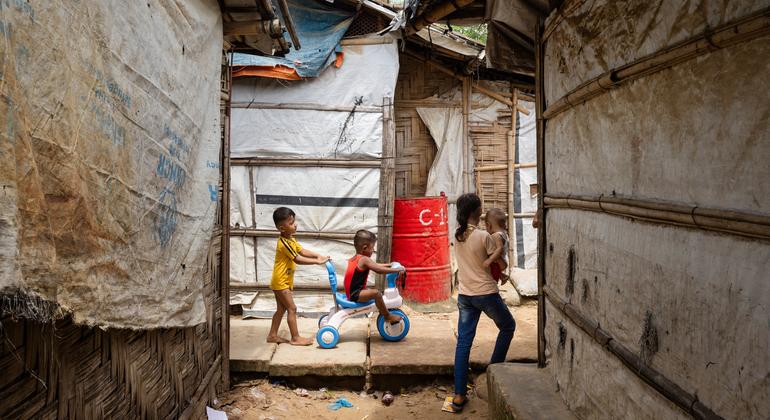
The UN human rights office has also called for ending impunity in the violence against the Rohingya people in Myanmar and ensuring their rights to security, citizenship and equality.

It said the Rohingya – a mostly Muslim minority community in predominantly Buddhist Myanmar – continue to suffer, eight years after a deadly crackdown by the military.

More than 700,000 fled to Bangladesh in the wake of the assault which began on 25 August 2017, joining others who had escaped earlier waves of attacks. 

Break the cycle

OHCHR said that ending impunity and ensuring the Rohingya’s rights to security, citizenship and equality, are essential for breaking the cycle of violence.

The Rohingya mainly live in Myanmar’s Rakhine state, and the office noted that the human rights and humanitarian situation there have sharply deteriorated since November 2023, further deepening the already life-threatening conditions they face.

OHCHR urged the international community to step up support for the Rohingya by increasing humanitarian funding to secure access to basic needs, essential services, and to ensure accountability. 

Source link

Gaza: UN rights chief condemns new killings around private aid hub

Attacks directed against civilians constitute a grave breach of international law and a war crime,” the High Commissioner said in a statement, issued after Palestinians were reportedly killed seeking assistance for a third day running.

Mr. Türk also urged Israel to respect “binding orders” issued by the International Court of Justice to fully cooperate with the UN and ensure that aid reaches the people of Gaza “without delay” and “at scale”.

“There is no justification for failing to comply with these obligations,” he said.

Access calls denied

The controversial new aid initiative run by the Gaza Humanitarian Foundation bypasses the work of UN aid agencies which have repeatedly appealed for unimpeded access to Gaza in order to bring in thousands of tonnes of supplies. To date, the little aid that has been allowed into the enclave has fallen far short of what is needed.

In an update, the UN World Health Organization (WHO) insisted that it still had “teams on the ground” in Gaza ready to distribute supplies where they are needed across the war-torn enclave, if only they could be allowed to move.

“We have right now 51 trucks waiting loaded with medical supplies to go to those few hospitals that are still functional,” said WHO spokesperson Tarik Jasarevic. “We need access so that we can bring in supplies within Gaza to health facilities so they can function. Unfortunately, what is happening is just the opposite. There is no hospital in north Gaza functional anymore.”

On Monday, Mr. Jasarevic said that a WHO team went to the Indonesian Hospital in northern Gaza “and basically evacuated all remaining patients and medical staff…now that hospital is completely empty”. In Jabalia, also in northern Gaza, three Israeli soldiers were reportedly killed on Monday when their vehicle struck an explosive device.

Most vulnerable miss out

Critics of the US-Israeli scheme – which include the UN – have warned that it prevents children, the elderly and those with disabilities from receiving aid, since recipients often have to walk long distances to retrieve boxes of supplies distributed on a first-come, first-serve basis.

“The wilful impediment of access to food and other life-sustaining relief supplies for civilians may constitute a war crime,” Mr. Türk said.

His lengthy statement also condemned “the threat of starvation” faced by Gazans today, the “20 months of killing of civilians and destruction on a massive scale”.

Gazans have also been repeatedly displaced by evacuation orders from the Israeli military and faced “intolerable, dehumanizing rhetoric and threats by Israel’s leadership to empty the Strip”, the UN rights chief noted. All of these facts constitute elements of the most serious crimes under international law, he insisted.

‘Am I going to get shot?’

Jeremy Laurence, spokesperson for the UN human rights office, OHCHR, highlighted the High Commissioner’s call for a prompt, independent investigation into the dozens of reported killings in Gaza since the new aid hub opened on 27 May.

“I think there’s so much which has happened in the past three days apart from the tragic circumstances of human beings trying to gather food to survive and then being killed in the process,” he told journalists in Geneva. “[Gazans] are being forced to walk to these centres and now they’re terrified. Probably they go there and they’re thinking, ‘Am I going to get food or am I going to get shot?’”

Mr. Laurence noted multiple media reports on killings around the southern Gaza aid hub in recent days indicating engagement by helicopters, naval vessels, tanks and ground troops.

“We are aware of those reports,” he said, noting that the Israel Defense Forces (IDF) had also published an account on X of what had happened on Tuesday.

“My colleagues who are working on the ground have conducted interviews with witnesses and they do report fire from the IDF on those trying to access the food distribution centres. We’ve received reports from other organizations on the ground to a similar effect.”

He added: “We’ve gathered our own information; we’ve spoken to witnesses on the ground who have shared what they have seen, heard and felt themselves.”

Asked to explain what the High Commissioner meant when he expressed concerns that the “most serious crimes under international law” may have been committed, Mr. Laurence explained that this referred to war crimes, crimes against humanity and genocide.

Source link

Gaza: Guterres urges probe into killings at food distribution sites

More than 30 people were killed and over 100 wounded while waiting in the early morning to get food from two sites in Rafah and Middle Gaza run by the newly established Gaza Humanitarian Foundation (GHF), according to media reports.

The organization is backed by Israel and the United States and uses private US security contractors supervised by the Israeli military. Aid distributions began at the end of May, bypassing the UN and other humanitarian agencies.

Risking their lives

UN chief António Guterres issued a statement on Monday saying he was “appalled” by the reports.

“It is unacceptable that Palestinians are risking their lives for food,” he said.

“I call for an immediate and independent investigation into these events and for perpetrators to be held accountable.”

He stressed that Israel has clear obligations under international humanitarian law to agree to and facilitate humanitarian aid. 

Allow UN operations

“The unimpeded entry of assistance at scale to meet the enormous needs in Gaza must be restored immediately,” he said.

The UN must be allowed to work in safety and security under conditions of full respect of humanitarian principles.

Meanwhile, the Secretary-General continues to call for an immediate permanent, sustainable ceasefire in Gaza and the immediate and unconditional release of all hostages.

“This is the only path to ensuring security for all. There is no military solution to the conflict,” he said.

More to follow… 

Source link

UN rights chief calls for end to daily killings in Ukraine after deadly weekend attacks

The majority of those killed and injured were in major cities such as Kyiv, Kharkiv, and Mykolaiv, or in populated areas in other regions.

Meanwhile, large numbers of long-range drones launched into Russia by Ukrainian armed forces injured at least 11 civilians over the weekend, according to Russian authorities.

Silence the guns

High Commissioner Volker Türk underscored the urgency for an end to hostilities.

“It is time to put an end to Russia’s invasion of Ukraine, to commit to – and implement – a comprehensive ceasefire that stops the daily killing and destruction, and to start genuine peace negotiations, built on respect for international law,” he said.

He highlighted that – even amid ongoing hostilities – people deprived of their liberty must be protected. Summary executions, torture and all forms of inhumane and degrading treatment of prisoners are always prohibited, in any circumstances, and must stop immediately.

In addition, civilian detainees should be released as soon as the lawful reason for their detention ceases to exist and their protection against refoulement must be ensured, he said.

Relief, but also loss

High Commissioner Türk welcomed the recent exchange of prisoners of war and civilian detainees.

Nearly 900 prisoners of war and 120 civilians from each side were exchanged. Most of the civilians appeared to have been detainees, but details on individuals included in the exchange are not yet available, according to his office, OHCHR.

“Many families can now breathe a sigh of relief because their loved ones have finally returned home,” Mr. Türk said.

“But at the same time, other families have lost relatives and their homes, as their communities across Ukraine came under attack.”

Impact on children

In a separate statement, the UN Children’s Fund (UNICEF) expressed deep concern for the impact of the latest attacks on Ukraine’s children.

Munir Mammadzade, UNICEF Representative in Ukraine, said that in the past three days, at least three children were reportedly killed in Zhytomyr, and at least 13 children were injured in several regions across the country.

“Ukraine’s children have suffered for far too long. How many more futures must be stolen? The senseless violence and loss of young lives must stop,” Mr. Mammadzade said.

According to UNICEF, more than 220 children were killed or injured between January and April 2025 – a 40 per cent increase compared to the same period last year.

“Attacks on civilian areas must end, and children must always be protected,” Mr. Mammadzade emphasised. “Above all, children need an end to this war.”

Source link

End senseless killings in the West Bank: UN rights office

OHCHR has urged Israel to stop all extrajudicial executions and other unlawful use of force and ensure all those responsible are brought to justice.

Over the last two weeks, Israeli security forces killed two Palestinian men in planned summary executions, while seven others were killed in conditions that raise concerns over the use of unnecessary or disproportionate lethal force, the office said in a statement.

On 8 May, Israeli undercover forces appear to have summarily executed a 30-year-old Palestinian man who was being sought in the old city of Nablus.  

CCTV footage suggests that an undercover officer killed the man while he tried to surrender and then shot him again as he lay on the ground, seemingly to “confirm the killing”, OHCHR said.

No evidence of threat

Moreover, the video evidence appears to contradict claims that the man was armed and posed a threat to the officers.

In another incident in Nablus, disguised Israeli security forces chased and killed a 39-year-old Palestinian man they were seeking out in Balata refugee camp on 2 May.  

“Although Israeli security forces claimed that they found a gun and cartridges in his car, they made no claim that he posed a threat to life at the moment he was shot,” the statement noted.

This past Wednesday, Israeli security forces reportedly fired live ammunition and injured a young Palestinian man near the Qalandiya Refugee Camp in Jerusalem. A video shows two Israeli soldiers repeatedly kicking him in the head while he lay injured on the floor from a wound to the thigh.

OHCHR said the soldiers then walked away, without carrying out an arrest or providing medical assistance to the man. 

End collective punishment

The pregnant Israeli woman, 30, was reportedly shot and killed by armed Palestinians while on the highway near Brukhin settlement, west of Salfit, on Thursday.

She was on the way to the hospital to give birth and was being driven by her husband, who was badly injured, according to media reports.

Following the incident, Israeli security forces closed several checkpoints in the northern and central West Bank. 

They also imposed severe movement restrictions particularly around Burqin and Salfit, while an Israeli minister called for the “flattening” of Palestinian villages in response. 

OHCHR said Israeli security forces must ensure that measures adopted following the attack comply with international law, including the prohibition of collective punishment.

UN deplores ‘criminalisation’ of education

Meanwhile, the UN agency that assists Palestine refugees, UNRWA, reported that its schools in East Jerusalem remain empty after Israeli forces enforced their closure last week, affecting nearly 800 students.

“Schools that have been providing education for decades now stand silent, and the daily life of these children has been shattered,” the Director of UNRWA Affairs for the West Bank, Roland Friedrich, said in a tweet on Friday.

He said Israeli forces returned to the schools at the Shu’fat camp and forced their way inside “in a clear attempt to verify that no educational activities were taking place.”

Heavily armed personnel also roamed the schoolyards searching for children and teachers, he added.

“The criminalisation of education at UN schools in East Jerusalem by Israeli authorities is reprehensible at all levels,” said Mr. Friedrich, calling for classrooms to be re-opened immediately.