
Fragile progress in Syria, at risk from exclusion and foreign interference, UN warns

They warned that foreign military action, political exclusion and dwindling resources threaten to undo fragile gains.

UN Special Envoy Geir Pedersen – who announced that he will be stepping down from his role during the meeting – told ambassadors that interim authorities in Damascus have inherited “not just the ruins of shattered buildings, but the deeper wreckage of a battered social fabric, decayed institutions and a hollowed-out economy.

He stressed that the success of Syria’s transition will depend on political stability, inclusivity and international support at a scale commensurate with the country’s needs.

“The international community must support Syria and robustly stand against foreign intervention,” he said. “But equally: the success of the transition will above all rest on the State acting as a State for all, not just in word but also in deed.

Geir Pedersen, Special Envoy of the Secretary-General for Syria, briefs the Security Council meeting on the situation in the country.

Call to bar interlopers

Mr. Pedersen urged respect for Syria’s sovereignty and territorial integrity amid ongoing external military action, including further reported Israeli strikes this month.

Any security concerns, he said, must be addressed through diplomacy, warning that mishandling them could leave Syria “indefinitely gridlocked, unable to heal or rebuild – and at worst, slipping into fresh waves of strife and external intervention.”

He pointed to the Druze-minority region of Sweida – where a ceasefire following brutal clashes has largely held since July – and welcomed a roadmap agreed last week by Syria, Jordan and the United States to address accountability, humanitarian access and reconciliation.

But he cautioned that fears within the Druze community must be addressed through dialogue and confidence-building.

He also highlighted reports of abuses in Damascus neighbourhoods and calls for accountability in Sweida – and along the coast following sectarian violence there.

The Syrian public needs to see that abuses are both acknowledged and addressed in accordance with international standards,” he said.

Humanitarian emergency continues

Speaking alongside Mr. Pedersen, UN Emergency Relief Coordinator Tom Fletcher described Syria as “one of the largest humanitarian emergencies globally.

More than 70 per cent of the population requires some form of aid, nine million are acutely food insecure seven million remain displaced inside the country and four million refugees abroad.

Despite these figures, he highlighted signs of progress. Thanks to more practical engagement with the interim authorities, aid is now reaching communities inaccessible a year ago.

Movements that last year would have required lengthy navigation of frontlines are happening routinely,” Mr. Fletcher said, citing food assistance for one million people each month and subsidized bread for two million more.

Nearly 900,000 refugees and 1.9 million internally displaced people have returned to their communities since December, though many face destroyed housing, lack of jobs and insecurity.

Funding gaps remain

Funding gaps however threaten these gains, with the UN’s humanitarian appeal for Syria only 18 per cent funded. The shortfall has forced closures of hospitals, safe spaces for women and community centres.

Just when organizations are seeking to expand their operations and have the opportunity to work more efficiently, they are instead forced to cut programmes, reduce support, lose staff,” Mr. Fletcher warned.

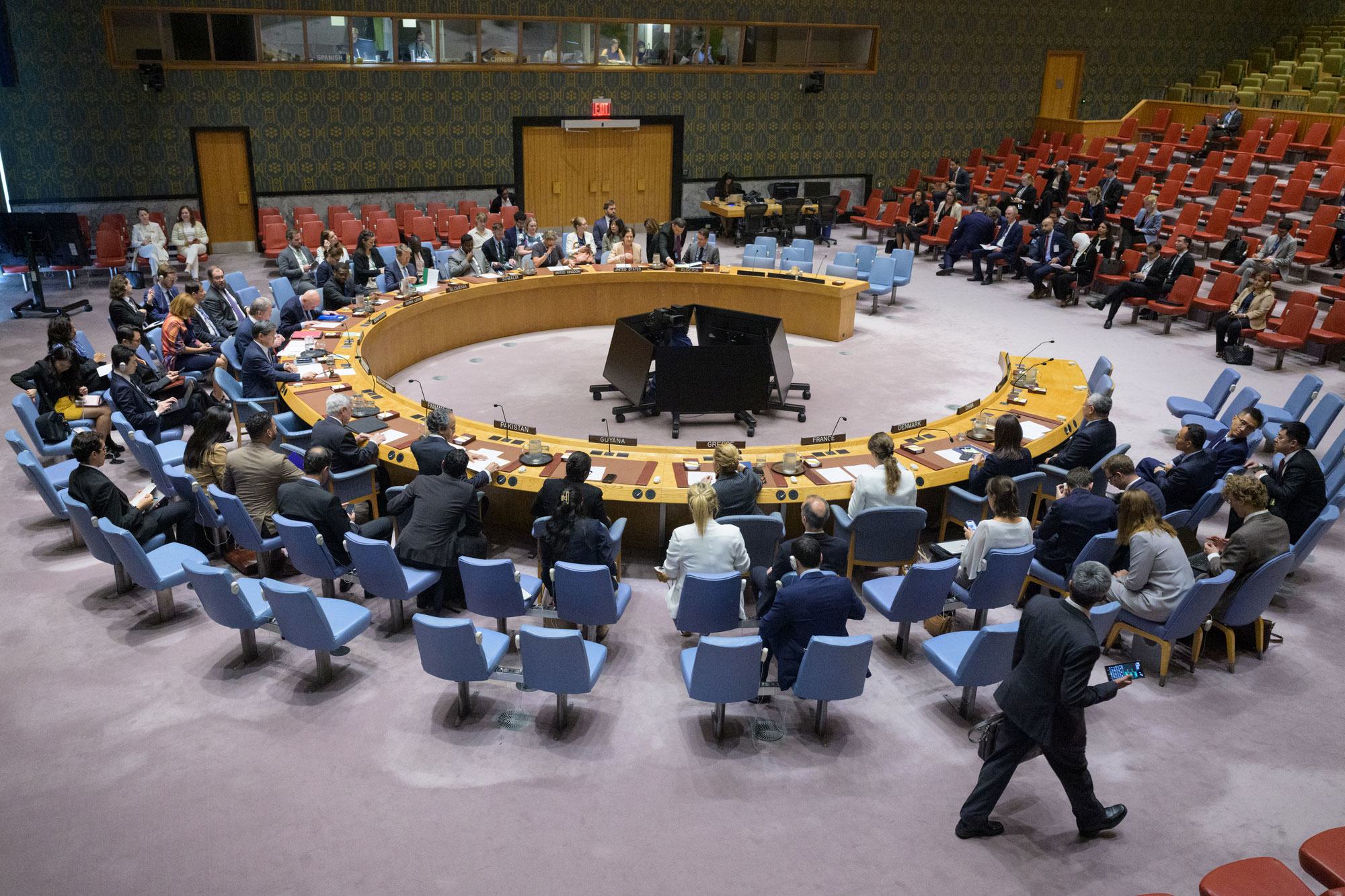
The UN Security Council meets to discuss the situation in Syria.

‘Unity is within reach’

Both officials warned that Syria’s fragile moment of progress could easily unravel.

“If this central challenge is mishandled, the consequences could be dire,” Mr. Pedersen cautioned. “But if met with genuine negotiation and bold compromise, unity is within reach and success against the odds is possible.

Mr. Fletcher echoed that message, urging Member States to “preserve stability, fund the humanitarian response and enable Syrian-led recovery.

“This time next year,” he added, “I want to report that we are substantially scaling down our emergency humanitarian operations in Syria – not because funding cuts have forced our hand, but because the international community has made the necessary investments in Syria’s future.”

UN alarmed after warning shots fired at foreign diplomats in the West Bank

Media reports said soldiers fired warning shots near the diplomats, who were on an official visit to view humanitarian conditions around the camp where a major Israeli military operation has been ongoing since January. 

The mission was hosted by the Palestinian Authority and approved by Israel, however it strayed from the approved route, media reports said, citing a statement by the Israel Defense Forces (IDF). 

Diplomats from more than 20 countries were in the group, along with staff from the UN agency that assists Palestine refugees, UNRWANo injuries were reported.

Diplomats must be respected

UN Spokesperson Stéphane Dujarric was asked about the incident during his regular media briefing from New York.  

He said Secretary-General António Guterres was alarmed by reports that “the IDF fired what they called warning shots” at diplomatic and UN personnel.

“It is clear that diplomats who are doing their work should never be shot at, attacked in any way, shape or form, and their safety, their inviolability, must be respected at all times,” he said.

Any use of force against them is unacceptable, and we urge the Israeli authorities to conduct a thorough investigation, to share those findings with us, and to take any measures that would prevent any other such incident to take place.”

‘Lax use of excessive force’

UNRWA Director of Affairs in the West Bank, Roland Friedrich, spoke out against the Israeli military’s actions.

This incident is a stark reminder of the lax use of excessive force routinely deployed by Israeli Security Forces in the West Bank, often with lethal consequences,” he said in a tweet.

He noted that “while the West Bank is not a war zone,” 137 Palestinians have been killed there since January in occupation-related violence.

“The IDF has said they are investigating the incident. However, claims such as ‘mistakenly identifying [the delegation] as a threat’ and firing ‘warning shots’ do not fully capture the severity of today’s events,” he said.

“This raises serious concerns over the way rules of engagement are applied to unarmed civilians,” he added.

Meanwhile, several countries have voiced their condemnation. Germany’s foreign ministry issued a statement calling for Israel to investigate the matter.

“The Federal Foreign Office strongly condemns this unprovoked fire. We can count ourselves lucky that nothing more serious occurred,” it said.

Jenin camp situation

The UN continues to highlight the situation at the Jenin camp and elsewhere in the West Bank.  

Mr. Friedrich said access to the camp “has been near-impossible” since Israel launched Operation ‘Iron Wall’ on 21 January. All residents have been forcibly displaced and UNRWA services there have been fully suspended. 

He called for safe humanitarian access to the camp to be restored, while those displaced must be allowed to return immediately.  

Notification issued for vehicles with foreign registration

The Ministry of Road Transport and Highways has issued the Motor Vehicles Non Transport Vehicles Visiting India Rules, 2022 vide notification GSR 680(E) dated 02.09.2022. These rules formalize the movement of Non-Transport (Personal) vehicles registered in other countries when entering or plying in the territory of India.

The following documents shall be carried in the vehicle(s) operating under these rules during the duration of stay in the country, namely:–

(i)         A valid registration certificate;

(ii)        A valid driving license or international driving permit, whichever is applicable;

(iii)       A valid insurance policy;

(iv)       A valid pollution under control certificate (if applicable in the origin country);

In case the documents referred above are in a language other than English, then an authorized English translation, duly authenticated by the issuing authority, shall be carried along with the original documents.

Driving in India/Photo:en.wikipedia.org

Motor vehicles registered in any country other than India shall not be permitted to transport local passengers and goods within the territory of India.

Motor vehicles registered in any country other than India shall be required to comply with rules and regulations made under Motor Vehicles Act, 1988 of India.