Fragile progress in Syria, at risk from exclusion and foreign interference, UN warns

They warned that foreign military action, political exclusion and dwindling resources threaten to undo fragile gains.

UN Special Envoy Geir Pedersen – who announced that he will be stepping down from his role during the meeting – told ambassadors that interim authorities in Damascus have inherited “not just the ruins of shattered buildings, but the deeper wreckage of a battered social fabric, decayed institutions and a hollowed-out economy.

He stressed that the success of Syria’s transition will depend on political stability, inclusivity and international support at a scale commensurate with the country’s needs.

“The international community must support Syria and robustly stand against foreign intervention,” he said. “But equally: the success of the transition will above all rest on the State acting as a State for all, not just in word but also in deed.

Geir Pedersen, Special Envoy of the Secretary-General for Syria, briefs the Security Council meeting on the situation in the country.

Call to bar interlopers

Mr. Pedersen urged respect for Syria’s sovereignty and territorial integrity amid ongoing external military action, including further reported Israeli strikes this month.

Any security concerns, he said, must be addressed through diplomacy, warning that mishandling them could leave Syria “indefinitely gridlocked, unable to heal or rebuild – and at worst, slipping into fresh waves of strife and external intervention.”

He pointed to the Druze-minority region of Sweida – where a ceasefire following brutal clashes has largely held since July – and welcomed a roadmap agreed last week by Syria, Jordan and the United States to address accountability, humanitarian access and reconciliation.

But he cautioned that fears within the Druze community must be addressed through dialogue and confidence-building.

He also highlighted reports of abuses in Damascus neighbourhoods and calls for accountability in Sweida – and along the coast following sectarian violence there.

The Syrian public needs to see that abuses are both acknowledged and addressed in accordance with international standards,” he said.

Humanitarian emergency continues

Speaking alongside Mr. Pedersen, UN Emergency Relief Coordinator Tom Fletcher described Syria as “one of the largest humanitarian emergencies globally.

More than 70 per cent of the population requires some form of aid, nine million are acutely food insecure seven million remain displaced inside the country and four million refugees abroad.

Despite these figures, he highlighted signs of progress. Thanks to more practical engagement with the interim authorities, aid is now reaching communities inaccessible a year ago.

Movements that last year would have required lengthy navigation of frontlines are happening routinely,” Mr. Fletcher said, citing food assistance for one million people each month and subsidized bread for two million more.

Nearly 900,000 refugees and 1.9 million internally displaced people have returned to their communities since December, though many face destroyed housing, lack of jobs and insecurity.

Funding gaps remain

Funding gaps however threaten these gains, with the UN’s humanitarian appeal for Syria only 18 per cent funded. The shortfall has forced closures of hospitals, safe spaces for women and community centres.

Just when organizations are seeking to expand their operations and have the opportunity to work more efficiently, they are instead forced to cut programmes, reduce support, lose staff,” Mr. Fletcher warned.

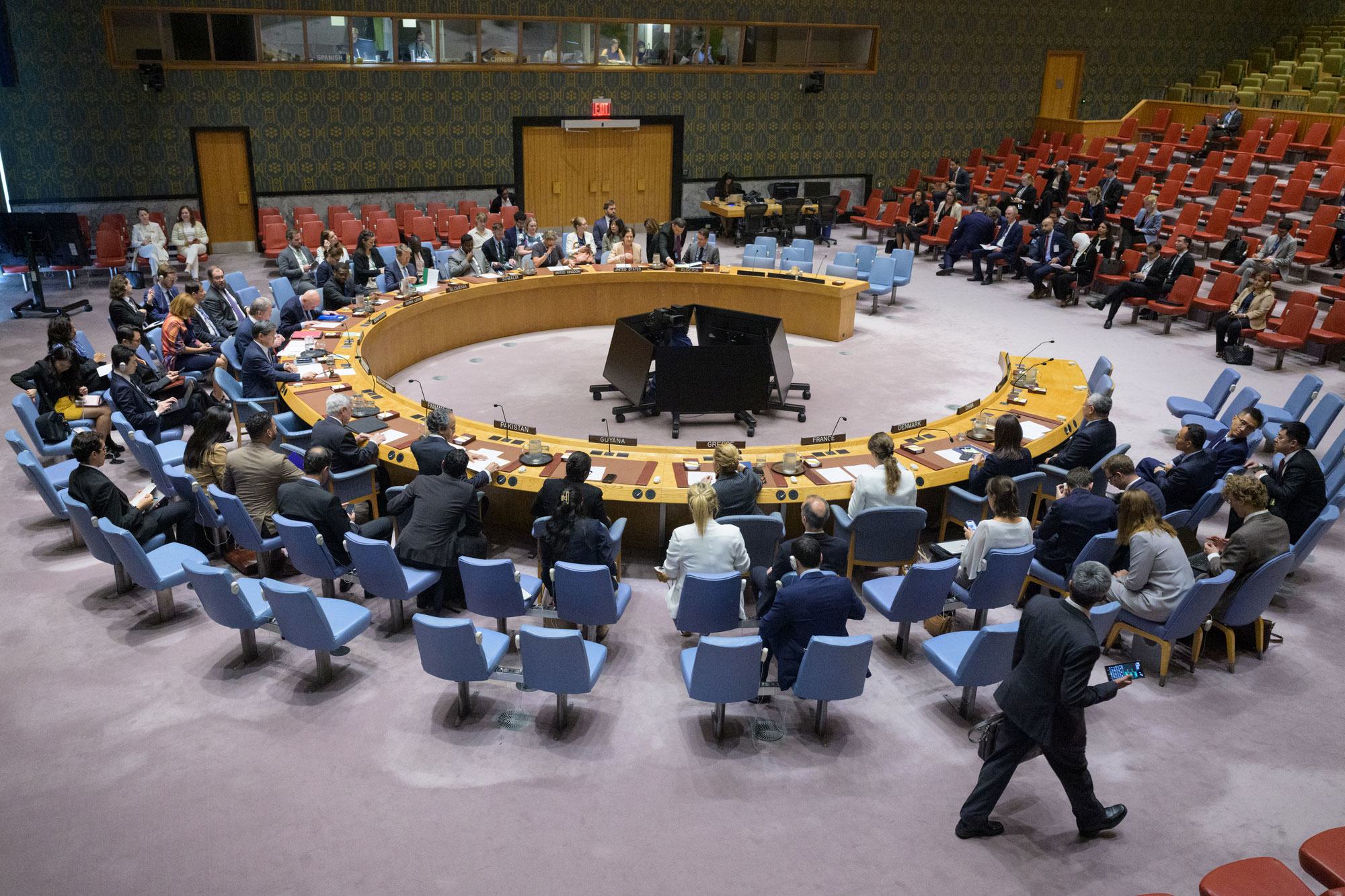
The UN Security Council meets to discuss the situation in Syria.

‘Unity is within reach’

Both officials warned that Syria’s fragile moment of progress could easily unravel.

“If this central challenge is mishandled, the consequences could be dire,” Mr. Pedersen cautioned. “But if met with genuine negotiation and bold compromise, unity is within reach and success against the odds is possible.

Mr. Fletcher echoed that message, urging Member States to “preserve stability, fund the humanitarian response and enable Syrian-led recovery.

“This time next year,” he added, “I want to report that we are substantially scaling down our emergency humanitarian operations in Syria – not because funding cuts have forced our hand, but because the international community has made the necessary investments in Syria’s future.”

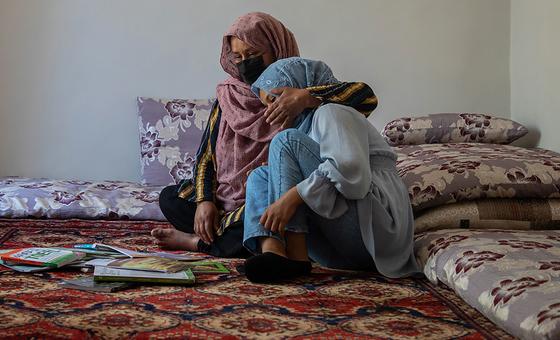
Four years on, here’s what total exclusion of women in Afghanistan looks like

Four years after Taliban fighters retook the capital Kabul on 15 August 2021, gender equality agency UN Women is warning that the situation for women and girls in Afghanistan is increasingly untenable.  

And without urgent action, this untenable reality will become normalised and women and girls will be fully excluded.

The Taliban is closer than ever to achieving its vision of a society that completely erases women from public life,” UN women said in a press release on Monday.

UN Women’s warning came just as the UN Assistance Mission in Afghanistan (UNAMA) released its latest report on the human rights situation between May and June, detailing harshening enforcement of regulations against women and death threats against female humanitarians.  

A society which is against them

The edicts which the Taliban have passed restricting women and girls’ rights interact together to create an inescapable cycle which relegates women to private spaces and increases their vulnerability. 

In most cases, including for humanitarian workers, women are not allowed to move freely in public without being accompanied by a mahram, or a male guardian. 

In its report, UNAMA noted a change in the enforcement of mahram requirements, with the de facto Taliban authorities instructing private businesses and health clinics to refuse services to all women who were not accompanied by a mahram.  

In certain regions, the authorities have also begun to strictly enforce hijab regulations, including by requiring women to wear a chador, a full body covering. In Herat, if they were not doing so, women are being banned from public spaces.   

Out of opportunities 

In addition to impeding women’s movements in public spaces, the Taliban has also banned women and girls from secondary and higher education.  

Taken together, these two edicts have profound ramifications at all levels of society. Now, not only is it functionally impossible for women to receive educational degrees, it is also unduly difficult for them to get jobs and enter into training programmes.  

As a result, over 78 per cent of Afghan women are not in education, employment or training.

This means that almost half of the work force is not contributing to the economy in measurable ways, a huge problem for a country whose economy has been devastated by sanctions and climate shocks.

UNAMA’s report noted that the de facto authorities continue to affirm that Islam permits women to work – even as other edicts seem to discourage it.  

An unhealthy cycle

But it’s not just the economy which is suffering. In some cases, these edicts can literally be a matter of life or death.

“The results are devastating. Women are living shorter, less healthy lives,” the UN agency said.

Take healthcare for instance. If women are not allowed to enter higher education, they cannot become doctors. And if women are banned from receiving treatment from male doctors – which they are in certain regions – they cannot expect to live healthy lives.  

UN Women estimates that impediments to receiving healthcare for women in Afghanistan will increase maternal mortality by 50 per cent by 2026.  

Child marriage is also becoming more common, and women are increasingly subjected to violence, inside and outside of their homes. In some cases, de facto authorities were the ones involved in or enforcing forced marriages.  

Solidarity in Afghanistan

It is not just in public that women’s voices are being excluded – 62 per cent of women feel that they cannot even influence decisions at home. This comes amidst a curtailing of expression rights more generally, with many private media outlets closing and social media accounts being monitored, according to the UNAMA report. 

UN Women emphasises that despite having little to hope for, Afghan women remain resilient. They continue to look for moments of solidarity and hope for a different future.  

In May, some women working for the UN were subjected to explicit death threats in relation to their work, but they continue to deliver lifesaving and life-building services.  

One woman whose grassroots leadership organization lost all of its funding in 2022 continues to work to support women in smaller ways.  

“I will continue to stand strong as a woman, supporting other Afghan women. I go to remote areas and collect [women’s] stories, listen to their problems and this gives them hope. I try my best and that also gives me hope,” she said.  

A dangerous precedent

In total, since 2021, almost 100 edicts which restrict how women and girls move through society have been instituted and enforced. In four years, not a single one has been overturned.  

Susan Ferguson, UN Women’s representative in Afghanistan, said that this lack of progress must be understood beyond the Afghan context.

“This is not only about the rights – and futures – of Afghan women and girls. It’s about what we stand for as a global community,” Ms. Ferguson said.

If we allow Afghan women and girls to be silenced, we send a message that the rights of women and girls everywhere are disposable. And that’s an immensely dangerous precedent.” 

Source link

Afghan women face near total social, economic and political exclusion

But recently, the level of participation has reached a new low – zero.

Zero women in national or local decision-making bodies.

Zero girls projected to be in secondary education following a December 2024 ban.

These numbers are part of the index released Tuesday by gender equality agency UN Women which is the most comprehensive study on gender inequality in Afghanistan since the Taliban resumed de facto control in 2021.

It paints a sobering picture of the state of gender equality in Afghanistan.

“Since [2021], we have witnessed a deliberate and unprecedented assault on the rights, dignity and very existence of Afghan women and girls. And yet, despite near-total restrictions on their lives, Afghan women persevere,” said Sofia Calltorp, UN Women chief of humanitarian action, at a briefing in Geneva.

Second-widest gender gap in the world

The report released by UN Women noted that while the Taliban regime has presided over “unparalleled” gender inequality, disparities existed long before 2021.

“The issue of gender inequality in Afghanistan didn’t start with the Taliban. Their institutionalised discrimination is layered on top of deep-rooted barriers that also hold women back,” Ms. Calltorp said. 

According to the index, Afghanistan currently has the second-worst gender gap in the world, with a 76 per cent disparity between women’s and men’s achievements in health, education, financial inclusion and decision-making.

Afghan women are currently realizing only 17 per cent of their potential, and recent policies by the de facto government — including the December 2024 ban on women in secondary education and the increasingly stringent restrictions on women’s movement — will perpetuate and perhaps worsen this under-realized potential.

Systematic exclusion and social effects

This sort of systematic exclusion of women from society at all levels not only impedes progress on the Sustainable Development Goals (SDGs) and gender equality but also exacerbates poverty and instability more broadly, making it harder for the economy to diversify labour sources.

“Afghanistan’s greatest resource is its women and girls. Their potential continues to be untapped,” said UN Women Executive Director Sima Bahous.

Right now, only 24 per cent of women are part of the labour force, compared to 89 per cent of men. Continued protracted economic strife has led to the number of women in the workforce increasing.

“Overlapping economic, political, and humanitarian crises — all with women’s rights at their core — have pushed many households to the brink. In response – often out of sheer necessity — more women are entering the workforce,” Ms. Calltorp said.

Nevertheless, women are still predominantly working in lower-paid and less secure positions and are overwhelmingly responsible for all unpaid domestic work.

Ms. Calltorp noted that despite the “devastating” daily constraints that Afghan women face, they continue to advocate for themselves and their rights.

“[Afghan women] continue to find ways to run businesses and advocate for their rights – and the rights of all Afghans…Their courage and resilience spans generations,” Ms. Calltorp said.

Stark choices

Alongside a deteriorating gender equality landscape, the aid outlook in Afghanistan is increasingly bleak with only 18 per cent of the 2025 humanitarian response plan for Afghanistan funded.

This is having tangible impacts on the ground, leading UN agencies and partners to call for action and funds.

“Time and time again in Afghanistan, we have seen how donor support can be the difference between life and death…We make an urgent appeal to donors to increase flexible, timely and predictable funding,” they said.

Women, girls and other vulnerable groups are particularly impacted by these funding shortages — 300 nutrition sites for malnourished mothers and children have shut and 216 gender-based violence points have suspended work impacting over one million women and girls.

“The choices we make now will reveal what we stand for as a global community. If the world tolerates the erasure of Afghan women and girls, it sends a message that the rights of women and girls everywhere are fragile and expendable,” Ms. Calltorp said.

“Afghan women and girls haven’t given up, and we will not give up on them.”

Source link