Myanmar crisis deepens five years after coup, as military ballot entrenches repression

The people of Myanmar continue to suffer amid “widespread violations of international human rights law and international humanitarian law,” as the cycle of impunity persists, the spokesperson for UN Secretary-General António Guterres said in a statement, on Friday, marking the anniversary.

“The suffering of the people of Myanmar has deepened,” Farhan Haq, the UN Deputy Spokesperson, said, pointing to escalating military airstrikes hitting civilians, acute food insecurity and nearly 5.2 million people displaced, both inside the country and across borders.

The Secretary-General, he added, remains “deeply concerned by the rapidly deteriorating situation” and its serious regional repercussions, including rising transnational crime, economic volatility and soaring humanitarian needs.

Elections deepen divisions

The grim anniversary has coincided with the conclusion of three-phased elections imposed by the military, which UN officials say have further polarised society and intensified violence instead of providing a credible political pathway.

They warned that the military-controlled ballot has compounded the crisis rather than offering a route back to civilian rule.

The process “failed to respect the fundamental human rights” of Myanmar’s citizens and “served only to exacerbate violence and societal polarisation,” Volker Türk, UN High Commissioner for Human Rights, said.

The vote was held in only 263 of 330 townships, largely confined to urban areas under military control. Large swathes of conflict-affected regions were excluded, along with displaced populations and minorities, including the Rohingya.

The main opposition National League for Democracy (NLD), which won the 2020 elections in a landslide, was barred from participating. Dozens of other parties opposed to military rule were also banned, and many of their leaders remain detained.

Violence and coercion during voting

The voting period between December 2025 and January 2026 was reportedly marked by intense violence. Open sources documented 408 military air attacks, which killed at least 170 civilians during the election period alone.

On 22 January, a military airstrike on a populated area in Bhamo Township, Kachin State, reportedly killed up to 50 civilians, with no reported presence of combatants.

To suppress dissent, the military arrested 324 men and 80 women under a unilaterally adopted election protection law, including for minor online activity. In one case, a 49-year prison sentence was imposed for posting anti-election material.

Mounting humanitarian and economic toll

The political repression is unfolding alongside a rapidly worsening humanitarian and economic crisis.

Nearly one quarter of Myanmar’s population now faces high levels of acute food insecurity, while more than one third are in urgent need of humanitarian assistance. Humanitarian access has been repeatedly obstructed, including in Rakhine State, where desperately needed aid for starving communities has been blocked.

Myanmar’s economy has lost nearly $100 billion since the coup, with the gross domestic product (GDP) not expected to recover to pre-pandemic levels for years.

“The military’s usurpation of power has also been accompanied by disastrous mismanagement of the country’s economy,” Mr. Türk said.

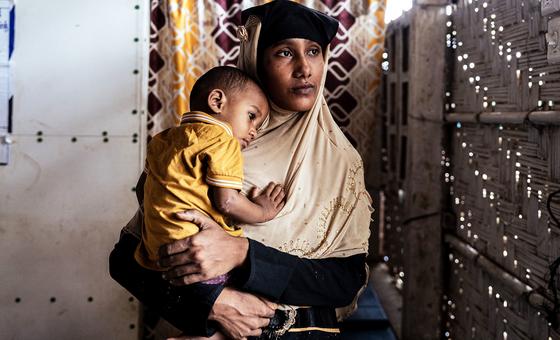
An IDP camp in Kayah (Karenni) state, eastern Myanmar / © UNOCHA/Siegfried Modola

At the same time, accountability mechanisms warn that serious international crimes against civilians continue unabated.

Nicholas Koumjian, head of the Independent Investigative Mechanism for Myanmar, said there is evidence that civilians across the country have endured atrocities amounting to crimes against humanity and war crimes since the military takeover.

The military has carried out air strikes, indiscriminately or deliberately attacking civilians in their homes, hospitals, and schools,” he said, adding that many detainees have been subjected to brutal torture.

The Mechanism is also investigating a growing number of allegations of atrocities committed by opposition armed groups.

Rohingya seek justice at world court

Amid the bleak outlook, an independent human rights expert pointed to a rare moment of accountability as Rohingya survivors testified before the International Court of Justice (ICJ) in the genocide case brought by the Gambia against Myanmar.

Special Rapporteur Tom Andrews praised the survivors’ courage, saying their testimony allows “the light of truth to shine through the darkness of the most horrific of crimes.”

He stressed that justice is not abstract, but “built on the courage of individuals who are willing to speak truth to power.”

Mr. Andrews has been appointed by the Geneva-based Human Rights Council to independently monitor and report on the situation in Myanmar. He is not a UN staff and does not draw a salary from the Secretariat.

The International Court of Justice (ICJ) in The Hague hears arguments concerning the case brought by the Gambia against Myanmar / UN Photo/ICJ/Frank van Beek

The Secretary-General reiterated that a viable path back to civilian rule must be founded on an immediate cessation of violence, a genuine commitment to inclusive dialogue and the swift release of all arbitrarily detained leaders, including President Win Myint and State Counsellor Aung San Suu Kyi.

“Regional and international unity and sustained engagement are needed,” the statement said, “to support a Myanmar-led solution that fully addresses the root causes of conflict, ensures accountability and responds to immediate humanitarian and development needs.”

The Secretary-General’s Special Envoy on Myanmar, Julie Bishop, continues to engage with all stakeholders, in close cooperation with ASEAN and regional partners, in the search for common ground toward a durable resolution and sustainable peace.


Eighty years at the heart of global development

Established in 1945 under the UN Charter, the Economic and Social Council (ECOSOC) was designed to ensure that peace and security would be backed by economic stability, social progress and international cooperation.

Eight decades after its first meeting in London in early 1946, ECOSOC remains a central – if often working out of the spotlight – engine of the UN’s work on sustainable development.

A wide remit by design

ECOSOC is the primary forum within the United Nations for policy dialogue on global economic, social and environmental issues, bringing together Member States, UN specialized agencies and other partners to debate priorities, share evidence and agree on collective action.

Its mandate includes coordinating the work of regional economic and social commissions, functional commissions, expert bodies and UN funds and programmes, which deliver development assistance and policy guidance that affect people’s daily lives.

For people unfamiliar with the UN system, what sets ECOSOC apart is its practical reach. It helps guide how the UN responds to disasters, supports countries recovering from crises, and aligns international efforts to reduce poverty, create jobs and protect the environment.

ECOSOC is also responsible for following up on major UN conferences and summits, helping ensure that high-level commitments do not fade once the news cycles move on.

ECOSOC at 80: A milestone for global cooperation and sustainable development

ECOSOC 2026 session at a glance

President: Lok Bahadur Thapa (Nepal)

Elected on 31 July 2025, becoming the first representative of Nepal – a least developed and landlocked developing country – to serve as ECOSOC President.

Presidency priorities: “Delivering better”

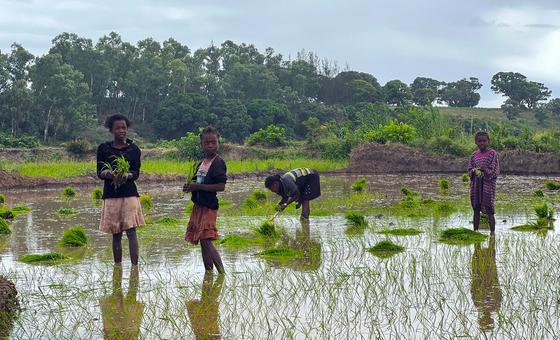
  • Transforming agriculture and food systems to strengthen resilience and help end hunger.
  • Digital entrepreneurship and youth engagement, harnessing the potential of youth populations.
  • Climate action and resilience, with a specific focus on risks linked to glacier lakes and flooding.
  • Reforming the international financial architecture to make it more inclusive and responsive.
  • Using the ECOSOC’s 80th anniversary, to reflect on its role and future relevance

Click here to read more.

Evolving with a changing world

Over time, ECOSOC has evolved to meet a changing global landscape. Its membership has expanded from 18 countries at its founding to 54 today, with Member States elected by the General Assembly to overlapping three-year terms that ensure geographical balance.

General Assembly reforms over the past decade have reinforced ECOSOC’s coordinating role within the UN system, sharpening its ability to identify emerging issues, promote innovation and integrate the economic, social and environmental dimensions of sustainable development.

Implementing the SDGs

A key focus of ECOSOC’s current cycle is the implementation of the 2030 Agenda for Sustainable Development, the UN’s global blueprint to end poverty, protect the planet and ensure prosperity for all.

ECOSOC provides political guidance and oversight for this agenda through its annual programme of work, bringing ministers, senior officials, civil society leaders, academics and the private sector together around shared priorities.

At the heart of this work is the High-level Political Forum on Sustainable Development (HLPF), convened annually under ECOSOC’s auspices. The HLPF reviews progress on the Sustainable Development Goals (SDGs), including voluntary national reports from governments that take stock of progress and challenges.

Discussions at the 2024 session of ECOSOC Youth Forum, the platform where young people can contribute to policy discussions at the United Nations through their collective ideas, solutions and innovations.

Seldom in the headlines

Unlike other main bodies of the Organization, such as the General Assembly and the Security Council, ECOSOC’s meetings seldom make the headlines, but they reflect the complexity of modern global governance.

The humanitarian affairs segment brings together governments and partners each year to strengthen coordination in response to protracted and costly crises.

Other segments – including operational activities, coordination and management – guide the work of UN development agencies, review expert recommendations on topics from public health to geospatial information, and address country-specific or regional concerns requiring focused attention.

A bridge for civil society

ECOSOC also acts as a bridge between the UN and the wider world.

More than 3,200 non-governmental organizations hold consultative status with ECOSOC, giving them a formal channel to contribute expertise and on-the-ground perspectives to debates and decisions. Dedicated forums for youth, scientists, development partners and other stakeholders reflect a recognition that global problems require inclusive solutions that extend beyond governments alone.

Delegates meet during the second session of the Economic and Social Council in May 1946.

80 years old, but as vital as ever

As ECOSOC marks its 80th anniversary on 23 January 2026, its core mission remains unchanged: to foster cooperation in pursuit of shared economic and social progress.

In a world facing intersecting crises – from climate change and inequality to humanitarian emergencies – the Council’s quiet work of coordination and consensus-building continues to shape how the international community responds, and why it still matters to people far beyond UN conference rooms.

Inside the ECOSOC Chamber

A wide view of an ECOSOC meeting on the election of the executive board of a UN agency.

The ECOSOC Chamber at United Nations Headquarters in New York is the principal meeting room where the Council conducts its formal sessions, including high-level segments and ministerial discussions.

Architecturally significant, the Chamber was designed by Swedish architect Sven Markelius and inaugurated in 1952. It was comprehensively renovated in 2013 as part of the UN Capital Master Plan.

The Chamber features several symbolic design elements, including a set of large woven curtains known as Dialogos, intended to evoke dialogue and the exchange of ideas – central to ECOSOC’s role as a forum for consensus-building among governments and global development partners.

One of the most striking features its unfinished ceiling. Exposed pipes and ducts were deliberately left visible to symbolize that the work of the United Nations – and the pursuit of economic and social progress – is never complete, but an ongoing collective effort.

Read more about the ECOSOC Chamber here


Click here for our coverage of the Economic and Social Council.

Source link

UN urges renewed solidarity eight years after forced exodus of Rohingya

More than 700,000 of them fled to neighbouring Bangladesh after armed attacks by a militant group against Myanmar security forces sparked a brutal military crackdown that began on 25 August 2017.

They joined thousands of others who had escaped earlier waves of violence and discrimination now living in refugee camps just across the border in the Cox’s Bazar district.

Violence and funding cuts

In a statement to mark the anniversary, UN Spokesman Stéphane Dujarric noted that the Rohingya people both in and outside Myanmar are facing a further deterioration of their already dire circumstances.

“In Rakhine State, Rohingya and other civilians are caught in the crossfire between the Myanmar military and the Arakan Army and subjected to forced recruitment, human rights violations and other abuse,” he said.

The ongoing violence has forced more Rohingya to flee, including to Bangladesh which is already hosting more than one million refugees from Myanmar. 

A military coup forced Myanmar’s democratically elected Government from power in 2021, fuelling armed insurgencies throughout Myanmar following a brutal military crackdown on protests.

Mr. Dujarric said reports of pushbacks, removals and deportations across the region raise serious concerns over potential violations of the principle of non-refoulement and shrinking asylum space.

This is happening amid funding cuts which are severely curtailing education, food assistance, healthcare, livelihood opportunities and protection services.

Protect all civilians

The Spokesman said UN Secretary-General António Guterres has repeated his call for the protection of all civilians in accordance with applicable obligations under international law. 

The Secretary-General also recalled his visit to Cox’s Bazar, Bangladesh, where he witnessed the resilience of Rohingya communities.

He stressed the urgent need for strengthened international solidarity and increased support, in parallel to efforts toward a comprehensive political solution that meaningfully includes the Rohingya and addresses their displacement and the root causes of the protracted crisis.

Hopes for upcoming conference

“The Secretary-General is hopeful that the 30 September High–level Conference on Rohingya and other minorities in New York, as mandated by the United Nations General Assembly, will draw renewed international attention to the urgency of finding durable solutions,” said Mr. Dujarric.

He added that the Special Envoy of the Secretary-General on Myanmar continues to engage all stakeholders towards ending the brutal civil conflict and supporting a viable Myanmar-led political process.

This should also lead to the voluntary, safe, dignified, and sustainable return of the Rohingya to Myanmar. 

Source link

Four years on, here’s what total exclusion of women in Afghanistan looks like

Four years after Taliban fighters retook the capital Kabul on 15 August 2021, gender equality agency UN Women is warning that the situation for women and girls in Afghanistan is increasingly untenable.  

And without urgent action, this untenable reality will become normalised and women and girls will be fully excluded.

The Taliban is closer than ever to achieving its vision of a society that completely erases women from public life,” UN women said in a press release on Monday.

UN Women’s warning came just as the UN Assistance Mission in Afghanistan (UNAMA) released its latest report on the human rights situation between May and June, detailing harshening enforcement of regulations against women and death threats against female humanitarians.  

A society which is against them

The edicts which the Taliban have passed restricting women and girls’ rights interact together to create an inescapable cycle which relegates women to private spaces and increases their vulnerability. 

In most cases, including for humanitarian workers, women are not allowed to move freely in public without being accompanied by a mahram, or a male guardian. 

In its report, UNAMA noted a change in the enforcement of mahram requirements, with the de facto Taliban authorities instructing private businesses and health clinics to refuse services to all women who were not accompanied by a mahram.  

In certain regions, the authorities have also begun to strictly enforce hijab regulations, including by requiring women to wear a chador, a full body covering. In Herat, if they were not doing so, women are being banned from public spaces.   

Out of opportunities 

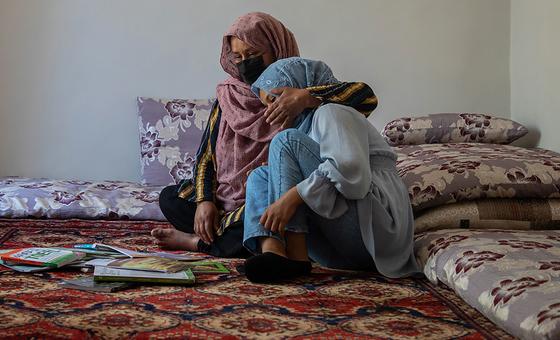
In addition to impeding women’s movements in public spaces, the Taliban has also banned women and girls from secondary and higher education.  

Taken together, these two edicts have profound ramifications at all levels of society. Now, not only is it functionally impossible for women to receive educational degrees, it is also unduly difficult for them to get jobs and enter into training programmes.  

As a result, over 78 per cent of Afghan women are not in education, employment or training.

This means that almost half of the work force is not contributing to the economy in measurable ways, a huge problem for a country whose economy has been devastated by sanctions and climate shocks.

UNAMA’s report noted that the de facto authorities continue to affirm that Islam permits women to work – even as other edicts seem to discourage it.  

An unhealthy cycle

But it’s not just the economy which is suffering. In some cases, these edicts can literally be a matter of life or death.

“The results are devastating. Women are living shorter, less healthy lives,” the UN agency said.

Take healthcare for instance. If women are not allowed to enter higher education, they cannot become doctors. And if women are banned from receiving treatment from male doctors – which they are in certain regions – they cannot expect to live healthy lives.  

UN Women estimates that impediments to receiving healthcare for women in Afghanistan will increase maternal mortality by 50 per cent by 2026.  

Child marriage is also becoming more common, and women are increasingly subjected to violence, inside and outside of their homes. In some cases, de facto authorities were the ones involved in or enforcing forced marriages.  

Solidarity in Afghanistan

It is not just in public that women’s voices are being excluded – 62 per cent of women feel that they cannot even influence decisions at home. This comes amidst a curtailing of expression rights more generally, with many private media outlets closing and social media accounts being monitored, according to the UNAMA report. 

UN Women emphasises that despite having little to hope for, Afghan women remain resilient. They continue to look for moments of solidarity and hope for a different future.  

In May, some women working for the UN were subjected to explicit death threats in relation to their work, but they continue to deliver lifesaving and life-building services.  

One woman whose grassroots leadership organization lost all of its funding in 2022 continues to work to support women in smaller ways.  

“I will continue to stand strong as a woman, supporting other Afghan women. I go to remote areas and collect [women’s] stories, listen to their problems and this gives them hope. I try my best and that also gives me hope,” she said.  

A dangerous precedent

In total, since 2021, almost 100 edicts which restrict how women and girls move through society have been instituted and enforced. In four years, not a single one has been overturned.  

Susan Ferguson, UN Women’s representative in Afghanistan, said that this lack of progress must be understood beyond the Afghan context.

“This is not only about the rights – and futures – of Afghan women and girls. It’s about what we stand for as a global community,” Ms. Ferguson said.

If we allow Afghan women and girls to be silenced, we send a message that the rights of women and girls everywhere are disposable. And that’s an immensely dangerous precedent.” 

Source link

Hiroshima, 80 years on: ‘Real change’ needed to end existential nuclear threat

While the city has been rebuilt, nuclear conflict remains a global threat, UN High Representative for Disarmament Affairs Izumi Nakamitsu said in remarks at the Hiroshima Peace Memorial.

It was the only structure left standing near the hypocentre of the bomb, which marked the first use of an atomic weapon in war.

Survivors, family members and representatives from international organizations and 120 countries were among the approximately 55,000 people who attended the ceremony, according to the Japanese Prime Minister’s Office.

Remembering the dead, honouring the survivors

“On this 80th anniversary, we remember those who perished. We stand with the families who carry their memory,” said Ms. Nakatmisu, delivering a message on behalf of UN Secretary-General António Guterres.

She paid tribute to the hibakusha – the term for those who survived Hiroshima and the atomic bombing of Nagasaki three days later – “whose voices have become a moral force for peace.”

“While their numbers grow smaller each year, their testimony — and their eternal message of peace — will never leave us,” she said.

UN Photo/Yoshito Matsushige

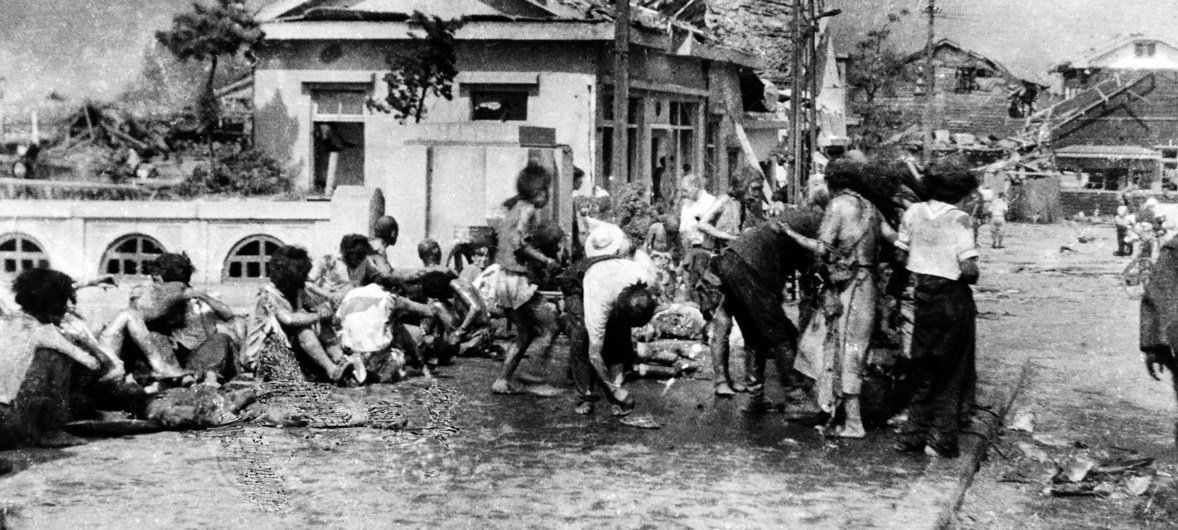
Injured civilians, having escaped the raging inferno, gathered on a pavement west of Miyuki-bashi in Hiroshima, Japan, at about 11 a.m. on 6 August 1945.

Rebuilding hope, sharing the vision

In a single moment on 6 August 1945, Hiroshima was reduced to ruins, tens of thousands were killed, “and humanity crossed a threshold from which there could be no return.”

In the aftermath, many believed the city would never recover and that nothing would grow, she said, but the population proved otherwise.

“You, the people of Hiroshima, didn’t just rebuild a city,” she said.  “You rebuilt hope. You nurtured a vision of a world without nuclear weapons. And you shared that vision with the world.”

Listen to our podcast with Japanese American author Kathleen Burkinshaw whose novel about a young hibakusha ‘The Last Cherry Blossom’ was inspired by her mother’s experience.

Duty to protect

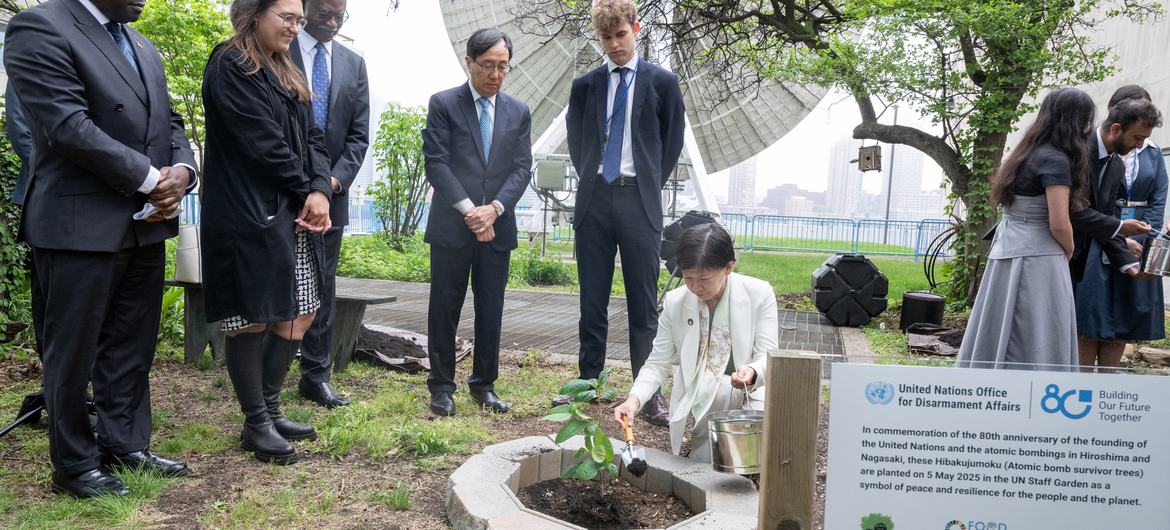
Ms. Nakamitsu noted that 2025 also marks 80 years since the UN was founded.  In May, saplings grown from the seeds of a persimmon tree that survived the bombing were planted at Headquarters in New York. 

“They are more than symbols of survival,” she said.  “They are living testaments to the strength of the human spirit — and of our shared duty to protect future generations from the horrors of nuclear annihilation.”

Furthermore, the UN anniversary is a reminder of why it was created in the first place – to prevent war, to uphold human dignity, and to ensure the tragedies of the past are never repeated.

“Yet, today the risk of nuclear conflict is growing,” she warned. “Trust is eroding. Geopolitical divisions are widening. And the very weapons that brought such devastation to Hiroshima and Nagasaki are once again being treated as tools of coercion.”

At the ceremony, Hiroshima’s Mayor Kazumi Matsui warned against the growing acceptance of nuclear weapons, according to media reports.  He cited the conflicts in Ukraine and the Middle East as examples.

Yet, signs of hope have emerged, according to the UN disarmament chief.  

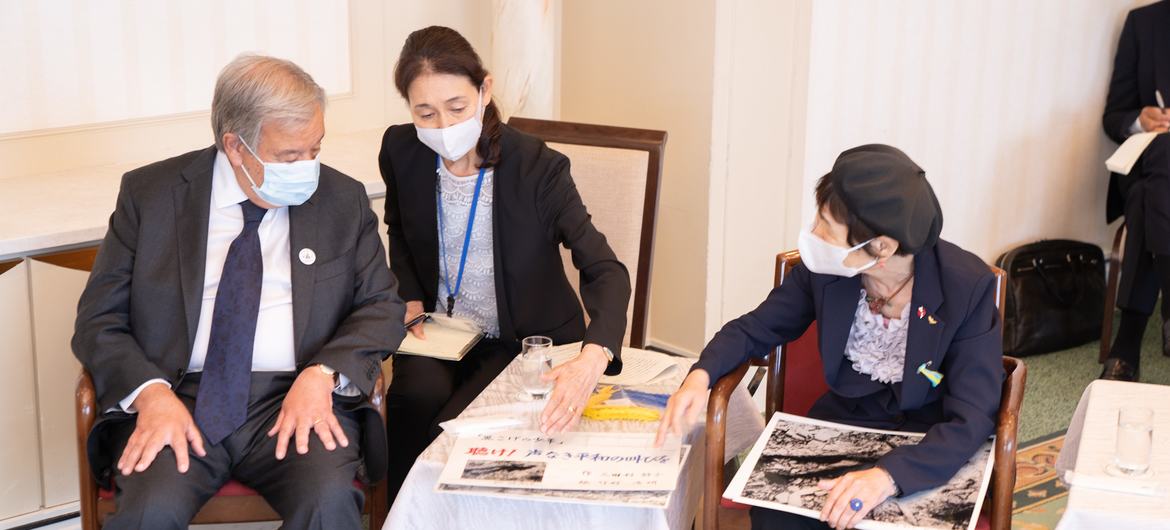
UN Secretary-General António Guterres met with hibakusha from Hiroshima and Nagasaki during a visit to Japan in 2022.

Abolish nuclear weapons

Last October, the Japanese anti-nuclear group Nihon Hidankyo – which represents the survivors of the bombings – was awarded the 2024 Nobel Peace Prize.  This came just weeks after countries meeting at the UN adopted the Pact for the Future, re-committing to a world free of nuclear weapons.

Ms. Nakamitsu insisted that “commitments must lead to real change by strengthening the global disarmament regime — in particular, the Treaty on Non-Proliferation of Nuclear Weapons, complemented by the momentum created by the Treaty on the Prohibition of Nuclear Weapons.” 

She urged countries to draw strength from both the resilience of Hiroshima and the wisdom of the hibakusha. 

“Let’s work to eradicate the threat of nuclear weapons by eradicating the weapons themselves,” she said.

“And let’s keep our pledge to the hibakusha, and ensure that their testimony and message of peace is carried forward. Remembering the past is about protecting and building peace today — and in the future.” 

Izumi Nakamitsu, UN High Representative for Disarmament Affairs (in white), during the tree planting ceremony at Headquarters to commemorate the 80th Anniversary of the founding of the United Nations and the atomic bombings in Hiroshima and Nagasaki.

Source link

‘By women, for women’: 15 years of the UN agency championing gender equality

This is just one way that the de facto authorities have restricted women and girls’ fundamental rights. Today, Afghanistan has the second largest gender gap in the world after Yemen. 

“Sometimes I wonder how to remain hopeful in these dark circumstances,” said Fariba, whose name was changed to protect her.

Afghanistan is not the only country where gender equality is losing ground. Worldwide, one in four countries is experiencing a backlash against women’s rights.

These are the challenges that UN Women confronts on its 15th anniversary, making its mandate and work more urgent than ever. 

“This is not the moment to pull back. It is the moment to step forward,” said Sima Bahous, the agency’s Executive Director.

Progress in peril

Established in July 2010, UN Women is currently working in 80 countries to empower women and girls to achieve their full potential.

Despite previous hard-won gains in accessible education for girls and advocacy for legal rights, funding for gender equality is drying up and progress is moving at a snail’s pace.

One in 10 women and girls lives in abject poverty, something the world will not eliminate for another 137 years at the current rate.  

The number of women living near and in conflict zones has doubled in the past decade, putting them at greater risk of gender-based violence, food insecurity and malnutrition.  

Additionally, 103 countries have never had a female Head of State, and gender parity in top governmental leadership will not be achieved for another 130 years.

While a digital revolution and increasingly high-powered artificial intelligence is sweeping the world, the gender digital divide is widening, making it hard for women and girls to access the tools around which the future will be built.  

However, despite such bleak circumstances, or perhaps because of them, UN Women continues to be a “powerhouse for gender equality and women’s empowerment”.

War and peace

Over 600 million women and girls live within 50 kilometres of a conflict, making them key stakeholders in any peace building process. More than that, evidence suggests that peace processes with women signatories are more durable.  

Despite this, between 2020 and 2023, 80 per cent of peace talks did not include women.  

However, in some countries, there are promising shifts towards great gender inclusion and parity in peace-related activities.  

For example, in Ukraine, demining, a profession which has historically excluded women due to normative perceptions of danger, is attracting more women.  

“What seems ‘not a woman’s job’ may turn out to be your mission,” said Tetiana Rubanka, the head of a demining team there.  

This is especially important in Ukraine, where the UN Mine Action Service (UNMAS) estimates that at least 20 per cent of land is contaminated with unexploded ordnance.

A collective voice

Despite clear proof that quotas in government work to ensure gender parity, women remain excluded from many policy making conversations.  

Because of this reality, UN Women works to support collective action by and for women whose voices are heeded more when they speak together.  

In the Pacific, women make up the majority of vendors at markets, but the markets themselves are managed and run by municipal councils, which tend to be predominantly made up of men. In the past, this meant that women’s concerns, including poor ventilation, security concerns and refrigeration infrastructure, went unaddressed.

With the support of a UN Women project launched in 2014, over 50,000 women vendors have formed associations that enable them to bargain collectively and achieve lasting changes.  

“We are not ordinary women who have nothing. We are women who are important. We just never thought of it that way in the past,” said Joy Janet Ramo, the head of a vendors’ association in the Solomon Islands.


SDG 5

SDG 5: EMPOWER ALL WOMEN AND GIRLS


  • End all forms of discrimination and violence against women and girls
  • Eliminate such harmful practices as early and forced marriages and female genital mutilation
  • Adapt and strengthen legislation to promote gender equality and empower women and girls
  • Ensure women’s full and effective participation and equal opportunities for leadership in political, economic and public life
  • Ensure universal access to sexual and reproductive health care


Globally, almost half of all married women currently lack decision-making power over their sexual and reproductive health and rights.


Finding hope

In Afghanistan, there are over 80 edicts that curtail women and girls’ fundamental rights, or 80 ways in which their potential is being restricted and 80 reasons to lose hope.  

“The colours of the rainbow have dimmed in my life, and I no longer see any colours to paint,” said Anita, a woman who used to be an artist and a teacher.

But still, they refuse to lose hope, instead forming local grassroots organizations that work to promote women’s leadership and prepare them for a time when they can again enjoy fundamental rights.  

Currently, there is a $420 billion annual gap in financing for gender equality globally, making the work of UN Women increasingly untenable. But, after 15 years, the agency insists that it is “doubling down” on the commitment to gender equality.

“My fellow women: never lose hope in the ups and downs of life, in the lows and highs,” Anita said. 

Source link

‘Perfect storm’ of global crises drove years of food price surges: FAO

The report, to be released later this month, reveals how between 2020 and 2024, the world experienced a dramatic increase in food prices driven by a combination of COVID-19 inflation, the war in Ukraine restricting movements on food and commodities, and increasing climate shocks.  

“The episodes described in this publication bring up what we call a perfect storm,” said Mr. Torero Cullen.

Máximo Torero Cullen speaks to journalists at UN Headquarters via video link.

First, he explained that during the COVID-19 pandemic, governments launched fiscal stimulus and relief packages, which increased demand and, thus, global inflation.

Russia’s full-scale invasion of Ukraine compounded this crisis. Before the war began in 2022, Ukraine was a key exporter of wheat, sunflower oil and fertilisers. The war not only restricted these exports but disrupted trade routes and pushed up fuel and input costs, which amplified inflation across the world.

Additionally, increasingly frequent and intense climate shocks in major producing regions – such as droughts, floods and heat waves – further aggravated food inflation.

Worldwide impacts

Only in 2024 did prices return to pre-COVID levels, meaning that households struggled for multiple years to afford food, with major consequences.

As real wages fell while food prices increased, household purchasing power was eroded. Households responded by buying cheaper and less nutritious food, reducing meal frequency, and often prioritising meals for certain family members and reducing intake for women and children.

Mr. Torero Cullen also explained that an increase in food prices directly correlates to an increase in moderate and severe food insecurity. The impacts of this were particularly harsh in Africa and Western Asia, where food imports, dependence and currency depreciation made food even more expensive.

Moreover, as food prices increased, nutrition outcomes among children under five worsened. The SOFI report illustrated that a 10 per cent food price increase led to a 2.7 to 6.1 per cent increase in moderate to severe wasting, which has long-lasting effects on child development and public health systems.  

Notably, these grave impacts were uneven, mostly affecting low-income and African countries – many of which are still seeing worsening figures. During the peak of the crisis in January 2023, some low-income countries experienced food price inflation of up to 30 per cent, compared to 13.6 per cent globally.

Policy recommendations  

Mr. Torero Cullen finished his briefing by outlining the policy prescriptions detailed in the SOFI report.  

He first underscored targeted fiscal support. “Social protection measures are the most effective response to food price spikes,” he explained. “This will protect vulnerable populations without creating long-term fiscal risk or market distortions.”  

He also highlighted avoiding trade disruptions, coordinating monetary and fiscal policies, improving market transparency, and institutional preparedness as essential components for avoiding future crises.

“This SOFI underscores that inflation can undermine progress. It underlines our vulnerabilities, and it also brings the importance of strengthening resilience, inclusiveness and transparency to be able to avoid and minimize the risk of these problems,” he concluded.  

Source link

Srebrenica, 30 years on: UN officials and survivors call for truth, justice and vigilance

“I have survived a genocide,” said Munira Subašić, whose youngest son – her favourite – and 21 other family members were murdered in the July 1995 Srebrenica massacre.

“And the world and Europe was just watching in silence.”

Now president of the Mothers of Srebrenica and Žepa, Ms. Subašić spoke at a special commemoration, urging global leaders not to forget the past and to deliver justice for the victims and survivors.

When you kill a mother’s child, you have killed a part of her,” Ms. Subašic said.

Europe’s worst atrocity since World War II

The 1995 genocide, perpetrated by the Bosnian Serb army, led to the killing of at least 8,372 men and boys, the displacement of thousands and destruction of entire communities in Srebrenica – which had been designed a “safe area” by the UN Security Council.

A small and lightly armed unit of Dutch peacekeepers under the UN flag were unable to resist the large Bosnian Serb force, which overran the town of Srebrenica.

The massacre has been formally recognized as genocide by both the International Court of Justice (ICJ) and the International Criminal Tribunal for the former Yugoslavia (ICTY).

Last year, the General Assembly designated 11 July as the International Day of Reflection and Commemoration for the 1995 Genocide in Srebrenica.  

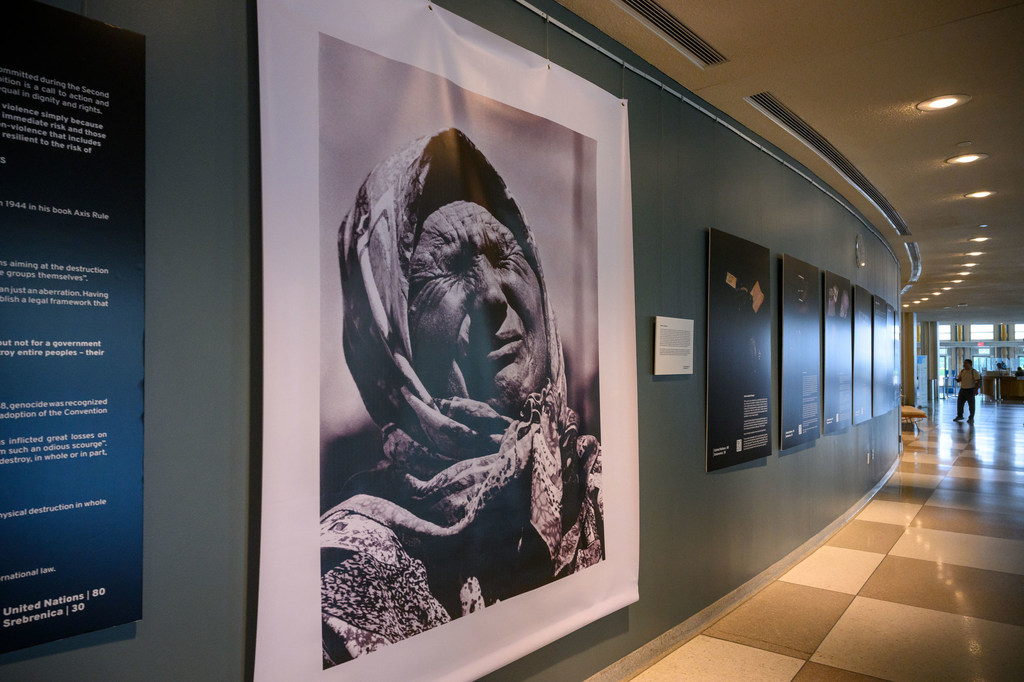
An exhibition marking the 30-year anniversary of the 1995 genocide in Srebrenica is held at UN headquarters in New York.

Remember and honour the victims 

Speaking on behalf of UN Secretary-General António Guterres, Chef de Cabinet Courtenay Rattray paid tribute to those who lost their lives and to the courage of their families. 

Today we remember and honour the victims. We pay tribute to the strength, dignity and resilience of the survivors,” he said.      

Mr. Guterres, in his message, said the international community must continue to stand against hatred, division, and denial.

Only by recognizing the suffering of all victims can we build mutual understanding, trust, and lasting peace,” he said. “We must ensure the voices of Srebrenica survivors continue to be heard – countering denial, distortion and revisionism.”  

The dangers of forgetting  

UN officials expressed concern over ongoing efforts to deny the genocide and glorify those convicted of war crimes. They warned that such narratives can fuel division and hinder reconciliation.

Education remains our strongest defence against the erosion of memory,” said Philémon Yang, President of the General Assembly. “We must not only remember history, but learn from it so that tragedies like Srebrenica are never repeated.”

Learning from the past is especially important today – the Secretary-General noted that the same “dangerous currents” which led to the genocide in Srebrenica are present again in the world today.  

After Srebrenica, the world said – once again – ‘Never Again.’ Yet, hate speech is on the rise again, fuelling discrimination, extremism and violence,” Mr. Guterres said.

A family scattered

Mirela Osmanović, a young professional at the Srebrenica Memorial Center, was born after the genocide but lives with its impact. Two of her brothers were killed. Some of their remains were found, but parts of their bodies are still missing. Their absence, she said, weighs on her family daily.

My parents forbade themselves any joy while their sons, my brothers, lay somewhere in the ground, incomplete, scattered across mass graves – as if every smile would be betrayal, as if happiness might mean forgetting.”

The pain of this loss is always with her family even as the world promised that Srebrenica would never happen again.  

“We were given words, resolutions, statements, solemn promises of ‘never again,’” she said. “And yet, 30 years later, we are still asking what does ‘never again’ mean?”

A new generation, still asking questions

Ms. Osmanović speaks frequently with young people around the world who ask what happens when violence ends.

“What happens when the headlines fade, when the graves are found and facts are clear? Does justice follow?”

Her answer is that justice does not follow often enough.  

Justice if it comes too late or only on paper cannot restore trust. And peace without dignity is not peace at all.”

Years of commemoration

In 2015, UN News spoke to Adama Dieng, the Secretary-General’s special advisor on the prevention of genocide, who underlined the importance of remembering the Srebrenica genocide. 

Source link

50 years of CITES: Shielding wildlife from trade-driven extinction

Originally conceived in 1963 at a meeting of the International Union for Conservation of Nature, the Convention entered into force in 1975, as the first global agreement of its kind. It continues to serve as a vital tool to help prevent the rapid decline of species.  

Why CITES matters?

The urgency of CITES’ mission is clear: international wildlife trade is now worth billions of dollars, and unregulated trade – alongside habitat loss and overexploitation – continues to drive vulnerable species towards extinction.

Because such trade span borders, international cooperation is critical.

“CITES is not a static agreement or self-sustaining,” said Ivonne Higuero, Secretary-General of CITES, marking the anniversary.

“It is a living promise to invest in nature – a commitment to the future, to each other and to the millions of species with whom we share this planet.”

With 185 parties – States or regional economic organizations – where the Convention has entered into force, CITES regulates trade for over 40,000 plant and animal, covering live animals, timber and herbal products.

Real world impact

CITES has established itself as one of the most effective multilateral environmental agreements by developing consensus-based governance and implementation tools such as the CITES Trade Database – the world’s most comprehensive source of global wildlife trade data – and guidelines for legal acquisition, permitting and enforcement.

Thanks to the Convention, international collaboration has brought critically endangered species from the brink, like African elephants, pangolin and crocodiles.

Michelle Henley/Elephants Alive

Pachyderm protection: Elephant mothers around baby.

A key initiative, the Monitoring the Illegal Killing of Elephants (MIKE) Programme, operates at over 70 sites across Africa and Asia, covering roughly half of the pachyderm population. MIKE data has contributed to a downward trend in illegal killings, especially in Africa.

Looking ahead

CITES Secretary-General Higuero called on the international community to remain committed to the cause.

“Let the next 50 years be marked by deeper unity, sharper focus and bolder action,” she said.

“We must continue aiming high and build a world where wild animals and plants thrive in their natural habitats, where trade supports – not threatens – biodiversity, and where people and planet prosper in harmony.”

UN and CITES

The CITES secretariat is supported by the United Nations Environment Programme (UNEP), which it with administrative and operational backing.  

CITES complements the work of other UN entities, such as the Food and Agriculture Organization (FAO) to improve fisheries management, capacity building and technical cooperation with the Economic and Social Commission for Asia and the Pacific (ESCAP), and initiatives focusing on the youth with the UN Development Programme. 

Source link

Eighty years on, UN Charter marked by reflection, resolve – and a run

Under cooler skies after days of intense heat, the run ended where it all began, at the original UN Charter – the document that launched the Organization and reshaped the modern international order – now on display at UN Headquarters.

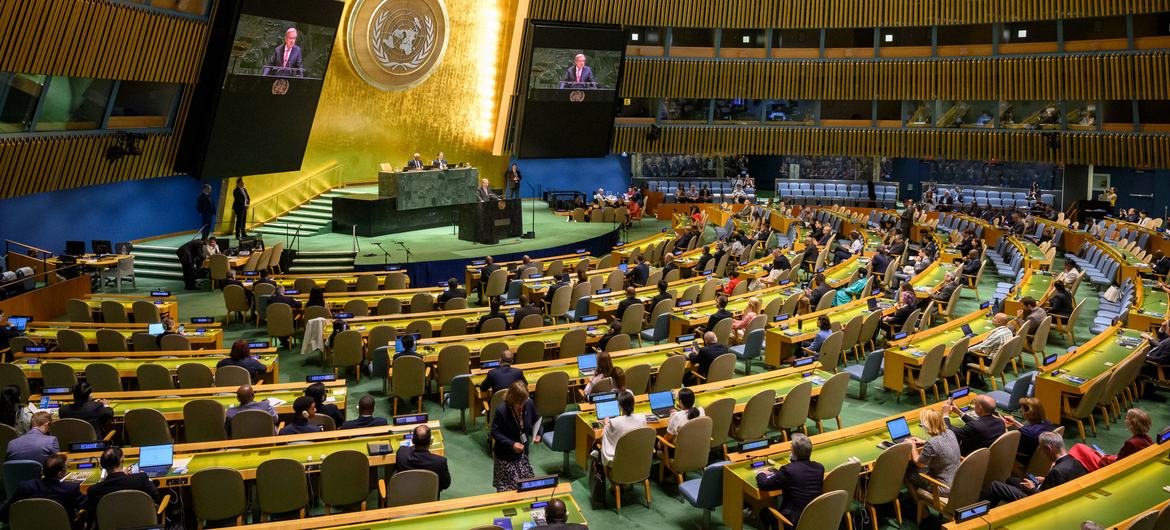
Inside the General Assembly Hall, delegates gathered to commemorate the 80th anniversary of its signing.

They reflected on the past eight decades in which the UN helped rebuild countries after the Second World War, supported former colonies’ independence, fostered peace, delivered aid, advanced human rights and development, and tackling emerging threats like climate change.

To save succeeding generations from the scourge of war

General Assembly President Philémon Yang described the moment as “symbolic” but somber, noting ongoing conflicts in Gaza, Ukraine and Sudan, and the growing challenges to multilateralism.

He urged nations to choose diplomacy over force and uphold the Charter’s vision of peace and human dignity: “We must seize the moment and choose dialogue and diplomacy instead of destructive wars.”

Secretary-General António Guterres echoed this call, warning that the Charter’s principles are increasingly under threat and must be defended as the bedrock of international relations.

The Charter of the United Nations is not optional. It is not an à la carte menu. It is the bedrock of international relations,” he said, stressing the need to recommit to its promises “for peace, for justice, for progress, for we the peoples.”

Carolyn Rodrigues-Birkett, Security Council President for June, emphasized the urgency of renewed collective action to address emerging global threats.

Let this 80th anniversary of the Charter be not just an occasion for reflection, but also a call to action,” she urged.

General Assembly commemorates 80th anniversary of the signing of UN Charter.

To unite our strength to maintain international peace and security

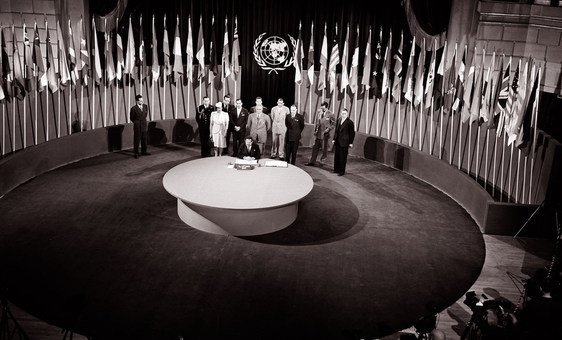
Eighty years ago, on 26 June 1945, delegates from 50 countries gathered in San Francisco to sign a document that would change the course of history.

Forged in the aftermath of the Second World War, by a generation scarred by the Great Depression and the Holocaust and having learnt the painful lessons of the League of Nations’ collapse, the Charter of the United Nations represented a new global pact.

Its preamble – “We the peoples of the United Nations” – echoed the determination to prevent future conflict, reaffirm faith in human rights, and promote peace and social progress.

That very document, preserved by the United States National Archives and Records Administration, has returned – for the first time in decades – to the heart of the institution it founded.

Now on public display at UN Headquarters through September, the original Charter stands as a powerful symbol: not just of a past promise, but of an enduring commitment to multilateralism, peace and shared purpose.

Video: UN Charter returns to UN Headquarters

To promote social progress and better standards of life

More voices – from the presidents of the Economic and Social Council (ECOSOC) and the International Court of Justice (ICJ) – also took the floor, reaffirming the enduring relevance of the Charter and the need to defend it.

Bob Rae, ECOSOC President, drew an arc through human history to underscore the UN’s relative youth – just eight decades old in a global context of millennia.

“We currently have the advantage of being able to lucidly look at what we have accomplished, while also recognizing our successes and failures,” he said, holding up a copy of the Charter once used by his father.

The United Nations is not a government and the Charter is not perfect,” he said, “but it was founded with great aspirations and hope.

ICJ President Judge Yuji Iwasawa reflected on the progress since 1945 and the challenges still facing the global community.

“In the 80 years since the drafters of the Charter set down their pens, the international community has achieved remarkable progress. However, it also faces many challenges,” he said. “The vision of the Charter’s drafters to uphold the rule of law for the maintenance of international peace and security, remains not only relevant but indispensable today.

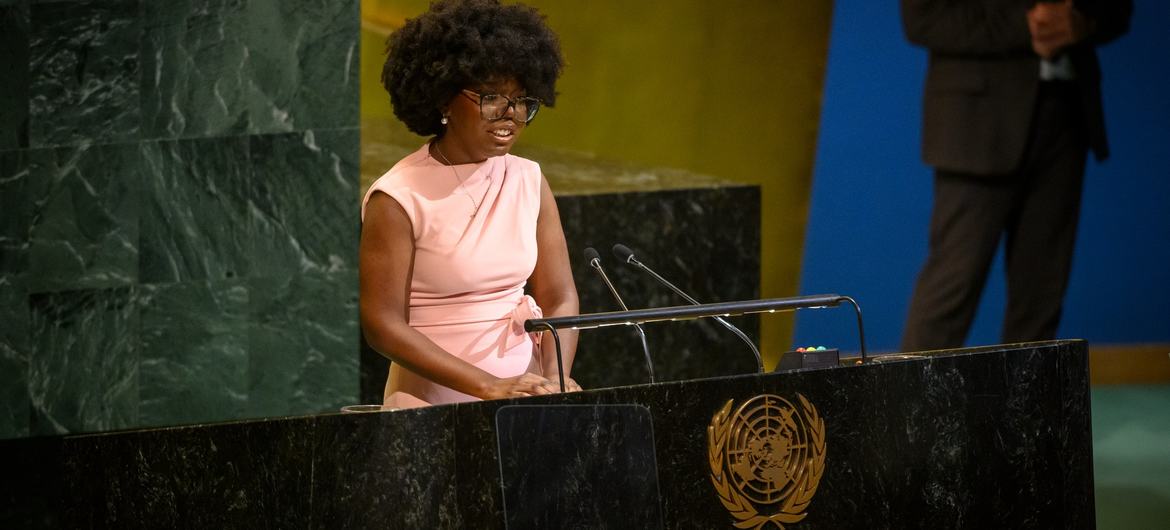
Jordan Sanchez, a young poet, speaks at the General Assembly during the commemoration of the 80th anniversary of the signing of the UN Charter.

To reaffirm faith in fundamental human rights

In a powerful reminder that the Charter speaks not only to the past but to future generations, Jordan Sanchez, a young poet took the stage.

Her spoken word piece, Let the Light Fall, evoked not declarations, but feelings of hope and vision for a better world.

“Let the light fall,” she began, “on fallen faces hidden in the shadow of scorn…where may the children run towards the light of your face, towards the warmth of your presence and the stillness of your peace.”

“There is no fear, only abundance, of safety, of security, of knowing there will always be enough light for me” she said, describing a dreamscape of Eden restored – not a paradise lost, but glimpsed in justice, fairness and shared humanity.

Let us be bold enough to look down and take it, humble enough to kneel down and bathe in it, loving enough to collect and share it, and childish enough to truly, truly believe in it.

The equal rights of men and women

As the world marks 80 years of the UN Charter, it’s worth remembering that its promise of equal rights for men and women was hard-won from the very start.

In 1945, just four women were among the 850 delegates who gathered in San Francisco to sign the document, and only 30 of the represented countries granted women the right to vote.

In a 2018 UN News podcast, researchers spotlighted these overlooked trailblazers – and asked why the women who helped shape the UN’s founding vision are so often left out of its story.

Listen to the podcast here.


Note: The subheads in this article are taken directly from the Preamble of the United Nations Charter, whose enduring language continues to guide the Organization’s mission.

Source link

80 years later, the UN Charter is a ‘living miracle,’ Secretary-General says

The UN Charter “is more than parchment and ink; it is a promise – of peace, dignity and cooperation among nations,” the Secretary-General said.

Almost 80 years after it was signed, Mr. Guterres underlined that the Charter was just the beginning, enshrining ideas and principles which the world works to implement on a daily basis.

Born from war

In the wake of the Second World War, representatives from almost 50 nations convened in San Francisco to put together an organization committed to the idea of “never again” — never again would a war of this magnitude devastate the world.

Instead, the world would choose peace and diplomacy, equality and prosperity.

“For a world mired in endless cycles of conflict and human suffering, the Charter and the principles it represented – dialogue, diplomacy, cooperation, and solidarity — was a path to a better, more peaceful, and prosperous future,” said UN General Assembly President Philémon Yang. The Charter was signed on 26 June 1945, almost exactly 80 years ago. However, it did not take effect until 24 October 1945 after the signatories’ legislative bodies had ratified it.

The Charter, which is considered an international treaty, is a legal instrument which binds all Member States to the principles and commitments laid out within it.

Since its ratification, the UN Charter has paved the way for other landmark international agreements including the 1948 Universal Declaration of Human Rights and the 2024 Pact for the Future.

“The decades since have only proven the Charter’s enduring legacy. It has shaped decades of progress — guided international action on decolonisation, protected human rights and promoted justice and sustainable development,” said Mr. Yang.

‘A living miracle’

The exhibit contextualizes the Charter as a document from the past which continues to live in our present and will help shape the future.

“As we look ahead, we would be wise to remember our past, celebrate our successes and build our future on the foundation of the UN Charter,” Mr. Yang said.

Mr. Guterres said that this exhibit is a moment for people to reflect on the artifacts of the UN’s founding — to see the photos, the videos and the documents which have shaped this global organization.

He acknowledged that while the world faces new challenges like climate change and technology, in addition to age-old challenges, the UN Charter can be a guiding force if the world is willing to carry the spirit of the Charter and its commitment to peace into the future.

“The UN is a living miracle — and the women and men of the United Nations bring this miracle to life every day and everywhere,” the Secretary-General said. 

Source link

Climate change: World Likely to Breach 1.5°C limit in next five years

According to the Global Annual to Decadal Climate Update, the planet is predicted to experience temperatures between 1.2°C and 1.9°C above pre-industrial levels (1850–1900) over the next five years.

Breaching critical thresholds

In 2024, the WMO estimated that the average global temperature was between 1.34°C and 1.41°C higher than pre-industrial levels (1850-1900). The WMO now projects the 20-year average warming for 2015–2034 to reach around 1.44°C above pre-industrial levels.

The report finds a staggering 86 per cent chance that global average temperatures will exceed 1.5°C above pre-industrial levels in at least one of the next five years, and a one per cent chance of one of those years exceeding 2°C of warming.

There is a 70 per cent chance that the five-year average itself will exceed this 1.5 degree threshold.

The WMO stressed that the 1.5°C Paris Agreement target refers to long-term averages over 20 years, meaning its threshold has not been breached quite yet.

However, these near-term spikes are warning signs of an accelerating climate crisis.

The forecast also highlights regional precipitation impacts, including wetter-than-average conditions expected in the African Sahel, northern Europe, and South Asia. Conversely, the Amazon region could see continued drought.

Arctic Warming Accelerates

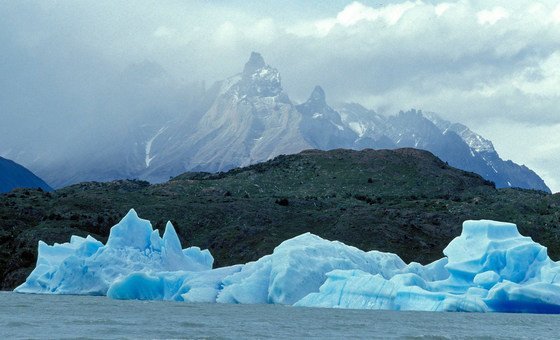
The situation is even more catastrophic in the Arctic than in the rest of the world. The average Arctic temperature over the next five winters (November to March) is expected to be 2.4°C warmer than the 1991–2020 average, more than three and a half times the increase in the global average temperature.

Sea ice is expected to keep shrinking, particularly in the Barents, Bering, and Okhotsk Seas, contributing to rising sea levels and disrupted weather patterns worldwide.

As the world enters this critical window, the UN agency urged climate action to prevent even more dangerous warming in the decades ahead and keep long-term warming below the 1.5°C limit.

Source link