Secretary-General on UN at 80: Humanity strongest when we stand as one

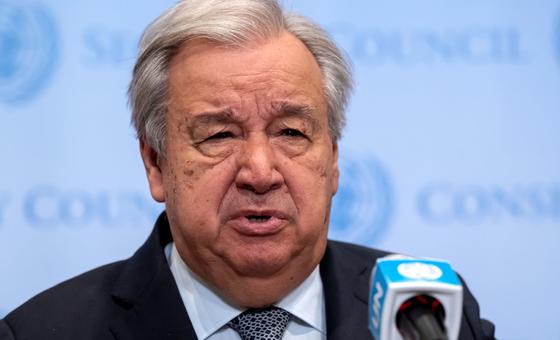
Speaking at Methodist Central Hall, the very same venue where the first-ever UN General Assembly was held on 10 January 1946, Mr. Guterres called on delegates at the event to be “bold enough to change. Bold enough to find the courage of those who came to this Hall 80 years ago to forge a better world.” 

From bomb shelter to diplomatic gathering 

Organised by the United Nations Association-UK, Saturday’s anniversary event gathered over 1,000 delegates from across the world, with speakers including President of the General AssemblyAnnalena Baerbock, the UN Champion for Space Professor Brian Cox and the UN Refugee Agency’s Goodwill Ambassador Maya Ghazal. The event also marks the 80th anniversary of the first UN Security Council, which took place on 17 January 1946 at nearby Church House. 

During his keynote address, Mr. Guterres reflected on the symbolic location of the commemoration. The first General Assembly took place within the same walls four months after the end of the Second World War, in a heavily bombed London where tens of thousands had been killed, a powerful reminder as to why the UN had been created. 

“To reach this Hall, delegates had to pass through a city scarred by war. Buckingham Palace, Westminster Abbey, and the House of Commons had been shelled by the Luftwaffe. And as those bombs fell, terrified civilians huddled here, in the basement of the Methodist Central Hall — one of the largest public air-raid shelters in London,” said the Secretary-General.   

Throughout the Blitz, as many as 2,000 people gathered in the hall for protection, before the nations of the world assembled there in 1946 to ‘save succeeding generations from the scourge of war’.  

“In many ways, this Hall is a physical representation of what the United Nations is: a place people put their faith — for peace, for security, for a better life,” reflected Mr. Guterres. 

The world of 2026 is not the world of 1946 

In the 80 years since the first General Assembly, the UN has expanded from 51 members to 193. Mr. Guterres emphasised that the General Assembly, the UN’s chief deliberative, policymaking and representative body, is “the parliament of the family of nations. It is a forum for every voice to be heard, a crucible for consensus, and a beacon for cooperation.”

Whilst he acknowledged that the General Assembly’s work “may not always be straightforward or seamless,” he described it as a “a mirror of our world, its divisions and its hopes. And it is the stage on which our shared story plays out.”

Reflecting on the last decade, Mr. Guterres spoke of how “the conflicts in Gaza, Ukraine and Sudan have been vicious and cruel beyond measure; artificial intelligence has become ubiquitous almost overnight; and the pandemic poured accelerant on the fires of nationalism — stalling progress on development and climate action.”

Mr. Guterres emphasised how 2025 was a “profoundly challenging” year for international cooperation and the UN’s values.

Aid was slashed. Inequalities widened. Climate chaos accelerated. International law was trampled. Crackdowns on civil society intensified. Journalists were killed with impunity. And United Nations staff were repeatedly threatened — or killed — in the line of duty.”

The UN reported in 2025 that global military spending reached $2.7 trillion — over 200 times the UK’s current aid budget, or equivalent to over 70 per cent of Britain’s entire economy.

Fossil fuel profits have also continued to surge whilst the planet broke heat records, Mr. Guterres underlined.

“And in cyberspace, algorithms rewarded falsehoods, fuelled hatred, and provided authoritarians with powerful tools of control.”

Multilateralism over division

A “robust, responsive and well-resourced multilateral” system is needed to address the world’s interconnected challenges, Mr. Guterres urged, but the “values of multilateralism are being chipped away.”

The Secretary-General gave the example of a landmark international agreement to protect marine life in international waters and the seabed, which comes into force on Saturday, as a “model of modern diplomacy, led by science, with the participation not just of governments, but of civil society, Indigenous Peoples and local communities.”

“These quiet victories of international cooperation — the wars prevented, the famine averted, the vital treaties secured — do not always make the headlines. Yet they are real. And they matter. If we wish to secure more such victories, we must ensure the full respect of international law and defend multilateralism, strengthening it for our times.”

As he addressed the London audience, the Secretary-General expressed his “gratitude to the United Kingdom for its decisive role in creating the United Nations,” and for being “such a strong pillar of multilateralism and champion of the United Nations today.”

© United Nations/Shaun Ottway

UN Secretary-General António Guterres (right) met with UK Prime Minister Keir Starmer at 10 Downing Street in London on Friday.

High stakes for a better world 

Looking towards the future, the Secretary-General called for an international system that reflects the modern world, including reforming international financial systems and the Security Council.

“As global centres of power shift, we have the potential to build a future that is either more fair — or more unstable.”

The Secretary-General reminded delegates in London that when the UN first opened its doors, “many of its staff bore the visible wounds of war — a limp, a scar, a burn.”

“There is a persistent myth — now echoing louder each day — that peace is naïve. That the only ‘real’ politics is the politics of self-interest and force,” Mr. Guterres said.  

“But the founders of the United Nations were not untouched by reality. On the contrary, they had seen war, and they knew: Peace, justice and equality, are the most courageous, the most practical, the most necessary pursuits of all.” 

*Miranda Alexander-Webber is a communications officer with the United Nations Regional Information Centre for Western Europe (UNRIC).

Source link

80 years later, the UN Charter is a ‘living miracle,’ Secretary-General says

The UN Charter “is more than parchment and ink; it is a promise – of peace, dignity and cooperation among nations,” the Secretary-General said.

Almost 80 years after it was signed, Mr. Guterres underlined that the Charter was just the beginning, enshrining ideas and principles which the world works to implement on a daily basis.

Born from war

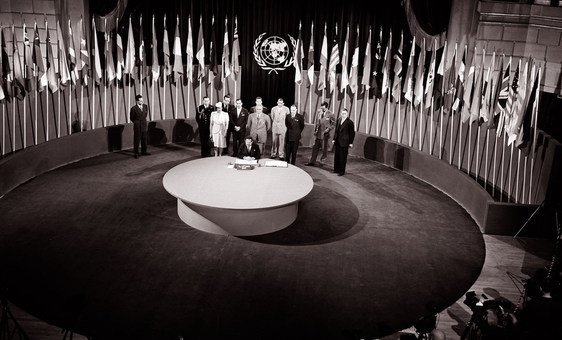
In the wake of the Second World War, representatives from almost 50 nations convened in San Francisco to put together an organization committed to the idea of “never again” — never again would a war of this magnitude devastate the world.

Instead, the world would choose peace and diplomacy, equality and prosperity.

“For a world mired in endless cycles of conflict and human suffering, the Charter and the principles it represented – dialogue, diplomacy, cooperation, and solidarity — was a path to a better, more peaceful, and prosperous future,” said UN General Assembly President Philémon Yang. The Charter was signed on 26 June 1945, almost exactly 80 years ago. However, it did not take effect until 24 October 1945 after the signatories’ legislative bodies had ratified it.

The Charter, which is considered an international treaty, is a legal instrument which binds all Member States to the principles and commitments laid out within it.

Since its ratification, the UN Charter has paved the way for other landmark international agreements including the 1948 Universal Declaration of Human Rights and the 2024 Pact for the Future.

“The decades since have only proven the Charter’s enduring legacy. It has shaped decades of progress — guided international action on decolonisation, protected human rights and promoted justice and sustainable development,” said Mr. Yang.

‘A living miracle’

The exhibit contextualizes the Charter as a document from the past which continues to live in our present and will help shape the future.

“As we look ahead, we would be wise to remember our past, celebrate our successes and build our future on the foundation of the UN Charter,” Mr. Yang said.

Mr. Guterres said that this exhibit is a moment for people to reflect on the artifacts of the UN’s founding — to see the photos, the videos and the documents which have shaped this global organization.

He acknowledged that while the world faces new challenges like climate change and technology, in addition to age-old challenges, the UN Charter can be a guiding force if the world is willing to carry the spirit of the Charter and its commitment to peace into the future.

“The UN is a living miracle — and the women and men of the United Nations bring this miracle to life every day and everywhere,” the Secretary-General said. 

Source link

UN Secretary-General urges military restraint from India, Pakistan

In a note to correspondents issued by his spokesperson on Tuesday, Secretary-General António Guterres called for military restraint from both countries.

The world cannot afford a military confrontation between India and Pakistan,” the note said.

On Monday, the Secretary-General had warned that the tensions between the two South Asian neighbours had reached “their highest in years.”

He offered his good offices to both governments to help defuse tensions and promote diplomacy, stressing that “a military solution is no solution.”

Source link