‘We must stand up for our shared humanity – each and every day’: UN human rights chief

Tuesday’s solemn commemoration marks the day 81 years ago that the Auschwitz-Birkenau concentration and extermination camp – where over a million people were murdered – was liberated by Allied forces towards the end of World War Two. 

Commenting on the disturbing rise of antisemitism in recent years – including the “heinous attacks” targeting Jewish communities in Sydney and Manchester – Mr. Türk warned that “hatred and dehumanization are creeping into our daily lives.” 

He urged people to remember the lessons of the Holocaust, during which six million Jews were killed by the Nazis and their collaborators. 

“The genocide did not begin with concentration camps and gas chambers; it started with apathy and silence in the face of injustice, and with the corrosive dehumanization of the other.”

The need for remembrance

The central theme of this year’s commemoration is Holocaust Remembrance for Dignity and Human Rights.

Reflecting this theme and addressing some of today’s challenges, the High Commissioner emphasised the need for “laws that prohibit discrimination, and politicians who do not polarize by calling out differences – but unite by calling out injustice.”

To protect humanity from repeating its darkest chapters, Mr Türk stated: “We need education about the Holocaust, human rights for all ages, and robust, inclusive systems to moderate digital content, so that people can express their concerns without fear.”

Reasons for hope 

Calling on the world to use available tools today such as international human rights law, unprecedented access to verifiable information and “the memory of how exclusion can turn into annihilation”, Mr Türk demanded action to counter the “plague” of racism, antisemitism, and dehumanisation.

Together, we must challenge exceptionalism, supremacy, and bigotry wherever we encounter them: at the dinner table, at our workplaces, and on social media,” the rights chief continued.

“Each of us can be an architect of a world free from discrimination and intolerance.”

Echoing the words of Anne Frank and remembering her step sister, Eva Schloss, who died a few weeks ago, Mr Türk emphasised that “nobody needs to wait a single moment before starting to improve the world.” 

Listen to our interview with Ms. Schloss, who spoke to UN News in Geneva in 2018, here

The UN commemorates

New York – United Nations Holocaust Memorial Observance

  • Start Time: 11:00am EST, General Assembly Hall, United Nations Headquarters

Exhibition: Between Life and Death: Stories of Rescue during the Holocaust | Visitors’ Lobby, United Nations Headquarters |15 January – 20 February 2026

Exhibition: Holocaust Remembrance – A Commitment to Truth | Visitors’ Lobby, United Nations Headquarters | 15 January – 8 February 2026

Geneva – Holocaust Remembrance 

  • Start Time: 1pm CET, Palais des Nations, Room XVI

Source link

Secretary-General on UN at 80: Humanity strongest when we stand as one

Speaking at Methodist Central Hall, the very same venue where the first-ever UN General Assembly was held on 10 January 1946, Mr. Guterres called on delegates at the event to be “bold enough to change. Bold enough to find the courage of those who came to this Hall 80 years ago to forge a better world.” 

From bomb shelter to diplomatic gathering 

Organised by the United Nations Association-UK, Saturday’s anniversary event gathered over 1,000 delegates from across the world, with speakers including President of the General AssemblyAnnalena Baerbock, the UN Champion for Space Professor Brian Cox and the UN Refugee Agency’s Goodwill Ambassador Maya Ghazal. The event also marks the 80th anniversary of the first UN Security Council, which took place on 17 January 1946 at nearby Church House. 

During his keynote address, Mr. Guterres reflected on the symbolic location of the commemoration. The first General Assembly took place within the same walls four months after the end of the Second World War, in a heavily bombed London where tens of thousands had been killed, a powerful reminder as to why the UN had been created. 

“To reach this Hall, delegates had to pass through a city scarred by war. Buckingham Palace, Westminster Abbey, and the House of Commons had been shelled by the Luftwaffe. And as those bombs fell, terrified civilians huddled here, in the basement of the Methodist Central Hall — one of the largest public air-raid shelters in London,” said the Secretary-General.   

Throughout the Blitz, as many as 2,000 people gathered in the hall for protection, before the nations of the world assembled there in 1946 to ‘save succeeding generations from the scourge of war’.  

“In many ways, this Hall is a physical representation of what the United Nations is: a place people put their faith — for peace, for security, for a better life,” reflected Mr. Guterres. 

The world of 2026 is not the world of 1946 

In the 80 years since the first General Assembly, the UN has expanded from 51 members to 193. Mr. Guterres emphasised that the General Assembly, the UN’s chief deliberative, policymaking and representative body, is “the parliament of the family of nations. It is a forum for every voice to be heard, a crucible for consensus, and a beacon for cooperation.”

Whilst he acknowledged that the General Assembly’s work “may not always be straightforward or seamless,” he described it as a “a mirror of our world, its divisions and its hopes. And it is the stage on which our shared story plays out.”

Reflecting on the last decade, Mr. Guterres spoke of how “the conflicts in Gaza, Ukraine and Sudan have been vicious and cruel beyond measure; artificial intelligence has become ubiquitous almost overnight; and the pandemic poured accelerant on the fires of nationalism — stalling progress on development and climate action.”

Mr. Guterres emphasised how 2025 was a “profoundly challenging” year for international cooperation and the UN’s values.

Aid was slashed. Inequalities widened. Climate chaos accelerated. International law was trampled. Crackdowns on civil society intensified. Journalists were killed with impunity. And United Nations staff were repeatedly threatened — or killed — in the line of duty.”

The UN reported in 2025 that global military spending reached $2.7 trillion — over 200 times the UK’s current aid budget, or equivalent to over 70 per cent of Britain’s entire economy.

Fossil fuel profits have also continued to surge whilst the planet broke heat records, Mr. Guterres underlined.

“And in cyberspace, algorithms rewarded falsehoods, fuelled hatred, and provided authoritarians with powerful tools of control.”

Multilateralism over division

A “robust, responsive and well-resourced multilateral” system is needed to address the world’s interconnected challenges, Mr. Guterres urged, but the “values of multilateralism are being chipped away.”

The Secretary-General gave the example of a landmark international agreement to protect marine life in international waters and the seabed, which comes into force on Saturday, as a “model of modern diplomacy, led by science, with the participation not just of governments, but of civil society, Indigenous Peoples and local communities.”

“These quiet victories of international cooperation — the wars prevented, the famine averted, the vital treaties secured — do not always make the headlines. Yet they are real. And they matter. If we wish to secure more such victories, we must ensure the full respect of international law and defend multilateralism, strengthening it for our times.”

As he addressed the London audience, the Secretary-General expressed his “gratitude to the United Kingdom for its decisive role in creating the United Nations,” and for being “such a strong pillar of multilateralism and champion of the United Nations today.”

© United Nations/Shaun Ottway

UN Secretary-General António Guterres (right) met with UK Prime Minister Keir Starmer at 10 Downing Street in London on Friday.

High stakes for a better world 

Looking towards the future, the Secretary-General called for an international system that reflects the modern world, including reforming international financial systems and the Security Council.

“As global centres of power shift, we have the potential to build a future that is either more fair — or more unstable.”

The Secretary-General reminded delegates in London that when the UN first opened its doors, “many of its staff bore the visible wounds of war — a limp, a scar, a burn.”

“There is a persistent myth — now echoing louder each day — that peace is naïve. That the only ‘real’ politics is the politics of self-interest and force,” Mr. Guterres said.  

“But the founders of the United Nations were not untouched by reality. On the contrary, they had seen war, and they knew: Peace, justice and equality, are the most courageous, the most practical, the most necessary pursuits of all.” 

*Miranda Alexander-Webber is a communications officer with the United Nations Regional Information Centre for Western Europe (UNRIC).

Source link

Guterres in Japan: ‘Humanity is strongest when we stand as one’

It brings together more than 160 countries and organizations – a testament to Japan’s enduring commitment to global dialogue and cooperation, said Secretary-General António Guterres.  

Japan has helped shape some of the most important multilateral achievements of our time,” he added, commending Japan for choosing peace and international cooperation following defeat at the end of the Second World War.  

A tireless advocate for nuclear disarmament, a generous contributor to peace, and a steadfast champion of human security, Japan has help lead ever since it joined the United Nations nearly 70 years ago.

Commitment to cooperation

The moral of the United Nations’ story is simple: humanity is strongest when we stand as one,” Mr. Guterres said.  

“Although many may not realise it, the United Nations touches our lives every single day,” he said, noting that the UN provides food assistance to more than 150 million people, supplies vaccines to 45 per cent of the world’s children, and supports elections in some 50 countries.  

From landmines to biodiversity, women’s rights to refugees, freedom of the press to access to clean water, the UN sustains a vast global system of conventions and treaties – while its Charter is the pillar of international law.  

‘Reform is crucial’

But today, as the multilateral project of nations working together under a common purpose is challenged, it must adapt.

From the composition of the Security Council to unjust and unfair international financial systems, reform is crucial.  

Since leaders adopted the Pact for the Future in 2024, a blueprint to make multilateralism more effective, Mr. Guterres has also launched the UN80 initiative to help ensure that the 80th anniversary of the UN is not only a moment of reflection, but a catalyst for renewal.  

“These are times of peril. But they are also times of profound opportunity -and obligation,” said the Secretary General.

Source link

Famine in Gaza: ‘a failure of humanity itself,’ says UN chief

UN Secretary-General António Guterres said the results of the Integrated Food Security Phase Classification (IPC) analysis were no mystery: “It is a man-made disaster, a moral indictment – and a failure of humanity itself.

“Famine is not about food; it is the deliberate collapse of the systems needed for human survival.”

Famine conditions are projected to spread from Gaza Governorate to Deir Al Balah and Khan Younis Governorates in the coming weeks, the IPC estimates.

UN agencies have collectively and consistently highlighted the extreme urgency of delivering immediate and full-scale humanitarian aid given the escalating hunger-related deaths, rapidly worsening levels of acute malnutrition and plummeting levels of food consumption in Gaza – with hundreds of thousands going days without anything to eat.

Israel’s obligations

“As the occupying power, Israel has unequivocal obligations under international law – including the duty of ensuring food and medical supplies of the population,” said the UN chief, reacting to the famine declaration from the IPC, which is endorsed by dozens of governments, UN agencies and NGOs as the key evidence-based measure of food insecurity and malnutrition.

See our UN News explainer here.

Mr. Guterres said Israel’s denial of its duties could not be allowed to continue: “No more excuses. The time for action is not tomorrow – it is now.”

Silence the guns, release the hostages

UN agencies operating in Gaza joined the UN chief in calling for an immediate ceasefire to finally allow unimpeded, large-scale humanitarian response and the immediate release of all hostages taken by Hamas and other militants during the 7 October 2023 terror attacks.

Agencies also expressed grave concern over the threat of the intensified military offensive on Gaza City and any further escalation in the conflict, as it would have further devastating consequences for civilians where famine conditions already exist.

“Many people – especially sick and malnourished children, older people and people with disabilities – may be unable to evacuate,” they said in a joint statement.

Famine set to expand

By the end of September, more than 640,000 people will face ‘catastrophic’ levels of food insecurity – classified as IPC Phase 5 – across the Gaza Strip.

An additional 1.14 million people in the enclave will be in phase 4 with a further 396,000 people facing phase 3 ‘crisis’ conditions.

Conditions in North Gaza are estimated to be as severe – or worse – than in Gaza City. However, limited data prevented an IPC classification, highlighting the urgent need for access.

Classifying famine means that the most extreme category is triggered when three critical thresholds – extreme food deprivation, acute malnutrition and starvation-related deaths – have been breached. The latest analysis now affirms on the basis of reasonable evidence that these criteria have been met, UN agencies said.

Briefing journalists on Friday at UN headquarters in Geneva, the UN Emergency Relief Coordinator Tom Fletcher said it was a famine that could have been prevented “if we had been allowed.”

A young severely malnourished girl is helped into her clothes.

Famine in a fertile land

“Yet food stacks up at borders because of systematic obstruction by Israel. It is a famine within a few hundred metres of food, in a fertile land.

It is a famine that we repeatedly warned of – but that the international media has not been allowed in to cover, to bear witness,” he added.

“It is a famine in 2025. A 21st century famine watched over by drones and the most advanced military technology in history. It is a famine openly promoted by some Israeli leaders as a weapon of war.”

On a wider scale, Mr. Fletcher said it was “the world’s famine. It is a famine that asks ‘but what did you do?’ A famine that will and must haunt us all.”

Malnutrition among children in Gaza is accelerating “at a catastrophic pace”, said UN agencies, who note that in July alone, more than 12,000 children were identified as acutely malnourished – the highest monthly figure ever recorded and a six-fold increase since the start of the year.

First Middle East famine

Since the last IPC Analysis in May, the number of children expected to be at severe risk of death from malnutrition by the end of June 2026 has tripled from 14,100 to 43,400.

The new assessment reports the most severe deterioration since the IPC began analysing acute food insecurity and acute malnutrition in Gaza Strip, and it marks the first time a famine has been officially confirmed in the Middle East region.

Since July, food and aid supplies entering Gaza increased slightly but remained vastly insufficient, inconsistent and inaccessible compared to the need.

Meanwhile, approximately 98 percent of cropland in the territory is damaged or inaccessible – decimating the agriculture sector and local food production – and nine of ten people have been serially displaced from homes. 

Gaza First Person: ‘The best of humankind in a place abandoned by humanity’

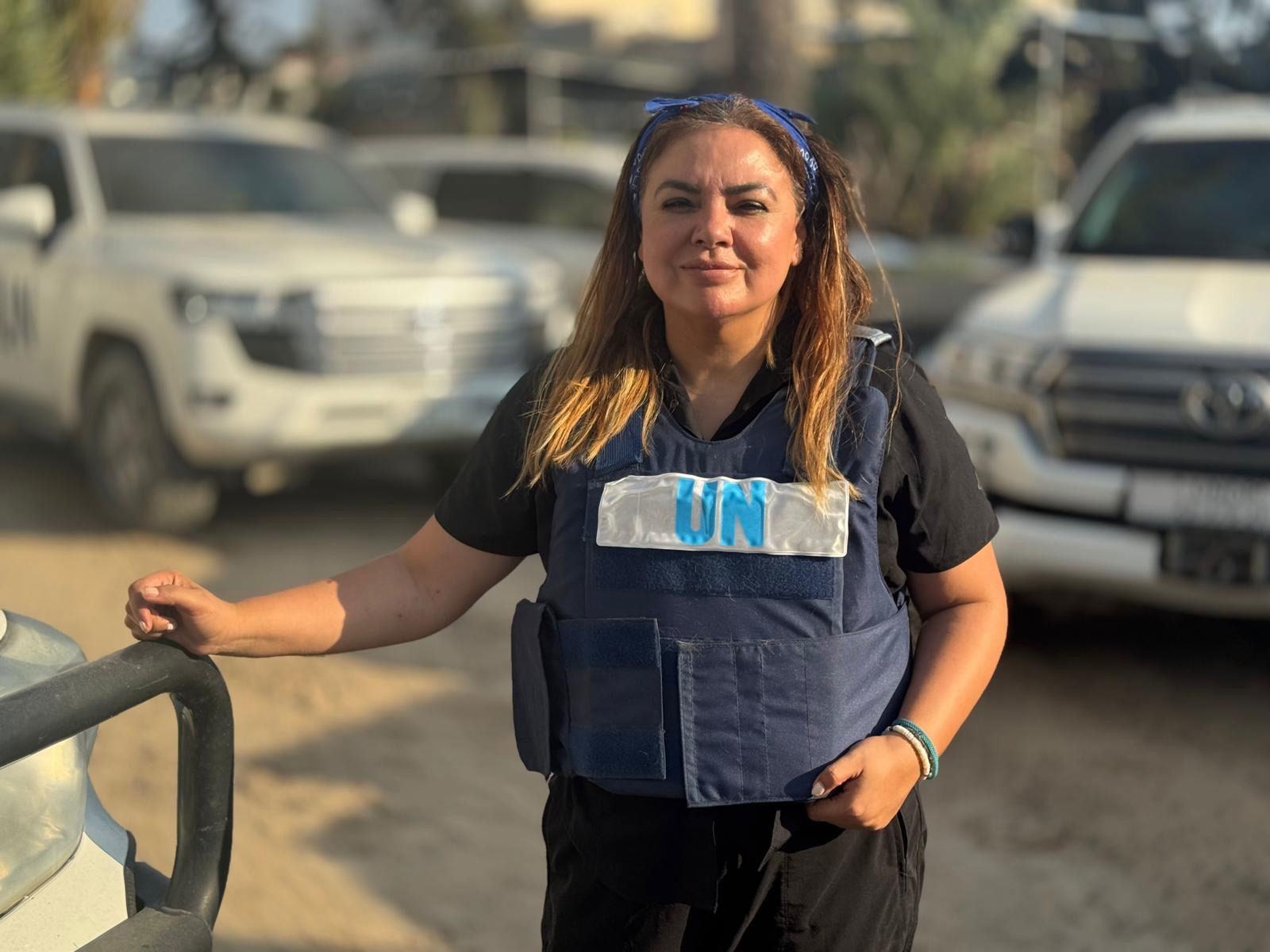
Sonia Silva has been working in the embattled enclave since the beginning of November 2023, just one-month after the terror attack by Hamas and other armed groups in southern Israel that sparked the brutal conflict.

She spoke to UN News about the misery people have experienced in recent days.

“In my one year and eight months in Gaza, this past week has been by far the worst. The only comparable experience was the Rafah incursion in May 2024, when the border was closed, but this week has been significantly more intense.

I live in UNICEF accommodation in Deir Al-Balah, a city in central Gaza.

Sonia Silva, UNICEF Head of Office in Gaza.

When you drive from south to north in the Gaza Strip, it looks as if there has just been a major natural disaster. The level of destruction has reached an unprecedented scale, devastating civilian infrastructure and entire neighborhoods.

Buildings are no longer standing. People are living in destroyed houses, tents and on the streets.

Seeing humanity in this condition is scary and fills me with a sense of doom and fear.

Terrifying offensive

Deir Al-Balah is or had been different.

It’s one of the few places in the Gaza Strip where urban infrastructure remains. It has been somewhat spared, compared to other areas.

That is until last Sunday evening, when a terrifying offensive was unleashed on Deir Al-Balah.

I have yet to see the level of destruction over the last few days, but reports indicate it is significant.

A building was destroyed by a rocket blast only 100 metres from where I normally sleep.

But, for 72 hours my colleagues and I barely slept. The explosions and gunfire were incessant.

It is stronger than you.

Your body knows something is wrong and is in an upper state of alertness.

I was not scared, but I was deeply concerned about my national colleagues who were very close to the crossfire and who were trying to comfort young children.

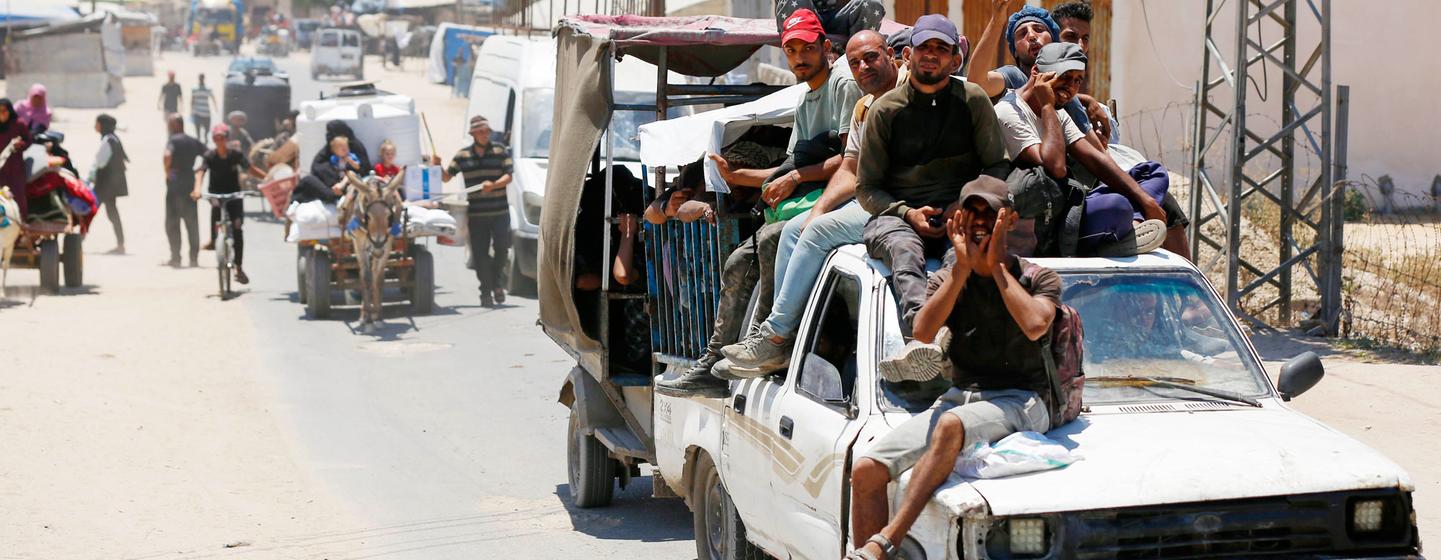
Families evacuate from Deir Al-Balah in the Gaza Strip

I am fortunate because I am an international civil servant and am entitled to a break. Every 4 to 6 weeks, I get to leave, I get to rest, I get to recharge my batteries.

But, not my Palestinian colleagues and their families, who have lived through this for more than 21 months, who have lost everything, their loved ones and belongings.

They don’t get to switch off.

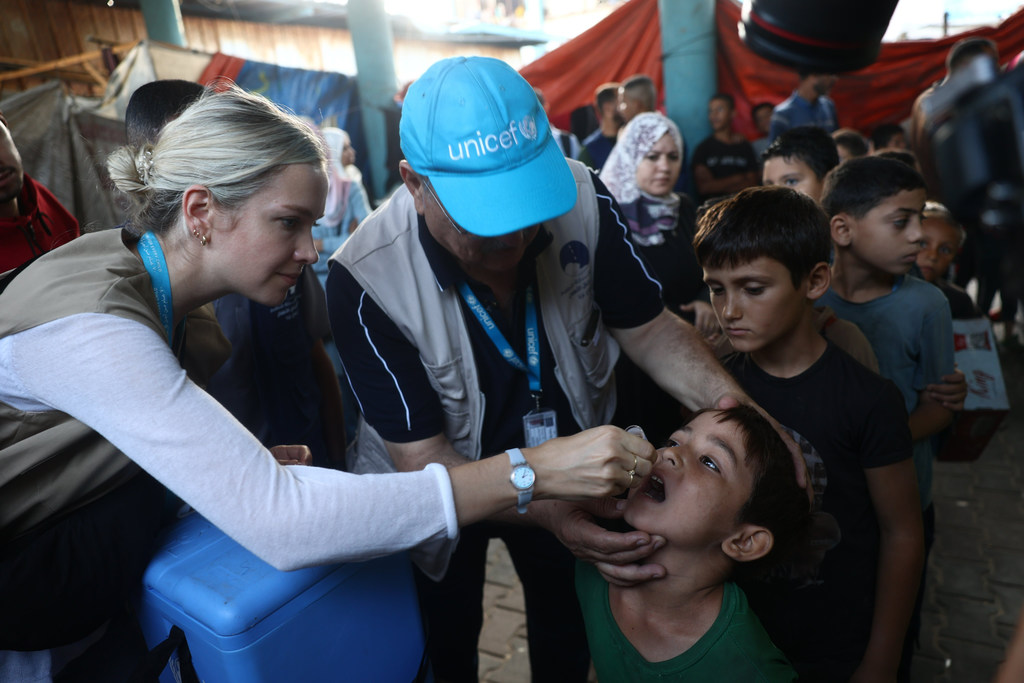
UNICEF staff vaccinate children against polio in September 2024.

The ongoing shortages of food are making things worse. It affects the entire population, including our frontline partners, our national colleagues and all the supporting staff.

What has struck me most about Gaza is that despite the hardship, colleagues keep going, colleagues keep teasing each other, colleagues who have lost everything show the utmost generosity and solidarity.

I would like to pay tribute to all of my colleagues and our partners who are hanging on to fragments of hope for a better life but still keep essential services running.

They are the best of humankind in a place abandoned by humanity.”

Source link

Two ex-militia leaders in Central African Republic sentenced for war crimes, crimes against humanity

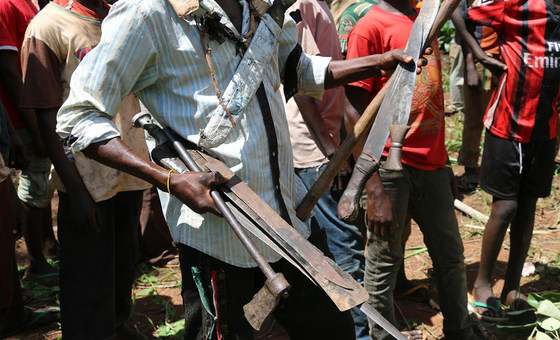
Alfred Yekatom and Patrice-Edouard Ngaïssona received prison sentences of 15 and 12 years for their roles in brutal attacks against civilians – primarily from the country’s mainly Muslim Seleka population – during the 2013-14 civil war.

They were found guilty “beyond any reasonable doubt” of leading and facilitating attacks on civilians in the capital, Bangui, and the country’s west.

Thousands of people were killed in the violence that swept CAR following a 2012 coup led by the mainly Muslim rebel coalition, Séléka. The fighting took on a deeply sectarian tenor as Anti-Balaka militia started a brutal campaign of reprisal attacks.

Long list of crimes

The ICC’s Trial Chamber V found Mr. Yekatom responsible for a number of crimes he committed in the context of the attack on Bangui (the capital of CAR), the events at Yamwara (a school where he had established a base), and during the advance of his group on the PK9-Mbaïki axis.

These included murder, torture, forcible transfer and deportation, directing an attack against a building dedicated to religion and persecution.

Mr. Ngaïssona was convicted for aiding and abetting many of the same crimes, including persecution, forcible displacement and cruel treatment.

Both men were also found to have targeted Muslims based on the Anti-Balaka’s perception of collective guilt for Seleka abuses.

The judges sentenced Mr. Yekatom to 15 years and Mr. Ngaïssona to 12 years, with time already served to be deducted.

Charges of war crimes of pillaging and directing an attack against a religious building during the attack on Bossangoa were not upheld against Mr. Ngaïssona, and those of conscription, enlistment and use of children were not upheld against Mr. Yekatom.

‘Instrumentalization of religion’

The Chamber noted that while religion was instrumentalised by armed groups during the conflict, the violence was not initially religious in nature.

Many witnesses testified that Muslims and Christians had lived peacefully together prior to the conflict.

The convictions mark the conclusion of a trial that began in February 2021. Over the course of proceedings, the Prosecution called 114 witnesses, while the Defense teams called 56. A total of 1,965 victims participated in the trial through legal representatives.

Source link

Unprecedented Afghan returns are ‘a test of our collective humanity’

Roza Otunbayeva, the Secretary-General’s Special Representative for Afghanistan, made the appeal during a visit to the Islam Qala border crossing with Iran on Tuesday where she witnessed the daily influx of tens of thousands of returnees.

She also met returnee families, aid partners and regional de facto officials.

Alarm bells should be ringing

What should be a positive homecoming moment for families who fled conflict decades ago is instead marked by exhaustion, trauma, and profound uncertainty,” said Ms. Otunbayeva, who also heads the UN Assistance Mission in Afghanistan (UNAMA).

“The sheer volume of returns – many abrupt, many involuntary – should be setting off alarm bells across the global community,” she added.

It is a test of our collective humanity. Afghanistan, already grappling with drought, and a chronic humanitarian crisis, cannot absorb this shock alone.” 

Local communities overstretched

Since January, more than 1.3 million have been largely compelled to head back to Afghanistan – a country where 70 per cent of the population lives in poverty. 

Women and children face the gravest risks, UNAMA said, as they are returning not only to dire economic hardships but to a context where their access to basic services and social protections remains severely constrained.

The UN has repeatedly highlighted the assault on women’s rights under Taliban rule, including bans affecting higher education, employment and freedom of movement.

Reintegration support critical

The returns are happening at a time when humanitarian operations remain woefully underfunded, forcing agonising choices between food, shelter, and safe passage.

Ms. Otunbayeva also underscored the critical need for immediate reintegration assistance as initial evidence shows that stabilising return communities requires urgent livelihood programmes and community infrastructure investments. 

She warned that without swift interventions, remittance losses, labour market pressures, and cyclical migration will lead to devastating consequences.

These could include the further destabilization of both returnee and host populations, renewed displacement, mass onward movement, and risks to regional stability.

‘We cannot afford indifference’

She urged donors, development partners, and regional governments not to turn away and abandon Afghan returnees.

“What we are witnessing are the direct consequences of unmet global responsibilities,” she said. “We must act now – with resources, with coordination, and with resolve.” 

Meanwhile, the UN in Afghanistan is calling for an integrated approach that resources humanitarian needs while scaling up assistance in areas of return.

At the same time, regional dialogue – including with Iran, Pakistan, and Central Asian states – must be prioritized to halt disorderly returns and uphold the principle of voluntary, dignified and safe repatriation.

“Afghanistan’s stability hinges on shared responsibility: We cannot afford indifference,” said Ms. Otunbayeva. “The cost of inaction will be measured in lives lost and conflicts reignited.” 

Source link

Israeli attacks on Gaza schools could be crimes against humanity: UN probe

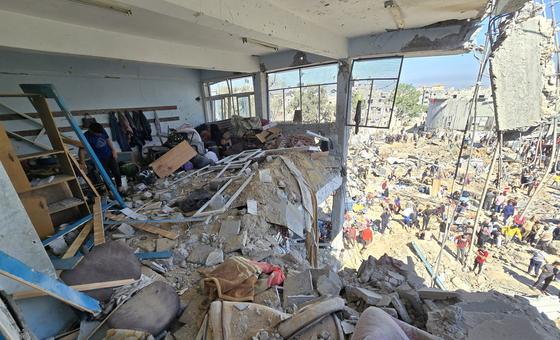
The UN Human Rights Council-mandated Independent International Commission of Inquiry (COI) report found that Israeli forces have used airstrikes, shelling, burning, and controlled demolitions to damage or destroy more than 90 per cent of schools and university buildings across Gaza.

This destruction in the wake of the 7 October 2023 Hamas-led terror attacks on Israel has made education impossible for over 658,000 children, many of whom have been out of school for nearly two years.

“We are seeing more and more indications that Israel is carrying out a concerted campaign to obliterate Palestinian life in Gaza,” said Navi Pillay, Chair of the Commission.

“Israel’s targeting of the educational, cultural and religious life of the Palestinian people will harm the present generations and generations to come, hindering their right to self-determination.”

Classroom-turned military base

The COI documented cases where Israeli forces seized and used educational institutions as military bases, including the conversion of part of Al-Azhar University’s Al-Mughraqa campus into a synagogue for troops.

The report also noted one instance where Hamas militants used a school for military purposes. Such conduct is a breach of international humanitarian law, which mandates the distinction between civilian objects and military targets.

Targeting of religious sites

More than half of Gaza’s religious and cultural sites have been damaged or destroyed, including places serving as refuges for civilians – killing hundreds, including women and children.

The Commission stated that Israeli forces knew or should have known the cultural significance of these sites and failed to prevent harm.

In the occupied West Bank, including East Jerusalem, Israeli authorities appropriated, developed and profited from cultural heritage sites representing Palestinian, Jewish and other cultures, while displaced Palestinian residents.

They have also blocked or severely restricted Palestinians from accessing the sites.

“Attacks on cultural and religious sites have deeply impacted intangible culture, such as religious and cultural practices, memories and history,” said Ms. Pillay.

“The targeting and destruction of heritage sites, the limiting of access to those sites in the West Bank and the erasure of their heterogenic history erode Palestinians’ historical ties to the land and weaken their collective identity.”

Recommendations

The Commission called on Israel to immediately cease attacks on cultural, religious, and educational institutions and to end the seizure and military use of such facilities. It urged Israel to end its occupation and settlement activities, especially near religious and cultural sites, and to comply fully with International Court of Justice (ICJ) orders.

Investigators also urged Palestinian authorities to protect and preserve cultural heritage sites, including those of diverse origins, calling on de facto authorities in Gaza to stop using civilian objects for military purposes.

Humanitarian crisis spiralling

UN agencies continue to warn of a worsening humanitarian crisis in Gaza.

The UN Children’s Fund (UNICEF) highlighted the case of a five-year-old malnourished child whose recovery depends on adequate food and sustained care.

Aid at scale must be allowed into Gaza for children’s health and survival,” the agency urged.

‘Another day of death traps’

Philippe Lazzarini, head of the UN agency assisting Palestine refugees, expressed deep concern over delays and obstacles in aid delivery, urging Israel to allow the UN safe and unhindered access to bring in supplies and distribute it safely.

“This is the only way to avert mass starvation including among one million children,” he said.

Mr. Lazzarini warned that casualties and injuries continue to be reported daily at US-backed distribution points managed by Israeli and private security forces – creating in effect, daily death traps.

He described the system as humiliating, forcing thousands of hungry and desperate people to walk tens of miles, while excluding the most vulnerable and those living too far from aid centres.

Source link

‘My husband died in my arms’: Russian drone attacks on Ukrainians amount to crimes against humanity, UN investigators report

“Russian armed forces have committed the crimes against humanity of murder and the war crimes of attacking civilians, through a months-long pattern of drone attacks targeting civilians on the right bank of the Dnipro River in Kherson Province,” the Independent International Commission of Inquiry on Ukraine said.

Attacks have been carried out since July 2024 in Kherson city and 16 localities stretching over more than 100 kilometres in river front areas under Ukrainian Government control. 

They are ongoing and nearly 150 civilians have been killed and hundreds more injured to date, according to official sources.

Attacks ‘planned and organised’

“The recurrence of these attacks for over 10 months, against multiple civilian targets and in a wide geographic area, demonstrates that they are widespread and systematic and have been planned and organised, requiring the mobilisation and allocation of necessary resources,” the report said.

The Commission examined over 300 publicly available videos of attacks and over 600 text posts on Telegram channels and, where possible, identified victims. 

Over 90 residents from affected areas were interviewed, including victims, witnesses, local authorities and medical personnel. 

Civilians were targeted “in various circumstances, mainly when they were outdoors, both on foot or while using any type of vehicles” the report said. Most victims were men, but women and children also were affected.

‘My husband died in my arms’

A woman from Poniativka village recounted that in September 2024, she was walking home with her husband and suddenly heard a drone. It was already above their heads and immediately dropped an explosive, giving them no time to seek shelter. Both were injured. 

My husband died in my arms, bleeding to death, because the ambulance did not arrive on time. I tried to stop the bleeding with a T-shirt, but it was not enough,” she said.

Videos posted on Telegram

Russian forces mostly used civilian drones that are widely commercially available, which were then modified.

The weaponized versions of these drones allow their operators, via an embedded camera, to remotely track, aim, and drop explosives on targets. They can return to their point of origin to be reused,” the report said.

“Occasionally, perpetrators employed suicide drones that are also equipped with cameras but that explode upon impact on their targets.”

Hundreds of the video feeds have been regularly disseminated on Russian Telegram channels, some of which have thousands of subscribers. 

“The video footage that they posted displays the attacks and the resulting death, injury, damage, or destruction, and is styled like video games, often accompanied by background music and threatening text,” the report said.

Ambulances targeted

Furthermore, ambulances also have been targeted and struck by drones to prevent them from reaching victims, and some have died because they could not get to a medical facility in time. 

“A 45-year-old man from Stanislav village recounted that in November 2024, a drone dropped an explosive near him as he was riding a moped, badly injuring his leg. An ambulance arrived, and while he was receiving first aid, a drone dropped two explosives on the ambulance,” the report said.

The Commission stressed that the use of drones to target civilians and civilian objects is a violation of the fundamental principle of international humanitarian law as such attacks may only be directed at military objects.

“The Commission therefore concludes that Russian armed forces perpetrated the war crime of intentionally directing attacks against civilians in Kherson Province,” it said, while “posting videos of civilians being killed and injured amounts to the war crime of outrages upon personal dignity.”

‘Drones were attacking everything’

The drone attacks have spread terror among residents of the affected areas. Many wait for cloudy days to go out, or seek cover under trees, where possible. 

“Drones were attacking everything; minibuses, cars, pedestrians…every time you went out of the house, you had to check the sky and look out for a buzzing sound and, in any case, run,” a man from Antonivka settlement told the Commission.

Moreover, fear is further induced by frequent messages posted on Telegram, such as “Get out of the city before the leaves fall, you who are destined to die.”

“The recurrent drone attacks, the widely disseminated videos showing them, and numerous posts explicitly exhorting the population to leave suggest a coordinated state policy, on the part of the Russian authorities, to force the population of Kherson Province to leave the area,” investigators said.

They concluded Russian forces may have committed the crime against humanity of forcible transfer of population.

Mandate from Human Rights Council

The commission is mandated by the UN Human Rights Council to investigate all alleged violations and abuses of human rights, violations of international humanitarian law and related crimes in the context of the aggression against Ukraine by Russia.

The three Commissioners serve in their individual capacity and are independent from any government or organization, including the UN.


 

Source link